Freedom251 › Enterprise AI Chatbots Software
Cognigy
by Cognigy
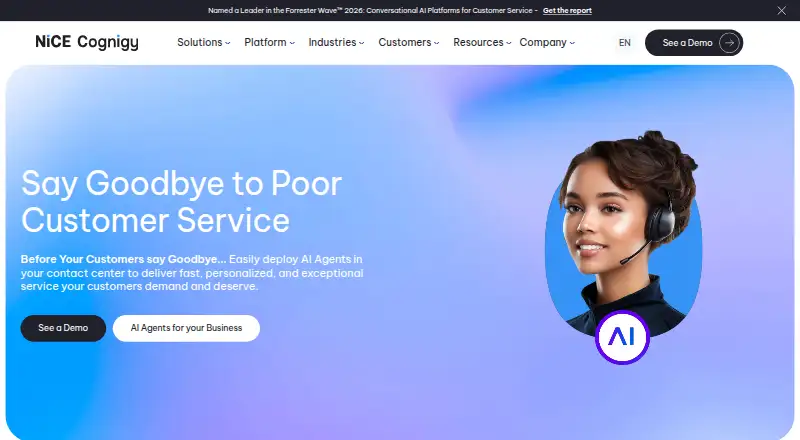
What Cognigy is
Cognigy is an enterprise platform for building and coordinating AI agents for customer service and contact centers. Its agents use large language models, real-time memory and integrated tools to work through tasks and answer customer queries. AI Agent Studio gives teams a collaborative, low-code visual workspace to build, test and deploy conversational agents. The platform includes a visual flow builder, AI bot generation, knowledge-base answers and human handoff, so agents can draw on knowledge and pass conversations to people when needed.
Cognigy supports deployment through webchat, voice, SMS and messaging apps. The company describes more than 100 prebuilt tools and integrations, including connectors for enterprise systems and contact center platforms. It lists support for more than 100 languages and more than 25,000 concurrent interactions. A secured REST API provides access to every Cognigy.AI feature.
Deployment can be on premises on Kubernetes. Cognigy recommends managed public cloud Kubernetes and does not configure or provision on-premises clusters. AI Agent Studio lists single sign-on, role-based access control, end-to-end encryption and fine-grained data controls. Cognigy says its agents comply with GDPR, SOC 2 Type II, ISO 27001, ISO 9001, PCI DSS and BSI C5 Type II, among other standards. Cognigy was founded in Düsseldorf in 2016 and has headquarters in Dallas and Düsseldorf.
Who it suits
Cognigy suits enterprise contact centers that want to build and deploy AI agents across digital messaging and voice channels. It is also relevant to teams that need integrations, multilingual support, knowledge-based answers and human handoff in a single agent platform.
What it does well
- Low-code visual workspace for building, testing and deploying agents
- Supports webchat, voice, SMS and messaging apps
- Lists more than 100 languages and 25,000 concurrent interactions
- More than 100 prebuilt tools and integrations
- Secured REST API covers every Cognigy.AI feature
What to know first
- Pricing is available by request
- On-premises Kubernetes clusters are not configured or provisioned by Cognigy
Plans
| Plan | Billed and limits | Price |
|---|---|---|
| Cognigy.AI | Enterprise AI platform; request a demo for details | On request |
As cognigy.com lists them, read 7 Oct 2026. The maker's own page has the final word.
Getting started
- Visit https://www.cognigy.com/
- Request a demo to discuss Cognigy.AI and pricing
- Choose a deployment approach, including on-premises Kubernetes or managed public cloud Kubernetes
- Build and test conversational agents in AI Agent Studio
- Deploy agents across supported channels
Cognigy is an enterprise platform for building and coordinating AI agents for contact-center work. It suits organizations that need multilingual automation across several channels, substantial integrations, and formal security controls. Its capabilities are broad and designed for scale, but buyers must request a quote and plan their own infrastructure carefully for on-premises use.
Overview
Cognigy.AI combines large-language-model agents with real-time memory and connected tools, allowing agents to reason through customer-service tasks rather than only follow fixed scripts. AI Agent Studio gives operations teams, designers, and developers a shared low-code environment for building, testing, and deploying conversational agents. That collaborative approach is useful when contact-center automation cannot be maintained by a single technical team.
Deployment is multichannel, covering webchat, voice, SMS, and messaging applications. Cognigy states support for more than 100 languages and more than 25,000 concurrent interactions, making the platform a plausible standard for international service organizations. The trade-offs are commercial and operational: pricing is supplied on request, and an on-premises Kubernetes installation does not include cluster configuration or provisioning.
Key features
Agent design and knowledge
The visual agent builder supports collaborative, low-code flow creation, testing, and deployment. AI bot generation and knowledge grounding help teams create agents that can answer from a knowledge base while handling more than scripted menu paths. Human handoff is included, so conversations can move to a person when automation is unsuitable. These features favor contact centers that want governed automation with a clear escalation route, rather than a standalone chatbot with no operational handoff.
Channels and integrations
Cognigy can publish agents to webchat, voice, SMS, and messaging apps. Its catalog includes more than 100 prebuilt tools and integrations, including connectors for enterprise systems and contact-center platforms. That breadth can reduce custom connector work in a complex environment, although the value depends on whether the systems a particular organization uses are covered. A secured REST API provides access to every Cognigy.AI feature, which gives engineering teams a route to extend or coordinate the platform programmatically.
Scale, security, and compliance
Support for more than 100 languages and more than 25,000 concurrent interactions is aimed at large, distributed operations rather than small support desks. Built-in security features include single sign-on, role-based access control, end-to-end encryption, and fine-grained data controls. Cognigy states compliance with GDPR, SOC 2 Type II, ISO 27001, ISO 9001, PCI DSS, and BSI C5 Type II, among other standards. Those controls and attestations matter for regulated or multinational contact centers, but they do not remove the need for an organization to assess its own deployment and governance requirements.
Pricing
| Plan | Price | What it includes |
|---|---|---|
| Cognigy.AI | Custom pricing | Enterprise AI platform with visual agent building, knowledge grounding, and knowledge-base capabilities; request a demo for details. |
Cognigy is a paid, quote-based product rather than a self-service subscription. That model fits enterprises expecting procurement, integration, and deployment discussions, but it prevents a small team from calculating cost or starting from a published free tier. No public seat, usage-quota, trial, or renewal terms are provided, so those points should be settled during the sales process.
Platforms
The platform is offered through an API, web access, and self-hosted deployment. Cognigy supports multichannel delivery across webchat, voice, SMS, and messaging apps. For on-premises installation, it runs on Kubernetes; Cognigy recommends managed public-cloud Kubernetes and does not support configuring or provisioning on-premises clusters. Organizations without Kubernetes expertise or an existing managed environment should treat that as a significant implementation responsibility.
Who it's for
Cognigy is aimed at enterprise contact centers that need one agent platform across regions and channels, with multilingual operation, high concurrent-interaction capacity, system integrations, and formal access and compliance controls. It is also a fit when business and technical teams need to collaborate in a visual builder while retaining API-level control.
It is a weaker choice for a small support operation seeking transparent monthly pricing, a free starting plan, or a turnkey on-premises appliance. Quote-based procurement and Kubernetes responsibilities add planning overhead that simpler IVR or chatbot products may avoid.
Pros and cons
Pros
- Broad channel coverage: Webchat, voice, SMS, and messaging apps support a consolidated contact-center strategy.
- Enterprise scale: Stated capacity above 25,000 concurrent interactions and support for more than 100 languages suit large international operations.
- Strong governance: SSO, role-based access, encryption, fine-grained data controls, and multiple stated compliance standards address regulated environments.
- Integration depth: More than 100 prebuilt tools and integrations, plus a full-coverage REST API, can connect agent workflows to existing systems.
Cons
- No public price: Buyers must request a quote, making early budget comparison difficult.
- On-premises infrastructure burden: Kubernetes installation is supported, but cluster configuration and provisioning are left to the customer.
- Enterprise complexity: The platform's scale and governance focus are likely excessive for teams needing a small, simple bot.
Alternatives
For a broader comparison of contact-center options, see Customer Service Automation Software, AI Customer Service Software, and AI Customer Service Agents. Teams focused specifically on telephony can also review IVR Software, Voicebot Software, or AI Voice Agents.
- Momo Business IVR is a paid option with a free pay-as-you-go plan and Linux, macOS, web, and Windows support; choose it when a simpler IVR arrangement and usage billing matter more than Cognigy's enterprise agent platform.
- Teloz IVR offers freemium access, a free trial, and Android, iOS, and web apps; it is better suited to organizations wanting a low-commitment IVR start.
- Voicent has a free tier, trial, API and self-hosted options, and a $179-per-month Starter plan; consider it when published entry pricing and campaign-oriented voice or text capacity are priorities.
- CallFire IVR provides pay-as-you-go billing without a free plan; choose it when usage-based IVR is preferable to a quoted enterprise platform.
- JVoiceXML is a free, self-hosted VoiceXML interpreter for Java, appropriate when an open, developer-led voice runtime is the requirement.
- Agent Voice Response is free for personal and commercial use and runs self-hosted; it suits buyers seeking a no-license-cost deployment.
- Dialogic Digital IVR is a paid API, self-hosted, and web option.
- Plum DEV is a paid API and web option.
Verdict
Choose Cognigy when a large contact center needs a governed agent platform that combines visual design, multilingual and multichannel delivery, integrations, and enterprise security. Look elsewhere if transparent pricing, a free entry tier, or vendor-managed on-premises infrastructure is more important than that breadth.
Verdict
Choose Cognigy if your contact center needs an enterprise agent platform with visual design, integrations and deployment across multiple channels. Ask for a demo to discuss its paid, quote-based offering and whether its deployment approach fits your infrastructure.
Questions
How much does Cognigy cost?
Cognigy is paid, with pricing available on request. The product page invites prospective customers to request a demo.
Which channels does Cognigy support?
Deployment channels include webchat, voice, SMS and messaging apps.
Can Cognigy run on premises?
Cognigy.AI can be installed on premises on Kubernetes. Cognigy recommends managed public cloud Kubernetes and does not configure or provision on-premises clusters.
What integrations does Cognigy offer?
Cognigy describes more than 100 prebuilt tools and integrations, including connectors for enterprise systems and contact center platforms.
What security and compliance features does Cognigy list?
AI Agent Studio lists single sign-on, role-based access control, end-to-end encryption and fine-grained data controls. Cognigy states compliance with standards including GDPR, SOC 2 Type II, ISO 27001, ISO 9001, PCI DSS and BSI C5 Type II.
Who makes Cognigy?
Cognigy was founded in Düsseldorf, Germany, in 2016. Its headquarters are in Dallas, Texas, and Düsseldorf, Germany.
Facts from Cognigy's own pages
- Agent design
- AI Agent Studio provides a collaborative, low-code visual interface for building, testing, and deploying conversational agents. · cognigy.com, 7 Oct 2026
- AI bot generation
- Yes · cognigy.com, 20 Sept 2026
- API
- Cognigy says its secured REST API provides access to every Cognigy.AI feature with full platform coverage. · cognigy.com, 7 Oct 2026
- Channels
- The platform supports deployment across channels including webchat, voice, SMS, and messaging apps. · cognigy.com, 7 Oct 2026
- Company history
- Cognigy says it was founded in Düsseldorf, Germany, in 2016 by Philipp Heltewig and Sascha Poggemann. · cognigy.com, 7 Oct 2026
- Compliance
- Cognigy states that its AI agents comply with GDPR, SOC 2 Type II, ISO 27001, ISO 9001, PCI DSS, and BSI C5 Type II, among other standards. · cognigy.com, 7 Oct 2026
- Core capabilities
- Its AI agents use large language models, real-time memory, and integrated tools to reason through tasks and respond to customer queries. · cognigy.com, 7 Oct 2026
- Deployment
- Cognigy.AI can be installed on premises on Kubernetes; Cognigy recommends managed public cloud Kubernetes and says it does not support configuring or provisioning on-premises clusters. · docs.cognigy.com, 7 Oct 2026
- Deployment channels
- multichannel · cognigy.com, 20 Sept 2026
- Founded
- 2016 · cognigy.com, 28 Sept 2026
- Headquarters
- The company’s About page lists headquarters in Dallas, Texas, and Düsseldorf, Germany. · cognigy.com, 7 Oct 2026
- Human handoff
- Yes · cognigy.com, 20 Sept 2026
- Integrations
- Cognigy describes more than 100 prebuilt tools and integrations, including connectors for enterprise systems and contact center platforms. · cognigy.com, 7 Oct 2026
- Knowledge-base answers
- Yes · cognigy.com, 20 Sept 2026
- Languages and scale
- Cognigy.AI lists support for more than 100 languages and more than 25,000 concurrent interactions. · cognigy.com, 7 Oct 2026
- Purpose
- Cognigy.AI is an enterprise agentic AI platform for customer service, designed to build and orchestrate AI agents for contact centers. · cognigy.com, 7 Oct 2026
- Security
- The AI Agent Studio page lists single sign-on, role-based access control, end-to-end encryption, and fine-grained data controls as built-in security features. · cognigy.com, 7 Oct 2026
- Support
- The product page invites prospective customers to request a demo; the site does not state a public response-time commitment on that page. · cognigy.com, 7 Oct 2026
- Visual flow builder
- Yes · cognigy.com, 20 Sept 2026
Where Cognigy stands on Freedom251
- Enterprise AI Chatbots Software#7 of 25
- AI Agents for Customer Support Software#8 of 27
- Genesys AppFoundry Marketplace#6 of 20
- Customer Service Automation Software#8 of 26
- AI Customer Service Software#16 of 40
- AI Customer Service Agents#24 of 56
- AI Voice Agents#16 of 32
- Voicebot Software#14 of 27
- IVR Software#12 of 22
- Conversational AI Platforms#26 of 41
- Chatbot Builders#164 of 257
- Conversational Chatbots Software#17 of 26
- Support Bots#14 of 20
- AI Agent Platforms#53 of 73
- Voice Ai Tools#21 of 28
- Tool Agents#20 of 26
- Ai Automation#23 of 28