Momo Business IVR
What Momo Business IVR is
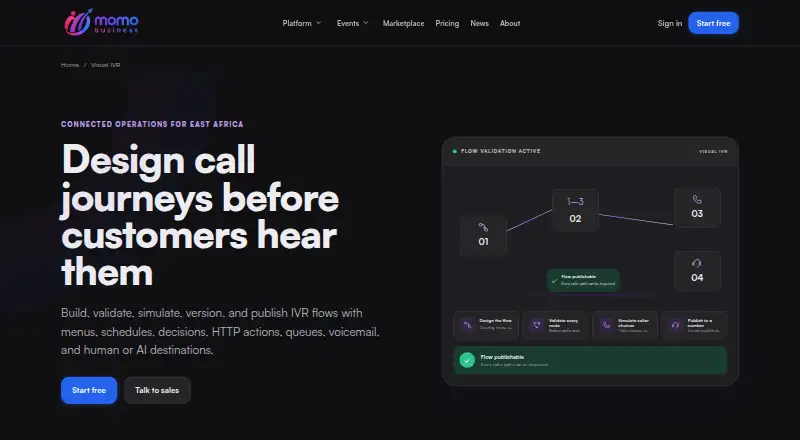
Momo Business IVR is a visual builder for creating and publishing telephone call flows. Teams can combine menus, schedules, decisions, queues, voicemail, HTTP actions, and destinations for people or AI. Before release, the builder checks for broken paths, missing assets, and invalid settings, and teams can simulate caller choices. Publishing assigns a selected version to a phone number while keeping drafts, versions, assignments, and production state distinct. Listed uses include self-service menus, department routing, and after-hours handling. HTTP actions can exchange data with approved external services. The platform works in a browser without downloads or installation; a macOS desktop app is listed, while Windows and Linux desktop apps are marked as coming soon. Momo Business describes its platform as serving teams operating for East African customers. Pay as you go has no monthly fee, with calls and messages charged at rate-card prices. Starter costs 25,000 TZS per month; Growth is 60,000 TZS per month, Business 150,000 TZS per month, and Scale 380,000 TZS per month. Enterprise pricing is custom.
Who it suits
It suits teams that need to design, validate, and publish phone call flows, including for self-service, department routing, or after-hours handling. The maker describes its platform as serving teams operating for East African customers.
What it does well
- Browser access requires no download or installation.
- Checks flows for broken paths and invalid settings.
- Teams can simulate caller choices before release.
- Publishing keeps drafts and production state separate.
- A free pay-as-you-go option has no monthly fee.
What to know first
- Windows and Linux desktop apps are marked as coming soon.
- Calls and messages on pay as you go use rate-card prices.
- Enterprise pricing is custom.
Limits
Pay as you go has no monthly fee, but calls and messages are charged at rate-card prices; SMS is TZS 23 each. Starter costs 25,000 TZS per month and includes one phone number, 300 inbound minutes, 30 outbound minutes, 1,000 WhatsApp messages, 50 IVR runs, 200 flow sessions, TZS 10,000 in AI credits, and SMS at TZS 19 per message.
Plans
| Plan | Billed and limits | Price |
|---|---|---|
| Pay as you go | No monthly fee · Calls and messages at rate-card prices · SMS TZS 23 each | Free |
| Business | per month · 4 phone numbers · 2,700 inbound minutes · 270 outbound minutes · 9,000 WhatsApp messages · 450 IVR runs · 1,800 flow sessions · TZS 40,000 AI credits · SMS TZS 15 per message | 150,000 TZS a month |
| Starter | per month · 1 phone number · 300 inbound minutes · 30 outbound minutes · 1,000 WhatsApp messages · 50 IVR runs · 200 flow sessions · TZS 10,000 AI credits · SMS TZS 19 per message | 25,000 TZS a month |
| Scale | per month · 8 phone numbers · 8,100 inbound minutes · 810 outbound minutes · 27,000 WhatsApp messages · 1,350 IVR runs · 5,400 flow sessions · TZS 80,000 AI credits · SMS TZS 15 per message | 380,000 TZS a month |
| Growth | per month · 2 phone numbers · 900 inbound minutes · 90 outbound minutes · 3,000 WhatsApp messages · 150 IVR runs · 600 flow sessions · TZS 20,000 AI credits · SMS TZS 17 per message | 60,000 TZS a month |
| Enterprise | Custom pricing · Phone numbers, allowances, and prices sized to the business · named contact | On request |
As momopulse.com lists them, read 4 Oct 2026. The maker's own page has the final word.
Getting started
- Open the Momo Business IVR website in a browser; the platform requires no download or installation.
- Choose Pay as you go or a paid plan, such as Starter at 25,000 TZS/mo.
- Build a call flow with the required menus, schedules, decisions, queues, voicemail, HTTP actions, or destinations.
- Validate the flow and simulate caller choices.
- Publish a version to an assigned phone number.
Momo Business IVR is a call-flow builder for teams that need more than a fixed phone menu. It is best suited to organizations serving East African customers that want to manage routing and review changes before release. Its strongest advantage is controlled publishing; the main trade-off is that desktop apps are not yet available for every listed operating system.
Overview
Teams can combine menus, schedules, decisions, queues, voicemail and human or AI destinations to handle self-service, department routing and after-hours calls. HTTP actions can exchange data with approved external services, making the builder relevant when call handling needs to interact with another system. That flexibility gives teams more room to shape a call path, but requires more configuration than a simple menu.
Key features
Before publishing, the builder checks for broken paths, missing assets and invalid settings, and teams can simulate caller choices. Those safeguards can catch setup problems before callers encounter them, although teams remain responsible for deciding whether a flow works for their needs. Drafts, versions, number assignments and production state are kept separate, and a chosen version is published to an assigned number. This is a useful change-control model for teams maintaining live call routes.
Momo says its platform security includes tenant separation, permissions, audit trails, secure credential handling, delivery diagnostics, monitoring and incident response. Its privacy policy describes access controls, monitoring, encryption where appropriate and retention practices shaped by service, contractual and legal requirements. Customers remain responsible for consent, caller identity, permitted content, opt-outs, recording notices and sector-specific obligations, so the platform does not remove the need for operational compliance processes.
Pricing
Pay as you go costs nothing, with no monthly fee; calls and messages use rate-card prices, and SMS costs TZS 23 each. It avoids a recurring subscription, but provides no bundled allowances. Starter costs 25,000 TZS a month and includes 1 phone number, 300 inbound minutes, 30 outbound minutes, 1,000 WhatsApp messages, 50 IVR runs, 200 flow sessions, TZS 10,000 in AI credits and SMS at TZS 19 per message. It is the entry point for a small operation that can work within those caps.
Growth is 60,000 TZS a month for 2 numbers, 900 inbound minutes, 90 outbound minutes, 3,000 WhatsApp messages, 150 IVR runs, 600 flow sessions, TZS 20,000 in AI credits and SMS at TZS 17 per message. Business costs 150,000 TZS a month and raises those allowances to 4 numbers, 2,700 inbound minutes, 270 outbound minutes, 9,000 WhatsApp messages, 450 IVR runs, 1,800 flow sessions, TZS 40,000 AI credits and SMS at TZS 15 per message. Scale costs 380,000 TZS a month, with 8 numbers, 8,100 inbound minutes, 810 outbound minutes, 27,000 WhatsApp messages, 1,350 IVR runs, 5,400 flow sessions, TZS 80,000 AI credits and SMS at TZS 15 per message. These higher tiers suit teams needing more capacity; the listed allowances make the right choice depend on expected usage across several channels, not just call volume. Enterprise has custom pricing, with phone numbers, allowances and prices sized to the business and a named contact.
Platforms
The platform runs in a browser without a download or installation. Momo lists a macOS desktop app, while Windows and Linux desktop apps are coming soon. Browser access makes it usable without waiting for those apps, but organizations that require a native Windows or Linux client should look elsewhere.
Who it's for
Momo Business IVR fits teams operating for East African customers that need configurable call handling, pre-release checks and a clear separation between drafts and live versions. It is less compelling for a small team that only needs a basic menu, or for organizations whose desktop workflow depends on Windows or Linux software.
Pros and cons
- Pros: Pre-publication validation and caller simulation help teams catch flow issues before release.
- Pros: Versioned publishing keeps drafts, assignments and production state distinct.
- Pros: HTTP actions and human or AI destinations support flows beyond simple menu routing.
- Cons: Starter and higher plans have finite phone, minute, message, run, session and credit allowances.
- Cons: Native desktop availability is uneven: macOS is listed, while Windows and Linux are coming soon.
- Cons: Customers retain responsibility for consent, recording notices and other compliance duties.
Alternatives
Compare IVR software if you want to consider a broader set of call-routing tools. Choose Teloz IVR if its free plan, which includes 100 minutes of US/Canada calling, 50 SMS segments, one local DID and 25 AI receptionist minutes per month, better matches your needs. Voicent is worth considering if you want its free 100 minutes/texts or need its listed API, self-hosted or Windows platforms. CallFire IVR is another paid web and API option, with a no-monthly-fee pay-as-you-go plan and optional monthly rentals. Choose JVoiceXML if a free, self-hosted VoiceXML interpreter for Java is the fit. Agent Voice Response is a free self-hosted option for personal and commercial use. Plum Fuse is a paid web and API alternative. Genesys Workforce Engagement Management may suit teams seeking its listed mobile and desktop platform coverage. Consider Zappix Visual IVR as another paid web and API option.
Verdict
Choose Momo Business IVR if your team needs to build and maintain configurable call flows with pre-release checks and disciplined version publishing, particularly for East African customer operations. Its strongest reason to buy is the combination of validation, simulation and separated production state. Look elsewhere if you need a native Windows or Linux app, or if your expected usage does not fit the plan allowances.
Verdict
Momo Business IVR combines flow design, pre-publication checks, simulation, and versioned publishing. Browser access is available, while desktop availability differs by operating system.
Questions
Is there a free plan?
Yes. Pay as you go has no monthly fee; calls and messages are charged at rate-card prices.
How much does Momo Business IVR cost?
Starter is 25,000 TZS/mo, Growth is 60,000 TZS/mo, Business is 150,000 TZS/mo, and Scale is 380,000 TZS/mo. Enterprise pricing is custom.
Can I use it in a browser?
Yes. The platform runs in a browser without downloads or installation.
Which desktop apps are available?
A macOS desktop app is listed. Windows and Linux desktop apps are marked as coming soon.
Who makes Momo Business?
Momo Telecommunications is identified as the maker of Momo Business.
Does it support API actions?
Yes. HTTP actions can exchange data with approved external services.
Facts from Momo Business IVR's own pages
- API actions
- Supported HTTP actions can exchange data with approved external services. · momopulse.com, 4 Oct 2026
- Audience
- Momo Business describes its platform as serving teams operating for East African customers. · momopulse.com, 4 Oct 2026
- Browser access
- The desktop downloads page says the platform works in a browser without downloads or installation. · momopulse.com, 4 Oct 2026
- Compliance responsibility
- Customers remain responsible for consent, sender identity, permitted content, opt-outs, recording notices, and sector-specific obligations. · momopulse.com, 4 Oct 2026
- Desktop availability
- The downloads page lists a macOS app and marks Windows and Linux apps as coming soon. · momopulse.com, 4 Oct 2026
- Desktop platforms
- The maker lists a macOS desktop app and marks Windows and Linux downloads as coming soon. · momopulse.com, 4 Oct 2026
- Flow components
- Flows can include menus, schedules, decisions, HTTP actions, queues, voicemail, and human or AI destinations. · momopulse.com, 4 Oct 2026
- IVR purpose
- Momo Business IVR lets teams design, validate, simulate, version, and publish call flows. · momopulse.com, 4 Oct 2026
- Maker
- Momo Business identifies Momo Telecommunications Ltd as its maker and Dar es Salaam as its location. · momopulse.com, 4 Oct 2026
- Pre-publication checks
- The workflow detects broken routes, missing assets, and invalid settings and supports simulation of caller choices before release. · momopulse.com, 4 Oct 2026
- Pricing model
- The pricing page says the platform is designed around usage and active resources and directs customers to sales for current commitments and enterprise terms. · momopulse.com, 4 Oct 2026
- Privacy
- The privacy policy says Momo applies access controls, tenant separation, monitoring, encryption where appropriate, and retention practices based on service, contractual, and legal requirements. · momopulse.com, 4 Oct 2026
- Product
- Momo Business IVR is a visual builder for designing, validating, simulating, versioning, and publishing call flows. · momopulse.com, 4 Oct 2026
- Publishing
- The workflow publishes a version to an assigned number and keeps drafts, versions, assignments, and production state separated. · momopulse.com, 4 Oct 2026
- Publishing control
- The product keeps drafts, versions, assignments, and production state separated and publishes a version to an assigned phone number. · momopulse.com, 4 Oct 2026
- Security
- The maker says its platform security includes tenant separation, permissions, audit trails, secure credential handling, delivery diagnostics, monitoring, and incident response. · momopulse.com, 4 Oct 2026
- Simulation
- Teams can simulate caller choices before releasing a flow. · momopulse.com, 4 Oct 2026
- Support
- The IVR page describes support from a team familiar with regional operations and lists [email protected]. · momopulse.com, 4 Oct 2026
- Use cases
- The maker lists self-service menus, department routing, and after-hours handling as use cases. · momopulse.com, 4 Oct 2026
- Validation
- The builder detects broken paths, missing assets, and invalid settings before publishing. · momopulse.com, 4 Oct 2026
- Web access
- The downloads page says the platform runs in a browser without downloads or installs. · momopulse.com, 4 Oct 2026
Where Momo Business IVR stands on Freedom251
- IVR Software#4 of 22