JVoiceXML
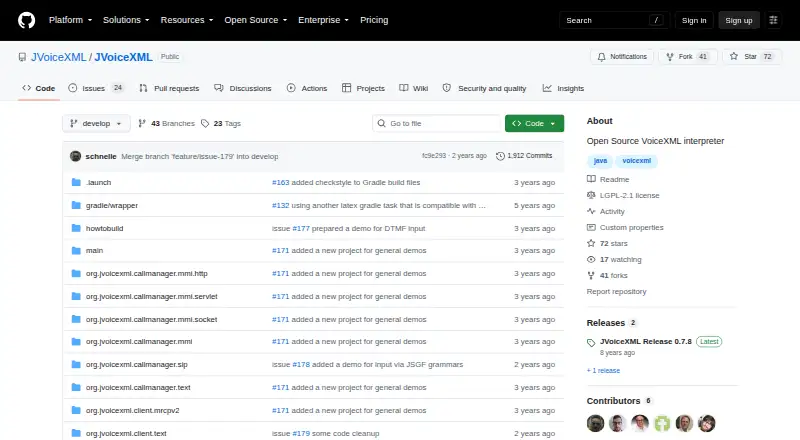
What JVoiceXML is
JVoiceXML is a free, open-source VoiceXML interpreter for Java, described by its project as implementing VoiceXML 2.1. It supports dialogs that combine synthesized speech or digitized audio with spoken input and DTMF recognition. Dialog capabilities also include recording, telephony, and mixed-initiative conversations. An open architecture allows custom extensions, and demo implementation platforms support Java APIs such as JSAPI and JTAPI. Repository modules include Mary, MRCPv2, JSAPI 2.0, JTAPI, and text implementations. The project identifies platform independence as a major goal. Its GitHub repository lists an LGPL-2.1 license and downloadable releases. The latest listed release is version 0.7.8; it added an SRGS grammar processor with SISR support, Microsoft LUIS as a grammar processor, bug fixes, and migration to Gradle. JVoiceXML is listed for API, Linux, and self-hosted use.
Who it suits
JVoiceXML suits Java developers building VoiceXML dialog systems who need speech, DTMF, or telephony capabilities. Its extension architecture and included modules may suit projects requiring custom integrations.
What it does well
- Implements VoiceXML 2.1.
- Supports synthesized speech, digitized audio, and DTMF.
- Provides an open architecture for extensions.
- Includes JSAPI and JTAPI-related modules.
- Free under the LGPL-2.1 license.
What to know first
- The project describes platform independence as a goal.
- Listed latest release is version 0.7.8.
Plans
| Plan | Billed and limits | Price |
|---|---|---|
| Free | Free VoiceXML interpreter for Java | Free |
| JVoiceXML | Free VoiceXML interpreter for Java | Free |
As github.com lists them, read 3 Oct 2026. The maker's own page has the final word.
Getting started
- Open the JVoiceXML GitHub repository.
- Choose a release download; version 0.7.8 is the latest listed release.
- Use it on Linux or in a self-hosted environment, or work through its API.
- Select from the repository modules, including Mary, MRCPv2, JSAPI 2.0, JTAPI, and text implementations.
JVoiceXML is a Java interpreter for VoiceXML-based voice applications. It suits developers who want to build and adapt dialog software around Java APIs, rather than adopt a packaged IVR service. The main appeal is a broad dialog model with no license fee; the trade-off is that teams must choose and integrate the modules their application needs.
Overview
JVoiceXML implements VoiceXML 2.1, covering dialogs that combine synthesized or recorded audio with spoken and keypad input. Support for telephony, recording, and mixed-initiative conversations gives developers room to build beyond simple prompt-and-response menus. Its open architecture also provides a basis for custom extensions, which makes it more adaptable to a Java application’s needs than a fixed call-flow product.
The project’s stated aim is a platform-independent implementation that can be used for free. Its repository identifies the license as LGPL-2.1, a practical consideration for teams evaluating how to use and distribute it. Platform independence is a project goal, not a substitute for checking whether the modules and environment in a particular deployment meet its requirements.
Key features
- VoiceXML 2.1 dialogs: Synthesized speech, digitized audio, spoken and DTMF recognition, recording, telephony, and mixed-initiative exchanges support varied voice interactions. Developers still need to assemble an application around the interpreter.
- Extension architecture: Custom extensions offer Java teams a way to adapt the interpreter to their systems. That flexibility favors developers comfortable making integration decisions over teams looking for a ready-made visual builder.
- Java API support: Demo implementation platforms support APIs including JSAPI and JTAPI, giving teams familiar integration points for speech and telephony.
- Modules and recent changes: The repository includes Mary, MRCPv2, JSAPI 2.0, JTAPI, and text modules. Release 0.7.8 added a more compliant SRGS grammar processor with SISR support, Microsoft LUIS as a grammar processor, bug fixes, and a move to Gradle.
Pricing
JVoiceXML is free: both the Free and JVoiceXML plans are priced at $0. There is no free trial because the product is free, and no paid tier is described. For developers seeking a no-license-fee Java interpreter, that removes a software-price barrier; it does not make integration or deployment work disappear.
Platforms
JVoiceXML is categorized for API use, Linux, and self-hosted deployment. Those options suit teams building or operating their own voice application infrastructure, rather than organizations seeking a hosted service with a finished management interface.
Who it's for
JVoiceXML is best suited to Java developers building custom voice dialogs who value control over extensions, speech and telephony components. It is a less natural fit for buyers who need a packaged service, a visual call-flow tool, or a solution that removes responsibility for assembling the application.
Pros and cons
- Pros: Free interpreter; VoiceXML 2.1 dialog support spans speech, DTMF, recording, and telephony; open extensions and Java API support give developers room to integrate and customize.
- Cons: Its developer-oriented, self-hosted approach leaves teams to select and integrate modules; it is not presented as a turnkey IVR service.
Alternatives
For a broader set of IVR options, start with IVR Software.
- Momo Business IVR is a paid option with a free plan, Linux, macOS, web, and Windows support, and a pay-as-you-go plan with no monthly fee.
- Teloz IVR is a freemium alternative with a free trial and Android, iOS, and web support; its free plan includes 100 minutes of US/Canada calling and 50 SMS segments.
- Voicent is a freemium choice with a free plan of 100 minutes/texts and API, self-hosted, web, and Windows support.
- CallFire IVR is a paid API and web option without a free plan; its Lite plan costs $99 a month.
- Agent Voice Response is another free, self-hosted option, with a plan described as free for personal and commercial use.
- Cognigy is a paid enterprise AI platform for API, self-hosted, and web deployments.
- Dialogic Digital IVR is a paid option for API, self-hosted, and web use.
- Plum DEV is a paid alternative with API and web support.
Verdict
Choose JVoiceXML if you are a Java developer who wants a free, extensible VoiceXML interpreter and is prepared to assemble the speech and telephony components around it. Look elsewhere if your priority is a packaged IVR service or a finished call-flow experience rather than a customizable foundation.
Verdict
JVoiceXML provides Java developers with a free VoiceXML interpreter and a range of dialog capabilities. Its extension model and modules offer flexibility, while release 0.7.8 is the latest version listed.
Questions
Is JVoiceXML free?
Yes. It is listed as free, with plans shown at no cost.
Is JVoiceXML open source?
Yes. The GitHub repository identifies the license as LGPL-2.1.
Which platforms are listed?
JVoiceXML is listed for API, Linux, and self-hosted use.
What does it support in voice dialogs?
It supports synthesized and digitized audio, spoken and DTMF input, recording, telephony, and mixed-initiative conversations.
What is the latest listed release?
Version 0.7.8 is the latest listed release. It added an SRGS grammar processor with SISR support, Microsoft LUIS as a grammar processor, bug fixes, and migration to Gradle.
Who maintains the project?
The GitHub repository is hosted under the JVoiceXML organization.
Facts from JVoiceXML's own pages
- APIs
- Its demo implementation platforms support Java APIs such as JSAPI and JTAPI. · github.com, 4 Oct 2026
- Available modules
- The repository includes modules for Mary, MRCPv2, JSAPI 2.0, JTAPI, and text implementations. · github.com, 3 Oct 2026
- Compatibility goal
- The project states that a major goal is a platform-independent implementation that can be used for free. · github.com, 4 Oct 2026
- Dialogs
- VoiceXML supports audio dialogs using synthesized speech, digitized audio, spoken and DTMF input recognition, spoken input recording, telephony, and mixed initiative conversations. · github.com, 4 Oct 2026
- Distribution
- The repository provides releases and lists downloadable assets for release 0.7.8. · github.com, 4 Oct 2026
- Extensibility
- JVoiceXML has an open architecture for custom extensions. · github.com, 3 Oct 2026
- Extensions
- JVoiceXML has an open architecture for custom extensions. · github.com, 4 Oct 2026
- Java APIs
- Its demo implementation platforms support Java APIs including JSAPI and JTAPI. · github.com, 3 Oct 2026
- Language
- The project describes JVoiceXML as a free VoiceXML interpreter for Java. · github.com, 4 Oct 2026
- Latest release
- The latest listed release is JVoiceXML 0.7.8. · github.com, 4 Oct 2026
- License
- The repository identifies its license as LGPL-2.1. · github.com, 4 Oct 2026
- Maintainer identity
- The GitHub repository is hosted under the JVoiceXML organization. · github.com, 3 Oct 2026
- Platform goal
- The project states that a major goal is a platform-independent implementation that can be used for free. · github.com, 3 Oct 2026
- Purpose
- JVoiceXML is an open source VoiceXML interpreter and an implementation of VoiceXML 2.1. · github.com, 4 Oct 2026
- Release features
- Release 0.7.8 added a more compliant SRGS grammar processor with SISR support, Microsoft LUIS as a grammar processor, bug fixes, and migration to Gradle. · github.com, 4 Oct 2026
- Speech dialogs
- The project describes VoiceXML dialogs supporting synthesized speech, digitized audio, spoken and DTMF input recognition, recording, telephony, and mixed-initiative conversations. · github.com, 3 Oct 2026
- VoiceXML version
- The project describes its implementation as VoiceXML 2.1. · github.com, 3 Oct 2026
Where JVoiceXML stands on Freedom251
- IVR Software#3 of 22