Freedom251 › IT Knowledge Base Software

Znuny
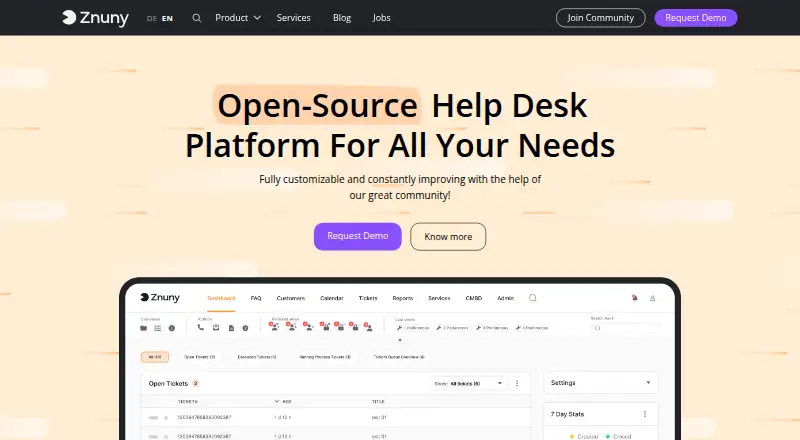
What Znuny is
Znuny is an open-source ticket and service management platform for help desks, IT service management, customer support, and other service operations. It can run on a customer’s server or be hosted by Znuny. Requests can come through a self-service portal, email, phone with CTI, REST or SOAP web services, and monitoring tools. Automation handles routing, classification, escalation, notifications, and state management. Knowledge management and self-service tools let customers look for answers themselves. Teams can adapt the platform using more than 2,000 configuration options, dynamic fields, modular architecture, and access to its source code. Security controls include roles and access rights, identity management integration, password policies, encrypted email, SSL data transfer, two-factor authentication, and ownership controls. Znuny lists integrations for identity systems, web services, monitoring tools, and third-party CRM, catalogue, and database systems. The software is free; annual support plans are paid. Znuny states that it has SOC 2 certification since 2024 and ISO/IEC 27001:2022 certification since January 2025, and complies with GDPR requirements. Mobile apps are not available.
Who it suits
Znuny may suit help desks and service operations that need configurable ticket workflows, self-hosting or hosted deployment, and multiple request channels. It is not a fit for teams requiring mobile apps.
What it does well
- Can run on a customer server or be hosted by Znuny.
- Supports portal, email, phone, web services, and monitoring channels.
- Automation covers routing, escalation, notifications, and state management.
- Offers more than 2,000 configuration options.
- Free, open-source software.
What to know first
- Mobile apps are not available.
- Paid support plans are priced annually.
- Support prices exclude VAT.
Limits
The free Znuny plan is open-source software and free to use. Paid support has service request limits on Silver (35 per year) and Gold (65 per year); Platinum includes unlimited service requests. The plans also differ in maximum reaction time and authorized support contacts.
Plans
| Plan | Billed and limits | Price |
|---|---|---|
| Free open-source Znuny | self-hosted or own cloud · no licence fee | Free |
| Znuny | Open-source software · free to use | Free |
| Gold Hosting | Paid annually · 500GB storage · 65 service requests · 3 support contacts · dedicated hardware · daily backup · monitoring | $1,419 a month |
| Platinum Support | Annual contract · unlimited service requests · 0.5h maximum reaction time · 5 support contacts · 24x7x365 coverage · remote patch and minor-release updates | $28,999 a year |
| Platinum Hosting | Paid annually · 750GB storage · unlimited service requests · 5 support contacts · 24x7x365 service window · read-only database access | $3,169 a month |
| Silver Support | Annual contract · 35 service requests · 4h maximum reaction time · 2 support contacts · email and phone support · security advisories and patches | $4,499 a year |
| Silver Hosting | Paid annually · 250GB storage · 35 service requests · 2 support contacts · dedicated hardware · daily backup · monitoring | $799 a month |
| Gold Support | Annual contract · 65 service requests · 2h maximum reaction time · 3 support contacts · remote patch updates · email and phone support | $9,999 a year |
As znuny.com lists them, read 14 Oct 2026. The maker's own page has the final word.
Getting started
- Visit the Znuny website.
- Choose whether to run Znuny on your own server or use Znuny hosting.
- Use the free open-source software, or select a paid annual support plan if you need support coverage.
- Select a deployment using the listed Linux, web, or API platforms.
Znuny is an open-source ticket and service-management platform for help desks, ITSM, customer support, and other service operations. It is strongest for organizations that need to tailor workflows and can manage a self-hosted system or arrange hosting and support. The free core is a meaningful advantage; its breadth also brings operational responsibility.
Overview
Teams can run Znuny on their own server or have it hosted by Znuny. That choice accommodates organizations with infrastructure of their own as well as those that prefer a hosted arrangement, while paid support offers a route to help with setup and ongoing operation.
The platform’s scope extends beyond ticket intake: it combines multiple request channels, automation, knowledge and self-service tools, and service-management capabilities. Its open-source code and extensive configuration options make it adaptable, but organizations seeking a narrowly scoped, ready-made workflow may have less reason to take on that flexibility.
Key features
Requests can arrive through a customer self-service portal, email, phone with CTI, REST and SOAP web services, and monitoring tools. This range suits service desks that need to connect channels and systems beyond email. Routing, classification, escalation, notifications, and state management can be automated, helping teams define how work moves through their operation.
Knowledge management and self-service let customers look for answers themselves. SLA management, approval workflows, an employee portal, asset management, and a knowledge base broaden Znuny’s usefulness for internal service operations as well as customer support.
More than 2,000 configuration options, flexible dynamic fields, a modular architecture, and access to the source code allow substantial adaptation. That is valuable when standard processes do not fit, but it is a poor match for teams that want minimal configuration and operational ownership.
Security controls include roles and access rights, identity-management integration, password policies, encrypted email, SSL data transfer, two-factor authentication, and ownership controls. Znuny states that it has held SOC 2 certification since 2024 and ISO/IEC 27001:2022 certification since January 2025, and complies with GDPR requirements. Integrations cover identity systems, web services, monitoring tools, and third-party CRM, catalogue, and database systems. Add-ons include TicketActionLink for triggering web services from tickets and SCIM Identity Provisioning for syncing users and groups from compatible identity providers.
Pricing
The Znuny plan costs free and provides the open-source software free to use. It is the natural starting point for teams able to deploy and operate the platform themselves; paid support is optional rather than a prerequisite for using the core.
Support contracts add configuration, installation, updates, troubleshooting, performance tuning, backup, and recovery, with service-level agreements and guaranteed response times. Each includes support for an associated test system, and agent counts are not limited. Prices are net and exclude VAT.
- Silver support: $4,499 a year. Includes 35 service requests, a 4h maximum reaction time, and 2 authorized support contacts. It suits teams with a limited support workload that can accept the slowest response commitment.
- Gold support: $9,999 a year. Includes 65 service requests, a 2h maximum reaction time, and 3 authorized support contacts. The higher allowance and faster reaction time suit organizations expecting more support needs.
- Platinum support: $28,999 a year. Includes unlimited service requests, a 0.5h maximum reaction time, and 5 authorized support contacts. It is aimed at teams that need the shortest stated reaction time and do not want a request cap.
All three contracts include the test system and have no agent limit, so the tiers differ chiefly in service-request allowance, reaction time, and authorized contacts. The free software avoids a license charge, but paid support is a substantial annual commitment.
Platforms
Znuny supports API, Linux, self-hosted, and web use. It has no mobile apps, a notable limitation for teams whose agents need a dedicated phone or tablet app. The current releases listed are Znuny 7.3.7 and Znuny LTS 6.5.25, both dated 2026-09-16.
Who it's for
Znuny is best for service desks and IT teams that need configurable ticket workflows, multiple intake channels, and service-management tools, especially where open-source access and deployment choice matter. It is less suitable for organizations that need mobile apps or want a low-configuration product without responsibility for deployment and operation.
Pros and cons
- Pro: The open-source core is free, and teams can choose between their own server and Znuny hosting.
- Pro: Broad channels, workflow automation, self-service, SLAs, approvals, and asset management cover more than basic ticket tracking.
- Pro: Extensive configuration and source access support adaptation to specialized processes.
- Pro: Paid support has no agent limit and includes an associated test system.
- Con: Extensive configuration and deployment choices call for technical ownership rather than a turnkey approach.
- Con: There are no mobile apps.
- Con: Support requires annual fees, with request caps on Silver and Gold and different response commitments by tier.
Alternatives
Consider iTop if a free, self-hosted option with Linux and web support is the priority; its Community plan is free of charge and not limited, and it also supports macOS and Windows. Choose FreeITSM for another free option with Linux, web, and Windows support, though it has no free trial.
Vivantio is a paid alternative at $49 a month, billed annually, with published pricing of $49–$99 per agent per month and free end users. GLPI is worth considering if mobile support matters: its platforms include Android and it offers a free plan as well as a public-cloud plan at €19 a month per IT agent.
ZServiceDesk is another service-desk option. Alemba Service Manager may suit teams interested in analyst and occasional-user interfaces, with a license-free self-service portal for end users. ManageEngine ServiceDesk Plus offers a freemium option and paid Standard and Professional plans. OMNITRACKER IT Service Management Center is a paid option for business customers and public institutions, with pricing available on request.
Browse IT Problem Management Software, IT Help Desk Software, IT Knowledge Base Software, and IT Incident Management Software for more options by category.
Verdict
Choose Znuny if your organization needs a flexible, open-source service-management platform, values deployment choice, and has the technical capacity to configure and operate it—or budget for support. Its free core and broad workflow capabilities are compelling; look elsewhere if mobile apps or a more turnkey service desk are essential.
Verdict
Znuny offers a configurable service-management platform with multiple request channels and deployment choices. The software is free, while paid support adds service allowances and response commitments; mobile apps are not offered.
Questions
Is Znuny free?
Yes. The Znuny plan is open-source software and costs nothing.
Can I try Znuny before choosing a plan?
A free trial is listed.
Where can Znuny run?
Listed platforms are API, Linux, self-hosted, and web. It can run on a customer's server or be hosted by Znuny.
What does paid support cost?
Silver support costs $4,499 a year, Gold support costs $9,999 a year, and Platinum support costs $28,999 a year. Prices are net and exclude VAT.
What support limits apply?
Silver includes 35 service requests, a 4-hour maximum reaction time, and 2 authorized support contacts. Gold includes 65 requests, 2 hours, and 3 contacts; Platinum includes unlimited requests, 0.5 hours, and 5 contacts.
Which certifications and compliance does Znuny list?
Znuny states it has had SOC 2 certification since 2024, ISO/IEC 27001:2022 certification since January 2025, and complies with GDPR requirements.
Facts from Znuny's own pages
- Add-ons
- Add-ons cover management, productivity, security, process management, analytics, service desk and communication categories. · znuny.com, 14 Oct 2026
- API and web services
- The documentation describes a generic interface supporting REST and SOAP transports, authentication methods, invokers and notification transports. · doc.znuny.org, 14 Oct 2026
- Automation
- Built-in automation handles routing, classification, escalation, notifications and state changes, including multi-step processes. · znuny.com, 14 Oct 2026
- Communication
- Supported channels include a customer self-service portal, email, phone with CTI, REST and SOAP web services, and system monitoring tools. · znuny.com, 7 Oct 2026
- Company founding and origin
- LinkedIn says Martin Edenhofer founded Znuny in 2012 and that the project was forked from OTRS Community Edition in December 2020. · linkedin.com, 14 Oct 2026
- Company legal identity
- LinkedIn identifies the maker as Znuny Group and describes it as a privately held IT services and consulting company. · linkedin.com, 14 Oct 2026
- Company size and headquarters
- LinkedIn lists 11–50 employees and headquarters in Berlin, Germany. · linkedin.com, 14 Oct 2026
- Compliance
- Znuny states that it has had SOC 2 certification since 2024, ISO/IEC 27001:2022 certification since January 2025, and complies with GDPR requirements. · znuny.com, 7 Oct 2026
- Current releases
- The site lists Znuny 7.3.7 and Znuny LTS 6.5.25, both dated 2026-09-16. · znuny.com, 7 Oct 2026
- Customer context
- Agents can see a customer’s identity, company, entitled services and support history while processing a ticket. · znuny.com, 14 Oct 2026
- Customization
- The feature page describes more than 2,000 configuration options, dynamic fields, modular architecture and access to source code. · znuny.com, 14 Oct 2026
- Deployment
- The software can run on an organization’s own server or on a cloud provider, with optional Znuny hosting. · znuny.com, 14 Oct 2026
- Developer extensibility
- The repository exposes source, contribution guidance, security policy, installation and update files, while the documentation covers system architecture and configuration. · github.com, 14 Oct 2026
- Download security
- Downloads provide SHA-256 checksums and detached PGP signatures; RPM packages released from 2026-04-29 are signed. · download.znuny.org, 14 Oct 2026
- Example connectors
- Documented ready-to-use web-service examples include GenericTicketConnectorREST, Mattermost and Microsoft Teams. · doc.znuny.org, 14 Oct 2026
- Free trial
- Znuny offers a free trial system created on request, with login details sent by email; the page does not specify a trial duration. · znuny.com, 7 Oct 2026
- Headquarters
- Berlin, Germany · znuny.com, 28 Sept 2026
- Independent feature listing
- SourceForge lists Znuny as supporting Windows, Mac, Linux, cloud, on-premises, iPhone, iPad, Android and Chromebook environments and offering an API. · sourceforge.net, 14 Oct 2026
- Installation requirements
- The installation guide requires a web server, supported database, Perl modules and Apache; it documents Debian- and RHEL-based setups. · doc.znuny.org, 14 Oct 2026
- Integrations
- The product page cites CRM systems, catalogues and databases as third-party systems that can be integrated. · znuny.com, 14 Oct 2026
- Knowledge and self-service
- The product includes FAQ or knowledge-management functions and a customer self-service interface. · znuny.com, 14 Oct 2026
- Licence
- The public repository states that Znuny is distributed under the GNU General Public License version 3. · github.com, 14 Oct 2026
- Limit: performance and collaboration
- A Gartner reviewer reported slow graph-board updates and missing ticket-discussion tagging for internal communication. · gartner.com, 14 Oct 2026
- Limit: ticket-window workflow
- A Gartner reviewer complained that the ticket window cannot be closed while the reply window is open. · gartner.com, 14 Oct 2026
Where Znuny stands on Freedom251
- IT Knowledge Base Software#6 of 60
- IT Problem Management Software#4 of 39
- Customer Support Software#3 of 29
- IT Help Desk Software#6 of 49
- IT Incident Management Software#4 of 31
- IT Service Management - Enterprise Software#3 of 22
- IT Service Management - Midmarket Software#3 of 22
- ITSM Software#4 of 21