Freedom251 › Live chat software
Vivocha
by Vivocha
What Vivocha is
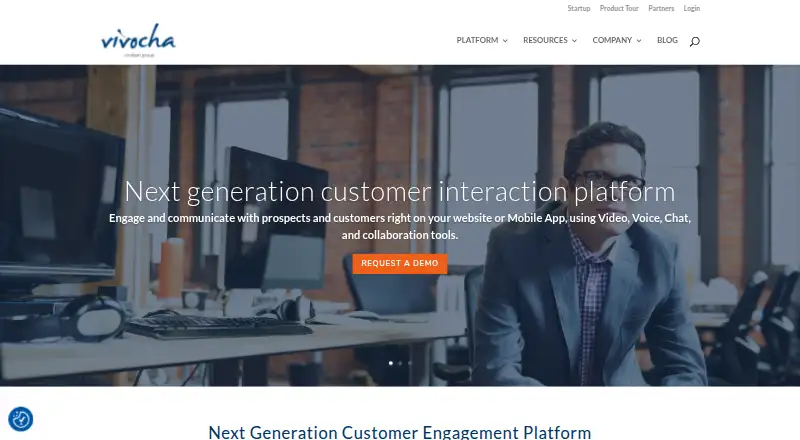
Vivocha is a cloud customer engagement platform for businesses communicating with visitors on websites and mobile apps. It brings live chat, Click2Call, co-browsing, video chat, and callbacks together with tools for agents to share forms, cast screens, transfer files, and review visitor navigation timelines. Customizable rules let businesses choose when and whom to engage based on visitor behavior and context. Vivocha supports iOS and Android app integration through SDKs, responsive mobile websites, and APIs for connections to business applications. Its integrations cover CRM, ticketing, analytics, CMS, and contact-center telephony systems; chatbot connections include Google Dialogflow, Microsoft Bot Framework Azure, and IBM Watson. For e-commerce, it describes a unified agent view of customer and cart information, configurable engagement widgets, and integrations it says can be set up without coding. The service is presented for customer-service and e-commerce teams. Vivocha offers a demo and contact channels, but does not list plan prices; pricing is on request.
Who it suits
Vivocha suits businesses, including e-commerce and customer-service teams, that want to engage website and mobile app visitors across chat, voice, video, and callbacks. Its SDKs and APIs are relevant to firms integrating customer support into apps or existing business systems.
What it does well
- Combines chat, voice, video, and callbacks.
- Offers co-browsing and agent collaboration tools.
- Supports iOS and Android app integration.
- Integrations cover CRM, ticketing, analytics, and CMS.
- Offers a demo and support resources.
What to know first
- Pricing is available on request, not listed.
- The linked security overview was last updated September 2018.
Getting started
- Visit the Vivocha website.
- Request a demo or contact Vivocha through its inquiry forms.
- Choose web deployment or integrate the iOS or Android SDK for mobile apps.
- Use Vivocha APIs to connect business applications or customize an integration.
Vivocha is a cloud customer-engagement platform for businesses communicating with visitors on websites, mobile apps and messaging channels. It is best suited to e-commerce and service teams that need agents to move between chat, voice and visual assistance while sharing one customer context. Its channel coverage is broad, but custom pricing and an aging security overview make commercial and governance checks essential.
Overview
Vivocha brings live chat, Click2Call, video chat, callbacks and co-browsing into one cloud service. A visitor can switch from text to a call or video conversation, while agents retain tools for continuing the same interaction rather than handing it between separate systems. Outbound dialing, call recording and supervisor tools extend its relevance beyond simple website chat to more structured contact-center operations.
Proactive engagement rules let a business decide when and whom to approach using visitor behavior and other context. That can focus assistance on high-intent shoppers or customers showing signs of difficulty, but it also puts responsibility on the business to maintain sensible rules and avoid intrusive prompts.
Key features
Conversation and collaboration
Agents can co-navigate a visitor's site, share forms, cast screens, transfer files and inspect a timeline of navigation. These capabilities are valuable when a written explanation is not enough—for example, guiding a customer through checkout or a complex form. They are less relevant to organizations that only need a basic text inbox.
Mobile, APIs and bots
SDKs support iOS and Android apps, while responsive mobile websites receive real-time support. APIs can adapt interface elements, create proactive rules, connect custom applications and support advertising campaigns. CRM, ticketing, analytics, CMS and contact-center telephony integrations can fit Vivocha into an existing stack instead of forcing a full replacement.
Chatbot connections use APIs and a Node.js SDK. Named integrations include Google Dialogflow, Convy.ai, Kore.ai, Microsoft Bot Framework Azure, Wit.ai and IBM Watson, giving teams options for routing automated conversations into live assistance.
E-commerce and operations
Vivocha describes a single agent view of customer and cart information, configurable engagement widgets and integrations positioned for five-minute, no-code setup. Those promises target online sales and service workflows; businesses with unusual processes should still validate the required integration work during a demo.
Security and support
Vivocha describes endpoint data protection and AWS hosting across availability zones and regions, with replication, backups and automatic failover. It says it runs internal and external vulnerability scans and penetration tests, alongside quarterly third-party security reviews. The security overview was last updated in September 2018, so organizations with current compliance requirements should request up-to-date evidence before deployment.
A support resource and training catalog accompany the product. The Startup Program includes standard onboarding and eight hours per month of customer-success-manager support, a useful allowance for smaller teams that need guidance during rollout.
Pricing
Vivocha uses paid, custom pricing. The official pages invite businesses to request a demo or contact the company rather than publishing plan rates, seat allowances, quotas, trial terms or renewal conditions. This approach can accommodate a tailored omnichannel deployment, but buyers cannot compare entry cost or expansion thresholds without a sales conversation. Request a quote that separates channels, integrations, seats, recording and support so the operating cost is clear.
Platforms
Vivocha is delivered as a cloud service with web access, Android and iOS support, and APIs. Its mobile SDKs cover native apps, while responsive mobile websites can receive real-time support. API access also allows custom applications and business-system integrations.
Who it's for
Vivocha fits e-commerce teams that want proactive help tied to visitor behavior, cart context and agent access to the same journey. Customer-service and contact-center groups can use its voice, video, callback, recording, supervisor and outbound-dialer capabilities. It is a weaker fit for a small operation seeking transparent self-serve pricing or only a lightweight chat widget, and for organizations unwilling to verify current security documentation.
Pros and cons
Pros
- Broad live-channel coverage: chat, voice, video, callbacks and Click2Call support different customer preferences in one platform.
- Deep agent assistance: co-browsing, screen casting, form sharing, file transfer and navigation timelines help resolve visual or procedural problems.
- Integration flexibility: APIs, SDKs and connectors for CRM, ticketing, analytics, CMS, telephony and named bot platforms support customized workflows.
- Contact-center functions: outbound dialing, call recording and supervisor tools extend it beyond basic visitor chat.
Cons
- No published rates: custom pricing prevents quick budget comparisons and requires a sales process.
- Security documentation age: the overview's September 2018 update date means buyers should obtain current assurance before approval.
- Operational complexity: proactive rules and many integration paths demand ongoing configuration and governance.
Alternatives
Choose Contact Center Software when you want to compare a wider range of contact-center products. For a narrower focus on website messaging, see Live chat software.
Webex App is a freemium option with Android, iOS, macOS, web and Windows clients; its free plan covers meetings up to 40 minutes and 100 attendees, making it a better fit for general team communication than Vivocha's visitor-engagement workflow.
Agentforce Vibes offers a free Salesforce Foundations tier and paid credit or flat-fee access, so Salesforce-oriented teams wanting that commercial model should compare it with Vivocha.
Freshdesk provides a free program for one or two agents for six months, plus a Growth plan at $19 a month billed annually; it suits teams prioritizing a conventional ticketing desk and visible entry pricing.
Zoom Scheduler is aimed at appointment booking, with a free basic tier and a 4.99 USD-per-month annual plan, so pick it for scheduling rather than multichannel visitor support.
Mitel Secure Cloud offers paid Essential and Elite service packages for organizations evaluating a Mitel cloud communications stack.
VICIdial is a free, self-hosted-capable alternative with optional VICIhost hosting at $400 per server per month after the first month and a 1,000 USD initial provisioning fee.
Alvaria Cloud is another paid cloud contact-center option. Enghouse CCaaS scales from 10 to 10,000 seats and includes 90-day recording storage, with standard and advanced capabilities and add-ons.
Verdict
Choose Vivocha if your business needs website and app visitors to reach agents through several live channels, with co-browsing, proactive engagement and contact-center controls in one cloud platform. Its main advantage is the combination of conversational breadth and shared agent context. Look elsewhere if transparent pricing or current, detailed security documentation is a prerequisite, or if your needs stop at basic chat or appointment scheduling.
Verdict
Vivocha brings multiple visitor communication channels and agent collaboration into a cloud platform. Businesses should request pricing and consider the stated age of its security overview when assessing fit.
Questions
How much does Vivocha cost?
Vivocha is paid, and pricing is available on request.
Which platforms does Vivocha support?
Its listed platforms are Android, iOS, API, and web.
What communication channels does it include?
The platform includes live chat, Click2Call, co-browsing, video chat, and callbacks.
Which business systems can it integrate with?
Its integration coverage includes CRM, ticketing, analytics, CMS, and contact-center telephony systems.
Which chatbot integrations are named?
The named options are Google Dialogflow, Convy.ai, Kore.ai, Microsoft Bot Framework Azure, Wit.ai, and IBM Watson.
Who makes Vivocha?
Vivocha is made by Vivocha, which lists its headquarters in Milan, Italy.
Facts from Vivocha's own pages
- API and customization
- Vivocha APIs can customize interface elements, create proactive rules, and integrate the service into custom apps or advertising campaigns. · vivocha.com, 11 Oct 2026
- Audience
- The platform is presented for businesses seeking to engage website, mobile app, and messaging-channel visitors, including e-commerce and customer-service teams. · vivocha.com, 11 Oct 2026
- Chatbots
- Vivocha supports chatbot integrations through APIs and a Node.js SDK, including Google Dialogflow, Microsoft Bot Framework Azure, and IBM Watson. · vivocha.com, 11 Oct 2026
- Collaboration
- Agents can co-navigate websites, share forms, cast screens, transfer files, and review visitor navigation timelines. · vivocha.com, 11 Oct 2026
- Communication channels
- The platform combines chat, voice, video, callbacks, and collaboration tools. · vivocha.com, 11 Oct 2026
- Company locations
- The contact page lists Vivocha’s Italy office in Milan and innovation labs in Sestu and Milan. · vivocha.com, 11 Oct 2026
- E-commerce features
- For e-commerce, Vivocha describes a single agent view of customer and cart information, configurable engagement widgets, and out-of-the-box integrations with five-minute setup and no coding required. · vivocha.com, 11 Oct 2026
- Headquarters
- Milan, Italy · vivocha.com, 28 Sept 2026
- Integrations
- The platform offers APIs for integrating with business applications, and its integrations cover CRM, ticketing, analytics, CMS, and contact-center telephony systems. · vivocha.com, 11 Oct 2026
- Intended users
- Vivocha describes its cloud service as tailored to businesses that want to engage visitors on their online sites. · vivocha.com, 11 Oct 2026
- Live channels
- The platform includes live chat, Click2Call, co-browsing, video chat, and callback features. · vivocha.com, 11 Oct 2026
- Mobile support
- Vivocha offers SDK integration for iOS and Android apps, as well as real-time support for responsive mobile websites. · vivocha.com, 11 Oct 2026
- Named bot integrations
- The integrations page names Google Dialogflow, Convy.ai, Kore.ai, Microsoft Bot Framework Azure, Wit.ai, and IBM Watson. · vivocha.com, 11 Oct 2026
- Pricing availability
- The official pages reviewed invite visitors to request a demo or contact Vivocha; they do not state plan prices. · vivocha.com, 11 Oct 2026
- Proactive engagement
- Businesses can use customizable rules to decide when and whom to engage, based on visitor behavior and other context. · vivocha.com, 11 Oct 2026
- Product
- Vivocha provides a cloud customer engagement platform for communicating with website and mobile app visitors through voice, video, chat, callbacks, and collaboration tools. · vivocha.com, 11 Oct 2026
- Security
- Vivocha describes its service as a secure cloud application and says it protects user data at platform endpoints. · vivocha.com, 11 Oct 2026
- Security document age
- The linked security overview says its last update was September 2018 and describes a cloud platform built on AWS with security controls and encryption options. · vivocha.com, 11 Oct 2026
- Security infrastructure
- A security overview describes AWS-based hosting across availability zones and regions, with database replication, backups, and automatic failover. · vivocha.com, 11 Oct 2026
- Security testing
- The security overview says Vivocha routinely runs internal and external vulnerability scans and penetration tests, with quarterly third-party security reviews. · vivocha.com, 11 Oct 2026
- Support
- Vivocha provides a support resource and training catalog, and its Startup Program lists standard onboarding and eight hours per month of CSM support. · vivocha.com, 11 Oct 2026
- Support and sales
- The site offers a free demo and provides contact forms and office contact details for inquiries. · vivocha.com, 11 Oct 2026
Where Vivocha stands on Freedom251
- Live chat software#86 of 94
- Contact Center Software#36 of 38