Freedom251 › Lead Routing Software

Gradient Works
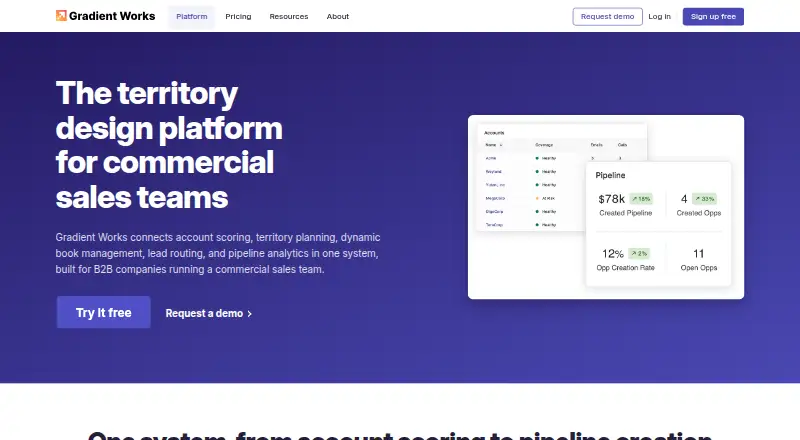
What Gradient Works is
Gradient Works combines account scoring, territory planning, rep book management, lead routing and pipeline analytics for B2B commercial sales teams. Market Map scores CRM accounts from 0–100 for similarity to closed-won customers and syncs the scores to Salesforce. Carve helps RevOps and Sales Strategy model territory scenarios using fit scores and send a selected design to Salesforce. Bookbuilder keeps rep books at roughly 100–150 accounts, replacing accounts that have been worked with higher-fit ones. Routing matches and assigns inbound MQLs, handoffs, customer-success assignments and opportunity escalations in Salesforce. AI Researcher supports custom account-research prompts and writes qualitative answers back to Salesforce. Integrations include Salesforce, HubSpot, Slack, Salesloft, Outreach, Google Calendar, Office 365 and CSV import, but only one calendar and one sales-engagement integration can be active at once. Salesforce is needed for the full platform; HubSpot and CSV support Account Research and Carve territory planning. A free plan is available; Growth is $799/mo (annual).
Who it suits
It suits upper mid-market B2B software companies with 200–2,500 employees, commercial sales teams and Salesforce. Teams needing territory planning, account research or lead routing may find its tools relevant.
What it does well
- Scores accounts against closed-won customers.
- Models territory scenarios and sends designs to Salesforce.
- Automatically replaces worked accounts with higher-fit accounts.
- Free plan includes Market Map and basic Bookbuilder.
What to know first
- Salesforce is required for the full platform.
- Only one calendar integration can be active at once.
- Only one sales-engagement integration can be active at once.
- Growth costs $799/mo (annual).
Limits
The Free plan is limited to 1,000 credits, five rep users, and one Carve scenario, with basic Bookbuilder. Growth costs $799/mo billed annually and includes 12,000 credits, 10,000 dynamic accounts, ten rep users, and five Carve projects.
Plans
| Plan | Billed and limits | Price |
|---|---|---|
| Free | forever · 1,000 credits · 5 rep users · Carve AI territory plans · Market Map scoring · basic Bookbuilder · activity and pipeline analytics | Free |
| Growth | paid annually · 12,000 credits · 10,000 dynamic accounts · 10 rep users · 5 Carve projects · routing · AI Account Research · Lookalikes · analytics · Slack, Salesloft and Outreach integrations | $799 a month |
| Enterprise | paid annually · Up to 2M credits · up to 1M dynamic accounts · up to 1,000 rep users · managed AI Researchers · custom workflow implementation · premium support and shared Slack channel | On request |
As gradient.works lists them, read 14 Oct 2026. The maker's own page has the final word.
Getting started
- Visit the Gradient Works platform website.
- Choose the Free plan or Growth plan based on the included usage and features.
- Connect Salesforce for full platform use; HubSpot or CSV support Account Research and Carve territory planning.
- Select supported integrations, keeping in mind the one-calendar and one-sales-engagement integration limits.
- Work with Gradient Works' team through implementation, which it says typically takes 2–4 weeks.
Gradient Works is a sales-operations platform for B2B teams coordinating account coverage and lead assignment. It suits upper mid-market software companies with commercial sales teams and Salesforce. It is most compelling when scoring, territory design and routing need to work together; teams without Salesforce should look elsewhere for the full platform.
Overview
The platform connects account scoring to territory planning, rep book management, routing and pipeline analytics. Market Map scores CRM accounts from 0–100 by similarity to closed-won customers and syncs the scores to Salesforce. That gives teams a way to carry account-fit decisions into territory design and prioritization rather than treating those jobs separately.
Founded in 2020 and headquartered in Austin, Texas, Gradient Works identifies B2B software companies with 200–2,500 employees as its target market. Its Salesforce-centered design makes it a better fit for established commercial sales operations than for teams looking only for a standalone map.
Key features
Account fit and territory planning
Carve lets RevOps and Sales Strategy model territory scenarios using fit scores, then push a selected design to Salesforce. This links planning to account quality, though teams that do not need Salesforce-based execution may not benefit from that connection.
Rep books and routing
Bookbuilder aims to keep rep books at roughly 100–150 accounts, replacing worked accounts automatically with higher-fit ones. That can help maintain coverage as accounts are worked, but the fixed target range may not suit every sales model. Routing automates lead-to-account matching and assignment in Salesforce for inbound MQLs, handoffs, customer-success assignments and opportunity escalations. Routing rules, territory routing, round-robin assignment and lead qualification are supported.
Research and integrations
AI Researcher allows RevOps to create prompts for account research at scale and write qualitative answers back to Salesforce. Supported connections include Salesforce, HubSpot, Slack, Salesloft, Outreach, Google Calendar, Office 365 and CSV import. Only one calendar integration and one sales-engagement integration can be active at a time, which may constrain teams using multiple tools in either category.
Salesforce is required for the full platform. HubSpot and CSV support Account Research and Carve territory planning, but do not remove that requirement for the broader product. Gradient Works says its implementation is team-led and typically takes 2–4 weeks, so buyers should allow for a guided rollout rather than assuming an immediate setup. It also says it completed a SOC 2 Type 2 audit and provides a process to request the report.
Pricing
Free
The Free plan costs nothing, billed forever. It includes 1,000 credits, 5 rep users, 1 Carve scenario, Market Map, basic Bookbuilder and analytics. This is a useful starting point for a small team exploring account scoring and planning, but the credit and scenario caps limit its role as an ongoing operating platform.
Growth
Growth costs $799 a month, billed paid annually. It includes 12,000 credits, 10,000 dynamic accounts, 10 rep users, 5 Carve projects, routing, AI Account Research, Lookalikes and integrations. The added routing and research make this the practical entry point for teams wanting connected execution, but the annual billing commitment and 10-rep cap matter for buyers with larger teams or uncertain needs.
Enterprise
Enterprise has custom pricing and is billed paid annually. It allows up to 2M credits, up to 1M dynamic accounts and up to 1,000 rep users, with managed AI Researchers, custom workflow implementation and premium support. Its higher limits and implementation support suit larger operations, while the custom quote means buyers cannot compare its cost from a fixed monthly rate.
There is no free trial, so the forever-free plan is the available way to begin without a paid commitment.
Platforms
Gradient Works is available on the web and via API. Its CRM and tool connections broaden how it fits into sales workflows, but the full platform still depends on Salesforce.
Who it's for
Gradient Works is best suited to upper mid-market B2B software companies with 200–2,500 employees, commercial sales teams and Salesforce, especially where RevOps wants account-fit scoring to inform territory coverage and routing. It is a weaker choice for teams seeking a mapping-only tool, or for organizations that need the complete workflow without Salesforce.
Pros and cons
Pros
- Account scores can inform territory scenarios and Salesforce execution, tying planning to account fit.
- Bookbuilder refreshes worked accounts with higher-fit accounts, supporting ongoing rep coverage.
- Growth combines routing, research and integrations with defined credit, account and user allowances.
- The Free plan is billed forever and includes Market Map, basic Bookbuilder and analytics.
Cons
- Salesforce is required for the full platform, limiting its fit for teams built around another CRM.
- Growth requires annual billing and allows 10 rep users, which may not fit larger or short-term deployments.
- The Free plan caps credits at 1,000 and Carve at one scenario.
- Only one calendar and one sales-engagement integration can be active at once.
- Implementation typically takes 2–4 weeks and is led by Gradient Works' team, adding rollout time.
Alternatives
For territory work, TerraMap is worth considering when a lower-cost, mapping-focused start is preferable: its Starter plan is $49 a month, billed $470/year (save $118), with up to 3 territory models, 15 territories, 10,000 data points and 2 users. Maptive may suit buyers who need broad platform coverage and short-term access: it offers a 45 Day Pass for $25,045, paid once, billed one-time, with one user, unlimited maps and 100,000 locations per data set.
Galigeo Sales Territory Mapping is another paid territory-mapping option with a self-service offer and a free trial. Optymyze, Forma.ai, LINEN Cloud Territory Management, Veeva Network MDM and Nomadia Territory Manager are also alternatives to compare.
Readers evaluating adjacent categories can browse Sales Territory Management Software, Ideal Customer Profile Software, Lead Routing Software and Sales Mapping Software.
Verdict
Choose Gradient Works if a Salesforce-based commercial sales team needs account scoring, territory planning, rep book maintenance and routing connected in one operating system. Its strongest reason to buy is that fit scoring can carry through to coverage and assignment; its clearest reason to look elsewhere is the Salesforce dependency, alongside Growth's annual commitment and 10-rep limit.
Verdict
Gradient Works brings several sales operations tasks into one platform, with account scoring, territory planning, book management and routing tied to Salesforce. Its free plan offers a starting point, while the full platform requires Salesforce and Growth is billed annually.
Questions
Is there a free plan?
Yes. Free is billed forever at no cost and includes 1,000 credits, five rep users, one Carve scenario, Market Map, basic Bookbuilder, and analytics.
How much does Growth cost?
Growth is $799 a month, billed paid annually. Its listed allowances include 12,000 credits, 10,000 dynamic accounts, ten rep users, and five Carve projects.
Does it require Salesforce?
Salesforce is required for the full platform. HubSpot and CSV support Account Research and Carve territory planning.
Which integrations are supported?
Supported integrations include Salesforce, HubSpot, Slack, Salesloft, Outreach, Google Calendar, Office 365, and CSV import. Only one calendar integration and one sales-engagement integration may be active at once.
What does Enterprise cost?
An Enterprise price is not provided. The plan includes up to 2 million credits, up to 1 million dynamic accounts, up to 1,000 rep users, managed AI Researchers, custom workflow implementation, and premium support.
Where is Gradient Works based?
Gradient Works was founded in 2020 and is headquartered in Austin, Texas, United States.
Facts from Gradient Works's own pages
- AI Researcher
- AI Researcher lets users ask custom prospect questions and returns structured answers at scale, with model choices and preview runs. · gradient.works, 14 Oct 2026
- Analytics
- The platform reports pipeline creation, account coverage, opportunity creation rate and rep coaching metrics. · gradient.works, 14 Oct 2026
- Bookbuilder
- Bookbuilder keeps rep books small and refreshed, replacing unworked accounts with higher-fit accounts automatically. · gradient.works, 14 Oct 2026
- Carve
- Carve uses natural-language instructions and AI to create balanced territory scenarios and push the chosen design to Salesforce. · gradient.works, 14 Oct 2026
- Company
- Gradient Works was founded in 2020 and is headquartered in Austin, Texas. · gradient.works, 30 Sept 2026
- Company founded
- The company was founded in 2020. · linkedin.com, 14 Oct 2026
- Company headquarters
- LinkedIn and Crunchbase place headquarters in Austin, Texas. · linkedin.com, 14 Oct 2026
- Company legal name
- Crunchbase lists the legal name as Gradient Works, Inc. · crunchbase.com, 14 Oct 2026
- Company size
- LinkedIn lists the company size as 11–50 employees. · linkedin.com, 14 Oct 2026
- CRM requirement
- Salesforce is required for the full platform, while HubSpot and CSV support Account Research and Carve territory planning. · gradient.works, 30 Sept 2026
- Developer extensibility
- The Automation Builder Kit adds more than 30 Salesforce Flow actions for matching, routing, assignment and business-process automation. · docs.gradient.works, 14 Oct 2026
- Documentation
- The documentation site covers Bookbuilder, Routing, Analytics, Account Research, integrations, automation actions and a release changelog. · docs.gradient.works, 14 Oct 2026
- Founded
- 2020 · gradient.works, 28 Sept 2026
- Funding status
- Crunchbase identifies Gradient Works as a private seed-stage company with two funding rounds and lists Stage 2 Capital among its investors. · crunchbase.com, 14 Oct 2026
- Headquarters
- Austin, Texas, United States · gradient.works, 28 Sept 2026
- Implementation
- Gradient Works says implementation typically takes 2–4 weeks and is led by its team. · gradient.works, 30 Sept 2026
- Integration authentication
- Integrations require authentication through Gradient Works Cloud, which connects the Salesforce package to third-party services. · docs.gradient.works, 14 Oct 2026
- Integration limits
- Only one calendar integration and one sales-engagement integration may be active at once. · docs.gradient.works, 30 Sept 2026
- Integrations
- Listed integrations are Slack, Salesloft, Outreach, Google Calendar and Microsoft 365, with Groove, ZoomInfo and 6sense described as planned. · gradient.works, 14 Oct 2026
- Licence
- Opened documentation describes a managed Salesforce package and cloud service but does not state an open-source licence. · docs.gradient.works, 14 Oct 2026
- Limit: changing ownership confusion
- One G2 reviewer says continuously changing territories can leave reps unsure which accounts belong to them and may risk lost business. · g2.com, 14 Oct 2026
- Limit: reporting visuals
- G2 reviewers request richer out-of-the-box reporting and more shareable visuals for how reps work their books. · g2.com, 14 Oct 2026
- Limit: scheduling integration
- A G2 reviewer wanted an integrated meeting scheduler and reported that using Chili Piper for the need worked poorly. · g2.com, 14 Oct 2026
- Limit: team capacity
- A G2 reviewer said the small vendor team can take time to build complex flows when customers put substantial work on it. · g2.com, 14 Oct 2026
Where Gradient Works stands on Freedom251
- Lead Routing Software#2 of 36
- Sales Capacity Planning Software#1 of 18
- Sales Mapping Software#3 of 33
- Sales Territory Management Software#3 of 27
- Predictive Lead Scoring Software#4 of 23
- Ideal Customer Profile Software#5 of 24