Freedom251 › Accessibility Testing Software
Alfa
by Alfa
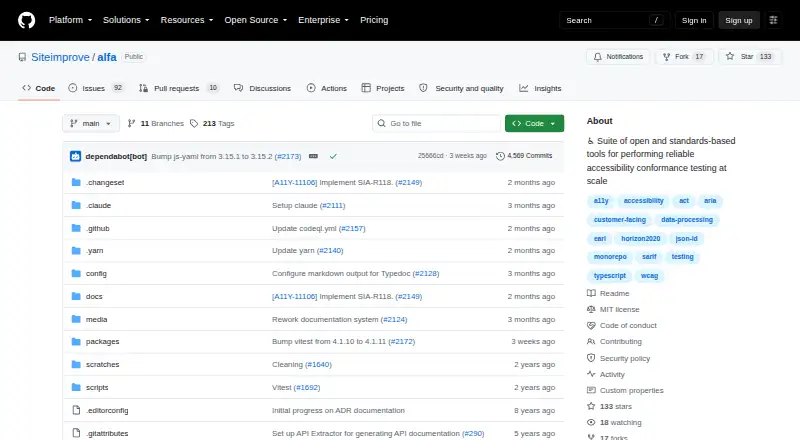
What Alfa is
Alfa is a free, open accessibility testing engine for websites built with HTML, CSS, and JavaScript. It checks accessibility against standards such as WCAG, using included WCAG-based rules or additional pluggable rules in the ACT Rules Format. Developers can add custom rules and filter findings by conformance level or WCAG version. Results follow the Evaluation and Report Language (EARL) Schema and are encoded as JSON-LD. Alfa includes a command-line interface for auditing one page and saving results as JSON. Its scraper can create page snapshots, while its crawler discovers and scrapes linked pages across a site or subdomain. Ready-made integrations are listed for frameworks and tools including Angular, React, Vue, Cypress, Jest, Playwright, Puppeteer, Selenium, and WebdriverIO. Alfa is released as separate npm packages under the MIT license. It runs in ECMAScript 2022-compatible JavaScript environments, including recent Node.js and browser versions. Building from source requires Node.js 20 or later and Yarn; the project says most integrations are experimental and subject to change.
Who it suits
Alfa suits developers who need accessibility conformance checks in website development or automated workflows. It is aimed at teams comfortable with JavaScript environments and npm packages.
What it does well
- Includes WCAG-based rules and supports pluggable ACT rules.
- Custom rules and result filters are supported.
- CLI can audit a page and save JSON results.
- Scraper and crawler integrations cover pages across a site.
- Free and released under the MIT license.
What to know first
- Most integrations are experimental and may change.
- Building from source requires Node.js 20 or later and Yarn.
- Older environments are not explicitly supported.
Plans
| Plan | Billed and limits | Price |
|---|---|---|
| Alfa | Open source · MIT license · Distributed as separate npm packages | Free |
As github.com lists them, read 11 Oct 2026. The maker's own page has the final word.
Getting started
- Open the Alfa project on GitHub.
- Choose the relevant npm package for your environment or integration.
- Use the command-line interface to audit a single page, or use the scraper and crawler for page snapshots and linked pages.
- Add custom rules or filter findings by conformance level or WCAG version as needed.
Alfa is a free, open-source accessibility testing engine for websites built with HTML, CSS, and JavaScript. It suits developers who want WCAG checks woven into their own code and test workflows. Its standards-based rules and structured reports are useful; the main trade-off is that most integrations are experimental.
Overview
Alfa evaluates web content against accessibility standards, including WCAG 2.2. Its default rules follow the ACT Rules Format, and developers can add custom rules or filter results by conformance level and WCAG version. That makes it a flexible option for engineering teams that want to shape checks around a project. Teams seeking a standalone audit interface should look elsewhere: Alfa is built as a testing engine and developer toolkit.
Reports use the Evaluation and Report Language (EARL) Schema encoded as JSON-LD, giving teams structured output for workflows that consume audit data. Alfa is distributed as separate npm packages under the MIT license. The project also says code that can affect test results resides within Alfa itself, a useful property for teams reviewing the provenance of their checks.
Key features
- Page and site audits: The command-line interface audits a single page and saves results as JSON. A scraper fetches a page representation for evaluation, while a crawler discovers and scrapes linked pages across a site or subdomain. The CLI is suited to focused checks; crawling extends the approach across more of a website.
- Customizable rules: Alfa includes WCAG-based rules and accepts pluggable implementations in the ACT Rules Format. Teams can add their own rules and filter findings by conformance level or WCAG version, which helps tailor checks to project requirements without being limited to the default set.
- Developer integrations: Packages cover frameworks and tools including Angular, React, Vue, Cypress, Jest, Playwright, Puppeteer, Selenium, and WebdriverIO. This range can bring checks closer to existing development workflows, but most integrations are experimental and subject to change, so teams should be prepared to manage that instability.
- Automated and CI/CD checks: Alfa supports automated scans and CI/CD integration, making it a fit for teams that want accessibility checks in development pipelines. Its outputs and rules are designed for integration into software workflows, rather than a separate audit product.
Pricing
Alfa is free: its sole plan costs nothing. The plan is open source under the MIT license and distributed as separate npm packages. There are no paid tiers to compare, and the plan facts state no seat or scan quota. The practical cost is in adopting and maintaining the tooling, particularly if a team relies on experimental integrations.
Platforms
Alfa is listed for API, Linux, macOS, self-hosted use, web, and Windows. It runs in ECMAScript 2022-compatible JavaScript environments, including recent versions of Node.js, Chrome, Firefox, Safari, and Edge. Building it from source requires Node.js 20 or later and Yarn. Older environments may be targetable from source, but the project does not explicitly support them, so teams with legacy runtimes should account for compatibility work.
Who it's for
Alfa is best suited to developers and engineering teams that need standards-based accessibility checks inside an existing JavaScript, browser-testing, or CI/CD workflow. Its open rule format, custom rules, and machine-readable reports are particularly useful when a team wants control over how checks run and how findings are consumed. It is a weaker fit for users who want a polished, standalone audit interface or dependable integrations without experimental status.
Pros and cons
- Pros: Free and MIT-licensed. Teams can use and adapt the packages without a subscription tier.
- Pros: Flexible rules and filters. Custom rules and conformance filters support checks tailored to a codebase and WCAG target.
- Pros: Structured reporting. EARL in JSON-LD and JSON output from the CLI are suited to workflows that process results programmatically.
- Cons: Most integrations are experimental. Teams depending on a particular framework or test runner may need to accommodate changes.
- Cons: Current JavaScript tooling is required for source builds. Building requires Node.js 20 or later and Yarn, while older environments lack explicit project support.
Alternatives
For a different kind of software, FileManagerTUI is a free, open-source terminal file manager for Linux, macOS, and Windows, with an MIT-licensed plan. Newt is another free, open-source terminal file manager for those three desktop platforms. nnn is a free, open-source terminal file manager that also supports Android. Rat Commander is a free, self-contained terminal file manager for Linux, macOS, and Windows, with no paid tiers or usage limits stated. Broot is a free, MIT-licensed terminal file manager with source and precompiled binaries for Linux, macOS, and Windows. Clifm is a free terminal file manager for Linux, macOS, and Android, released under GPL version 2 or later. elio is a free terminal file manager for Linux, Windows, and self-hosted use. pointer is a free terminal file manager for Linux and macOS, distributed as a single binary under the Unlicense.
Verdict
Choose Alfa if your team wants a free, adaptable way to run WCAG checks within its JavaScript and CI/CD workflows, with structured results and control over rules. Its strongest reason to choose is the combination of open standards, customizable checks, and developer integrations. Look elsewhere if you need a standalone audit interface or require integrations with a stable, non-experimental status.
Verdict
Alfa offers rule-based accessibility checks, structured reports, and a range of developer integrations. Teams should account for the experimental status of most integrations and the stated runtime requirements.
Questions
Does Alfa cost anything?
Alfa is free and open source under the MIT license, distributed as separate npm packages.
What does Alfa check?
It tests websites built with HTML, CSS, and JavaScript against accessibility standards such as WCAG. Its listed coverage includes WCAG 2.2.
What platforms and environments does Alfa support?
The listed platforms are API, Linux, macOS, self-hosted, web, and Windows. Alfa runs in ECMAScript 2022-compatible JavaScript environments, including recent Node.js and browser versions.
Can Alfa run in CI/CD workflows?
Yes. CI/CD integration is listed, and ready-made integrations include tools such as Cypress, Jest, Playwright, Puppeteer, Selenium, and WebdriverIO.
Can developers change Alfa's rules?
Yes. Developers can add custom rules to the default rule set and filter results by conformance level or WCAG version.
Who makes Alfa?
Alfa is made by Siteimprove, which was founded in Denmark in 2003 and lists Copenhagen among its locations.
Facts from Alfa's own pages
- Automated scans
- Yes · github.com, 21 Sept 2026
- Availability
- Alfa is distributed as separate packages through npm and is released under the MIT license. · github.com, 10 Oct 2026
- CI/CD integration
- Yes · github.com, 21 Sept 2026
- CLI
- Alfa includes a command-line interface for auditing a single page. · github.com, 11 Oct 2026
- Company
- Siteimprove says it was founded in Denmark in 2003 and lists Copenhagen among its locations. · siteimprove.com, 10 Oct 2026
- Customization
- Developers can add custom rules to the default rule set and filter results by conformance level or WCAG version. · github.com, 11 Oct 2026
- Developer integrations
- Ready-made integrations include Angular, React, Vue, Cypress, Jest, Playwright, Puppeteer, Selenium, and WebdriverIO. · github.com, 10 Oct 2026
- Development requirement
- Building Alfa from source requires Node.js version 20 or later and Yarn. · github.com, 10 Oct 2026
- Founded
- 2003 · github.com, 28 Sept 2026
- Free plan
- Yes · github.com, 21 Sept 2026
- Headquarters
- Copenhagen, Denmark · github.com, 19 Oct 2026
- Integrations
- The integrations repository lists packages for Angular, Chai, Cheerio, Cypress, Jasmine, Jest, jQuery, Playwright, Puppeteer, React, Selenium, Unexpected, Vitest, Vue, and WebdriverIO. · github.com, 11 Oct 2026
- Integration status
- Most integrations are experimental and subject to change; Cypress, Playwright, Puppeteer, and WebdriverIO integrations are actively maintained as part of the Accessibility Code Checker. · github.com, 11 Oct 2026
- License
- Alfa is released under the MIT license. · github.com, 11 Oct 2026
- Maker
- The repository identifies Siteimprove A/S as the copyright holder, and Siteimprove says it was founded in Denmark in 2003. · siteimprove.com, 11 Oct 2026
- Purpose
- Alfa is an open, standards-based accessibility conformance testing engine for websites built with HTML, CSS, and JavaScript. · github.com, 11 Oct 2026
- Remediation guidance
- Yes · github.com, 21 Sept 2026
- Results
- Alfa produces audit results in the Evaluation and Report Language (EARL) Schema encoded as JSON-LD. · github.com, 10 Oct 2026
- Rules
- Alfa accepts pluggable rule implementations in the ACT Rules Format and includes a set of WCAG-based rules. · github.com, 10 Oct 2026
- Rule sets
- Alfa supports pluggable rules and includes a default rule set based on WCAG. · github.com, 11 Oct 2026
- Runtime
- Alfa runs in ECMAScript 2022-compatible JavaScript environments, including recent versions of Node.js, Chrome, Firefox, Safari, and Edge. · github.com, 11 Oct 2026
- Scraping and crawling
- Its integrations include a scraper for page snapshots and a crawler that can scrape pages belonging to a subdomain or website. · github.com, 10 Oct 2026
- Site crawling
- Its scraper fetches a page representation for auditing, and its crawler discovers and scrapes linked pages across a site. · github.com, 11 Oct 2026
- Standards
- It tests against accessibility standards such as the Web Content Accessibility Guidelines (WCAG). · github.com, 10 Oct 2026
Where Alfa stands on Freedom251
- Accessibility Testing Software#4 of 169
- Terminal File Managers#4 of 29
- File Manager Software#48 of 100
- File managers#22 of 29