Freedom251 › Accessibility Testing Software
axe-core
by axe-core
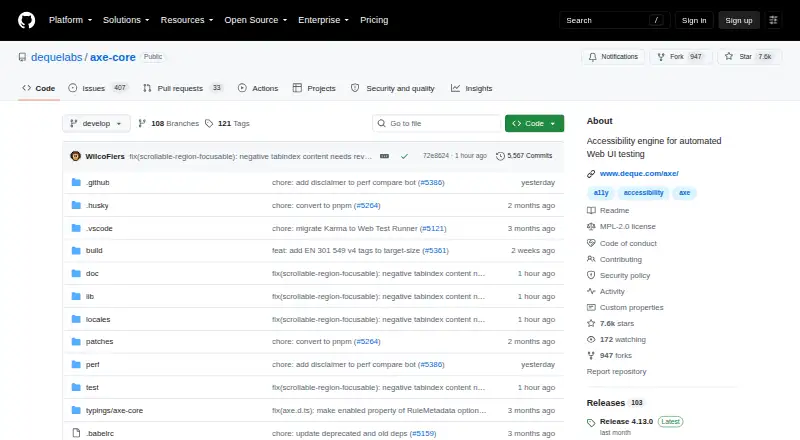
What axe-core is
axe-core is an accessibility testing engine for websites and other HTML-based interfaces. It can run alongside functional tests and is designed to fit into unit, integration, browser, and other test environments. Its rules cover WCAG 2.0, 2.1, and 2.2 at A, AA, and AAA levels, along with additional best practices. Deque says automated checks identify an average of 57% of WCAG issues; uncertain findings are marked for manual review. The project describes installation with npm or pnpm and use of the axe.run() API in tests. The API lists Microsoft Edge, Google Chrome, Mozilla Firefox, and Apple Safari as supported browsers, though Internet Explorer 11 is deprecated. Chrome and Firefox are tested on every pull request. JSDOM support is limited, and color-contrast checks do not work there. axe-core is free and distributed under the Mozilla Public License, version 2.0. Deque says security updates are available for minor version lines up to 18 months old. Vulnerability reports should be sent by email, and Deque says it responds within 24 business hours; there is no bug bounty program.
Who it suits
It suits developers and teams adding accessibility checks to existing web-interface tests. Manual review is still relevant because uncertain results are flagged and automated checks find only an average of 57% of WCAG issues, according to Deque.
What it does well
- Free under the Mozilla Public License 2.0.
- Covers WCAG 2.0, 2.1, and 2.2.
- Designed to integrate with existing test environments.
- API lists four supported modern browsers.
What to know first
- Automated checks find an average of 57% of issues.
- JSDOM support is limited.
- Color-contrast checks do not work in JSDOM.
- Internet Explorer 11 is deprecated.
Plans
| Plan | Billed and limits | Price |
|---|---|---|
| axe-core | Open-source accessibility testing engine · MPL-2.0 license | Free |
As github.com lists them, read 11 Oct 2026. The maker's own page has the final word.
Getting started
- Visit the axe-core GitHub project.
- Install the package through npm or pnpm.
- Call the axe.run() API from your tests.
- Integrate it with your unit, integration, browser, or other functional test environment.
- Use it in CI/CD if that fits your workflow.
axe-core is a developer-focused engine for putting accessibility checks inside automated tests for web and HTML-based interfaces. It is strongest for teams that already use unit, integration, browser or CI pipelines and want repeatable regression checks. The trade-off is fundamental: automated findings cover only part of WCAG, so human assessment still has to complete the job.
Overview
Deque Systems, Inc. released axe-core in 2015, and the project is distributed under the Mozilla Public License 2.0. It scans a page through an API rather than presenting itself as a standalone audit service. That approach makes it a sensible foundation for developers who want accessibility treated like a code-quality check, while organizations looking for a finished reporting workflow may need a different product around it.
Key features
The rule set addresses WCAG 2.0, 2.1 and 2.2 success criteria at A, AA and AAA levels, with additional best-practice rules. That broad scope helps a team align one automated check with several compliance targets instead of maintaining separate rule engines. It does not make the scan a conformance verdict: Deque reports an average automatic detection rate of 57% of WCAG issues, and uncertain results are deliberately marked for manual review.
Integration is the engine's central advantage. Installation is available through npm or pnpm, and tests can invoke axe.run(). API access and CI/CD integration let teams run checks during unit, integration, browser or other functional testing, catching regressions near the change that caused them. Teams without an existing test harness will get less immediate benefit and must build that surrounding workflow themselves.
Supported API browsers are Microsoft Edge, Google Chrome, Mozilla Firefox and Apple Safari; Internet Explorer 11 is deprecated. Chrome and Firefox receive testing on every pull request, while the other supported browsers do not receive that same stated coverage. JSDOM support is limited, and color-contrast checks do not work in JSDOM, a material gap for projects that depend on that environment for fast component tests.
Deque says security updates are provided for minor-version lines up to 18 months old. Vulnerability reports should be sent by email, with a stated response within 24 business hours; there is no bug-bounty program.
Pricing
| Plan | Price | What it includes |
|---|---|---|
| axe-core | free | Open-source accessibility testing engine under the MPL-2.0 license |
There are no paid tiers, seat charges or usage quotas attached to this plan. It is the natural fit for open-source projects and development teams able to maintain their own test integration. The free package also means there is no vendor-managed audit, expanded automated coverage or separate support tier to purchase; teams must supply manual review and their own reporting and pipeline work.
Platforms
axe-core is offered through an API and web-oriented engine, with extension-based use also supported. Its package installation targets npm and pnpm workflows, and CI/CD support suits hosted or self-managed build systems. Browser execution covers Edge, Chrome, Firefox and Safari, with the JSDOM and Internet Explorer qualifications noted above.
Who it's for
Choose axe-core when developers need accessibility checks embedded in existing functional tests, particularly in JavaScript-based projects using npm or pnpm. It is also a good fit for teams that want an open-source component they can run in CI without buying seats or scan credits.
It is a poor sole choice for a compliance program that needs complete issue discovery, because the stated 57% average leaves substantial work for manual testing. Projects whose primary test environment is JSDOM should plan a second method for contrast checks, and teams requiring broad pull-request coverage across every supported browser should account for the narrower testing emphasis on Chrome and Firefox.
Pros and cons
- Pros: Free, open-source distribution avoids licensing barriers for teams and projects of different sizes.
- Pros: WCAG 2.0 through 2.2 rules at A, AA and AAA levels provide one broad rule base.
- Pros: The axe.run() API, API access and CI/CD integration place checks directly in development pipelines.
- Cons: An average 57% automated detection rate means manual assessment remains indispensable.
- Cons: JSDOM cannot run color-contrast checks, limiting coverage in that common test setup.
- Cons: Only Chrome and Firefox are tested on every pull request, so browser confidence is uneven.
Alternatives
WAVE is worth choosing when a freemium service with web, extension and desktop platforms, plus a subscription API starting at $10 a month for 250 credits, better matches your workflow.
IBM Equal Access Accessibility Checker is another free, open-source option with browser extensions and CI/CD packages.
Alfa suits teams seeking a free MIT-licensed engine distributed as separate npm packages across web, desktop and self-hosted environments.
Axe DevTools is the more appropriate direction when a free one-page-at-a-time extension or paid AI-enhanced guided testing is preferred.
Axe Developer Hub fits open-source projects or solo developers wanting a free plan with one API key, with paid subscription options beyond it.
Accessibility Insights for Web is a free, open-source browser tool for Chrome and Microsoft Edge.
Gamyata is better suited to a web service with a free allowance of five pages per month and paid higher-volume tiers.
Total Validator is an alternative for readers wanting a freemium validator with a free one-page summary and downloadable desktop coverage.
For a wider shortlist, see Accessibility Testing Software and Website Accessibility Tools.
Verdict
axe-core is the right choice for developers who want a capable, free rules engine embedded in automated tests and CI/CD. Choose it for pipeline-level regression detection and broad WCAG rule coverage; look elsewhere, or add dedicated manual and browser testing, if you need a complete accessibility audit or dependable contrast results in JSDOM.
Verdict
axe-core offers free automated accessibility rules that can be added to several kinds of test environments. Its stated coverage is partial, so flagged uncertainty and the JSDOM limitations matter when choosing a testing setup.
Questions
Is axe-core free?
Yes. It is listed as free and has a free plan.
What license does axe-core use?
axe-core is distributed under the Mozilla Public License, version 2.0.
Which standards does it cover?
Its rules address WCAG 2.0, 2.1, and 2.2 at levels A, AA, and AAA, plus additional best practices.
Which browsers does its API support?
The API lists Microsoft Edge, Google Chrome, Mozilla Firefox, and Apple Safari. Internet Explorer 11 is deprecated.
Can axe-core find every accessibility issue automatically?
Deque says automated checks find an average of 57% of WCAG issues. It marks uncertain results for manual review.
Who makes axe-core?
Deque Systems, Inc. is identified as the maker. The project was released in 2015, and Deque is headquartered in Herndon, Virginia.
Facts from axe-core's own pages
- API access
- Yes · github.com, 21 Sept 2026
- Automated coverage
- Deque says axe-core finds an average of 57% of WCAG issues automatically and marks uncertain results for manual review. · github.com, 11 Oct 2026
- Browser testing limits
- Only Chrome and Firefox are tested on every pull request, and JSDOM support is limited, with color-contrast known not to work there. · github.com, 11 Oct 2026
- CI/CD integration
- Yes · github.com, 21 Sept 2026
- Founded
- 2015 · github.com, 28 Sept 2026
- Free plan
- Yes · github.com, 21 Sept 2026
- Headquarters
- Herndon, Virginia, USA · github.com, 28 Sept 2026
- Integration
- The engine is designed to integrate with existing unit, integration, browser and other functional test environments. · github.com, 11 Oct 2026
- License
- axe-core is distributed under the Mozilla Public License, version 2.0. · github.com, 11 Oct 2026
- Maintainer
- Deque says it released axe-core in 2015 and identifies Deque Systems, Inc. as its maker. · deque.com, 11 Oct 2026
- Maker headquarters
- Deque Systems, Inc. lists its address as 13800 Coppermine Road, Herndon, Virginia 20171. · deque.com, 11 Oct 2026
- Package
- The README shows installation through npm or pnpm and use of the axe.run() API in tests. · github.com, 11 Oct 2026
- Purpose
- axe-core is an accessibility testing engine for websites and other HTML-based user interfaces that can run alongside functional tests. · github.com, 11 Oct 2026
- Scan scope
- page · github.com, 21 Sept 2026
- Security updates
- Deque says security updates are available for minor version lines up to 18 months old. · github.com, 11 Oct 2026
- Standards
- Its rules cover WCAG 2.0, 2.1 and 2.2 at levels A, AA and AAA, plus additional best practices. · github.com, 11 Oct 2026
- Supported browsers
- The API lists Microsoft Edge, Google Chrome, Mozilla Firefox and Apple Safari as supported; Internet Explorer 11 is deprecated. · github.com, 11 Oct 2026
- Vulnerability reporting
- Deque asks researchers to report vulnerabilities by email rather than through public GitHub issues and says it responds within 24 business hours; it has no bug bounty program. · github.com, 11 Oct 2026
- WCAG version
- wcag 2.2 · github.com, 21 Sept 2026
Where axe-core stands on Freedom251
- Accessibility Testing Software#7 of 169
- Website Accessibility Tools#7 of 133
- AI Personal Assistants#5 of 54
- Web Accessibility Software#8 of 21