Freedom251 › Text-to-speech tools
SESTEK Text-to-Speech
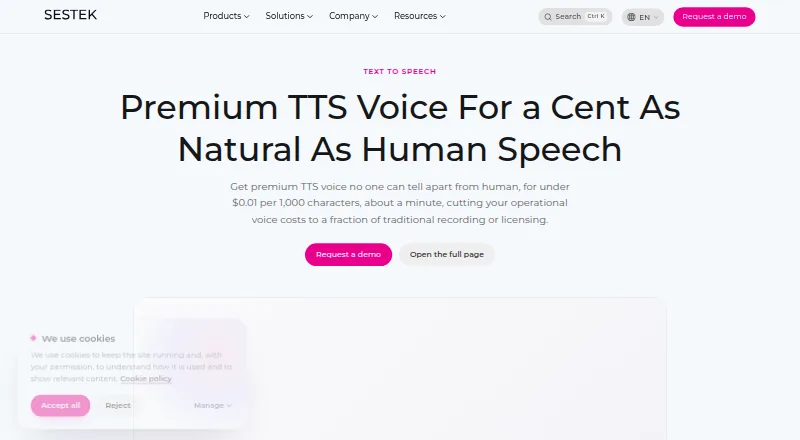
What SESTEK Text-to-Speech is
SESTEK Text-to-Speech converts written content into expressive speech for business applications. It supports more than 20 languages, with accent-specific voices that include Gulf, Najdi, Kuwaiti, and Emirati Arabic, as well as American and British English. Users can adjust tone, pace, emphasis, and volume, and define pronunciations for abbreviations, brand names, product codes, and specialized terms. Commonly used SSML tags cover pauses, pronunciation, external audio, and voice switching.
Organizations can ask SESTEK to develop a brand-specific voice model that it says is exclusive to that organization. The service can be deployed on-premises or in the cloud, with the same feature set in either model. Standard-tier voices run on Windows, Linux, Docker Compose, and Kubernetes without a GPU; Premium-tier voices require a GPU and are available on Linux, Docker Compose, and Kubernetes. APIs and SDKs let developers add voice capabilities to existing software. Listed connections include Azure, ElevenLabs, and other SESTEK products such as Speech Recognition, Virtual Translator, and AI Agents.
Exports are available in WAV, Opus, MP3, and FLV. Licensing options are pay-as-you-go, subscription-based, and custom agreement, with pricing available on request. SESTEK invites businesses to request a demo to discuss voice development, deployment, and language coverage.
Who it suits
SESTEK Text-to-Speech suits businesses that need speech generation with language and accent choices, adjustable delivery, or custom pronunciations. It also fits organizations seeking a custom brand voice or deployment on-premises or in the cloud, with runtime requirements depending on voice tier.
What it does well
- Supports more than 20 languages and accent-specific voices.
- Adjusts tone, pace, emphasis, and volume.
- Custom pronunciations cover abbreviations and specialized terms.
- Custom voice models are exclusive to the organization.
- On-premises and cloud deployment provide the same feature set.
- Exports WAV, Opus, MP3, and FLV.
What to know first
- Pricing is available on request.
- Premium-tier voices require a GPU.
- Premium-tier voices are limited to Linux, Docker Compose, and Kubernetes.
Limits
Standard-tier voices run on Windows, Linux, Docker Compose, and Kubernetes without a GPU. Premium-tier voices require a GPU and run on Linux, Docker Compose, and Kubernetes.
Plans
| Plan | Billed and limits | Price |
|---|---|---|
| Pay-as-you-go | Pricing not published; licensing offered for business usage | On request |
| Subscription | Pricing not published; licensing offered for business usage | On request |
| Custom agreement | Custom licensing agreement | On request |
As sestek.com lists them, read 30 Sept 2026. The maker's own page has the final word.
Getting started
- Visit https://www.sestek.com/products/text-to-speech.
- Request a demo to discuss deployment, language coverage, or custom voice development.
- Choose cloud or on-premises deployment.
- Select a licensing option: pay-as-you-go, subscription, or custom agreement.
- Choose Standard or Premium voices and confirm the supported runtime environment.
SESTEK Text-to-Speech is a business speech-generation product for companies adding spoken output to applications and services. It is best suited to teams that need control over voice, pronunciation, language, or deployment. Its configurable speech and exclusive custom voice option make it a strong fit for branded experiences, while Premium voices require GPU capacity and all licensing is custom-priced.
Overview
Founded in 2000, SESTEK builds speech technology for business use. Its text-to-speech engine uses an LLM-based neural architecture to produce natural-sounding speech in more than 20 languages. Accent-specific choices include Gulf, Najdi, Kuwaiti, and Emirati Arabic, plus American and British English. That breadth can serve organizations working across markets, though teams should confirm that the voices they need are supported.
Deployment is available on-premises or in the cloud, with the same feature set in either model. This gives organizations flexibility in where speech generation runs. The product is aimed at integration into business applications rather than standalone personal reading.
Key features
Teams can adjust tone, pace, emphasis, and volume without changing the underlying voice model. Custom pronunciation rules handle abbreviations, brand names, product codes, and specialist terminology, reducing the risk that important names or terms will be spoken inconsistently. Common SSML tags add control over pauses, pronunciation, external audio, and voice switching.
SESTEK can develop a voice reflecting an organization’s brand, and that voice model is exclusive to the organization. This offers a distinct identity for products or services, though it is a bespoke business option rather than a ready-made voice choice. APIs and SDKs let developers add speech capabilities to existing software without significant infrastructure changes. The platform also supports Azure and ElevenLabs integrations and connects with SESTEK Speech Recognition, Virtual Translator, and AI Agents.
Standard-tier voices run on Windows, Linux, Docker Compose, and Kubernetes without a GPU. Premium voices require a GPU and run on Linux, Docker Compose, and Kubernetes, so teams choosing Premium need to account for both the hardware requirement and narrower environment support. The product supports WAV, Opus, MP3, and FLV exports, offers voice cloning, and provides API access.
SESTEK says it holds ISO 27001, ISO 9001, and SOC 2 Type 2 certifications and undergoes annual independent audits. Businesses can request a demo to discuss custom voice development, deployment, and language coverage.
Pricing
SESTEK offers three business licensing routes, with custom pricing for each:
- Pay-as-you-go: custom pricing for businesses whose usage varies or is best matched to consumption-based licensing.
- Subscription: custom pricing for businesses seeking a subscription arrangement.
- Custom agreement: custom licensing for organizations that need a tailored arrangement.
No prices, quotas, seat limits, trial terms, or renewal conditions are published. Teams should request a quote and compare the licensing terms against expected usage before choosing a route.
Platforms
The product is offered through API, Linux, Windows, and self-hosted deployments, with cloud and on-premises options. Standard voices support Windows, Linux, Docker Compose, and Kubernetes without GPU hardware. Premium voices need a GPU and are supported on Linux, Docker Compose, and Kubernetes.
Who it's for
SESTEK fits businesses adding speech to software, services, or customer experiences, especially those that need custom pronunciations, accent-specific voices, or a voice tied to their brand. Its deployment choices and developer access also suit organizations integrating speech into existing systems. It is a less natural fit for individuals looking for a simple reading utility or teams that cannot accommodate Premium’s GPU requirement.
Pros and cons
- Pros: More than 20 languages and several named regional accents give teams options for varied audiences.
- Pros: Adjustable delivery, custom pronunciation rules, and SSML support provide practical control over how text is spoken.
- Pros: An exclusive brand voice can give an organization a consistent spoken identity.
- Pros: On-premises and cloud deployment offer flexibility, with the same feature set in both.
- Cons: Premium voices require GPU hardware, and they do not support Windows.
- Cons: Custom pricing across all licensing routes makes costs harder to compare before requesting a quote.
Alternatives
For teams evaluating adjacent contact-center and speech-analysis products, these options may be a better match depending on their priorities:
- Convin offers a free plan and free trial, with Android, iOS, and web platforms; consider it when those access options or its free entry point suit your evaluation.
- MaestroQA has a free plan and extension and web platforms. Its Free plan includes 100 Agent Runs per month, unlimited Q&A, and $100 in AI credits; choose it when those quality-management allowances fit your needs.
- CallMiner Eureka is a paid API and web product with pricing that depends on user count or interaction volume, modules, integrations, and deployment; consider it when you are comparing contact-center analytics licensing.
- Hear is a paid product with API and web platforms.
- Level AI Contact Center Analytics is a paid API and web product with demo-based pricing; consider it if you prefer to arrange a demo before discussing a quote.
- MaxContact Auto QA is a paid API and web product with custom quotes, typically based on conversation volume and offered under monthly or annual contracts; consider it for auto QA licensing.
- QEval offers custom enterprise pricing for a web product; consider it if a tailored proposal is the right purchasing route.
- Xdroid Customer Interaction Intelligence Platform supports API, self-hosted, and web platforms, with a stated minimum of 25 agents; consider it if those deployment options and team scale match.
Browse Contact Center Analytics Software, Call Center Speech Analytics Software, Agent Assist Software, Speech Analytics Software, and Text-to-Speech Software for more options in these categories.
Verdict
SESTEK Text-to-Speech is a strong choice for businesses that need configurable, multilingual speech integrated into their own applications, especially when custom pronunciations or an exclusive brand voice matter. Its cloud and on-premises options add deployment flexibility. Look elsewhere if Premium voices are essential but GPU infrastructure is unavailable, or if you need transparent pricing before engaging a vendor.
Verdict
Choose SESTEK Text-to-Speech if your business needs configurable speech, custom pronunciations, or a brand-specific voice across supported languages. Check the runtime requirements for your chosen tier, especially if you need Premium voices, and request pricing for the available licensing options.
Questions
How much does SESTEK Text-to-Speech cost?
Pricing is available on request. Licensing options include pay-as-you-go, subscription-based, and custom agreement.
Which export formats are supported?
The listed formats are WAV, Opus, MP3, and FLV.
Can SESTEK create a custom voice?
Yes. SESTEK can develop a voice reflecting an organization’s brand and says the resulting model is exclusive to that organization.
Can it be deployed on-premises?
Yes. It is available on-premises or in the cloud, with the same feature set in both models.
What integrations are listed?
The platform supports Azure and ElevenLabs integrations. It can also connect with SESTEK Speech Recognition, Virtual Translator, and AI Agents.
Who makes the product?
The maker is SESTEK, which says it was founded in 2000. Its site lists offices in Wilmington, Delaware; Dubai, UAE; and Istanbul, Türkiye.
Facts from SESTEK Text-to-Speech's own pages
- API access
- Yes · sestek.com, 20 Sept 2026
- Audience
- SESTEK describes its TTS licensing options as business choices suited to usage scale and pattern. · sestek.com, 30 Sept 2026
- Company history
- SESTEK says it was founded in 2000 as an R&D-driven speech technology innovator. · sestek.com, 29 Sept 2026
- Custom voice
- SESTEK can develop a voice reflecting an organization’s brand, and says the resulting voice model is exclusive to that organization. · sestek.com, 29 Sept 2026
- Custom voices
- SESTEK can develop a brand-specific voice model exclusive to an organization. · sestek.com, 30 Sept 2026
- Deployment
- TTS is available for cloud or on-premises deployment with the same feature set in either environment. · sestek.com, 30 Sept 2026
- Developer access
- SESTEK says APIs and SDKs let developers add voice capabilities to existing software without significant infrastructure changes. · sestek.com, 29 Sept 2026
- Export formats
- WAV,Opus,MP3,FLV · sestek.com, 20 Sept 2026
- Founded
- 2000 · sestek.com, 28 Sept 2026
- Headquarters
- Istanbul, Türkiye · sestek.com, 28 Sept 2026
- Integration
- SESTEK says APIs and SDKs can add voice capabilities to existing software, and its platform supports Azure and ElevenLabs integrations. · sestek.com, 30 Sept 2026
- Integrations
- The platform supports Azure and ElevenLabs integrations and can connect with SESTEK Speech Recognition, Virtual Translator, and AI Agents. · sestek.com, 29 Sept 2026
- Languages
- The product supports more than 20 languages, with accent-specific voices including Gulf, Najdi, Kuwaiti, and Emirati Arabic, and American and British English. · sestek.com, 29 Sept 2026
- Licensing
- The product page lists pay-as-you-go, subscription-based, and custom agreement licensing, but does not state prices. · sestek.com, 29 Sept 2026
- Platforms
- Windows,Linux,API · sestek.com, 20 Sept 2026
- Pronunciation
- Businesses can define custom pronunciations for abbreviations, brand names, product codes, and industry terms. · sestek.com, 30 Sept 2026
- Purpose
- SESTEK TTS converts written text into natural-sounding speech for business applications. · sestek.com, 30 Sept 2026
- Runtime requirements
- Standard voices run on Windows, Linux, Docker Compose, and Kubernetes without a GPU; Premium voices require a GPU and are available on Linux, Docker Compose, and Kubernetes. · sestek.com, 30 Sept 2026
- Security
- SESTEK states that it holds ISO 27001, ISO 9001, and SOC 2 Type 2 certifications and undergoes annual independent audits. · sestek.com, 30 Sept 2026
- Speech controls
- Users can adjust tone, pace, emphasis, and volume without changing the underlying voice model. · sestek.com, 30 Sept 2026
- SSML
- TTS supports commonly used SSML tags for pauses, pronunciation, external audio, and voice switching. · sestek.com, 30 Sept 2026
- Suite connections
- TTS can connect with Speech Recognition, Virtual Translator, and AI Agents in the SESTEK Agentic CX Suite. · sestek.com, 30 Sept 2026
- Support
- The SESTEK site links to a customer support portal. · sestek.com, 30 Sept 2026
- Supported environments
- Standard-tier voices run on Windows, Linux, Docker Compose, and Kubernetes without requiring a GPU; Premium-tier voices require a GPU and are available on Linux, Docker Compose, and Kubernetes. · sestek.com, 29 Sept 2026
Where SESTEK Text-to-Speech stands on Freedom251
- Text-to-speech tools#188 of 232
- Text-to-Speech Software#195 of 223