Freedom251 › Records Management Software
OpenText Content Manager
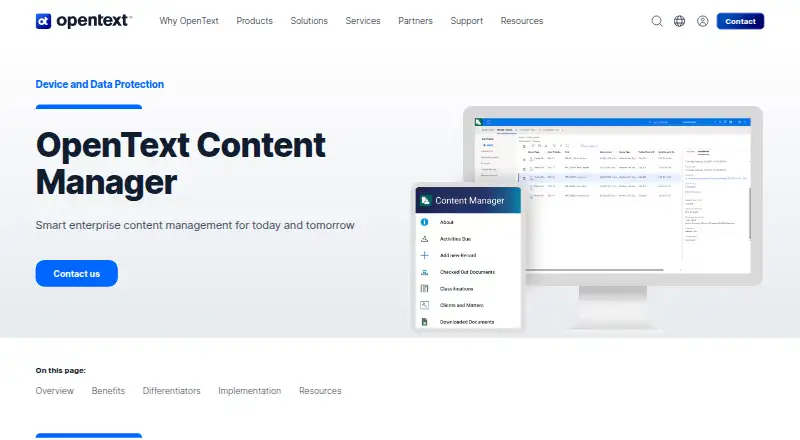
What OpenText Content Manager is
OpenText Content Manager supports organizations managing content through retention, legal holds, disposition, and audit controls. It provides retention rules to govern how long content is kept, legal holds for material subject to a hold, and disposition workflows for handling content through disposition. An audit trail is also listed. Classification is AI-assisted, and the deployment model is hybrid. The product is listed for Android, iOS, web, and Windows, giving buyers platform options across mobile devices, browsers, and Windows computers. OpenText was founded in 1991 and is headquartered in Waterloo, Ontario, Canada. Content Manager is a paid product, and its pricing is available on request. Organizations can visit the product website to learn about it and request pricing. These capabilities make it relevant to buyers seeking defined controls around content records and their lifecycle, including retention, holds, classification, and disposition. The listed features give buyers a set of controls to consider alongside the hybrid deployment model and the platforms their organization uses.
Who it suits
OpenText Content Manager suits organizations that need controls for content retention, legal holds, disposition, and audit trails. It may also suit buyers looking for AI-assisted classification and a hybrid deployment model across Android, iOS, web, and Windows.
What it does well
- Includes retention rules, legal holds, and disposition workflows.
- Provides an audit trail.
- Classification is AI-assisted.
- Hybrid deployment is listed.
- Available on Android, iOS, web, and Windows.
What to know first
- The product is paid.
- Pricing is available on request.
Getting started
- Visit the OpenText Content Manager website.
- Review the product details for your organization’s needs.
- Request pricing from OpenText.
OpenText Content Manager is a paid records-management platform from OpenText, founded in 1991 and headquartered in Waterloo, Ontario. It is best suited to organizations that need formal control over records from creation through final disposition, particularly where compliance teams and legal staff share responsibility. Its strongest case is a governed, hybrid environment; organizations seeking a lightweight or transparently priced document repository should look elsewhere.
Overview
Content Manager centers on records governance rather than general file storage. Retention rules define how long records remain under policy, while legal holds can suspend normal disposition when litigation or investigations require preservation. Disposition workflows provide a controlled route to review and final action, and an audit trail records activity for accountability. Together, these controls fit regulated organizations that must demonstrate why a record was kept, placed on hold, or disposed of.
AI-assisted classification can reduce the manual work of assigning records to the right categories, but it does not remove the need for policy design and oversight. Hybrid deployment is useful when an organization must combine hosted services with systems or data kept under its own control. That flexibility also implies more architecture and administration than a cloud-only product.
Key features
Retention and disposition controls
Retention rules give records managers a repeatable schedule instead of relying on individual reminders. Disposition workflows add review and approval steps before records are removed, making the product a stronger fit for formal governance than an ordinary content library. The trade-off is process overhead: teams that simply need quick sharing may find these controls heavier than necessary.
Legal holds and auditability
Legal holds let authorized teams preserve relevant material despite ordinary retention schedules. The audit trail supports investigations and compliance reviews by documenting actions across the record lifecycle. These features matter most where defensible records handling is a business requirement, not an optional administrative extra.
AI-assisted classification
AI-assisted classification is designed to help route and organize content at scale. It can be valuable when large volumes make manual filing expensive, while organizations should still establish review practices for classification decisions that carry legal or regulatory consequences.
Pricing
OpenText Content Manager uses a paid model with custom pricing. There is no published self-serve tier, free plan, seat allowance, quota, or trial term to compare. Buyers should request a quote from OpenText and assess the commercial scope alongside deployment, governance, and implementation requirements. Custom pricing suits larger projects with varying repositories and control needs, but it makes direct budget comparison harder for smaller teams.
Platforms
The platform is available on Android, iOS, the web, and Windows. That combination supports access from mobile devices and desktop environments as well as browser-based administration or use. Hybrid deployment broadens infrastructure choices, though organizations should plan for consistent governance across those access points.
Who it's for
Choose Content Manager when records retention, legal holds, approved disposition, and auditable activity are core operational requirements. It is a particularly logical candidate for compliance-led programs that also need AI assistance with classification and a hybrid deployment model. It is less compelling for a small team wanting a simple, low-commitment workspace, or for buyers who require immediately visible pricing and clearly defined entry-level limits.
Pros and cons
Pros
- End-to-end records governance: retention, holds, disposition workflows, and auditing address the main control points in a defensible lifecycle.
- AI-assisted classification: can reduce repetitive categorization work in large content collections.
- Hybrid deployment: accommodates organizations that cannot place every workload in one environment.
- Broad client coverage: Android, iOS, web, and Windows support mixed-device workforces.
Cons
- Custom pricing only: prospective buyers cannot estimate cost from a public plan or compare published quotas.
- Governance overhead: formal holds, approvals, and retention schedules require disciplined administration and are unnecessary for casual file sharing.
- Hybrid complexity: operating across environments can demand more planning than a single-cloud service.
Alternatives
For a wider comparison, see Records Management Software.
- AvePoint Cloud Backup is a paid Android, iOS, and web option with custom pricing; choose it when cloud backup is the priority rather than the full records-governance scope described above.
- ELO eRecords is a paid product for Android, iOS, web, and Windows; request a demo if you want to evaluate another cross-platform electronic-records system.
- Hyland AP Automation is an enterprise accounts-payable automation product with a free plan and Android, API, iOS, and web support; pick it when invoice and AP workflows are the central need.
- Hyland OnBase is a paid, multi-platform option with a free plan and a base subscription for 100 named users; consider it when that named-user structure fits your organization.
- Zasio Versatile offers feature selection, SaaS or on-premises deployment, and Standard or Advanced electronic-records tiers; choose it when tiered records functionality and deployment choice are decisive.
- Gimmal Records is a paid records-management alternative for self-hosted, web, and Windows environments.
- everteam.rrs is a paid API, self-hosted, and web option; contact sales for a quote if those deployment channels suit your program.
- Rational Governance uses custom pricing that can be data-volume-based, user-based, or fixed-fee/project-based; consider it when that commercial model is preferable.
Verdict
OpenText Content Manager is a strong choice for organizations that need enforceable retention, legal-hold protection, controlled disposition, and an audit trail across a hybrid estate. Its AI-assisted classification and broad platform support add practical reach. Look elsewhere if your priority is a simple file-sharing tool, a cloud-only setup, or a product with published entry pricing and limits.
Verdict
Consider OpenText Content Manager if your organization needs retention rules, legal holds, disposition workflows, and an audit trail. Its hybrid deployment and AI-assisted classification are additional listed capabilities. Buyers who need to confirm cost should request pricing from OpenText.
Questions
How much does OpenText Content Manager cost?
It is a paid product, with pricing available on request.
Which platforms does it support?
The listed platforms are Android, iOS, web, and Windows.
Does it support legal holds and retention rules?
Yes. Retention rules and legal holds are listed features.
Can it manage disposition workflows?
Yes. Disposition workflow support is listed.
How is content classification handled?
The listed classification method is AI-assisted.
Where is OpenText based?
OpenText is headquartered in Waterloo, Ontario, Canada, and was founded in 1991.
Facts from OpenText Content Manager's own pages
- Founded
- 1991 · opentext.com, 23 Sept 2026
- Headquarters
- Waterloo, Ontario, Canada · opentext.com, 23 Sept 2026
Where OpenText Content Manager stands on Freedom251
- Records Management Software#15 of 22