Freedom251 › A/B Testing Tools

GrowthBook
What GrowthBook is
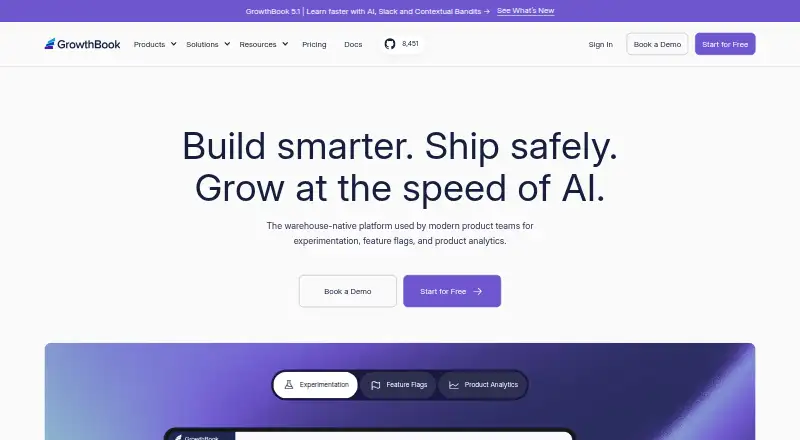
GrowthBook is a warehouse-native platform for experimentation, feature flags, and product analytics. It supports A/B tests and lists Bayesian, frequentist, and sequential testing, along with CUPED and other variance reduction methods. Feature management includes unlimited flags, percentage rollouts, instant kill switches, and advanced targeting. Pro includes safe rollouts with automatic rollback; Enterprise adds ramp schedules and approval workflows.
GrowthBook says its architecture analyzes data where it is stored and keeps SQL visible. Listed warehouse connections include Snowflake, BigQuery, Databricks, ClickHouse, Trino, and Adobe Experience Platform. It describes more than 24 SDKs, including JavaScript, Python, React, Swift, and Kotlin. The platform is available as managed cloud software or self-hosted software, including air-gapped deployment on major clouds or on-premises. GrowthBook says analysis uses aggregate data and that personally identifiable information does not leave the warehouse. It also says it is SOC 2 Type II certified, complies with GDPR, COPPA, and CCPA, and encrypts data at rest and in transit.
The free self-hosted plan includes one project, while free Starter Cloud supports up to three users and one project. Both list unlimited feature flags, experiments, and traffic. Pro Cloud costs $40 a month billed per seat per month, with up to 30 users and three projects. Enterprise plan prices are tailored to scale and licensing requirements.
Who it suits
GrowthBook suits individuals and small teams seeking free cloud or self-hosted experimentation, and small or mid-sized teams that need more users and projects. Teams operating at scale can consider Enterprise, while organizations that require self-hosting or air-gapped deployment can use its self-hosted option.
What it does well
- Supports Bayesian, frequentist, sequential, and CUPED testing methods.
- Unlimited feature flags, experiments, and traffic on listed free plans.
- Works as managed cloud software or self-hosted software.
- Lists more than 24 SDKs, including JavaScript, Python, Swift, and Kotlin.
- Analysis uses aggregate data, according to GrowthBook.
- Data is encrypted at rest and in transit.
What to know first
- Free Starter Cloud is limited to three users and one project.
- Pro Cloud allows up to 30 users and three projects.
- Enterprise pricing is tailored and not listed.
Limits
Free Open Source Self-Hosted includes one project. Free Starter Cloud allows up to three users and one project; Pro Cloud allows up to 30 users and three projects.
Plans
| Plan | Billed and limits | Price |
|---|---|---|
| Starter | Free · up to 3 users · 1 project · unlimited feature flags · unlimited experiments · unlimited traffic | Free |
| Open Source (Self-Hosted) | 1 project · Unlimited feature flags · Unlimited experiments · Unlimited traffic | Free |
| Starter (Cloud) | Up to 3 users · 1 project · Unlimited feature flags · Unlimited experiments · Unlimited traffic | Free |
| Open Source | $0 on premise · self-hosted open-source edition | Free |
| Pro (Cloud) | per seat / month · Up to 30 users · 3 projects · Unlimited feature flags · Unlimited experiments · Unlimited traffic | $40 a month |
| Pro | per seat / month · up to 30 users · 3 projects · unlimited feature flags · unlimited experiments · unlimited traffic | $40 a month |
| Enterprise | Custom pricing · custom environments · ramp schedules · approval workflows · SSO & SCIM · audit logs · 99.99% uptime SLA | On request |
| Enterprise (Cloud) | Pricing tailored to your scale and licensing requirements · Custom environments · SSO & SCIM provisioning · Dedicated support & training · 99.99% uptime SLA | On request |
The first 8 of 9 plans, as growthbook.io lists them, read 15 Oct 2026. The maker's own page has the final word. Every plan
Getting started
- Visit growthbook.io.
- Choose managed cloud or a self-hosted deployment.
- For cloud access, select Starter, Pro, or Enterprise; for self-hosting, select Open Source or Enterprise.
- Connect a listed warehouse such as Snowflake, BigQuery, Databricks, ClickHouse, Trino, or Adobe Experience Platform.
- Use a GrowthBook SDK such as JavaScript, Python, React, Swift, or Kotlin.
Overview
GrowthBook brings experimentation, feature management and product analytics into a platform built around data warehouses. It is best suited to teams that want to run tests against data they control and choose between managed cloud and self-hosted deployment. Its broad free allowances make it approachable; Pro adds more room for teams and safer rollouts, while scale-focused organizations should weigh custom-priced Enterprise plans.
Key features
Experimentation and analysis
GrowthBook supports A/B tests and multi-arm bandits, with Bayesian, frequentist and sequential methods plus CUPED variance reduction. A visual editor, server-side testing and mobile SDK support give teams several ways to run experiments across web and mobile products. The breadth is useful for teams with varied testing practices, though GrowthBook’s warehouse-native approach will be most compelling to organizations already prepared to work with warehouse data and SQL.
Feature management
All plans include unlimited feature flags, experiments and traffic. Percentage rollouts, instant kill switches and advanced targeting help teams control how changes reach users. Pro adds safe rollouts with automatic rollback; Enterprise adds ramp schedules and approval workflows. Those higher-tier controls are more relevant when releases need formal oversight or staged progression.
Warehouse architecture, integrations and privacy
GrowthBook analyzes data where it lives and makes SQL visible. It lists integrations for Snowflake, BigQuery, Databricks, ClickHouse, Trino and Adobe Experience Platform. The company says only aggregate data is accessed for analysis and personally identifiable information stays in the warehouse, a useful fit for teams that want to keep that information within their data environment.
Deployment and security
Teams can use managed cloud or self-host GrowthBook, including air-gapped deployments on major clouds or on-premises. GrowthBook says it is SOC 2 Type II certified and complies with GDPR, COPPA and CCPA, with data encrypted in transit and at rest. Self-hosting offers deployment control, while cloud plans avoid running the platform yourself.
Pricing
GrowthBook has free cloud and self-hosted options, plus paid cloud Pro and custom-priced Enterprise plans. Unlimited flags, experiments and traffic are included throughout, so the main plan differences are project and user limits, support and rollout controls.
- Open Source (Self-Hosted): free, with one project and unlimited feature flags, experiments and traffic. It suits teams able to operate their own deployment; the allowance is limited to one project.
- Starter (Cloud): free, for up to three users and one project, with unlimited flags, experiments and traffic. It is aimed at individuals and small teams, but the user and project caps constrain growing groups.
- Pro (Cloud): $40 a month, billed per seat / month, for up to 30 users and three projects. It keeps unlimited flags, experiments and traffic and adds safe rollouts with auto-rollback, premium support and a larger team allowance. It fits small and mid-sized teams that need those controls.
- Enterprise (Cloud): custom pricing tailored to scale and licensing requirements. It includes custom environments, SSO and SCIM provisioning, dedicated support and training, and a 99.99% uptime SLA.
- Enterprise (Self-Hosted): custom pricing tailored to scale and licensing requirements. It includes custom environments, advanced access control, SSO and SCIM provisioning, dedicated support and training.
Starter includes community support; Pro upgrades that to premium support, and Enterprise includes dedicated support and training. Enterprise’s custom pricing means teams need a tailored quote to assess its cost.
Platforms
GrowthBook supports web and mobile, with Android, iOS, API, web and self-hosted availability. Its SDK options include JavaScript, Python, React, Swift and Kotlin, among more than 24 SDKs described by the product.
Who it's for
GrowthBook is a strong fit for product and engineering teams that want experimentation and feature flags tied to warehouse data, need flexible statistical methods, or value a choice of cloud and self-managed deployment. Small teams can start on the free cloud plan, while organizations with up to 30 users and three projects can move to Pro for safer rollouts and premium support. Teams requiring custom environments, formal approvals, or dedicated support should consider Enterprise. A team that needs an upfront Enterprise price should look elsewhere.
Pros and cons
- Pro: Every plan includes unlimited flags, experiments and traffic, so usage of those core capabilities is not capped by the plan.
- Pro: Cloud and self-hosted deployment, including air-gapped options, suit teams with different infrastructure requirements.
- Pro: Warehouse integrations and analysis where data resides support teams that want SQL-visible experimentation and aggregate-data analysis.
- Con: The free cloud plan is capped at three users and one project, which may be restrictive once a team or portfolio grows.
- Con: Pro is capped at 30 users and three projects; larger organizations need Enterprise.
- Con: Enterprise pricing is custom, making costs harder to compare before requesting a tailored price.
Alternatives
Experimentation Platforms, A/B Testing Tools and Feature Flag Software are useful category directories for comparing options.
- Confidence by Spotify is worth considering if a free plan with unlimited seats, 75,000 monthly credits and up to five surfaces fits better; it also offers a free trial and Google SSO.
- Bucketeer suits teams seeking an open-source, self-hosted feature-flag tool with free-forever access and no per-seat pricing.
- Statsig may suit teams whose needs fit its free Developer allowance of 2 million events per month, unlimited flag and config checks, 50,000 session replays monthly and one-year analytics retention.
- Compose is an alternative for web experimentation with an early adopter usage price of $0.0012 per monthly tested user, billed after each month for the prior month.
- Marpipe is another option to compare.
- Amplitude offers a free plan with 2 million events per month, 10,000 monthly session replays and 2,000 AI feedback records.
- Optimizely Experimentation may suit teams looking for free feature flags with one experiment at a time.
- AB Tasty is another paid alternative to compare.
Verdict
Choose GrowthBook if your team wants warehouse-based experimentation and feature management, with broad free usage and the flexibility to run cloud or self-hosted. Pro is the practical step up for teams needing more users, projects and automatic rollback. Look elsewhere if custom-priced Enterprise plans do not suit your buying process or if the free cloud limits are too small for your team.
Verdict
Choose GrowthBook for warehouse-based experimentation and feature management with a choice of cloud or self-hosted deployment. Its free plans include unlimited flags, experiments, and traffic, while Pro adds a larger user and project allowance and safe rollouts. Look elsewhere if you need Enterprise pricing upfront; the listed Enterprise price is tailored to scale and licensing requirements.
Questions
Does GrowthBook have a free plan?
Yes. Open Source Self-Hosted costs nothing, and Starter Cloud costs nothing. Both list unlimited feature flags, experiments, and traffic.
How much does GrowthBook Pro cost?
Pro Cloud costs $40 a month, billed per seat per month.
What are GrowthBook’s platform options?
It lists Android, iOS, API, web, and self-hosted platforms. Deployment options include managed cloud and self-hosted, including air-gapped deployments.
Is GrowthBook open source?
GrowthBook lists an Open Source Self-Hosted plan at no cost.
Which warehouses does GrowthBook connect to?
Listed integrations include Snowflake, BigQuery, Databricks, ClickHouse, Trino, and Adobe Experience Platform.
What does GrowthBook Enterprise cost?
The Enterprise plans list pricing tailored to scale and licensing requirements; no fixed price is given.
Facts from GrowthBook's own pages
- API
- The project documents a full REST API, separate management and SDK endpoints, webhooks and OpenAPI documentation. · github.com, 15 Oct 2026
- Audience
- The pricing page describes Starter as for individuals or small teams, Pro for small and mid-sized teams, and Enterprise for teams operating at scale. · growthbook.io, 30 Sept 2026
- Chrome extension limits
- GrowthBook DevTools requires the GrowthBook JavaScript, React or HTML Script Tag SDK installed on the site. · chromewebstore.google.com, 15 Oct 2026
- Cloud hosting
- GrowthBook Cloud is hosted on AWS and Enterprise Cloud includes a 99.99% uptime SLA. · growthbook.io, 15 Oct 2026
- Company facts
- LinkedIn lists GrowthBook as privately held, founded in 2020, headquartered in Palo Alto and employing 11–50 people. · linkedin.com, 15 Oct 2026
- Company legal name
- The Chrome Web Store publisher and website footer identify the maker as GrowthBook Inc. · chromewebstore.google.com, 15 Oct 2026
- Current service status
- The official status page reports the Cloud App, API and CDN operational with 100.0% uptime and no notices in the past seven days. · status.growthbook.io, 15 Oct 2026
- Data architecture
- GrowthBook says its warehouse-native architecture analyzes data where it lives and makes SQL visible. · growthbook.io, 30 Sept 2026
- Deployment
- GrowthBook is available as a managed cloud service or self-hosted, including air-gapped deployment on major clouds or on-premises. · growthbook.io, 30 Sept 2026
- Developer integrations
- GrowthBook lists Slack, Discord, GitHub, Datadog and Vercel Marketplace integrations. · growthbook.io, 15 Oct 2026
- Documentation depth
- The docs include quickstart, API, webhooks, integrations, security, self-hosting, SDK, tutorials and agent guides. · docs.growthbook.io, 15 Oct 2026
- Event integrations
- Event and tracking integrations include FullStory, Firebase, Segment, GA4 and RudderStack. · growthbook.io, 15 Oct 2026
- Experimentation
- The experimentation product supports multivariate, sequential and bandit tests with Bayesian or frequentist analysis. · growthbook.io, 15 Oct 2026
- Feature flags
- Feature flags support targeting, gradual rollouts, low-latency delivery and rollback control. · growthbook.io, 15 Oct 2026
- Feature management
- Feature management includes unlimited feature flags, percentage rollouts, instant kill switches, and advanced targeting. · growthbook.io, 30 Sept 2026
- Founded
- 2020 · growthbook.io, 23 Sept 2026
- Funding
- Crunchbase lists two funding rounds and three investors, naming Y Combinator and Data Tech Fund among the most recent investors. · crunchbase.com, 15 Oct 2026
- Installation
- The repository provides Docker Compose self-hosting instructions that start the public image and expose GrowthBook locally on port 3000. · github.com, 15 Oct 2026
- Integrations
- Listed warehouse integrations include Snowflake, BigQuery, Databricks, ClickHouse, Trino, and Adobe Experience Platform. · growthbook.io, 30 Sept 2026
- License
- GrowthBook uses an open-core model: most code is MIT licensed while some directories use the commercial GrowthBook Enterprise License. · github.com, 15 Oct 2026
- Limit: technical learning curve
- G2 reviewers report that experiment setup, data validation and onboarding require technical comfort and can take time. · g2.com, 15 Oct 2026
- Limit: UI and documentation
- G2 reviewers mention confusing or barebones UI, difficult initial integration and gaps in documentation for multi-organization setups. · g2.com, 15 Oct 2026
- MCP server
- The MCP server can create features, start experiments, clean stale flags and query product analytics from MCP clients. · growthbook.io, 15 Oct 2026
- Notable news
- GrowthBook 5.1 was announced as available to cloud and self-hosted users with a new MCP server, Slack app, contextual bandits and expanded product analytics. · growthbook.io, 15 Oct 2026
Where GrowthBook stands on Freedom251
- A/B Testing Tools#2 of 52
- Conversion Rate Optimisation Tools#1 of 22
- AB Testing#1 of 21
- Experimentation Platforms#2 of 23
- Feature Flag Software#4 of 27