Freedom251 › Conversion Rate Optimisation Tools

Statsig
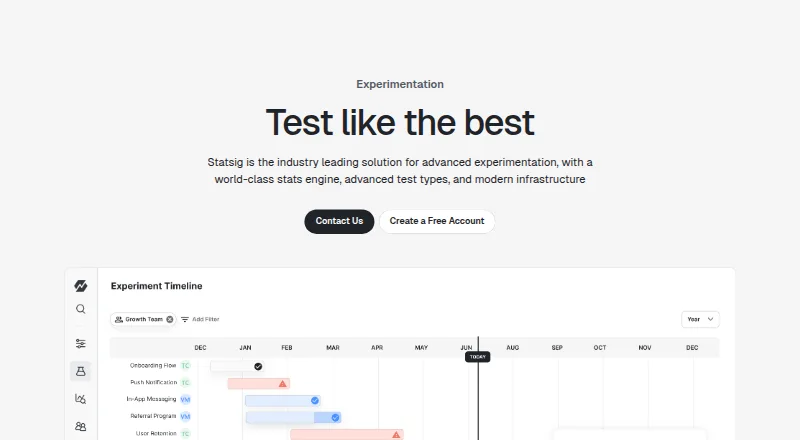
What Statsig is
Statsig is an experimentation and product analytics platform for assigning experiments, analyzing results, and managing feature releases. It supports A/B/n, multivariate, sequential, switchback, non-inferiority, holdout, and multi-arm bandit tests, with Bayesian and frequentist methods. Feature tools include flags, dynamic configurations, audience targeting, percentage-based and scheduled rollouts, and release impact monitoring. Product analytics include funnels, retention, user journeys, dashboards, and web and mobile session replays. Statsig lists client SDKs for JavaScript, React, React Native, iOS, Android, .NET, Roku, Unity, Dart/Flutter, and C++, and server SDKs for Node.js, Java, Python, Go, Ruby, .NET, PHP, Rust, and C++. It connects with services including Segment, Snowflake, Amplitude, Google Analytics, Mixpanel, Slack, and Jira, but supports one data connection at a time. The free Developer plan includes 2 million metered events per month; metric-lift computations stop after that limit unless the customer upgrades. Pro costs $150 a month. Warehouse-native deployment is an Enterprise offering.
Who it suits
Statsig suits teams that need experimentation, feature management, and product analytics across web and mobile. Its broad client and server SDK lists may also suit teams building with the listed platforms and languages.
What it does well
- Supports several experiment designs and statistical methods.
- Includes flags, targeting, and scheduled rollouts.
- Provides funnels, retention, dashboards, and session replays.
- Developer plan includes 2 million monthly metered events.
What to know first
- Supports only one data connection at a time.
- Metric-lift computations stop beyond Developer's event limit.
- Warehouse-native deployment is limited to Enterprise.
Limits
The Developer plan includes 2 million metered events per month; after that, metric-lift computations stop unless the customer upgrades. Pro includes 5 million events, then charges $0.05 per 1K events, and is limited to one project per subscription.
Plans
| Plan | Billed and limits | Price |
|---|---|---|
| Developer | monthly usage allowance · 2M events/month · unlimited flag/config checks · 50,000 session replays/month · 1-year analytics retention · unlimited seats | Free |
| Pro | monthly · 5M events included · $0.05 per additional 1K events · unlimited flag/config checks · 100,000 session replays/month · unlimited analytics retention · API controls | $150 a month |
| Enterprise | custom billing and payment terms · event- or experiment-based contracts · volume discounts · Warehouse Native · SSO/RBAC/teams · priority support · HIPAA eligibility with BAA | On request |
As statsig.com lists them, read 14 Oct 2026. The maker's own page has the final word.
Getting started
- Visit the Statsig experimentation website.
- Choose the Developer plan or review the Pro and Enterprise options.
- Use the client or server SDK listed for your platform and language.
- Connect a data source, keeping the one-connection limit in mind.
Overview
Statsig brings product experimentation, feature management, and analytics together for teams building web and mobile products. It is best suited to product and engineering groups that want to test changes and manage releases in the same system, though its one-connection limit may constrain teams with more complex data stacks.
Its testing methods range from A/B/n and multivariate experiments to sequential, switchback, non-inferiority, holdout, and multi-arm bandit tests. Analytics and session replay add ways to examine user behavior alongside experiment results.
Key features
Experimentation and analytics
Statsig supports Bayesian and frequentist methods, giving teams a choice of analytical approaches rather than a single testing framework. Sequential and switchback tests, among other designs, add flexibility for different experiment needs. A visual editor, audience targeting, server-side testing, and mobile SDK support broaden where teams can run tests.
Funnels, retention, user journeys, dashboards, and web and mobile session replays help teams inspect behavior beyond a test's headline result. This breadth is useful for teams seeking a shared experimentation and analytics workflow; it may be more than organizations that only need a basic A/B test require.
Feature management and integrations
Feature flags, dynamic configs, percentage-based and scheduled rollouts, targeting, and release impact monitoring cover both controlled launches and post-release measurement. That makes Statsig a plausible fit for teams that want rollout controls closely linked to experimentation, rather than a standalone testing tool.
Client SDKs cover JavaScript, React, React Native, iOS, Android, .NET, Roku, Unity, Dart/Flutter, and C++; server SDKs cover Node.js, Java, Python, Go, Ruby, .NET, PHP, Rust, and C++. Connectors include Segment, Snowflake, Amplitude, Google Analytics, Mixpanel, RudderStack, Braze, Datadog, Slack, Microsoft Teams, PagerDuty, and Jira. However, Statsig supports only one data connection at a time, a meaningful limitation for teams needing several simultaneous integrations. Warehouse-native deployment is an Enterprise option for Snowflake, Databricks, BigQuery, Redshift, Athena, and Fabric.
Security and support
Statsig says it is SOC 2 Type II audited and certified, encrypts stored data with AES-256 and communications in transit with TLS, and supports GDPR and CCPA compliance through its data protection practices and a Data Processing Addendum. Developer and Pro include Slack Community support. Enterprise adds a four-business-hour response and a 99.95% service SLA, with premium support and accelerated onboarding options.
Pricing
Statsig has a free Developer plan and paid plans from $150 a month. The free tier is unusually accommodating on seats and flag checks, but its metered-event ceiling is the important constraint.
- Developer — free: 2 million events per month, unlimited flag and config checks, 50,000 session replays per month, one-year analytics retention, and unlimited seats. Once the event limit is exceeded, metric-lift computations stop unless the customer upgrades, so this plan is best for smaller workloads that can stay within the cap.
- Pro — $150 a month: 5 million events included, then $0.05 per 1K events; unlimited flag and config checks; 100,000 session replays per month; and one project per subscription. It raises the event and replay allowances, but the per-subscription project limit may not suit teams managing several products or environments.
- Enterprise — custom pricing: event- or experiment-based contracts, large-volume discounts, warehouse-native deployment, SSO, role-based access controls, teams, and priority support. It is the relevant tier for organizations that need these controls or higher-volume arrangements.
Platforms
Statsig lists Android, iOS, web, and API support. Its client and server SDK coverage spans a wide range of languages and environments, making it suitable for teams whose products extend beyond a single web stack.
Who it's for
Statsig is strongest for product and engineering teams that need experimentation, rollout controls, and product behavior analysis to work together. The Developer plan can accommodate teams that need unlimited seats and flags while keeping event use below 2 million monthly. Teams with higher usage can move to Pro, while those requiring multiple simultaneous data connections should look elsewhere.
Pros and cons
- Pros: Multiple experiment designs and Bayesian or frequentist methods support varied testing needs; feature flags and scheduled rollouts pair release control with impact monitoring; broad SDK coverage and included analytics and replay serve teams working across web and mobile.
- Cons: Only one data connection can be active at a time; Developer stops metric-lift computations after 2 million monthly events unless upgraded; Pro covers one project per subscription.
Alternatives
For a narrower or different need, consider Optux AI for web-based A/B and split testing with AI text personalization; its Pro plan is $39 a month, billed annually, and includes 3 seats, 25K MTU for A/B and split testing, 5K MTU for AI text personalization, and unlimited patches. Semrush has a free tier with one demo project and 10 reports per day, while ovoSEO offers a free SEO plan with one website, a checklist and roadmap, a basic site audit, easy opportunities, and Google OAuth for GSC and GA4. Rankerli is another free option, with unlimited websites and linked GSC accounts, 16 months of Search Console history, and one-time allowances of 200 Site Audit pages and 200 Content Changes checks. For a single free experiment, SEO A/B Tester offers a free plan limited to one experiment. MetaMonster has a Starter plan at $149 a month, with 50 page credits, 300 bulk credits, 5,000 pages crawled per month, unlimited sites, and unlimited users. Botify is a paid alternative with Essential and Accelerate plans, and RankGear is a paid option for Windows and macOS.
These SEO-oriented alternatives are a better fit when the priority is the specific SEO or crawling work described above, rather than combining product experiments with feature release controls and behavioral analytics. For more options, browse Experimentation Platforms, A/B Testing Tools, Product Analytics Tools, Feature Flag Software, Release Management Software, and SEO Testing Software.
Verdict
Choose Statsig if your product team wants a broad experimentation toolkit alongside feature controls and behavioral analytics, with a free entry point and clear path to higher event volume. Look elsewhere if multiple active data connections are essential, or if the Developer event ceiling and Pro's single-project subscription do not fit your workload.
Verdict
Statsig combines testing, release controls, and product analytics in one platform, with a free Developer plan and Pro at $150 a month. Review the one-connection limit and Developer event cap when choosing a plan.
Questions
Is there a free plan?
Yes. Developer costs nothing and includes 2 million metered events per month.
How much does Pro cost?
Pro costs $150 a month, billed monthly. It includes 5 million events, then $0.05 per 1K events.
Which platforms and SDKs does Statsig support?
Listed platforms are Android, API, iOS, and web. Client SDKs include JavaScript, React, React Native, iOS, Android, .NET, Roku, Unity, Dart/Flutter, and C++; server SDKs include Node.js, Java, Python, Go, Ruby, .NET, PHP, Rust, and C++.
Which integrations are available?
The integrations overview lists Segment, Snowflake, Amplitude, Google Analytics, Mixpanel, RudderStack, Braze, Datadog, Slack, Microsoft Teams, PagerDuty, and Jira. Statsig supports one data connection at a time.
Does Statsig offer warehouse-native deployment?
Yes, on Enterprise. Supported warehouses listed are Snowflake, Databricks, BigQuery, Redshift, Athena, and Fabric.
Facts from Statsig's own pages
- Advanced experiment methods
- Advanced experimentation includes holdouts, multi-arm bandits, CUPED, sequential testing, switchback tests and non-inferiority tests. · statsig.com, 14 Oct 2026
- Analytics and replay
- The platform includes product analytics such as funnels, retention, user journeys, dashboards, and web and mobile session replays. · statsig.com, 29 Sept 2026
- API key model
- Statsig documents client keys, server secret keys and console API keys with different read, logging and CRUD permissions. · docs.statsig.com, 14 Oct 2026
- Company
- Statsig says it was founded in February 2021 with an office in Kirkland, Washington. · statsig.com, 29 Sept 2026
- Company identity
- LinkedIn lists Statsig as a San Francisco software-development company founded in 2021 by former Facebook engineers, with 51–200 employees. · linkedin.com, 14 Oct 2026
- Documentation and support
- The documentation includes product guides, SDK quickstarts, API references and Warehouse Native instructions, while support is available through a Statsig Slack community. · docs.statsig.com, 14 Oct 2026
- Enterprise identity
- SSO through OIDC is available on selected packages, with additional enterprise options for SAML, SCIM and role-based access controls. · statsig.com, 14 Oct 2026
- Experimentation
- The platform supports A/B/n and multivariate tests with both Bayesian and frequentist analysis methods. · statsig.com, 14 Oct 2026
- Feature management
- Feature management provides flags, dynamic JSON configs, parameter stores, percentage rollouts, scheduled rollouts and attribute or segment targeting. · statsig.com, 14 Oct 2026
- Founded
- 2021 · statsig.com, 23 Sept 2026
- Funding
- Statsig announced a $100 million Series C in May 2025 at a $1.1 billion valuation, led by ICONIQ Growth with Sequoia and Madrona participating. · statsig.com, 14 Oct 2026
- Headquarters
- Bellevue, Washington, United States · statsig.com, 23 Sept 2026
- Integration limit
- Statsig states that it supports only one data connection at a time. · docs.statsig.com, 29 Sept 2026
- Integrations
- Documented integrations include Segment, Snowflake, Amplitude, Bugsnag, Fivetran, Google Analytics, Heap, Mixpanel, RevenueCat, mParticle, RudderStack, webhooks, GTM and Braze, plus Datadog, Discord, LogDNA, Teams, PagerDuty, Slack and Jira notifications. · docs.statsig.com, 14 Oct 2026
- Legal name and ownership
- Crunchbase lists the legal name as Statsig, Inc. and identifies OpenAI as its acquirer and parent relationship. · crunchbase.com, 14 Oct 2026
- Limit: Capterra onboarding and coherence
- Capterra reviewers report that engineering-oriented documentation makes non-engineer self-service harder and that rapidly added analytics features can feel disconnected. · capterra.com, 14 Oct 2026
- Limit: G2 onboarding and UI
- G2 reviewers mention a learning curve, dense screens, setup overwhelm, many server requests and awkward sharing of experiments or gates with colleagues. · g2.com, 14 Oct 2026
- Limit: TrustRadius complexity
- A TrustRadius reviewer describes the interface as complex and focused on data-science users. · tr-web.stage.trustradius.com, 14 Oct 2026
- Notable outage
- Statsig reported delayed experiment and feature-gate exposure results for some Warehouse Native customers on August 26–27, 2026, with data later backfilled. · status.statsig.com, 14 Oct 2026
- Open-source components
- Statsig advertises 30-plus open-source SDKs; the published React and .NET SDK repositories use the ISC license. · github.com, 14 Oct 2026
- Praise: Capterra experimentation velocity
- Capterra reviewers say Statsig increased experiment velocity, made cloning and analytics easy, and helped teams make faster data-backed decisions. · capterra.com, 14 Oct 2026
- Praise: G2 usability and analysis
- G2 reviewers repeatedly praise the intuitive interface, easy experiment setup, statistical engine, real-time analytics and responsive support. · g2.com, 14 Oct 2026
- Praise: TrustRadius experimentation insight
- TrustRadius reviewers value clear experiment-health information, statistical analysis and the ability to replace separate Mixpanel and LaunchDarkly tools. · tr-web.stage.trustradius.com, 14 Oct 2026
- Privacy
- Statsig says its data protection practices support GDPR and CCPA compliance and that it provides a Data Processing Addendum. · docs.statsig.com, 29 Sept 2026
Where Statsig stands on Freedom251
- Conversion Rate Optimisation Tools#4 of 22
- AB Testing#4 of 21
- Release Management Software#9 of 38
- Experimentation Platforms#6 of 23
- SEO Testing Software#6 of 21
- A/B Testing Tools#16 of 52
- Product Analytics Tools#25 of 45
- Web And Mobile Analytics Software#16 of 28
- Mobile App Analytics Software#22 of 37
- Feature Flag Software#19 of 27