Freedom251 › A/B Testing Tools

Experimently
What Experimently is
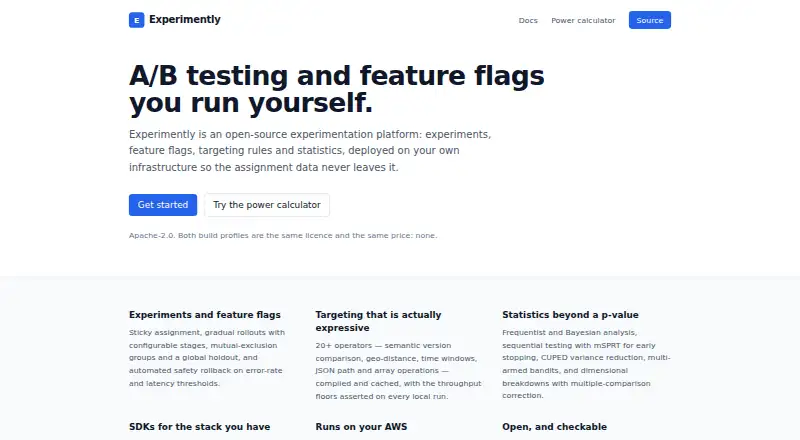
Experimently is an open-source experimentation platform for A/B testing and feature flags that runs on infrastructure you manage. Its Free Preview costs nothing when self-hosted on your AWS account, and includes all features; the platform is Apache-2.0 licensed and has no hosted tier. It supports A/B and multivariate tests, split URL testing, sequential tests, CUPED, multi-armed bandits, Bayesian testing, and LLM/model evaluation. Rollout controls include sticky assignment, staged releases, mutual-exclusion groups, a global holdout, and automatic rollback based on error-rate and latency thresholds. Targeting has more than 20 operators, including options for semantic versions, geo-distance, time windows, JSON paths, and arrays. Analysis offers frequentist and Bayesian methods, sequential mSPRT testing, and segment breakdowns with Bonferroni correction. Deployment options include Docker Compose, Kubernetes with Helm, or an AWS CDK app in your AWS account. Assignment data stays on your infrastructure. SDKs cover multiple languages and mobile platforms, but the maker says they are not yet available through package registries; installation instructions are in each SDK guide.
Who it suits
Experimently suits teams that want to run experiments and feature flags on infrastructure they control. It may fit organizations that can deploy and manage a self-hosted platform and use its listed SDKs.
What it does well
- Apache-2.0 licensed with all features in Free Preview
- Supports staged rollouts and automatic rollback
- Offers frequentist and Bayesian analysis
- Assignment data stays on your infrastructure
What to know first
- No hosted tier is available
- SDKs are not yet on package registries
Limits
The Free Preview is self-hosted on your AWS account, and the maker says there is no hosted tier. SDKs are not yet available through package registries; installation instructions are provided in each SDK guide.
Plans
| Plan | Billed and limits | Price |
|---|---|---|
| Free Preview | $0/month · Self-hosted on your AWS account · all features included · unlimited A/B experiments | Free |
As getexperimently.com lists them, read 14 Oct 2026. The maker's own page has the final word.
Getting started
- Open the Experimently website.
- Choose a deployment route: Docker Compose, Kubernetes with Helm, or the AWS CDK app.
- Set up the Free Preview on your AWS account for free.
- Follow the installation instructions in the guide for the SDK you need.
- Connect any listed data, project or communication integrations you use.
Experimently combines A/B testing, feature flags, and rollout controls for teams that can operate their own infrastructure. Its broad testing and analysis toolkit is a strong fit for product and engineering groups; teams looking for a managed service should look elsewhere.
Overview
Apache-2.0 licensing and a free Free Preview make the platform available without a subscription charge. The trade-off is operational: there is no hosted tier, and teams deploy it themselves and install its SDKs using the product’s guides rather than package registries. Assignment data stays on the user's infrastructure, which suits organizations that want to keep that data in-house.
The testing range covers A/B and multivariate tests, split URL testing, sequential testing, CUPED, Bayesian testing, multi-armed bandits, and LLM or model evaluation. That breadth can serve teams with varied experimentation programs, but may be unnecessary overhead for those needing only a basic hosted test tool.
Key features
Experiments and rollouts
Sticky assignment keeps users in consistent experiment groups, while staged rollouts support gradual releases. Mutual-exclusion groups and a global holdout help control overlap and preserve a baseline. Automatic rollback based on error-rate and latency thresholds adds a release safeguard for teams that want experiments and rollout controls in the same system.
Targeting and analysis
More than 20 targeting operators include semantic version comparisons, geographic distance, time windows, JSON paths, and array operations. This gives teams several ways to define audiences beyond basic user attributes. Analysis includes frequentist and Bayesian methods, sequential mSPRT testing, multi-armed bandits, and segment breakdowns with Bonferroni correction. The range is useful for teams applying different statistical approaches, though it calls for people able to choose and interpret them appropriately.
SDKs, integrations, and controls
SDKs cover JavaScript, React, React Native, Edge, Python, Go, Java, Android, iOS, Flutter, Ruby, PHP, .NET, and Elixir; OpenFeature providers are listed for JavaScript and Python. Since the SDKs are not yet on package registries such as npm or PyPI, installation takes a guide-based step rather than a standard registry install. Connections include Snowflake, BigQuery, Redshift, Databricks, ClickHouse, MySQL, Jira, Salesforce, GitHub, Slack, and email. Listed security features include HMAC-SHA256 audit logging, role-based access control, scoped API keys, SAML and OIDC/OAuth2 SSO, and SOC 2, ISO 27001, and HIPAA compliance features.
Pricing
The Free Preview costs nothing and is self-hosted on your AWS account with all features included. It is a practical fit for teams able to take responsibility for deployment and infrastructure, rather than a no-setup hosted free tier. The maker says build profiles have no price, and the platform is Apache-2.0 licensed. No free trial is offered; teams wanting a managed hosted option will need another product.
Platforms
Experimently supports web and mobile use, with listed platforms spanning Android, iOS, Linux, macOS, Windows, API, web, and self-hosted deployment. Visual editing, server-side testing, mobile SDKs, audience targeting, and feature flags are supported. Deployment options are Docker Compose, Kubernetes via Helm, or an AWS CDK app targeting ECS Fargate, Aurora PostgreSQL, and ElastiCache in the user's AWS account.
Who it's for
Experimently is best suited to product and engineering teams that want a broad experimentation toolkit, need rollout safeguards, and can run software on their own infrastructure. Keeping assignment data in-house is a meaningful advantage for teams with that requirement. It is a weaker fit for teams that prioritize a hosted service, standard package-registry installation, or minimal operational work.
Pros and cons
- Pros: Broad test methods, targeting operators, and statistical approaches support varied experimentation needs.
- Pros: Staged rollouts, holdouts, mutual exclusion, and threshold-based rollback put release controls alongside testing.
- Pros: Assignment data remains on the user's infrastructure, with an Apache-2.0 license and a free all-features preview.
- Cons: Self-hosting means teams must deploy and operate the platform themselves; there is no hosted tier.
- Cons: SDKs are not yet on package registries, so installation requires following individual guides.
Alternatives
A/B Testing Tools is a useful starting point for comparing products in the category. Consider Confidence by Spotify if a free plan with 75,000 credits per month, unlimited feature flags and seats, and up to five surfaces better matches your usage; its free plan also includes Google SSO, EU or US hosting, and a one-month audit log.
DevCycle is another option with a free plan and support across web and mobile platforms. Firebase Cloud Messaging is a no-cost alternative for readers considering that product. GrowthBook may suit teams that want a self-hosted open-source option with one project, unlimited feature flags, experiments, and traffic at no cost. LaunchDarkly Experimentation offers a free Developer plan billed forever with 100K experimentation MAU per month, one project, and three environments.
Mida has a no-time-limit Sandbox plan with no credit card required, 100,000 monthly tested users, 50,000 daily tracked events, 60 days of data retention, and two active tests. Omniconvert Explore offers a free plan for 50,000 website visitors with its full Explore feature set and no credit card required. Statsig may appeal to teams needing a free Developer plan with two million events per month, unlimited flag and config checks, 50,000 session replays per month, one-year analytics retention, and unlimited seats.
Verdict
Choose Experimently if your team wants extensive testing and rollout controls, values keeping assignment data on its own infrastructure, and can handle self-hosting. Its breadth and all-features free preview are compelling, but teams that want a managed service or registry-based SDK installation should choose elsewhere.
Verdict
Experimently offers broad experiment and rollout controls for teams prepared to host it themselves. Its Free Preview costs nothing on the user's AWS account, but setup includes managing deployment and SDK installation.
Questions
Is Experimently free?
The Free Preview is listed as free and includes all features when self-hosted on your AWS account. The platform is Apache-2.0 licensed.
Is there a hosted version?
No hosted tier is listed. The maker says users run Experimently on their own infrastructure, and assignment data stays there.
Which deployment options are available?
The listed options are Docker Compose, Kubernetes using a Helm chart, and an AWS CDK app targeting services in your AWS account.
Which platforms and SDKs does it support?
Platforms listed include Android, iOS, Linux, macOS, web, Windows, API and self-hosted environments. SDKs are listed for multiple languages and mobile platforms, with OpenFeature providers for JavaScript and Python.
Can I install an SDK from a package registry?
The maker says its SDKs are not yet on npm, PyPI or other package registries. Installation instructions are in each SDK guide.
What integrations are listed?
Documented connections include Snowflake, BigQuery, Redshift, Databricks, ClickHouse, MySQL, Jira, Salesforce, GitHub, Slack and email.
Facts from Experimently's own pages
- A/B and multivariate testing
- The product documentation covers A/B, multivariate, sequential, split-URL, Bayesian and bandit experiments. · getexperimently.com, 14 Oct 2026
- Compliance reporting
- The documentation provides export functions for SOC 2 and ISO 27001 reports and describes HIPAA-related encryption, retention and BAA features. · getexperimently.com, 14 Oct 2026
- CUPED
- CUPED variance reduction is documented as a method for reducing variance using pre-experiment covariates. · getexperimently.com, 14 Oct 2026
- Data handling
- The maker says assignment data stays on the user's own infrastructure and that there is no hosted tier. · getexperimently.com, 5 Oct 2026
- Data integrations
- Documentation lists AWS, Snowflake, BigQuery, Redshift, Databricks, ClickHouse and MySQL connectors. · getexperimently.com, 14 Oct 2026
- Deployment
- Users can deploy with Docker Compose, Kubernetes using a Helm chart, or an AWS CDK app targeting ECS Fargate, Aurora PostgreSQL, and ElastiCache in their own AWS account. · getexperimently.com, 5 Oct 2026
- Deployment options
- Customers can run published containers with Docker Compose, deploy to Kubernetes with Helm, or use an AWS CDK deployment. · getexperimently.com, 14 Oct 2026
- Documentation depth
- The documentation site includes quick starts, API schemas, SDK guides, integration references, security topics, deployment instructions and statistics references. · getexperimently.com, 14 Oct 2026
- Experiment controls
- The platform supports sticky assignment, staged rollouts, mutual-exclusion groups, global holdouts and automatic rollback triggered by error-rate or latency thresholds. · getexperimently.com, 14 Oct 2026
- Experiments and rollouts
- It supports sticky assignment, staged rollouts, mutual-exclusion groups, a global holdout, and automatic rollback based on error-rate and latency thresholds. · getexperimently.com, 5 Oct 2026
- Independent maintainer
- PyPI identifies amarkanday as the sole maintainer of the placeholder experimently package. · pypi.org, 14 Oct 2026
- Independent package maturity
- PyPI classifies the package as development status 1, Planning, and lists Python 3.9 or newer as a requirement. · pypi.org, 14 Oct 2026
- Independent performance target
- The project article sets a target of under 50 ms at p99 for feature-flag evaluation and more than 10,000 assignments per second. · medium.com, 14 Oct 2026
- Independent planned architecture
- The project article describes an AWS architecture using ECS/Fargate, Lambda, Aurora PostgreSQL, DynamoDB, ElastiCache, S3, Kinesis, EventBridge, OpenSearch, Glue and Athena. · medium.com, 14 Oct 2026
- Independent project date
- The product-management article describing the platform was published March 28, 2025. · medium.com, 14 Oct 2026
- Independent project origin
- Ashish Markanday wrote that building the platform was a personal project intended to create a production-quality experimentation system with AI assistance in roughly three to four months. · medium.com, 14 Oct 2026
- Independent risk: complexity
- The project article identifies high-throughput real-time evaluation, data integrity, integration complexity and statistical validity as material implementation risks. · medium.com, 14 Oct 2026
- Integration API
- Integration endpoints support Jira, Salesforce and GitHub, including webhook receivers and role-based permissions. · getexperimently.com, 14 Oct 2026
- Integrations
- The documentation lists connections for Snowflake, BigQuery, Redshift, Databricks, ClickHouse, MySQL, Jira, Salesforce, GitHub, Slack, and email. · getexperimently.com, 5 Oct 2026
- JavaScript SDK
- The JavaScript client supports browser and Node.js use, variant assignment, feature-flag evaluation and event tracking. · getexperimently.com, 14 Oct 2026
- Licence
- The core platform is Apache-2.0 licensed; the SDKs are MIT licensed. · getexperimently.com, 14 Oct 2026
- License and price
- The platform is Apache-2.0 licensed, and the maker says its build profiles have no price; its Free Preview is listed at $0/month. · getexperimently.com, 5 Oct 2026
- Limit: hosting responsibility
- There is no hosted tier, so users must provision and operate the deployment in their own infrastructure or AWS account. · getexperimently.com, 14 Oct 2026
- Limit: SDK registry availability
- The homepage says JavaScript and Python SDKs are beta releases while the other listed SDKs are not yet published in package registries and must be installed from the repository. · getexperimently.com, 14 Oct 2026
Where Experimently stands on Freedom251
- A/B Testing Tools#1 of 52