Freedom251 › Release Management Software

LaunchDarkly Experimentation
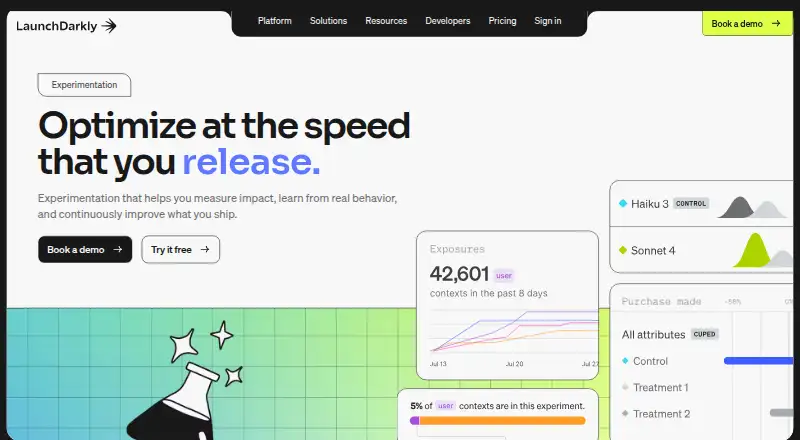
What LaunchDarkly Experimentation is
LaunchDarkly Experimentation helps teams measure how changes affect user behavior and use results to guide what they ship. Experiments can cover features, models, prompts, page layouts, and AI-powered systems. Teams can segment results by cohort, device, geography, or attribute, then export them to a warehouse. Statistical tools include CUPED variance reduction, sequential testing, sample ratio mismatch detection, and multi-armed bandits. Mutual exclusion and holdout groups can separate experiments and help assess longer-term impact. Warehouse-native experimentation supports Snowflake, Redshift, and Databricks, among other connections. Listed integrations include Amplitude, Datadog, Slack, and Microsoft Teams. Client-side and mobile SDKs include JavaScript, iOS, and Android, with a separate API for programmatic product interactions. The free Developer plan includes 100K experimentation MAU per month, one project, three environments, and five service connections per month. Foundation costs $108.33 a month billed yearly after a 14-day trial; paid plans are listed from 8.33/mo annually.
Who it suits
It suits product and data teams, including product managers and data scientists, who want to run and analyze experiments across features, interfaces, or AI systems.
What it does well
- Tests features, models, prompts, layouts, and AI systems
- Segments results by cohort, device, geography, or attribute
- Includes holdout groups and mutual exclusion
- Free Developer plan includes A/B tests and experiments
- Mobile SDKs and a programmatic API are listed
What to know first
- Developer plan allows one project
- Developer plan allows three environments
- Foundation costs $108.33 a month, billed yearly
Limits
The free Developer plan allows 100K experimentation MAU per month, one project, three environments, and five service connections per month. Foundation includes the first five service connections per month and 5K AI runs per month; additional runs cost $5 per 1k.
Plans
| Plan | Billed and limits | Price |
|---|---|---|
| Developer | forever · 100K experimentation MAU/month · 1 project · 3 environments · 5 service connections/month · A/B tests and experiments | Free |
| Foundation | Billed yearly; 14-day trial, then pay as you go · First 5 service connections/month included · 5K AI runs/month included · additional runs $5 per 1k · unlimited projects and environments | $108.33 a month |
| Enterprise | Custom pricing · Everything in Foundation · custom AI run count · 100 days data retention · advanced targeting, roles, teams, workflows and approvals | On request |
As launchdarkly.com lists them, read 29 Sept 2026. The maker's own page has the final word.
Getting started
- Open the LaunchDarkly Experimentation website.
- Choose the free Developer plan or review paid plan options.
- Use the listed JavaScript, iOS, or Android SDKs, or the API for programmatic interactions.
- Set up an experiment for a feature, model, prompt, layout, or AI-powered system.
- Use experiment controls and segment results for analysis.
Overview
LaunchDarkly Experimentation is a testing and measurement product for teams evaluating changes across digital products, from feature releases to AI systems. It is best suited to product and data teams that need rigorous experiment controls and warehouse analysis; smaller teams focused only on visual page tests may find it more than they need.
Its breadth is the main draw: teams can test varied product changes, apply several statistical methods, and carry results into supported data warehouses. The trade-off is a tightly capped free tier and a paid entry point that requires annual billing.
Key features
Experiment design and controls
Experiments can cover features, models, prompts, page layouts, and AI-powered systems. A/B and A/A tests, multi-armed bandits, and holdout experiments support different evaluation approaches. CUPED variance reduction and sequential testing add analytical options, while sample ratio mismatch detection can flag uneven assignment between groups.
Mutual exclusion helps keep concurrent experiments from interfering with one another. Holdout groups offer a way to assess longer-term impact. This makes the product a stronger fit for teams running a portfolio of experiments than for a site that simply wants a visual editor: LaunchDarkly has no visual editor.
Analysis and connections
Results can be segmented by cohort, device, geography, or attribute, then exported to a warehouse. Warehouse-native experimentation supports Snowflake, Redshift, and Databricks, and integrations also include Amplitude, Datadog, Google Cloud Pub/Sub, Slack, and Microsoft Teams. These connections are useful for teams that already rely on those systems; they matter less to organizations whose analysis stays entirely within a standalone testing workflow.
Client-side and mobile SDKs include JavaScript, iOS, and Android, with a separate API for programmatic product interactions. Server-side testing, mobile SDK support, audience targeting, and feature flags make the offering relevant beyond browser-only testing.
Security and privacy
LaunchDarkly lists SOC 2 Type II, ISO 27001, FedRAMP authorization, and Data Privacy Framework participation, alongside encryption in transit, MFA, SAML SSO, and audit logging. It says personally identifiable information is not required and offers an EU hosted region supporting EU data residency. These provisions are useful considerations for organizations with security or regional hosting requirements.
Pricing
The free Developer plan is billed forever at no cost. It includes 100K experimentation MAU/month, one project, three environments, five service connections/month, and A/B tests and experiments. That is a meaningful way to start, but its project, environment, and connection caps will constrain teams operating across multiple products or services.
Foundation costs $108.33 a month, billed yearly, with a 14-day trial followed by pay-as-you-go billing. It includes the first five service connections/month, 5K AI runs/month, and unlimited projects and environments; additional AI runs cost $5 per 1k. The higher allowance and expanded project capacity suit teams that have outgrown Developer, though annual billing is a material commitment.
Enterprise has custom pricing and includes everything in Foundation, a custom AI run count, 100 days of data retention, and advanced targeting, roles, teams, workflows, and approvals. It is the plan for organizations needing those governance controls and tailored AI capacity. The listed paid starting price is $8.33/mo (annual), while Foundation’s stated plan price is $108.33 a month billed yearly.
Platforms
LaunchDarkly Experimentation supports Android, iOS, web, and API access. Mobile SDKs and server-side testing extend it beyond browser experiments, while the API supports programmatic product interactions.
Who it's for
Product managers, data scientists, developers, and product, marketing, or business teams can use the product to evaluate changes against user behavior. It is particularly suited to teams combining feature experimentation with warehouse-based analysis, or testing models and prompts alongside conventional product changes. A small team seeking only page-level visual experimentation is less likely to benefit from its breadth.
Pros and cons
- Broad experiment scope: teams can test features, models, prompts, layouts, and AI-powered systems rather than limiting work to page variants.
- Strong measurement controls: CUPED, sequential testing, mismatch detection, mutual exclusion, and holdout groups support more deliberate experiment design.
- Warehouse connections: Snowflake, Redshift, and Databricks support teams that want to analyze results alongside other data.
- Restrictive free-tier capacity: one project, three environments, and five service connections/month can be limiting as deployments grow.
- No visual editor: teams wanting to construct page tests through a visual interface should look elsewhere.
- Annual billing at the paid entry: Foundation is billed yearly, so teams should weigh the commitment against their expected testing needs.
Alternatives
For adjacent categories, browse A/B Testing Tools, Feature Flag Software, or Release Management Software.
Flagsmith is a freemium alternative with a free plan, free trial, broad platform support, and open-source core feature flag functionality under a BSD-3 licence. It is a reasonable direction for teams prioritizing open-source feature flags over LaunchDarkly's stated experimentation and warehouse-analysis breadth.
ConfigCat may suit teams whose main need is feature-flag configuration: its Forever Free plan includes 10 feature flags, two environments, two products, five million config JSON downloads/month, and 20 GB network traffic/mo.
Statsig is another freemium option. Its free Developer plan includes 2M events/month, unlimited flag and config checks, 50,000 session replays/month, one-year analytics retention, and unlimited seats; teams whose needs align with those allowances may prefer it.
Blue Canvas offers a free browser-based plan for side-by-side profile and permission-set comparison, making it the more relevant choice when that specific Salesforce comparison task is the priority.
Devtron Release Orchestration, ReARM, Runway, and Veloptra are additional alternatives to consider.
Verdict
Choose LaunchDarkly Experimentation if your team needs more than basic A/B tests: its mix of statistical methods, experiment controls, mobile and server-side support, and warehouse connections can serve complex product and AI testing programs. Look elsewhere if a visual editor or a looser free allowance is more important, or if an annual paid commitment does not fit your needs.
Verdict
LaunchDarkly Experimentation offers varied experiment types, statistical methods, and warehouse connections. The free Developer tier has defined project, environment, and service-connection limits; paid pricing starts at 8.33/mo annually.
Questions
Is LaunchDarkly Experimentation free?
Yes. The Developer plan is free forever and includes 100K experimentation MAU per month, one project, three environments, and five service connections per month.
What does Foundation cost?
Foundation costs $108.33 per month billed yearly. It includes a 14-day trial, then pay-as-you-go billing; paid plans are listed from $8.33/mo billed annually.
Which platforms does it support?
Listed platforms are web, Android, iOS, and API. Client-side and mobile SDKs include JavaScript, iOS, and Android.
Which analytics and warehouse integrations are listed?
Listed integrations include Databricks, Snowflake, Redshift, Amplitude, Datadog, Google Cloud Pub/Sub, Slack, and Microsoft Teams. Warehouse-native experimentation supports Snowflake, Redshift, and Databricks, among others.
What security and privacy provisions does LaunchDarkly list?
It lists SOC 2 Type II, ISO 27001, FedRAMP authorization, Data Privacy Framework participation, encryption in transit, MFA, SAML SSO, and audit logging. It says personally identifiable information is not required and offers an EU hosted region supporting EU data residency.
Who makes LaunchDarkly?
LaunchDarkly was founded in 2014 in Oakland, California, by Edith Harbaugh and John Kodumal.
Facts from LaunchDarkly Experimentation's own pages
- Analysis
- Results can be segmented by cohort, device, geography, or attribute, and exported to a warehouse for further analysis. · launchdarkly.com, 29 Sept 2026
- Company
- LaunchDarkly was founded in 2014 in Oakland, California, by Edith Harbaugh and John Kodumal. · launchdarkly.com, 29 Sept 2026
- Experiment controls
- Users can use mutual exclusion and holdout groups to isolate experiments and measure long-term impact. · launchdarkly.com, 29 Sept 2026
- Experiment scope
- Teams can test features, models, prompts, page layouts, and AI-powered systems. · launchdarkly.com, 29 Sept 2026
- Founded
- 2014 · launchdarkly.com, 28 Sept 2026
- Headquarters
- Oakland, California, United States · launchdarkly.com, 28 Sept 2026
- Integrations
- Listed integrations include Databricks, Snowflake, Redshift, Amplitude, Datadog, Google Cloud Pub/Sub, Slack, and Microsoft Teams. · launchdarkly.com, 29 Sept 2026
- Privacy and residency
- LaunchDarkly says it does not require personally identifiable information and offers an EU hosted region supporting EU data residency. · launchdarkly.com, 29 Sept 2026
- Purpose
- Experimentation helps teams measure impact, learn from real behavior, and improve what they ship. · launchdarkly.com, 29 Sept 2026
- SDKs and API
- LaunchDarkly lists client-side and mobile SDKs including JavaScript, iOS, and Android, and documents a separate API for programmatic product interactions. · launchdarkly.com, 29 Sept 2026
- Security
- The company lists SOC 2 Type II, ISO 27001, FedRAMP authorization, and Data Privacy Framework participation, along with encryption in transit, MFA, SAML SSO, and audit logging. · launchdarkly.com, 29 Sept 2026
- Statistical methods
- Experimentation includes CUPED variance reduction, sequential testing, sample ratio mismatch detection, and multi-armed bandits. · launchdarkly.com, 29 Sept 2026
- Support
- The site links to a Help Center and a direct support request channel. · launchdarkly.com, 29 Sept 2026
- Warehouse support
- Warehouse-native experimentation supports Snowflake, Redshift, and Databricks, among others. · launchdarkly.com, 29 Sept 2026
- Who it serves
- LaunchDarkly says its platform serves product, marketing, and business teams as well as developers, and names product managers and data scientists among its target teams. · launchdarkly.com, 29 Sept 2026
Where LaunchDarkly Experimentation stands on Freedom251
- Release Management Software#7 of 38
- A/B Testing Tools#11 of 52
- Rollback Management#8 of 25
- Feature Flag Software#16 of 27