Freedom251 › IT Release Management Software

Veloptra
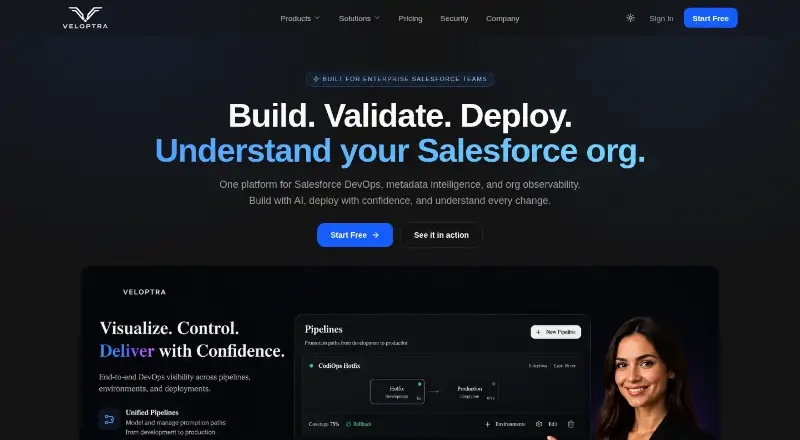
What Veloptra is
Veloptra is a web platform combining Salesforce DevOps, metadata intelligence, and org observability. Engineering teams can model promotion paths and move git-backed user stories through validation, approval, and deployment with traceability. A deployed promotion can be reverted to the target org’s pre-deployment state using git history, with check-only verification. Veloptra discovers metadata in connected orgs, tracks it over time, and compares it across orgs and git branches. AI Engineering can turn a user story into Salesforce metadata, then pauses for approval before building and deploying. Customers select the provider and key used for AI features; named options include Anthropic, OpenAI, and Google. Listed toolchain integrations include Salesforce, GitHub, GitLab, Azure DevOps, Bitbucket, Jira, and Slack. The security description includes TLS 1.3 encryption in transit, AES-256 encryption at rest for API keys and OAuth tokens, tenant-level isolation, role-based access, and immutable audit trails. Raw monitoring events are retained for 90 days, with rollups kept indefinitely. Starter is free; Team and Enterprise pricing is custom per tenant.
Who it suits
Veloptra is aimed at Salesforce release managers, developers, architects, and platform leads. Its release controls, metadata comparisons, and migration options may suit teams managing Salesforce changes across connected orgs.
What it does well
- Tracks git-backed promotions through approval and deployment.
- Reverts deployments using git history with check-only verification.
- Compares metadata across orgs and git branches.
- AI Engineering pauses for approval before building and deploying.
- Free Starter plan includes community support.
What to know first
- Raw monitoring events are retained for 90 days.
- Team and Enterprise pricing is custom per tenant.
- Users are responsible for maintaining their own backups.
Limits
Starter covers connecting initial Salesforce orgs, pipelines, user stories and promotions, metadata sync and compare, and community support. Team and Enterprise are custom priced per tenant; raw monitoring events are retained for 90 days.
Plans
| Plan | Billed and limits | Price |
|---|---|---|
| Starter | Connect your first Salesforce orgs · Pipelines, user stories & promotions · Metadata sync & compare · Community support | Free |
| Team | Custom per tenant · More connected orgs & team members · Approval gates, freeze windows & release calendar · Health assessments · AI Engineering · Priority support | On request |
| Enterprise | Custom per tenant · Monitoring & observability · Enterprise Migration add-ons · Code scans, test coverage & metrics · Dedicated onboarding & support | On request |
As veloptra.com lists them, read 30 Sept 2026. The maker's own page has the final word.
Getting started
- Visit the Veloptra website.
- Connect your first Salesforce orgs with Starter.
- Use pipelines, user stories, promotions, and metadata sync and compare.
- Choose Team or Enterprise if you need their listed capabilities.
- Connect tools from the listed integrations as needed.
Veloptra is a web platform for managing Salesforce releases, metadata and org health in one workflow. It suits Salesforce release managers, developers, architects and platform leads who need governed promotion across environments. The main trade-off is that broader observability, migration and advanced engineering controls require custom-priced plans.
Overview
Veloptra connects Salesforce orgs to Git-backed delivery processes. Teams can model promotion paths, move user stories through validation and approval, and deploy with a traceable history. That focus makes it a stronger fit for Salesforce change control than for general project management.
The platform also maintains a view of metadata across connected orgs and branches, while its governance features address production coordination. It is offered only on the web, so organizations wanting a native desktop or mobile client should look elsewhere.
Key features
Release workflows cover validation, approval and deployment, with environment tracking, a release calendar and approval workflows for coordinating production work. Rollback planning is practical rather than merely procedural: Engineering can return a target org to its pre-deploy state through Git history, with check-only verification before the reversal.
Metadata intelligence discovers metadata in connected orgs, records how it changes and compares orgs with one another and with Git branches. This is valuable when environments drift and teams need to understand differences before promoting a change.
AI Engineering can turn a user story into Salesforce metadata, but it pauses for approval before building and deploying. That human checkpoint is useful for teams adopting generated changes without surrendering release control. Customers select the AI provider and key; the named toolchain providers include Anthropic, OpenAI and Google.
Deployment integrations include Salesforce, GitHub, GitLab, Azure DevOps, Bitbucket and Jira. Slack, along with the AI providers, is also named among the broader toolchain integrations.
Security controls include TLS 1.3 for data in transit and AES-256 encryption at rest for API keys and OAuth tokens. Tenant-level isolation, role-based access, short-lived JWTs and refresh-token rotation support account protection. Immutable audit trails, deployment traceability, freeze windows and production approval workflows strengthen governance. Monitoring retains raw events for 90 days and keeps rollups indefinitely, which favors trend analysis over long-term raw forensic access.
Enterprise Migration adds dependency-aware sequencing for Revenue Cloud or CPQ data, OmniStudio components and Agentforce agents. That is a specialized reason to consider the top tier during a major Salesforce program.
Pricing
Starter
free. Starter connects your first Salesforce orgs and includes pipelines, user stories, promotions, metadata sync and comparison, plus community support. It is the sensible entry point for a small team proving its release process, but it does not include the Team and Enterprise capabilities such as AI Engineering, health assessments, monitoring or migration add-ons.
Team
Custom pricing per tenant. Team adds more connected orgs and team members, approval gates, freeze windows, a release calendar, health assessments, AI Engineering and priority support. Choose it when several contributors need formal release governance and assisted engineering; the custom quote makes budgeting less predictable than a published per-user price.
Enterprise
Custom pricing per tenant. Enterprise adds monitoring and observability, Enterprise Migration add-ons, code scans, test coverage and metrics, with dedicated onboarding and support. It is aimed at organizations running complex, high-governance Salesforce estates. Teams that only need basic promotion and metadata comparison may pay for capabilities they do not use.
Users remain responsible for their own backups, and data is retained while an account is active. Those terms matter to teams planning offboarding or independent disaster-recovery processes.
Platforms
Veloptra is available on the web. Its deployment connections cover Salesforce, GitHub, GitLab, Azure DevOps, Bitbucket and Jira.
Who it's for
Veloptra is best for Salesforce release managers, developers, architects and platform leads coordinating multiple orgs, Git branches and production approvals. Starter fits a small or early-stage Salesforce practice. Team suits growing groups that need shared gates and AI-assisted delivery. Enterprise is the better match for organizations requiring observability, migration sequencing, code-quality metrics and dedicated support.
Pros and cons
Pros
- Salesforce-specific release control: promotion paths, approvals, traceability and Git-based rollback address the risks of production change.
- Useful environment intelligence: metadata history and cross-org or branch comparison expose drift before deployment.
- Governed AI workflow: generated metadata stops for approval before build and deployment.
- Strong governance foundation: audit trails, freeze windows, role controls and encrypted credentials support regulated processes.
- Free starting point: Starter provides core org connections, pipelines and metadata comparison at no cost.
Cons
- Custom pricing above Starter: Team and Enterprise costs require a quote, complicating direct budget comparison.
- Web-only access: there is no stated native desktop or mobile platform.
- Limited raw monitoring history: raw events are retained for 90 days, even though rollups remain indefinitely.
- Backup responsibility sits with the customer: teams must maintain their own backups.
Alternatives
Choose Linear instead if you want a broad issue and agent platform with a free tier for unlimited members, two teams and 250 issues across web, desktop, mobile and API.
YouTrack is a better alternative for general development tracking, with a free cloud plan for up to 10 users and 30 GB of storage.
Pick Azure Test Plans when test planning and tracking are the priority within an Azure-oriented workflow; its Basic + Test Plans plan is $52 per user per month.
HCL DevOps Velocity is another release-management option, including a free Community Edition for 2–3 licenses.
Striven, Zoho Sprints, Orangescrum and Productboard are alternatives for broader project, sprint or product-management needs rather than Veloptra's Salesforce-centered control.
For more options, browse IT Release Management Software and Release Management Software.
Verdict
Choose Veloptra when Salesforce promotions, metadata drift and production governance must live in one controlled process, especially if Git traceability and rollback are priorities. Starter lowers the barrier to adoption, while Team and Enterprise cover collaborative governance and complex migrations. Look elsewhere if you need a general-purpose tracker, transparent scaling prices or a non-web client.
Verdict
Veloptra combines Salesforce release management with metadata tracking and observability. Starter is free, while Team and Enterprise pricing is custom; monitoring keeps raw events for 90 days.
Questions
Does Veloptra have a free plan?
Yes. Starter is listed as free and includes pipelines, user stories and promotions, metadata sync and compare, and community support.
What do Team and Enterprise cost?
Both plans are billed custom per tenant; no fixed price is listed.
Which platforms does Veloptra support?
Web is the listed platform.
Which integrations are listed?
The homepage lists Salesforce, GitHub, GitLab, Azure DevOps, Bitbucket, Jira, Slack, Anthropic, OpenAI, and Google.
Can customers choose the AI provider?
Yes. AI features use the provider and key chosen by the customer. Named providers include Anthropic, OpenAI, and Google.
How long are monitoring events retained?
Raw events are retained for 90 days, and rollups are kept indefinitely.
Facts from Veloptra's own pages
- Access controls
- The security page describes tenant-level data isolation, role-based access control, short-lived JWT access tokens, and refresh token rotation. · veloptra.com, 30 Sept 2026
- AI engineering
- AI Engineering can turn a user story into Salesforce metadata and pauses for approval before building and deploying. · veloptra.com, 30 Sept 2026
- AI providers
- AI features use the provider and key chosen by the customer; the homepage names Anthropic, OpenAI, and Google among its toolchain providers. · veloptra.com, 30 Sept 2026
- Audit and governance
- The security page describes immutable audit trails, deployment traceability, freeze windows, and approval workflows for production deployments. · veloptra.com, 30 Sept 2026
- Integrations
- The homepage lists Salesforce, GitHub, GitLab, Azure DevOps, Bitbucket, Jira, Slack, Anthropic, OpenAI, and Google as toolchain integrations. · veloptra.com, 30 Sept 2026
- Intended users
- The site presents Veloptra for Salesforce release managers, developers, architects, and platform leads. · veloptra.com, 30 Sept 2026
- Metadata intelligence
- The platform discovers metadata in connected orgs, tracks it over time, and compares it across orgs and git branches. · veloptra.com, 30 Sept 2026
- Migration
- Enterprise Migration covers Revenue Cloud or CPQ data, OmniStudio components, and Agentforce agents with dependency-aware sequencing. · veloptra.com, 30 Sept 2026
- Monitoring limit
- Monitoring retains raw events for 90 days and keeps rollups indefinitely. · veloptra.com, 30 Sept 2026
- Privacy and backups
- The privacy policy says users are responsible for maintaining their own backups and that data is retained while an account is active. · veloptra.com, 30 Sept 2026
- Product
- Veloptra combines Salesforce DevOps, metadata intelligence, and org observability in one platform. · veloptra.com, 30 Sept 2026
- Release delivery
- Engineering models promotion paths and moves git-backed user stories through validation, approval, and deployment with traceability. · veloptra.com, 30 Sept 2026
- Rollback
- Engineering can revert a deployed promotion to the target org’s pre-deploy state using git history, with check-only verification. · veloptra.com, 30 Sept 2026
- Security
- The security page states data is encrypted in transit using TLS 1.3 and API keys and OAuth tokens are encrypted at rest with AES-256. · veloptra.com, 30 Sept 2026
Where Veloptra stands on Freedom251
- IT Release Management Software#15 of 42
- Release Management Software#18 of 38