Freedom251 › IT Release Management Software

Productboard
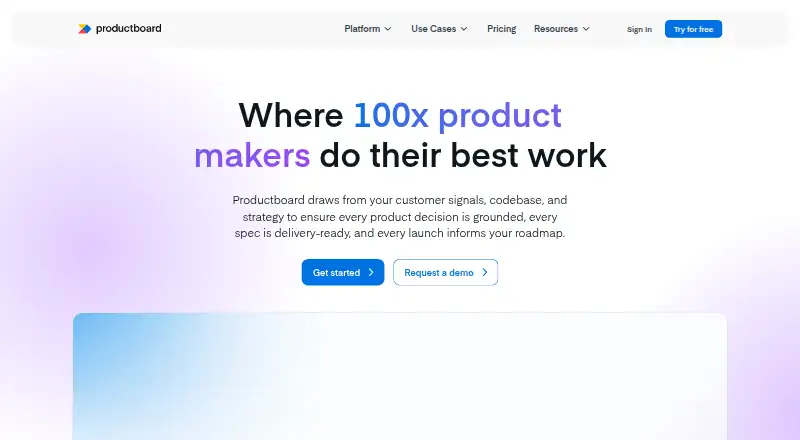
What Productboard is
Productboard helps product teams gather customer feedback, identify customer needs, and decide which product work to prioritize. Its centralized feedback tools help teams spot trends, surface frequent requests, and connect customer insights with feature ideas. Teams can use collaborative, contextual roadmaps to keep stakeholders informed and align priorities and product objectives with business goals. Productboard Spark includes AI capabilities; listed features across plans include AI chat, feedback summaries, scheduled tasks, and an MCP server. Integrations include Zendesk, Slack, Intercom, Jira, Azure DevOps, GitHub, Salesforce, Amplitude, Mixpanel, and Google Drive. The platform is available on the web, through an API, and as an extension, and offers API v2.0 and a GDPR API for customer-data removal. A free plan and 14-day trial are listed. Plus starts at $19/mo (annual). Free and Plus plans have limits of 25 contributors and 500 feedback items; the higher plans add other limits and support options.
Who it suits
Productboard suits product teams at fast-scaling startups and enterprise organizations that need to organize feedback, prioritize product work, and share roadmaps. It also fits teams looking to connect product objectives with business goals.
What it does well
- Centralizes feedback and links insights to feature ideas.
- Collaborative roadmaps keep stakeholders informed.
- Integrates with Jira, Slack, Salesforce, and others.
- API v2.0 and a GDPR API are available.
- Free plan and 14-day trial are listed.
What to know first
- Free and Plus limit contributors to 25.
- Free and Plus cap feedback at 500 items.
- Business requires at least two makers.
- Enterprise requires at least five makers.
Limits
The Free plan includes 25 contributors, 500 feedback notes, one teamspace, and one product portal. Plus includes 25 contributors and 500 feedback items; Business requires at least two makers, and Enterprise at least five makers.
Plans
| Plan | Billed and limits | Price |
|---|---|---|
| Free | billed annually (or $0, billed monthly) · 50 AI credits/month · 500 feedback notes · 25 contributors · 1 teamspace · 1 product portal | Free |
| Plus | billed annually (or $25 maker/month, billed monthly) · 250 AI credits maker/month · 500 feedback items · 25 contributors · 1 teamspace · 1 product portal | $19 a month |
| Business | 2 makers minimum, billed annually (or $75 maker/month, 2 makers minimum, billed monthly) · 500 AI credits maker/month · 25 contributors · 2 product portals · unlimited teamspaces | $59 a month |
| Enterprise | 5 makers minimum, billed annually · 800 AI credits maker/month · unlimited contributors · unlimited teamspaces · SAML SSO and SCIM | On request |
As productboard.com lists them, read 3 Oct 2026. The maker's own page has the final word.
Getting started
- Visit the Productboard website.
- Start with the Free plan or use the listed 14-day trial.
- Choose a plan based on contributor, feedback, teamspace, and product portal needs.
- Connect relevant services such as Jira, Slack, or Google Drive.
- Use the web platform, API, or extension.
Productboard is a product-management workspace for turning customer input into priorities, feature ideas, and stakeholder-facing roadmaps. It is best suited to product teams that need those activities connected across a growing organization. The main appeal is an end-to-end workflow with substantial integrations and AI; the main constraint is the tight contributor and feedback allowances on lower tiers.
Overview
Productboard centralizes feedback so teams can identify trends, find frequently requested improvements, and connect customer insights to feature ideas. Product priorities can be aligned with objectives and wider business goals, then communicated through collaborative, contextual roadmaps. This combination is useful when product decisions must remain traceable from customer need to planned work.
It is a broader system than a standalone feedback board. Teams wanting only a simple request-collection portal may not need its prioritization and roadmap layer, while fast-growing teams should watch the caps on cheaper plans.
Key features
Feedback and prioritization
Feature requests, a feedback portal, and sentiment analysis support the feedback loop. Linking insights to feature ideas gives requests a route into product planning rather than leaving them as an unstructured inbox. That makes Productboard more compelling for teams making evidence-led prioritization decisions than for organizations seeking only public voting.
Roadmaps and alignment
Collaborative roadmaps provide context for stakeholders and help keep plans aligned. Productboard connects product-team priorities with product objectives and business goals, which is valuable when several groups need a shared view of direction.
AI, integrations, and APIs
Productboard Spark supplies AI capabilities. AI chat, feedback summaries, scheduled tasks, and an MCP server are included across plans, with monthly AI-credit allowances increasing at higher tiers. Connections are listed for Zendesk, Slack, Intercom, Jira, Azure DevOps, GitHub, Salesforce, Amplitude, Mixpanel, and Google Drive. API v2.0, an MCP server, and a GDPR API for removing customer data support automation and data administration.
Security and support
Productboard’s Trust Center lists SOC 2 Type II, CSA, GDPR, CCPA, SIG, PCI, EU-US DPF, ISO 27001:2022, and CASA badges. It says the service undergoes annual third-party penetration tests and weekly application DAST scans. Community and email support are included in every plan; Business adds prioritized email support, and Enterprise adds expedited email support.
Pricing
Free
The Free plan costs nothing, billed annually or monthly at $0. It includes 50 AI credits per month, 500 feedback notes, 25 contributors, one teamspace, and one product portal. It is a practical starting point for a small product group, but the single teamspace and 500-note ceiling make it unsuitable for a large or multi-product feedback operation.
Plus
Plus costs $19 a month billed annually, or $25 per maker per month billed monthly. It raises AI allowance to 250 credits per maker each month but keeps 500 feedback items and 25 contributors, with one teamspace and one product portal. This is the low-cost paid choice for teams that need more AI capacity without needing additional spaces; it does not remove the core feedback or contributor bottlenecks.
Business
Business costs $59 a month with a two-maker minimum, billed annually, or $75 per maker per month with the same minimum billed monthly. Each maker receives 500 AI credits monthly. The plan keeps a 25-contributor limit but adds two product portals, unlimited teamspaces, and unlimited feedback notes. It fits organizations running multiple product areas or a high-volume feedback program, provided 25 contributors is enough.
Enterprise
Enterprise uses custom pricing and requires at least five makers, billed annually. It provides 800 AI credits per maker each month, unlimited contributors and teamspaces, plus SAML SSO and SCIM. Those controls and unlimited collaboration make it the appropriate tier for larger organizations with identity-management requirements.
A 14-day trial offers a time-limited way to assess paid capabilities before committing. Paid annual prices renew on an annual basis, while the monthly alternatives cost more per maker where offered.
Platforms
Productboard is available on the web, through an API, and as an extension. The API and MCP options make it suitable for teams that need Productboard connected to existing workflows rather than used as an isolated application.
Who it's for
Productboard targets product teams ranging from fast-scaling startups to enterprise organizations. It is a strong match for teams that need customer evidence, prioritization, objectives, and roadmaps in one process. Small teams can begin on Free, while organizations with multiple teamspaces, large feedback volumes, or centralized identity controls should consider Business or Enterprise. It is less suitable when the requirement is only a lightweight feedback board or changelog.
Pros and cons
Pros
- Connected product workflow: Feedback can be linked to feature ideas, priorities, objectives, and roadmaps.
- Broad integration coverage: Connections span support, communication, development, CRM, analytics, and storage tools.
- AI on every tier: AI chat, summaries, scheduled tasks, and MCP access are included, with larger allowances on higher plans.
- Enterprise safeguards: Extensive compliance badges, security testing practices, SAML SSO, and SCIM support larger deployments.
Cons
- Lower-tier caps: Free and Plus stop at 500 feedback items and 25 contributors, which can force an upgrade as usage grows.
- Business contributor ceiling: Unlimited feedback notes do not remove the 25-contributor limit.
- Minimum maker commitments: Business requires two makers and Enterprise five, reducing fit for very small paid teams.
- Potentially excessive scope: Teams needing only request collection may pay for planning capabilities they will not use.
Alternatives
Choose Beamer when you want feedback and announcement tooling across Android, iOS, web, and API with a free plan capped at 1,000 monthly active users and one teammate. Choose Featurebase for a feedback-focused free tier with unlimited conversations and one seat, or its $29-per-month Growth plan billed yearly. Pendo Analytics is the better direction when product analytics and in-app guides are central; its free tier supports 500 monthly active users.
Featul suits small web teams wanting a free public feedback portal, roadmap, changelog, voting, and comments for three team members. Fider is an open-source, self-hosted customer-feedback option with a free plan under a fair-use policy. Sleekplan fits teams prioritizing unlimited feedback and subscribers on a free-forever plan. Tempo Portfolio Manager is for portfolio, project, and task management rather than a feedback-led product workflow. Canny is a focused alternative for tracked-user feedback, with unlimited feedback on its free plan and paid product-management integrations.
For broader comparisons, see Product Management Software, Product Roadmap Software, IT Release Management Software, and Customer Feedback Software.
Verdict
Productboard is a strong choice for product teams that want customer feedback, prioritization, objectives, and roadmaps governed in one connected workspace. Choose it for its integration breadth, AI capabilities, and enterprise-ready controls. Look elsewhere if you need only a lightweight feedback tool, or if your team will quickly outgrow the 25-contributor and 500-item limits on the lower plans.
Verdict
Productboard brings customer feedback, prioritization, and roadmaps into a platform for product teams. The free plan and trial offer an entry point, while listed contributor and feedback limits differ by plan.
Questions
Does Productboard have a free plan?
Yes. The Free plan costs 0.00 USD and includes 50 AI credits per month, 500 feedback notes, 25 contributors, one teamspace, and one product portal.
How much does Plus cost?
Plus costs $19 a month when billed annually. The listed monthly billing price is $25 maker/month.
Is there a free trial?
Yes. Productboard lists a 14-day trial.
Which services does Productboard integrate with?
Listed integrations include Zendesk, Slack, Intercom, Jira, Azure DevOps, GitHub, Salesforce, Amplitude, Mixpanel, and Google Drive.
Which platforms are available?
Productboard lists web, API, and extension platforms.
What is the Enterprise price?
No Enterprise price is listed. The plan requires a five-maker minimum and includes unlimited contributors, unlimited teamspaces, SAML SSO, and SCIM.
Facts from Productboard's own pages
- AI
- Productboard Spark includes AI-powered capabilities, and the pricing page lists AI chat, feedback summaries, scheduled tasks, and an MCP server across all plans. · productboard.com, 3 Oct 2026
- API
- Productboard offers API v2.0, an MCP server, and a GDPR API for removing customer data. · productboard.com, 3 Oct 2026
- Audience
- Productboard describes its platform as built for product teams from fast-scaling startups to enterprise organizations. · productboard.com, 3 Oct 2026
- Customer insights
- The platform centralizes product feedback so teams can identify trends, surface top requests, and link insights to feature ideas. · productboard.com, 3 Oct 2026
- Founded
- 2014 · productboard.com, 28 Sept 2026
- Integrations
- Listed integrations include Zendesk, Slack, Intercom, Jira, Azure DevOps, GitHub, Salesforce, Amplitude, Mixpanel, and Google Drive. · productboard.com, 3 Oct 2026
- Plan limits
- The Free and Plus plans include up to 25 contributors and 500 feedback items, while Business includes unlimited feedback notes and Enterprise includes unlimited contributors. · productboard.com, 3 Oct 2026
- Purpose
- Productboard helps teams collect feedback, understand customer needs, prioritize what matters, and bring products to market faster. · trust.productboard.com, 3 Oct 2026
- Roadmaps
- Productboard offers collaborative, contextual roadmaps to keep stakeholders informed and aligned. · productboard.com, 3 Oct 2026
- Security
- The Trust Center lists SOC 2 Type II, CSA, GDPR, CCPA, SIG, PCI, EU-US DPF, ISO 27001:2022, and CASA badges. · trust.productboard.com, 3 Oct 2026
- Security practices
- The Trust Center says Productboard conducts annual third-party penetration tests and weekly application DAST scans. · trust.productboard.com, 3 Oct 2026
- Strategy
- Productboard aligns product team priorities, product objectives, and business goals. · productboard.com, 3 Oct 2026
- Support
- The pricing page includes community and email support in every plan; Business adds prioritized email support and Enterprise adds expedited email support. · productboard.com, 3 Oct 2026
Where Productboard stands on Freedom251
- IT Release Management Software#6 of 42
- Customer Feedback Software#11 of 59
- Product Management Software#8 of 37
- Product Roadmap Software#6 of 27