Freedom251 › A/B Testing Tools

DevCycle
What DevCycle is
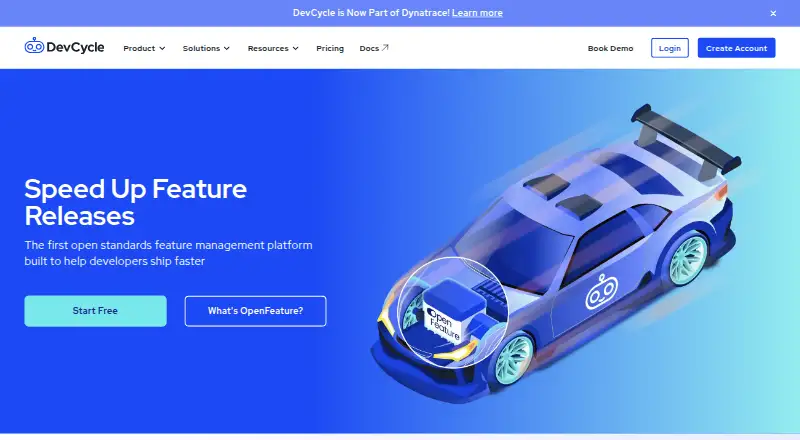
DevCycle is a feature flag platform for creating, rolling out, and cleaning up flags. Teams can target releases using user attributes and launch them gradually, on a schedule, or in multiple steps. A/B and multivariate experiments can be measured using events and metrics, and APIs let teams manage flags, targeting, rollouts, and experiments remotely. The platform is designed for developers, with SDKs for JavaScript, React, Next.js, Angular, iOS, Android, React Native, Flutter, and Roku on the client side, and Node.js, Go, PHP, Python, Ruby, Java, and .NET on the server side. DevCycle supports OpenFeature across its SDKs. Listed integrations include VS Code, Slack, GitHub, Bitbucket, GitLab, Jira, Terraform, Datadog, Snowflake, Google Analytics, and Rollbar. The Free plan lists limits for users, requests, and events. Business costs $500 a month, billed annually, and includes monthly usage limits with overage charges applying. DevCycle states it is SOC 2 Type II and GDPR compliant; its website says it is now part of Dynatrace.
Who it suits
DevCycle suits developers and teams managing feature releases across client and server applications. It also fits teams that want to target staged releases or measure A/B and multivariate experiments.
What it does well
- Targets releases by user attributes.
- Supports scheduled and multi-step rollouts.
- SDKs cover client and server platforms.
- OpenFeature support spans its SDKs.
- Free plan requires no credit card.
What to know first
- Business is billed annually at $500 a month.
- Business overage charges apply beyond included usage.
- Free plan has monthly user, request, and event limits.
Limits
The Free plan includes 1,000 client-side MAUs, 10,000 cloud config requests per month, 100,000 server config requests per month, and 5,000 events per month. Business includes 100,000 client-side MAUs, 500,000 events, 1,000,000 cloud config requests, and 10,000,000 server config requests per month; additional usage is charged per unit.
Plans
| Plan | Billed and limits | Price |
|---|---|---|
| Free | No credit card required · 1,000 client-side MAUs · 10,000 cloud config requests/month · 100,000 server config requests/month · 5,000 events/month · unlimited seats, flags, environments and projects | Free |
| Business | Billed annually · 100,000 client-side MAUs · 1,000,000 cloud config requests/month · 10,000,000 server config requests/month · 500,000 events/month · overages charged by usage | $625 a month |
| Enterprise | Billed annually · Custom plans with no limits · approval workflows · RBAC · SSO/SAML · SCIM · premium support · uptime SLA | On request |
As devcycle.com lists them, read 14 Oct 2026. The maker's own page has the final word.
Getting started
- Open https://devcycle.com/.
- Choose the Free plan, which requires no credit card, or review Business at $500 a month billed annually.
- Use a client-side or server-side SDK for your platform and language.
- Create flags and configure targeting or rollout behavior.
- Use events and metrics to measure A/B or multivariate experiments.
DevCycle is a feature-flag platform for teams that want to control releases and run experiments across web and mobile products. It is best suited to developer-led teams that need gradual, targeted rollouts alongside measurement; its free plan is generous on seats and projects, while the Business plan’s annual commitment and usage overages deserve a close look.
Overview
DevCycle lets teams create, target, roll out, and clean up feature flags. Developers get SDKs and APIs for managing flags and experiments, while the platform also supports collaboration and integrations used across product and engineering workflows. Its support for OpenFeature offers a vendor-agnostic standard across its SDKs.
Release controls include targeting by user attributes, gradual releases, scheduled rollouts, and multi-step rollouts. Teams can measure A/B and multivariate experiments using events and metrics. DevCycle is now part of Dynatrace; it was founded in 2022 and is headquartered in Toronto, Ontario, Canada.
Key features
- Feature flags and staged releases: Attribute targeting and gradual, scheduled, or multi-step rollouts give teams control over who sees a change and when. That makes the platform a fit for coordinated releases, though teams should account for the Business plan’s included usage and overage charges as activity grows.
- Experimentation: A/B and multivariate tests can be measured against events and metrics, connecting release controls to evaluation. The platform also supports server-side testing.
- SDKs and APIs: Client-side SDKs cover JavaScript, React, Next.js, Angular, iOS, Android, React Native, Flutter, and Roku. Server-side SDKs cover Node.js, Go, PHP, Python, Ruby, Java, and .NET. APIs let teams remotely manage flags, targeting, rollouts, and experiments.
- Integrations: Listed connections include VS Code, Slack, GitHub, Bitbucket, GitLab, Jira, Terraform, Datadog, Snowflake, Google Analytics, and Rollbar, plus OpenFeature.
- Security and support: DevCycle states that it is SOC 2 Type II and GDPR compliant. It operates a vulnerability disclosure program through HackerOne but has no bug bounty program. Email support and a shared Slack channel are listed support options; Enterprise adds premium support and an uptime SLA.
Pricing
DevCycle has a free tier and paid plans from $500/mo (annual). All plans include unlimited seats, flags, environments, and projects, so the main distinction is usage capacity and, at Enterprise level, support and service terms.
- Free — free: No credit card required. Includes 1,000 client-side MAUs, 10,000 cloud config requests per month, 100,000 server config requests per month, and 5,000 events per month. It is a practical starting point for small workloads or evaluation, but the client-side MAU and event caps can constrain active products and experiments.
- Business — $500 a month, billed annually: Includes 100,000 client-side MAUs, 500,000 events per month, 1,000,000 cloud config requests per month, and 10,000,000 server config requests per month. Overage charges apply beyond the included usage. This suits teams that need larger allowances, but the annual billing and metered overages make usage forecasting important.
- Enterprise — custom pricing, billed annually: A custom plan with no limits, unlimited seats, premium support, and an uptime SLA. It is the option for teams that need higher or uncapped usage and stronger support commitments.
Platforms
DevCycle supports web and mobile use, with Android, iOS, and web among its platforms, as well as an API and extension. Its broad client-side and server-side SDK coverage makes it relevant to teams shipping across multiple application stacks.
Who it's for
DevCycle is strongest for developer-led teams that want feature flags, controlled rollouts, and experimentation in one platform, particularly when they need both client-side and server-side SDKs. OpenFeature support and remote APIs suit teams that value standardization and programmatic control. It is less compelling for a small product with modest needs if the free caps are too low but the annual Business commitment and overages are hard to justify.
Pros and cons
- Pros: Unlimited seats, flags, environments, and projects even on Free make it easier for a team to collaborate without a seat ceiling.
- Pros: Gradual, scheduled, and multi-step rollouts combine with attribute targeting, giving teams several ways to control exposure.
- Pros: Broad SDK coverage and APIs span client-side and server-side development, while OpenFeature support adds a vendor-agnostic option.
- Cons: Free usage is capped at 1,000 client-side MAUs and 5,000 events monthly, which may be limiting for growing traffic or experimentation.
- Cons: Business costs $500 a month billed annually, and usage above included limits incurs overage charges.
- Cons: Enterprise uses custom pricing, so teams seeking uncapped usage and an SLA must evaluate a quote rather than a published rate.
Alternatives
For a wider comparison, browse Feature Flag Software and A/B Testing Tools.
- GrowthBook is worth considering if self-hosting matters: its free self-hosted plan includes one project, unlimited feature flags, unlimited experiments, and unlimited traffic.
- Confidence by Spotify may fit teams whose needs match its free allowance of 75,000 credits per month, unlimited flags and seats, and up to five surfaces.
- Experimently is an option for teams seeking a self-hosted AWS deployment with all features included in its free preview.
- Apex is another freemium alternative, with a free Starter plan for up to three live experiments and 10,000 tested visits.
- LaunchDarkly Experimentation offers a free Developer plan with 100K experimentation MAU per month, one project, and three environments.
- Mida may suit website testing needs, with a free Sandbox that allows 100,000 monthly tested users and 50,000 daily tracked events.
- Omniconvert Explore offers a free plan for 50,000 website visitors with its full Explore feature set.
- Firebase Cloud Messaging is a no-cost option for teams looking specifically for cloud messaging.
Verdict
Choose DevCycle if your team needs developer-oriented feature flags, flexible staged releases, and experimentation across a broad range of SDKs. Its unlimited seats and projects on Free make it an accessible starting point, but the caps are modest for active products and Business brings an annual commitment plus overage exposure. Teams that need a different deployment model or narrower testing tool should compare alternatives before stepping up.
Verdict
DevCycle combines feature flag management, staged releases, and experimentation with broad SDK coverage. Compare the Free usage limits with Business allowances and overage charges before committing.
Questions
Is DevCycle free?
Yes. The Free plan costs nothing and requires no credit card.
What does Business cost?
Business costs $500 a month when billed annually. Additional per-unit charges apply for usage above its included limits.
Which platforms and SDKs does DevCycle support?
Supported platforms include Android, iOS, web, API, and extension. Client SDKs include JavaScript, React, Next.js, Angular, iOS, Android, React Native, Flutter, and Roku; server SDKs include Node.js, Go, PHP, Python, Ruby, Java, and .NET.
Does DevCycle support OpenFeature?
Yes. DevCycle supports OpenFeature across its SDKs.
What integrations are listed?
Listed integrations include VS Code, Slack, GitHub, Bitbucket, GitLab, Jira, Terraform, Datadog, Snowflake, Google Analytics, and Rollbar.
Who makes DevCycle, and where is it based?
DevCycle was founded in 2022 and is headquartered in Toronto, Ontario, Canada. Its website says it is now part of Dynatrace.
Facts from DevCycle's own pages
- API
- A documented Management API exposes project, feature and change-request operations, while a Bucketing API serves evaluations. · docs.devcycle.com, 14 Oct 2026
- Architecture
- Client SDK APIs run on Cloudflare Workers at the edge, while shared WebAssembly bucketing logic keeps evaluations consistent. · devcycle.com, 14 Oct 2026
- CLI
- The CLI installs globally with npm as @devcycle/cli and includes code-usage and GitHub Actions workflows. · github.com, 14 Oct 2026
- Company history
- Taplytics was founded in 2011, and the DevCycle product was built from the ground up in 2022. · devcycle.com, 14 Oct 2026
- Company relationship
- DevCycle’s website states that DevCycle is now part of Dynatrace. · devcycle.com, 2 Oct 2026
- Debugging
- The Web Debugger lets authorized users inspect live configurations, apply self-targeting overrides and watch SDK events. · docs.devcycle.com, 14 Oct 2026
- Documentation
- Documentation includes quickstarts, SDK references, feature behavior, architecture, APIs, security controls and integration guides. · docs.devcycle.com, 14 Oct 2026
- Environments
- New projects start with Development, Staging and Production environments, with additional environments customizable. · docs.devcycle.com, 14 Oct 2026
- Experimentation
- Its experimentation tools run on web, mobile and server-side applications and accept custom metrics and events. · devcycle.com, 14 Oct 2026
- Extensibility
- DevCycle documents outbound webhooks, a complete API and CLI for custom automation. · docs.devcycle.com, 14 Oct 2026
- Feature flags
- The platform provides unlimited feature flags, environments and projects on every listed plan. · devcycle.com, 14 Oct 2026
- Founded
- 2022 · devcycle.com, 28 Sept 2026
- Gartner limitation
- A Gartner reviewer praised quick implementation but highlighted additional work caused by missing Bitbucket support. · gartner.com, 14 Oct 2026
- Headquarters
- The company describes its team as based in Toronto, Ontario, Canada. · blog.devcycle.com, 14 Oct 2026
- Integrations
- Documented integrations include GitHub, GitLab, Bitbucket, Jira, Slack, Terraform, Datadog, Snowflake, Google Analytics, Rollbar, Vercel Edge Config and webhooks. · devcycle.com, 14 Oct 2026
- JavaScript SDK
- The JavaScript client SDK is distributed through npm, includes TypeScript interfaces and supports service-worker environments. · docs.devcycle.com, 14 Oct 2026
- License
- The public SDK and proxy repositories display MIT licenses, while the hosted DevCycle service itself is proprietary SaaS. · github.com, 14 Oct 2026
- Limit: documentation complexity
- A G2 reviewer said documentation can become unclear when working with complex features. · g2.com, 14 Oct 2026
- Limit: events reliability
- A G2 reviewer reported event tracking problems, including a past site crash, and moved analytics to Google Analytics. · g2.com, 14 Oct 2026
- Limit: JSON editing
- A G2 reviewer reported intermittent unpredictability when editing JSON in the web interface. · g2.com, 14 Oct 2026
- Limit: pricing
- A G2 reviewer considered the pricing high and requested more feature-based customization of plans. · g2.com, 14 Oct 2026
- Limit: testing tools
- A G2 reviewer wanted a first-class testing SDK or helper to reduce mocking boilerplate. · g2.com, 14 Oct 2026
- Notable news
- DevCycle announced its acquisition by Dynatrace on January 13, 2026, linking feature delivery with Dynatrace observability. · blog.devcycle.com, 14 Oct 2026
- OpenFeature
- DevCycle embeds OpenFeature support across its SDKs to improve portability between providers. · devcycle.com, 14 Oct 2026
Where DevCycle stands on Freedom251
- A/B Testing Tools#6 of 52
- Feature Flag Software#7 of 27