Freedom251 › Product Adoption Software
Driver.js
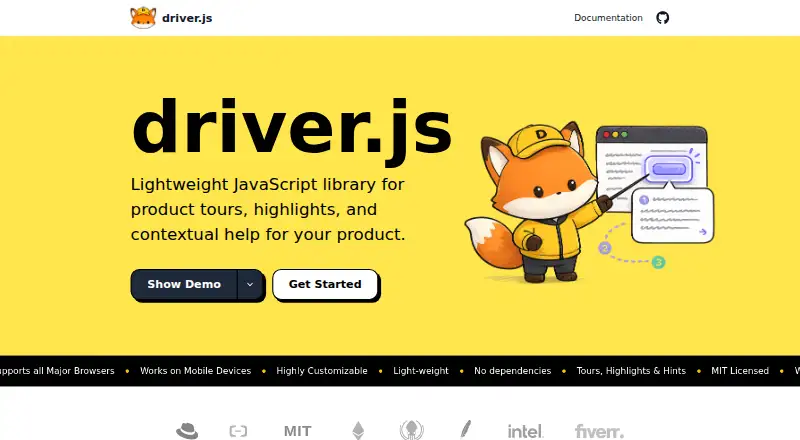
What Driver.js is
Driver.js is a JavaScript library for adding product tours, page highlights and contextual help to websites. It can guide users through a sequence of steps or spotlight one page element with a popover. Clickable hints appear as pulsing beacons and open popovers, with an optional page overlay. The maker lists onboarding, interactive tutorials, feature adoption, form guidance and directing attention among its intended uses. Configuration can be set globally, for a particular step or while a tour is running. Driver.js works with any framework or library, as well as vanilla JavaScript; it can be installed through npm, pnpm or yarn, or loaded from a CDN. The homepage describes it as dependency-free and about 5 KB. Driver.js is open source under the MIT license. Its free plan costs nothing and allows personal and commercial use without attribution. The homepage also lists accessibility and support for major browsers and mobile devices. One instance can be active on screen at a time.
Who it suits
It suits developers adding guided onboarding, tutorials or contextual prompts to web products. Its framework flexibility and multiple installation options fit varied JavaScript setups.
What it does well
- Supports multi-step tours and single-element highlights.
- Hints can show popovers with an optional overlay.
- Works with frameworks or vanilla JavaScript.
- Free for personal and commercial use without attribution.
What to know first
- Only one instance can be active on screen at a time.
- The homepage describes it as about 5 KB, not an exact size.
Limits
The free plan allows unlimited projects. Only one Driver.js instance can be active on screen at a time.
Plans
| Plan | Billed and limits | Price |
|---|---|---|
| Free | Unlimited projects · Personal and commercial use · No attribution required | Free |
As driverjs.com lists them, read 3 Oct 2026. The maker's own page has the final word.
Getting started
- Open https://driverjs.com/.
- Install the package with npm, pnpm, or yarn, or load it from a CDN.
- Use it with your framework, library, or vanilla JavaScript.
- Configure a tour, highlight, or hint globally, per step, or while a tour runs.
Driver.js is a lightweight JavaScript library for adding product tours, highlights and contextual prompts to a web interface. It suits developers who want an open-source, framework-agnostic tool; its small footprint and free commercial use are compelling, though only one instance can be active on screen at a time.
Overview
Driver.js handles both guided sequences and smaller moments of direction: a tour can move through multiple steps, while a highlight can focus a single page element and pair it with a popover. Clickable pulsing hints offer another way to call attention to interface details. That range makes it useful for onboarding, tutorials, feature adoption, form guidance and contextual help without requiring a separate product for each interaction.
The library is MIT-licensed, dependency-free and described as about 5 KB. It works with vanilla JavaScript or any framework or library, and can be installed through npm, pnpm or yarn, or loaded from a CDN. Configuration can be applied globally, per step or while a tour is running, offering useful control without tying the experience to one framework.
Key features
- Tours and focused highlights: Multi-step tours support guided onboarding, while a single-element highlight with a popover is better suited to explaining one control without a full walkthrough.
- Hints: Clickable pulsing beacons open popovers and can appear with an optional page overlay. They are a lighter-touch way to surface help than taking users through a sequence.
- Flexible configuration: Settings can be defined globally, for individual steps or during a running tour, so developers can tailor behavior at different levels.
- Framework independence: Compatibility with any framework or library, as well as vanilla JavaScript, makes Driver.js a practical fit for varied web stacks.
The main architectural constraint is that only one Driver.js instance can be active on screen at once. Applications planning overlapping guides need to coordinate them rather than run separate instances simultaneously.
Pricing
Free — free. The plan includes unlimited projects, personal and commercial use, and no attribution requirement. For developers building tours or contextual guides, that removes project-count and commercial-use restrictions from the stated plan. Driver.js is also open source under the MIT license.
There is no paid tier in the stated pricing model to weigh against this plan. The practical trade-off is instead the library's one-active-instance limit, which matters for products that need concurrent guides.
Platforms
Driver.js is marked for Android, iOS and web, with in-app tours and contextual guides supported. Its implementation is a JavaScript library, so framework compatibility and web development are its clearest fit; the platform listing also includes mobile platforms.
The maker cites accessibility, major-browser support and mobile-device support among its product characteristics. That breadth is useful for interfaces serving varied devices, while the single-active-instance constraint still applies.
Who it's for
Driver.js is best for developers who want to build their own onboarding, feature guidance or contextual help directly into a product, especially when they value a small, dependency-free library and an MIT license. Its framework flexibility makes it suitable for projects that use different JavaScript stacks.
It is less suited to teams that need multiple independent guides visible at once. Teams looking for a more managed alternative can compare options in User Onboarding Software, Customer Onboarding Software or Product Adoption Software.
Pros and cons
- Pro — No project cap in the free plan: Unlimited projects and personal and commercial use make it suitable for broad use without a stated project ceiling.
- Pro — Small and dependency-free: At about 5 KB with no dependencies, it adds relatively little weight or dependency overhead to a JavaScript application.
- Pro — Multiple guidance patterns: Tours, single-element highlights and clickable hints cover both structured walkthroughs and brief contextual prompts.
- Con — One active instance: Only one instance can be on screen at a time, so products with overlapping guides must manage when each appears.
Alternatives
Wakeline is worth considering for teams that want defined usage allowances and teammate support: its free plan includes 3 flows, 1,000 monthly active users, 1 teammate and community support.
Candu may suit teams seeking overlays with a free tier that allows 3 live experiences and unlimited user licenses. Its free plan is overlays-only.
Clew is an option for self-hosted use; its free plan includes 1 site, 1 team seat, up to 3 published tours, tours and tooltips, 1 month of analytics history and docs support.
Guidez may fit teams looking for a free plan with usage and environment allowances: Hobby includes 100 monthly active users, 1 team member and 1 environment.
Guida.js is another free, MIT-licensed web option, described as about 4.8 kB minified and gzipped with zero external dependencies.
Usertour is an alternative with a public, MIT-licensed core and self-hosting through Docker.
Guide.js is another free web option.
React Joyride is another free option for the web.
Verdict
Choose Driver.js if you want a compact, MIT-licensed JavaScript library for building tours, highlights and hints without a project cap or framework lock-in. Its low-overhead approach is its strongest case; look elsewhere if your product needs more than one active guidance instance on screen at a time.
Verdict
Driver.js covers tours, highlights and hints in a small, dependency-free JavaScript library. Its single-active-instance limit is worth considering when planning overlapping guides.
Questions
Is Driver.js free?
Yes. The listed Free plan costs nothing and allows unlimited projects.
Can I use Driver.js commercially?
Yes. The free plan permits personal and commercial use without attribution, and Driver.js is open source under the MIT license.
Which platforms does Driver.js support?
The listed platforms are Android, iOS, and web. The homepage also lists support for major browsers and mobile devices.
How can I install Driver.js?
The package can be installed with npm, pnpm, or yarn, or loaded from a CDN.
What can Driver.js show?
It can run multi-step tours, highlight a page element with a popover, and show clickable hints that open popovers.
Who holds the copyright listed for the MIT license?
The project repository identifies Kamran Ahmed as the MIT license copyright holder.
Facts from Driver.js's own pages
- Accessibility
- The homepage lists accessibility and support for major browsers and mobile devices among the product characteristics. · driverjs.com, 3 Oct 2026
- Customization
- Configuration can be set globally, per step, or while a tour is running. · driverjs.com, 3 Oct 2026
- Dependencies and size
- The homepage describes Driver.js as having no dependencies and being about 5 KB. · driverjs.com, 3 Oct 2026
- Frameworks
- The maker says Driver.js works with any framework or library, as well as vanilla JavaScript. · driverjs.com, 3 Oct 2026
- Hints
- Hints are clickable pulsing beacons that open popovers, and can be shown with an optional page overlay. · driverjs.com, 3 Oct 2026
- Installation
- The package can be installed with npm, pnpm, or yarn, or loaded from a CDN. · driverjs.com, 3 Oct 2026
- License
- Driver.js is open source under the MIT license. · driverjs.com, 3 Oct 2026
- Maintainer
- The project repository identifies Kamran Ahmed as the MIT license copyright holder. · github.com, 3 Oct 2026
- Product
- Driver.js is a lightweight JavaScript library for product tours, highlights, and contextual help. · driverjs.com, 3 Oct 2026
- Technical limits
- The API documentation says only one Driver.js instance can be active on screen at a time. · driverjs.com, 3 Oct 2026
- Tours and highlights
- The library can run multi-step tours and highlight a single page element with a popover. · driverjs.com, 3 Oct 2026
- Use cases
- The maker lists user onboarding, interactive tutorials, feature adoption, contextual help, form guidance, and focusing attention as use cases. · driverjs.com, 3 Oct 2026
Where Driver.js stands on Freedom251
- Product Adoption Software#2 of 32
- Customer Onboarding Software#2 of 31
- User Onboarding Software#2 of 30
- Onboarding Bots#2 of 27