Freedom251 › Digital Adoption Platforms

Ziplyne
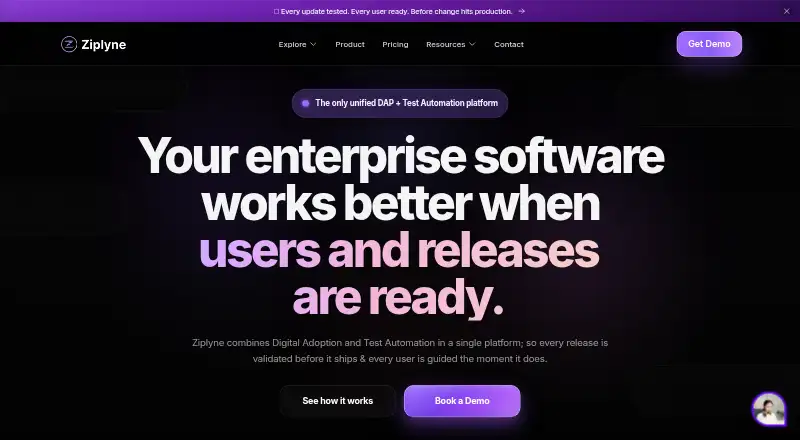
What Ziplyne is
Ziplyne combines digital adoption tools with test automation to validate releases and guide users through enterprise applications. Its DAP provides step-by-step in-app guidance, no-code onboarding and change communication flows, and adoption analytics. ZipRPA generates tests from process recordings, runs continuous regression tests, and can self-heal scripts when interface elements change. Testing can run across development, test, and production environments. The product is pre-tuned for Workday, Salesforce, ServiceNow, SAP, Coupa, Oracle, and Microsoft Dynamics, and can also run in browser-based internal apps and portals. Testing integrations include Jenkins, Azure DevOps, GitHub Actions, GitLab, and Bamboo, with REST API support for other pipeline systems. Ziplyne also lists BI and warehouse connections including Tableau, Power BI, Looker, Snowflake, and BigQuery. It supports walkthroughs, mobile apps, localization, and a no-code builder. The product is available on Android, iOS, web, as an extension, through an API, and as self-hosted software. There is no free plan; paid plans start at $500 a month, and a 14-day trial is available.
Who it suits
Ziplyne suits system integrators, IT and application leaders, business leaders, HR and people operations, training teams, and QA teams. It is relevant to organizations seeking both in-app guidance and release test automation for enterprise applications.
What it does well
- Combines digital adoption tools and test automation.
- Creates tests from process recordings.
- Supports regression testing across three environments.
- Integrates with listed testing and analytics tools.
- Offers a 14-day trial.
What to know first
- There is no free plan.
- Paid plans start at $500 a month.
- The trial is guided and not self-serve.
- ISO 27001 is still in progress.
Limits
The 14-day POV allows 3 Guides and 1 Application Domain. ZCX starts at $500 per month, is based on SaaS monthly active users, and includes 1 application domain; ZEX starts at $1,000 per month and is priced per user, application, and month.
Plans
| Plan | Billed and limits | Price |
|---|---|---|
| Ziplyne POV | 14 days free · Create 3 Guides · Unlimited Steps · 1 Application Domain · Customer Success Team support; not self-serve | Free |
| ZEX | Starting at $1k/Month · Per user/application/month · Includes everything in ZCX · Unlimited Guides · User Groups · Unlimited steps per Guide · Multiple Apps/Domains · Content Links · Validations · Guide Analytics | $1,000 a month |
| ZEX | Starting at $12k/Year · Per user/application/year · Includes everything in ZCX · Unlimited Guides · User Groups · Unlimited steps per Guide · Multiple Apps/Domains · Content Links · Validations · Guide Analytics | $12,000 a year |
| ZCX | Starting at $500/Month · Based on SaaS MAUs · Ziplyne branding · Zips, modals, tooltips, pulses · Team licenses · 1 application domain · Guide analytics | $500 a month |
| ZCX | Starting at $6k/Year · Based on SaaS MAUs · Ziplyne branding · Zips, modals, tooltips, pulses · Team licenses · 1 application domain · Guide analytics | $6,000 a year |
As ziplyne.com lists them, read 9 Oct 2026. The maker's own page has the final word.
Getting started
- Visit the Ziplyne website.
- Request the guided 14-day POV with Customer Success.
- Create up to 3 Guides for 1 Application Domain during the POV.
- Choose a paid plan: ZCX starts at $500 per month or ZEX at $1,000 per month.
- Use Ziplyne through web, Android, iOS, an extension, an API, or a self-hosted deployment.
Ziplyne brings in-app guidance and regression testing together for organizations managing enterprise applications. It is best suited to IT, application, and QA teams that need to support users while checking releases across those systems. The combined scope is useful, though its guided trial and starting prices make it a considered purchase.
Overview
Ziplyne pairs a digital adoption platform with ZipRPA, its test automation product. The adoption tools create step-by-step guidance, onboarding, and change communications without code, then track adoption through analytics. ZipRPA turns recorded processes into tests, runs continuous regression checks, and can repair scripts when interface elements change.
That connection between user support and release validation is the product’s clearest advantage for teams responsible for both. Organizations looking only to add onboarding prompts may have little reason to take on the testing capabilities, while QA teams seeking test automation alone may not need the adoption layer.
Key features
Guidance across enterprise applications
The no-code builder supports walkthroughs and communication through guides, modals, tooltips, and pulses. Teams can use these for onboarding or to explain changes in an application, and adoption analytics provide a way to track engagement. Ziplyne is pre-tuned for Workday, Salesforce, ServiceNow, SAP, Coupa, Oracle, and Microsoft Dynamics, and also runs in browser-based internal apps and portals. That coverage suits companies supporting several major business systems; teams with a single, less complex app may not need the breadth.
Regression testing and integrations
Process recordings can be turned into tests, and continuous regression runs are intended to catch release issues. Self-healing scripts address changes to user interface elements, which can reduce the upkeep associated with changing screens. Deployment spans development, test, and production environments.
ZipRPA integrates with Jenkins, Azure DevOps, GitHub Actions, GitLab, and Bamboo, and supports other pipeline systems through a REST API. For analytics exports and data warehouse sync, Ziplyne names Tableau, Power BI, Looker, Snowflake, and BigQuery. These connections make the product relevant to teams already working in those pipelines or reporting tools.
Security and deployment
Ziplyne lists SOC 2 Type II, GDPR, HIPAA-ready deployments with a BAA available, and alignment with the NIST AI RMF; ISO 27001 is in progress. Controls include SAML, OIDC, and OAuth single sign-on, SCIM provisioning, role-based access, customer-managed encryption keys, and US, EU, and APAC data residency. Application data and worker PII stay in the customer environment, with optional on-premises and private-cloud deployments. These options address varied enterprise requirements, while teams should confirm their particular deployment and compliance needs before choosing a plan.
Pricing
Ziplyne has no free plan. The 14-day Ziplyne POV trial costs nothing and includes three guides, unlimited steps, one application domain, and Customer Success support. It is guided rather than self-serve, so evaluation requires working with the Customer Success team.
ZCX starts at $500/Month, billed at $500 a month. It is based on SaaS monthly active users and includes Ziplyne branding, zips, modals, tooltips and pulses, team licenses, one application domain, and guide analytics. The monthly active user basis matters when estimating fit and cost; the starting price is not a fixed quote for every deployment.
ZEX starts at $1k/Month, billed at $1,000 a month, with per-user, per-application, per-month pricing. It includes ZCX features plus unlimited guides, user groups, unlimited steps per guide, multiple apps and domains, content links, validations, and guide analytics. This tier fits organizations that need multiple application domains or larger guide libraries; ZCX gives up those expanded guide and application allowances. Both paid prices are starting prices.
Platforms
Ziplyne supports Android, iOS, browser extensions, web, API, and self-hosted deployment. Mobile app support and localization are available, making it relevant to teams supporting users across devices and locations.
Who it's for
Ziplyne is aimed at system integrators, IT and application leaders, business leaders, HR and people operations, training teams, and QA teams. Its strongest case is an organization where application adoption and release quality overlap: user-facing teams can build guidance while QA checks recorded workflows as systems change. Buyers who need only one of those functions should compare the value of the combined platform against a more focused tool.
Pros and cons
- Guidance and testing in one platform: adoption flows and regression checks can support the same enterprise application estate.
- Broad enterprise application coverage: pre-tuning for seven named business suites extends to browser-based internal apps and portals.
- Pipeline and analytics connections: named integrations cover several CI/CD systems and BI or warehouse tools, with REST API support for other pipelines.
- Enterprise deployment and controls: customer-environment data handling, optional private deployment, and multiple identity, access, and residency controls suit organizations with specific operational requirements.
- Meaningful entry cost: ZCX starts at $500/Month, while ZEX starts at $1k/Month and charges per user, application, and month.
- Trial requires guided evaluation: the 14-day POV is not self-serve, which may slow teams that want to assess the product independently.
Alternatives
Browse the Digital Adoption Platforms directory to compare the category. Consider Whatfix if a free plan is important; its free plan is exclusively available with a DAP Web & Desktop plan. Stonly is a freemium alternative with a free plan capped at 400 guide views per month, five published guides, one language, 100 steps per guide, and one team member.
Candu is worth considering for overlays: its free plan allows three live experiences and unlimited user licenses, while Starter costs $199 a month when billed annually. VisualSP offers a free Adopt365 plan for Microsoft 365 web apps, with predefined prompts and step-by-step answers in Chrome and Edge.
Zoho Digital Adoption Platform may suit a small team starting with a free tier for one manager and one walkthrough; its Standard plan is $24 a month when billed monthly. Nexthink Adopt, Cornerstone Learning, and Newired are also alternatives to consider.
Verdict
Choose Ziplyne when your organization wants user guidance and regression testing for enterprise applications in one platform, especially if its supported systems, integrations, and deployment options fit your environment. Its main drawback is the commitment involved in evaluation and cost: the trial is guided, ZCX starts at $500/Month, and broader multi-app use starts with ZEX at $1k/Month. Teams needing only basic adoption guidance or a self-serve trial should look elsewhere.
Verdict
Ziplyne pairs in-app guidance with regression testing, integrations, and deployment options. Teams should account for the trial’s guided format and the listed starting price when evaluating it.
Questions
Does Ziplyne have a free plan?
No ongoing free plan is listed. Its Ziplyne POV is free for 14 days and is guided by Customer Success.
How much do paid plans cost?
ZCX starts at $500 per month and is based on SaaS monthly active users. ZEX starts at $1,000 per month and is priced per user, application, and month.
What platforms does Ziplyne support?
It is listed for Android, iOS, web, extension, API, and self-hosted deployment.
Which applications are supported?
Ziplyne is pre-tuned for Workday, Salesforce, ServiceNow, SAP, Coupa, Oracle, and Microsoft Dynamics. It can also run in browser-based internal apps and portals.
Which security controls and certifications are listed?
The site lists SOC 2 Type II, GDPR, HIPAA-ready deployments with a BAA available, and NIST AI RMF alignment. Controls include SAML, OIDC, and OAuth SSO, SCIM provisioning, role-based access, customer-managed encryption keys, and US, EU, and APAC data residency.
Facts from Ziplyne's own pages
- Analytics integrations
- Ziplyne lists Tableau, Power BI, Looker, Snowflake, and BigQuery for BI export and data warehouse sync. · ziplyne.com, 9 Oct 2026
- Deployment and data
- Ziplyne says application data and worker PII stay in the customer environment and offers optional on-premises and private-cloud deployment. · ziplyne.com, 9 Oct 2026
- Founded
- 2017 · ziplyne.com, 28 Sept 2026
- In-app guidance
- Ziplyne DAP provides step-by-step in-app guidance, no-code onboarding and change communication flows, and analytics for adoption tracking. · ziplyne.com, 9 Oct 2026
- Pricing limits
- The POV is guided by Customer Success and is not self-serve; paid plan prices are labeled as starting prices, with ZCX based on SaaS monthly active users. · ziplyne.com, 9 Oct 2026
- Product
- Ziplyne combines Digital Adoption and Test Automation in one platform to validate releases before shipping and guide users in enterprise applications. · ziplyne.com, 9 Oct 2026
- Security certifications
- The site lists SOC 2 Type II, GDPR, HIPAA-ready deployments with a BAA available, and NIST AI RMF alignment; ISO 27001 is in progress. · ziplyne.com, 9 Oct 2026
- Security controls
- Listed controls include SSO via SAML, OIDC, and OAuth, SCIM provisioning, role-based access control, customer-managed encryption keys, and US, EU, and APAC data residency. · ziplyne.com, 9 Oct 2026
- Support
- Ziplyne lists [email protected] and US office hours of 8 am–5 pm EST; global office hours vary by time zone. · ziplyne.com, 9 Oct 2026
- Supported applications
- The product is pre-tuned for Workday, Salesforce, ServiceNow, SAP, Coupa, Oracle, and Microsoft Dynamics, and can run in browser-based internal apps and portals. · ziplyne.com, 9 Oct 2026
- Test automation
- ZipRPA generates tests from process recordings, runs continuous regression tests, self-heals scripts when UI elements change, and supports deployment across development, test, and production environments. · ziplyne.com, 9 Oct 2026
- Testing integrations
- ZipRPA lists Jenkins, Azure DevOps, GitHub Actions, GitLab, and Bamboo integrations, plus REST API support for other pipeline systems. · ziplyne.com, 9 Oct 2026
- Who it serves
- The site describes solutions for system integrators, IT and application leaders, business leaders, HR and people operations, training teams, and QA teams. · ziplyne.com, 9 Oct 2026
Where Ziplyne stands on Freedom251
- Digital Adoption Platforms#20 of 29