Freedom251 › Medical Residency Scheduling Software
Resident Vacation Scheduler
What Resident Vacation Scheduler is
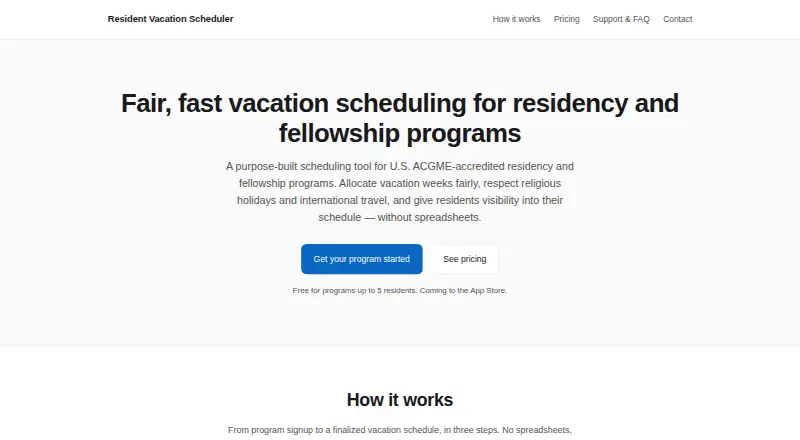
Resident Vacation Scheduler schedules vacation weeks for U.S. ACGME-accredited residency and fellowship programs. Vacation rounds use PGY seniority and check conflicts within each level, while enforcing a program-wide cap on residents off in a week. Religious holiday requests can bypass same-level conflicts; when all overlapping requests are religious, the global cap can also be relaxed. Consecutive vacation weeks requested for international travel stay together. Programs can run multiple academic years in parallel, and residents can view past schedules after the purchase year ends.
Administrators sign in with Apple or Google, while residents join with a unique one-time access code. The privacy policy describes HTTPS data transmission, encrypted on-device session-token storage, and no selling or sharing data with advertisers for marketing. The maker says the iOS app is completing App Store review; its iPhone listing requires iOS 15.1 or later. The free plan supports up to 5 residents. One-time purchases cover one GME academic year: Starter costs 299.00 USD for up to 20 residents, Standard costs 699.00 USD for up to 50, Pro costs 999.00 USD for up to 150, and Institutional costs 3500.00 USD for unlimited residents.
Who it suits
The scheduler is intended for U.S. ACGME-accredited residency and fellowship programs, including surgery, internal medicine, pediatrics, and subspecialties. Its plan sizes range from a free option for up to 5 residents to an institutional license for unlimited residents.
What it does well
- Vacation rounds use PGY seniority and conflict checks
- Religious requests can receive specified scheduling exceptions
- Consecutive international-travel weeks stay together
- Programs can run multiple academic years in parallel
What to know first
- The iOS app is completing App Store review
- Free plan supports up to 5 residents
- Paid purchases cover one GME academic year
- iPhone listing requires iOS 15.1 or later
Limits
The free plan supports up to 5 residents. Starter, Standard, and Pro are one-time purchases covering one GME academic year and support up to 20, 50, and 150 residents respectively; Institutional supports unlimited residents under a direct license.
Plans
| Plan | Billed and limits | Price |
|---|---|---|
| Free | No payment; self-service signup for up to 5 residents · Up to 5 residents | Free |
| Starter | One purchase covers one GME academic year · Up to 20 residents · Apple in-app purchase | $299, paid once |
| Institutional | One purchase covers one GME academic year · Unlimited residents · Direct license; contact the maker | $3,500, paid once |
| Standard | One purchase covers one GME academic year · Up to 50 residents · Apple in-app purchase | $699, paid once |
| Pro | One purchase covers one GME academic year · Up to 150 residents · Apple in-app purchase | $999, paid once |
As residentvacationscheduler.com lists them, read 7 Oct 2026. The maker's own page has the final word.
Getting started
- Open the product website at https://residentvacationscheduler.com/.
- Use the free self-service plan for up to 5 residents.
- Have administrators sign in with Apple or Google.
- Give residents their unique one-time access codes to join.
- For a paid year, choose Starter, Standard, Pro, or contact the maker about an Institutional direct license.
- Use the iPhone app; it requires iOS 15.1 or later and is completing App Store review.
Resident Vacation Scheduler is an iOS tool for allocating vacation weeks at U.S. ACGME-accredited residency and fellowship programs. It suits programs that need seniority-based vacation rounds and defined exceptions for religious holidays or international travel. Its focus is deliberately narrow: it does not schedule rotations.
Overview
The scheduler addresses one recurring program task rather than trying to manage every part of residency scheduling. PGY-based rounds, conflict checks, and a global limit on residents off in a week give administrators consistent guardrails for vacation allocation. That focus is useful when vacation requests are the problem; programs needing rotation scheduling will need another tool for that work.
Key features
- Seniority and conflict rules: Vacation rounds use PGY seniority, automatically checking for conflicts within each level and enforcing a program-wide cap on residents off in a given week. This helps keep allocation rules consistent, though programs still need to set the rules that fit their coverage needs.
- Religious-holiday exceptions: The scheduler can bypass same-level conflicts for religious holidays and relax the global cap when all overlapping requests are religious. The exception is targeted rather than a general suspension of scheduling rules.
- International travel: Consecutive weeks requested for international travel stay together. That is a practical accommodation for residents whose trip depends on a longer block, rather than separate weeks.
- Multiple academic years: Programs can run schedules for multiple academic years in parallel, and residents can view past schedules after the purchase year ends. This supports continuity, although each paid purchase covers only one academic year.
- Access and privacy: Administrators sign in with Apple or Google; residents join through a unique one-time access code. The privacy policy says data is sent over HTTPS, session tokens are kept on-device using encrypted storage, and data is not sold or shared with advertisers for marketing. It names Render, Neon, Cloudflare, Apple Sign In, and Google Sign In as service providers. Users can delete accounts and associated data in the app or by email, and administrators can delete resident profiles.
Pricing
The free plan costs nothing, requires no payment, and supports self-service signup for up to 5 residents. It is a sensible way for a small program to start, but the resident cap makes it unsuitable once the program grows beyond five.
Paid plans are one-time purchases for one GME academic year, not annual subscriptions. Starter costs $299, paid once for up to 20 residents; Standard costs $699, paid once for up to 50; and Pro costs $999, paid once for up to 150. Each is an Apple in-app purchase, so the appropriate tier depends on program size, and the purchase term matters for budgeting even though past schedules remain viewable after the year ends.
Institutional costs $3,500, paid once for unlimited residents through a direct license; contact the maker. It is the only stated option without a resident cap, but its price is substantially higher than the largest in-app tier. The maker directs questions and early-access inquiries to [email protected].
Platforms
The product is for iPhone and requires iOS 15.1 or later. The maker says the iOS app is completing App Store review, so availability may affect programs considering an immediate rollout. Mobile access is a fit for residents checking schedules on a phone; no rotation-scheduling capability is offered.
Who it's for
The maker describes it for U.S. ACGME-accredited programs in surgery, internal medicine, pediatrics, and subspecialties. It is best suited to teams that want vacation allocation governed by seniority, conflict limits, and specific exceptions, rather than a broader scheduling system.
Pros and cons
- Pro: PGY rounds, per-level checks, and a global weekly cap put key vacation-allocation constraints into the process.
- Pro: Religious-holiday exceptions and bundled international-travel weeks address two specific cases that ordinary conflict rules can mishandle.
- Pro: Multiple academic years can run in parallel, with past schedules still visible after the purchase year.
- Con: It does not schedule rotations, so programs looking for broader residency scheduling need another product.
- Con: Paid tiers cover one academic year per purchase, and the iPhone-only platform excludes programs that need a web or desktop option.
- Con: The free tier stops at five residents; the unlimited-resident direct license costs $3,500, paid once.
Alternatives
For a broader comparison, browse Medical Residency Scheduling Software.
- GME Manager is worth considering if a web-based option and a no-commitment trial matter: its LaunchPad Pilot is free for 30 days, self-guided, and requires no credit card.
- TigerConnect Physician Scheduling is a better fit for teams seeking broad platform coverage, including Android, iOS, Linux, macOS, web, and Windows; pricing is enterprise-wide and requires contacting sales.
- Amion may suit programs needing more schedules or custom rules: its Pro plan supports up to 10 schedules with self-serve setup and mobile and desktop access, while Enterprise offers unlimited schedules and organization-wide settings.
- Aurora-Med is another option for teams seeking web, desktop, or self-hosted platforms.
- Lightning Bolt may fit teams that want broad platform coverage, but its clinical scheduling plan uses per-seat licenses and requires additional licenses when scheduled headcount increases.
- MedHub is an alternative with Android, iOS, API, and web platforms.
- New Innovations is an alternative with Android, iOS, and web platforms.
- Equina may suit programs that prefer pricing based on what they run rather than the number of people who log in.
Verdict
Choose Resident Vacation Scheduler if your U.S. ACGME-accredited program needs a focused way to allocate vacation weeks by seniority while handling religious holidays and consecutive international-travel requests. Its strongest reason to buy is that specific rule set; its clearest reason to look elsewhere is the lack of rotation scheduling, with iPhone-only access and one-academic-year paid terms also worth weighing.
Verdict
Resident Vacation Scheduler focuses on vacation allocation for residency and fellowship programs, with rules for seniority, conflicts, religious holidays, and international travel. Check the resident limit and one-academic-year term for each purchase.
Questions
Is there a free plan?
Yes. The free self-service plan costs nothing and supports up to 5 residents.
What do the paid plans cost?
Starter costs $299, paid once for up to 20 residents, Standard $699, paid once for up to 50, and Pro $999, paid once for up to 150. Each purchase covers one GME academic year. Institutional costs $3,500, paid once for unlimited residents through a direct license.
Which devices does it support?
The listed platform is iOS. The App Store lists the app for iPhone and requires iOS 15.1 or later; the maker says it is completing App Store review.
How do administrators and residents sign in?
Administrators can sign in with Apple or Google. Residents join with a unique one-time access code.
Can it schedule rotations?
No. Rotation scheduling is listed as unavailable; coverage rules and conflict checks are listed as supported.
How does the Institutional plan work?
It costs $3,500, paid once, covers one GME academic year, allows unlimited residents, and is obtained through a direct license by contacting the maker.
Facts from Resident Vacation Scheduler's own pages
- Access and sign-in
- Administrators can sign in with Apple or Google, while residents join using a unique one-time access code. · residentvacationscheduler.com, 7 Oct 2026
- Data deletion
- Users can delete accounts and associated data in the app or by email, and administrators can delete resident profiles. · residentvacationscheduler.com, 7 Oct 2026
- Fair allocation
- Vacation rounds use PGY seniority and automatically enforce per-level conflicts and a global cap on residents off in a week. · residentvacationscheduler.com, 7 Oct 2026
- Intended users
- The maker describes the product as suitable for U.S. ACGME-accredited programs across surgery, internal medicine, pediatrics, and subspecialties. · residentvacationscheduler.com, 7 Oct 2026
- International travel
- Consecutive vacation weeks requested for international travel are kept together. · residentvacationscheduler.com, 7 Oct 2026
- Multi-year schedules
- Programs can run multiple academic years in parallel, and residents can still view past schedules after the purchase year ends. · residentvacationscheduler.com, 7 Oct 2026
- Platform availability
- The maker says the iOS app is completing App Store review; the App Store lists the app for iPhone and requires iOS 15.1 or later. · apps.apple.com, 7 Oct 2026
- Privacy and security
- The privacy policy says data is transmitted over HTTPS, session tokens are stored on-device using encrypted storage, and data is not sold or shared with advertisers for marketing. · residentvacationscheduler.com, 7 Oct 2026
- Purpose
- The product schedules vacation weeks for U.S. ACGME-accredited residency and fellowship programs. · residentvacationscheduler.com, 7 Oct 2026
- Religious holidays
- The scheduler can bypass same-level conflicts for religious holidays and relax the global cap when all overlapping requests are religious. · residentvacationscheduler.com, 7 Oct 2026
- Service providers
- The privacy policy names Render for API hosting, Neon for PostgreSQL database hosting, Cloudflare for website hosting, and Apple Sign In and Google Sign In. · residentvacationscheduler.com, 7 Oct 2026
- Support
- The maker directs users to contact [email protected] for questions and early access. · residentvacationscheduler.com, 7 Oct 2026