Freedom251 › Minecraft Mod Development Tools
Quilt Loom
What Quilt Loom is
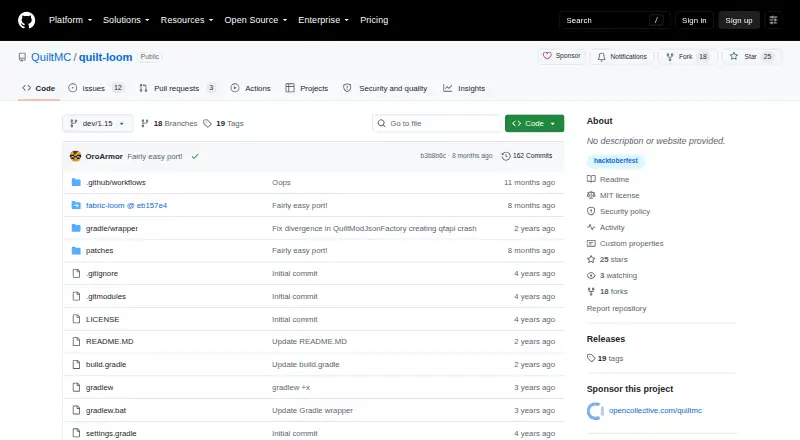
Quilt Loom is a Gradle plugin that adds Quilt support to the Fabric Loom Gradle plugin, for projects in Minecraft modding. It reads `quilt.mod.json` metadata for features such as jars-in-jars, transitive access wideners, and interface injection. The plugin automatically adds the Quilt Releases repository to projects and applies the Quilt Mappings on Loom plugin. It uses Quiltflower by default through loom-quiltflower by Juuxel. The project is based on a fabric-loom subproject with Quilt-specific patches, and its repository includes Gradle wrapper scripts for build tasks. The MIT license permits use, copying, modification, and distribution subject to its conditions. Quilt Loom is free and supports Linux, macOS, and Windows. The repository has no releases listed. Contributors are directed to work in the patched-quilt-loom subproject and submit changes as new patches for manual merging. Quilt says it makes Minecraft modding tools and is not an official Minecraft product or approved by or associated with Mojang Studios.
Who it suits
Quilt Loom suits developers building Minecraft modding projects that need Quilt support in the Fabric Loom Gradle plugin. Its contributor process is relevant to developers preparing changes to the project.
What it does well
- Reads `quilt.mod.json` metadata.
- Automatically adds the Quilt Releases repository.
- Applies Quilt Mappings on Loom.
- MIT-licensed and free.
- Supports Linux, macOS, and Windows.
What to know first
- No releases are listed.
- Contributors submit changes as patches for manual merging.
- Not an official Minecraft product.
Plans
| Plan | Billed and limits | Price |
|---|---|---|
| Quilt Loom | Free software under the MIT License | Free |
As github.com lists them, read 5 Oct 2026. The maker's own page has the final word.
Getting started
- Visit the Quilt Loom GitHub repository.
- Use its Gradle wrapper scripts to run build tasks.
- For development, run `./gradlew applyPatches`.
- Import the generated `patched-quilt-loom` subfolder into an IDE.
Overview
Quilt Loom is a Gradle plugin that brings Quilt-specific support to Fabric Loom-based Minecraft mod projects. It is best suited to developers building for the Quilt loader who need Quilt metadata and mappings within their build workflow. Its narrow focus is useful for that work, but contributors should be comfortable with a patch-based development process.
Key features
Quilt Loom reads quilt.mod.json, enabling support for Jars-in-Jars (JiJ), transitive access wideners, and interface injection. These capabilities make it a strong fit when a project relies on Quilt’s metadata conventions; it is not a general-purpose plugin for every Minecraft mod workflow.
The plugin automatically adds the Quilt Releases repository to projects and applies Quilt Mappings on Loom. It also uses Quiltflower by default through loom-quiltflower by Juuxel. Together, these integrations tailor the build setup to Quilt development rather than asking teams to assemble those Quilt-specific pieces separately.
Quilt Loom is based on a fabric-loom subproject with Quilt-specific patches, and Gradle wrapper scripts are provided for build tasks. Contributors are instructed to run ./gradlew applyPatches, import the generated patched-quilt-loom subfolder into an IDE, and submit changes as new patches for maintainers to merge manually. That is a clear route for contributing, but a more involved one than editing a conventional standalone project.
Pricing
Quilt Loom costs free and is MIT-licensed software. The license permits use, modification, distribution, and sale subject to its stated conditions. There is no trial to weigh against a paid plan; the free plan is the product’s only stated plan.
Platforms
Quilt Loom supports Linux, macOS, and Windows. Its supported loader is Quilt, so developers targeting another loader should choose tooling aligned with that project instead.
Who it's for
Quilt mod developers who already use Fabric Loom-based Gradle projects are the clearest audience. Automatic Quilt Mappings and Quilt Releases repository setup, together with support for Quilt metadata features, make it a practical fit for Quilt-specific build needs. Developers seeking a broad Minecraft development environment, or contributors who prefer not to work through patches, may be better served elsewhere.
Pros and cons
Pros
- Quilt metadata support: Reads quilt.mod.json and enables JiJ, transitive access wideners, and interface injection for Quilt projects.
- Focused setup: Automatically adds the Quilt Releases repository and applies Quilt Mappings on Loom.
- Free and permissively licensed: The MIT license allows use and modification subject to its conditions.
Cons
- Loader-specific: Its stated support is for Quilt, limiting its fit for projects built around other loaders.
- Patch-based contributions: Changes must be submitted as patches for manual merging, adding process overhead for contributors.
- No listed releases: The repository's Releases page has no releases, which may deter teams that require a published release for adoption.
Alternatives
For a broader set of options, browse Minecraft Mod Development Tools.
- Architectury Loom is another free Gradle Loom option; consider it when its experimental project and Gradle 8.1-or-newer requirements suit your setup.
- Fabric is free and includes the Fabric Loader; choose it when your project targets Fabric rather than Quilt. Most mods also require Fabric API.
- ForgeGradle is a free alternative for projects using ForgeGradle.
- Gradle is a free open-source build system; choose it when you need the general build tool rather than Quilt-specific Loom support.
- Blockbench is a free tool for any type of project, with no strings attached; consider it when that broader project use is the priority.
- Visual Studio Code is another free option, though its role differs from Quilt Loom's Gradle plugin.
- Minecraft Development MCP Server is free and open source under MIT, with Node.js 18+ and Java 17+ required; consider it when an MCP server is what your workflow needs.
- Eclipse IDE is free and open source; consider it when you want an IDE rather than a Quilt-focused Gradle plugin.
Verdict
Quilt Loom is the right choice for Minecraft mod developers building Quilt projects on Fabric Loom who want Quilt metadata, mappings, and repository setup integrated into Gradle. Its free MIT-licensed plan is appealing, but its loader-specific scope, patch-based contribution workflow, and lack of listed releases are reasons to look elsewhere if your project needs another loader or a published release to adopt.
Verdict
Quilt Loom adds Quilt-specific metadata and mapping support to Fabric Loom-based projects. The repository lists no releases, and contributions follow a patch-based process.
Questions
What does Quilt Loom do?
It adds Quilt support to the Fabric Loom Gradle plugin and reads `quilt.mod.json` metadata for features such as JiJ, transitive access wideners, and interface injection.
How much does Quilt Loom cost?
It is listed as free.
Which operating systems does it support?
The listed platforms are Linux, macOS, and Windows.
Is Quilt Loom open source?
The repository includes an MIT License. Its stated terms permit use, copying, modification, and distribution subject to the license conditions.
Who makes Quilt Loom?
Quilt makes Quilt Loom and other tools for Minecraft modding. Quilt says it started in 2021.
Is Quilt Loom an official Minecraft product?
No. Quilt says it is not an official Minecraft product and is not approved by or associated with Mojang Studios.
Facts from Quilt Loom's own pages
- Build tooling
- The repository provides Gradle wrapper scripts for running its build tasks. · github.com, 5 Oct 2026
- Contributing
- The contribution instructions ask contributors to submit changes as new patches, which maintainers manually merge into the patch series. · github.com, 5 Oct 2026
- Contributors
- The repository explains that contributors should work in the patched-quilt-loom subproject and submit changes as new patches. · github.com, 4 Oct 2026
- Decompiler
- It uses Quiltflower by default through loom-quiltflower by Juuxel. · github.com, 5 Oct 2026
- Development setup
- Contributors are instructed to run ./gradlew applyPatches and import the generated patched-quilt-loom subfolder into their IDE. · github.com, 5 Oct 2026
- Integration
- The project is based on a fabric-loom subproject and applies Quilt-specific patches to it. · github.com, 5 Oct 2026
- License
- The repository’s MIT license permits use, copying, modification, distribution, and sale subject to its stated conditions. · github.com, 5 Oct 2026
- Maker
- Quilt says it started in 2021 and builds tools for Minecraft modding. · quiltmc.org, 4 Oct 2026
- Mappings
- It automatically applies the Quilt Mappings on Loom plugin. · github.com, 5 Oct 2026
- Mod metadata
- It reads quilt.mod.json metadata so features including JiJ, transitive access wideners, and interface injection work properly. · github.com, 5 Oct 2026
- Not official Minecraft product
- Quilt states that it is not an official Minecraft product and is not approved by or associated with Mojang Studios. · quiltmc.org, 4 Oct 2026
- Product
- Quilt Loom is a Gradle plugin based on Loom with support for the quilt.mod.json specification. · quiltmc.org, 4 Oct 2026
- Purpose
- Quilt Loom adds Quilt support to the Fabric Loom Gradle plugin. · github.com, 5 Oct 2026
- Quilt Releases
- The project automatically adds the Quilt Releases repository to projects. · github.com, 5 Oct 2026
- Release availability
- The GitHub Releases page states that there are no releases listed. · github.com, 5 Oct 2026
- Security
- The repository links a security policy, but its contents were not available on the opened page. · github.com, 5 Oct 2026
- Support
- The README says questions can be raised on the Quilt Discord or by opening an issue. · github.com, 5 Oct 2026
- Use case
- Quilt says it makes tools for Minecraft modding, including Quilt Loom. · quiltmc.org, 4 Oct 2026
Where Quilt Loom stands on Freedom251
- Minecraft Mod Development Tools#18 of 35