
Visual Studio Code
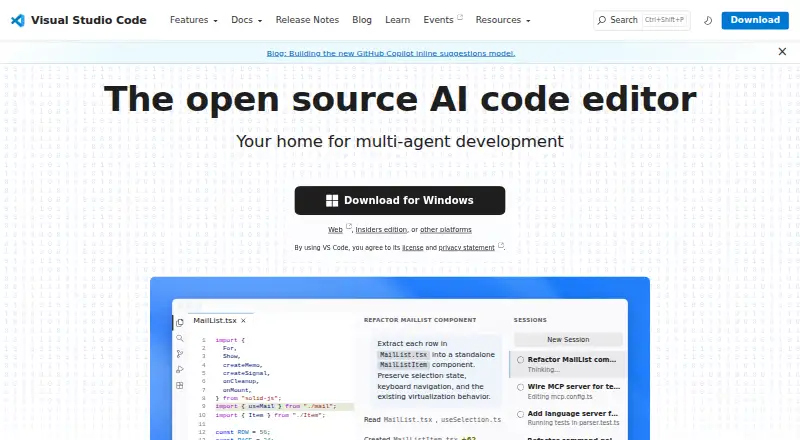
What Visual Studio Code is
Visual Studio Code is a free code editor for macOS, Linux, Windows and the web, with AI-assisted development features. It offers inline suggestions and intelligent completions, and its agent workflows can plan tasks, change code, run commands and iterate. Users can move between agent-led work and direct coding in the same editor. Agent workflows support Copilot and third-party providers, and users can bring their own model key. Customization includes instructions, agents, skills, MCP servers, plugins and extensions; the Marketplace lists more than 80,000 extensions. JavaScript, TypeScript, CSS and HTML support is included, with extensions adding other languages. Built-in tools include Git source control, a terminal, code running and debugging, build tasks and local history. VS Code can connect to GitHub Codespaces and remote development environments. The browser version has a limited execution environment. Workspace Trust can block automatic execution in Restricted Mode. Extensions have verified signatures, but may still access files, make network requests and run processes with VS Code’s permissions. Telemetry can be disabled in settings.
Who it suits
VS Code suits developers who want a code editor with built-in development tools, extensions and optional AI agent workflows. Web users should account for its limited execution environment, while extension users should consider the permissions extensions can use.
What it does well
- Free for private or commercial use.
- Marketplace lists more than 80,000 extensions.
- Built-in Git, terminal, debugging and build tasks.
- Settings Sync shares user settings across instances.
- Workspace Trust can prevent automatic code execution.
What to know first
- Starting AI agent work requires a GitHub account.
- The web editor has a limited execution environment.
- Extensions can access files and run processes.
- Microsoft may not provide support services.
Limits
The free plan is listed as free for private or commercial use. The web editor has a limited execution environment, and building with AI agents requires a GitHub account.
Plans
| Plan | Billed and limits | Price |
|---|---|---|
| Visual Studio Code | Free for private or commercial use | Free |
As code.visualstudio.com lists them, read 29 Sept 2026. The maker's own page has the final word.
Getting started
- Open the Visual Studio Code website.
- Choose a Windows, macOS, or Linux DEB or RPM download, or open the web editor.
- Install the desktop edition or use the browser version.
- Agree to the license and privacy statement.
- Sign in with a GitHub account to start building with AI agents.
Overview
Visual Studio Code is an open-source editor for writing and working with software, with optional AI-assisted editing and agent workflows. It suits developers who want a customizable editor spanning common languages and desktop systems. Its breadth is a strong reason to choose it, while browser execution limits and the permissions extensions receive call for care.
Key features
JavaScript, TypeScript, CSS, and HTML support are built in, and extensions add support for almost every major programming language. The Marketplace has more than 80,000 extensions, offering substantial room to adapt the editor to different work; the trade-off is that extensions warrant thoughtful selection because they can access files, make network requests, and run processes with VS Code’s permissions. Marketplace extensions are signed and their signatures are checked during installation, but that does not remove those permissions.
Multi-cursor and column editing, large-file handling, an integrated terminal, code running and debugging, build tasks, and local history make VS Code a capable everyday workbench. Git source control is built in, and the editor can connect to GitHub Codespaces and remote development environments. Remote Development can open a folder in a container on a remote machine, which helps when work needs a remote environment. Settings Sync shares user settings across instances, while profiles let users switch between customization sets.
AI features include inline suggestions and intelligent completions. Copilot and third-party providers are supported, and users can bring their own model key. Custom instructions, agent skills, custom agents, MCP servers, plugins, and extensions provide ways to shape those workflows. Starting to build with AI agents requires a GitHub account, so that path is not account-free.
Workspace Trust can prevent automatic execution of workspace code while a project is in Restricted Mode. VS Code collects telemetry, which users can disable through the telemetry.telemetryLevel setting; extensions may collect separate telemetry. Organizations can restrict installable extensions and host a private Marketplace. Use also requires agreement to the license and privacy statement, and the license says Microsoft may not provide support services.
Pricing
Visual Studio Code costs nothing and is free for private or commercial use. The free plan is a good fit for individual developers and organizations that want the editor without a software charge; there is no paid editor tier to compare. It has no free trial because the plan is free, and there is no stated seat or usage quota for the editor.
Platforms
The desktop editor runs on macOS, Linux, and Windows, with downloads offered for macOS, Windows, and Linux DEB or RPM packages. Visual Studio Code for the Web provides a browser option, but its execution environment is limited, making desktop the better fit when local execution matters. Insiders and other platforms are also offered.
Who it's for
VS Code is a strong fit for developers who want one extensible editor across common languages, remote environments, and optional AI workflows. Its customization range and integrated development tools can serve varied projects, while people who want a tightly controlled extension surface, do not want a GitHub account for agent workflows, or need an unrestricted browser execution environment should weigh those limits before choosing it.
Pros and cons
- Pro: Broad language coverage, built-in editing tools, Git, and remote development make it useful across many coding tasks.
- Pro: AI suggestions and configurable agent workflows let users combine automation with direct editing, including third-party providers and a bring-your-own-key option.
- Con: Extensions can access files, use the network, and run processes with VS Code’s permissions, so the large Marketplace calls for selection and oversight.
- Con: Web execution is limited, and beginning AI agent development requires a GitHub account.
- Con: Microsoft may not provide support services, a consideration for teams that need vendor support.
Alternatives
For other editor choices, browse Text Editors or Code editors. Pick Neovim for a free editor that also lists Android, API, and self-hosted platforms. Zed is a free-forever code editor with 2,000 accepted edit predictions and external-agent or API-key support; its free plan suits readers who want those stated limits and options. Choose Notepad++ for a free Windows text and source code editor supporting several programming and natural languages. Kate, Vim, and jEdit are also free editor alternatives. For other editing options, consider EmEditor or BBEdit. Readers working in specific areas can also browse Minecraft Mod Development Tools, Go IDEs, PHP IDEs, and Minecraft Add-on Editors.
Verdict
Choose Visual Studio Code if you want a free, extensible editor with broad language support, remote-development tools, and optional AI agents in one workspace. Look elsewhere if unrestricted browser execution, minimal extension access, or guaranteed Microsoft support is essential.
Verdict
VS Code offers a broad editor toolkit and optional agent workflows across desktop and web. Consider the web environment’s limits and extension permissions when deciding how to use it.
Questions
How much does Visual Studio Code cost?
The listed plan is free and is free for private or commercial use.
Which platforms does it support?
VS Code runs on Windows, macOS, and Linux, and a web editor runs in a browser. Downloads include Windows, macOS, and Linux DEB or RPM packages.
Is Visual Studio Code open source?
It is presented as an open source AI code editor.
Who makes Visual Studio Code?
Microsoft Corporation is named in the product license.
Does it support integrations?
It includes Git source control and can connect to GitHub Codespaces and remote development environments.
What is required to use AI agents?
A GitHub account is required to start building with AI agents. The editor supports Copilot and third-party providers, including bringing your own model key.
Facts from Visual Studio Code's own pages
- Account Requirement
- A GitHub account is required to start building with AI agents. · code.visualstudio.com, 27 Sept 2026
- Agent Automation
- AI agents can plan, change code, run commands, and iterate on tasks. · code.visualstudio.com, 27 Sept 2026
- Agent Customization
- Custom instructions, agent skills, custom agents, MCP servers, plugins, and extensions are supported. · code.visualstudio.com, 27 Sept 2026
- Agent Workflows
- Users can switch between agent work and hands-on coding in the same editor. · code.visualstudio.com, 27 Sept 2026
- AI agents
- Agents can autonomously plan tasks, make code changes, run commands, and iterate. · code.visualstudio.com, 29 Sept 2026
- AI Editing Features
- The editor includes AI-powered inline suggestions and intelligent completions. · code.visualstudio.com, 27 Sept 2026
- Built-In Languages
- JavaScript, TypeScript, CSS, and HTML are included in the box. · code.visualstudio.com, 27 Sept 2026
- Column editing
- Yes · code.visualstudio.com, 22 Sept 2026
- Customization
- Settings Sync shares user settings across VS Code instances, and profiles let users create and switch between sets of customizations. · code.visualstudio.com, 29 Sept 2026
- Desktop platforms
- VS Code runs on macOS, Linux, and Windows. · code.visualstudio.com, 29 Sept 2026
- Developer Adoption
- VS Code has been the editor of choice for millions of developers for over a decade. · code.visualstudio.com, 27 Sept 2026
- Editor tools
- Built in features include an integrated terminal, code running and debugging, build tasks, and local history. · code.visualstudio.com, 29 Sept 2026
- Enterprise controls
- Organizations can restrict installable extensions and host a private extension marketplace. · code.visualstudio.com, 29 Sept 2026
- Extension Marketplace
- The Extension Marketplace contains more than 80,000 extensions. · code.visualstudio.com, 27 Sept 2026
- Extensions
- The Visual Studio Marketplace lists more than 80,000 extensions. · code.visualstudio.com, 29 Sept 2026
- Extension security
- The Marketplace signs extensions and VS Code verifies signatures during installation; extensions can still access files, make network requests, and run processes with VS Code's permissions. · code.visualstudio.com, 29 Sept 2026
- Extension support
- Yes · code.visualstudio.com, 22 Sept 2026
- Free plan
- Yes · code.visualstudio.com, 22 Sept 2026
- Integrations
- The editor includes Git source control and can connect to GitHub Codespaces and remote development environments. · code.visualstudio.com, 29 Sept 2026
- Language Coverage
- VS Code supports almost every major programming language. · code.visualstudio.com, 27 Sept 2026
- Languages
- JavaScript, TypeScript, CSS, and HTML support are included, and extensions add support for other languages. · code.visualstudio.com, 29 Sept 2026
- Large-file handling
- Yes · code.visualstudio.com, 22 Sept 2026
- License Privacy
- Using VS Code requires agreement to its license and privacy statement. · code.visualstudio.com, 27 Sept 2026
- Maker
- Microsoft Corporation is the company named in the product license; Microsoft lists its headquarters in Redmond, Washington, and says it was founded in 1975. · code.visualstudio.com, 29 Sept 2026
Where Visual Studio Code stands on Freedom251
- Text Editors#5 of 82
- Code editors#3 of 45
- Front End Tools#7 of 28
- PHP IDEs#11 of 23
- Editor Software#16 of 32
- Agentic Ides#11 of 21
- Web Development IDEs#26 of 44
- Minecraft Mod Development Tools#21 of 35
- Debugging Software#18 of 30
- Developer Tools#22 of 33
- Go IDEs#16 of 24
- Minecraft Add-on Editors#18 of 26
- Free Tools#27 of 31