Freedom251 › Minecraft Mod Development Tools

Fabric
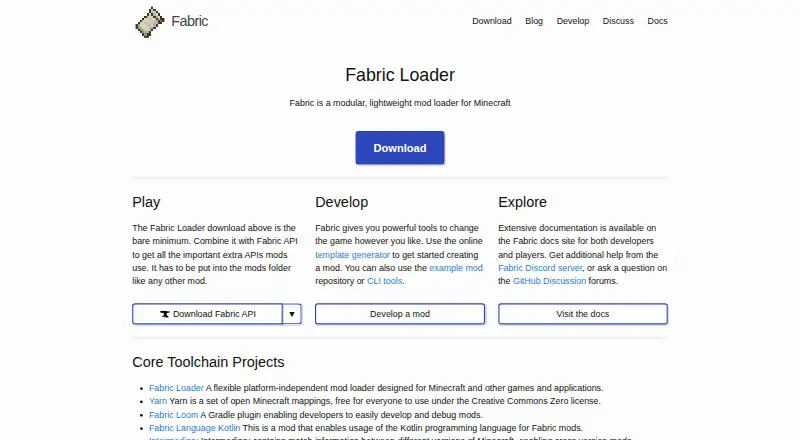
What Fabric is
Fabric is a modular mod loader for Minecraft, with a toolchain for players and mod developers. Fabric Loader provides the basic loader, but most mods also require Fabric API in the mods folder for the extra APIs they use. The download page lists installation options including Minecraft Launcher, Minecraft Server, MultiMC, CurseForge, GDLauncher, ATLauncher, MCUpdater, Technic, and portablemc. For mod creation, Fabric provides an online template generator, project templates, command-line tools, and an example mod repository. Fabric Loom is a Gradle plugin for developing and debugging mods. Yarn supplies open Minecraft mappings under CC0, Intermediary provides match information between Minecraft versions, and Tiny Remapper remaps JAR files. The official documentation includes player instructions for downloading, installing, and troubleshooting mods, plus developer guides covering topics from setup to rendering and networking. Fabric directs users and modders to Discord, repository issue trackers, or its IRC channel for support. The project says it is not an official Minecraft product and is not approved by or associated with Mojang. Fabric is free for everyone to use.
Who it suits
Fabric suits Minecraft players installing mods and developers building or debugging them. It is aimed at Java edition modding, with player and developer guides available in its documentation.
What it does well
- Free to use.
- Offers multiple listed launcher and server installation options.
- Includes templates, command-line tools, and an example mod.
- Documentation covers player setup and mod development.
- Yarn mappings are offered under CC0.
What to know first
- Most mods also require Fabric API.
- The loader download is only the bare minimum.
- Fabric is not approved by or associated with Mojang.
Limits
Fabric Loader is the basic download, and most mods also require Fabric API installed in the mods folder.
Plans
| Plan | Billed and limits | Price |
|---|---|---|
| Fabric | Free for everyone to use · Fabric Loader download is the bare minimum · most mods also require Fabric API | Free |
As fabricmc.net lists them, read 4 Oct 2026. The maker's own page has the final word.
Getting started
- Visit the Fabric website.
- Choose an installation option such as Minecraft Launcher, Minecraft Server, MultiMC, CurseForge, GDLauncher, ATLauncher, MCUpdater, Technic, portablemc, or Metadata API.
- Download Fabric Loader for the relevant Minecraft setup.
- Install Fabric API in the mods folder for mods that require it.
- Use the documentation's player guides for installation and troubleshooting, or its developer guides to set up a project.
Fabric is a free, modular foundation for running and creating Minecraft Java mods. It is best for players committed to Fabric-compatible mods and developers who want a lightweight, Gradle-based toolchain with version-conscious workflows. The main trade-off is practical rather than financial: installing the loader alone often will not satisfy a mod’s requirements.
Overview
Fabric combines a Minecraft mod loader with development utilities, mappings, documentation, and multiple installation routes. The loader is designed to be flexible, platform independent, and mostly version independent, making it a sensible base for projects that need to track changing Minecraft releases. For players, however, compatibility remains a mod-by-mod concern, and most Fabric mods also require Fabric API in the mods folder.
The project is for Minecraft Java Edition and is not an official Minecraft product or associated with Mojang. Its documentation supports both sides of the ecosystem: players get setup, download, installation, and troubleshooting guidance, while developers get material ranging from initial project setup through rendering and networking.
Key features
Fabric Loader is the core installation. The download is deliberately minimal, which keeps the foundation focused but means players should expect an additional dependency in Fabric API for many mods. Documentation names Minecraft 26.2, 26.1.2, 1.21.11, 1.21.1, and 1.20.4, while the loader’s version-independent design can help projects span releases without making every mod automatically compatible.
Creators receive an online template mod generator, reusable project templates, command-line tools, and an example mod repository. Fabric Loom adds a Gradle plugin for developing and debugging mods, so the workflow suits developers already comfortable with Gradle rather than people seeking a graphical, no-build-system editor.
The supporting toolchain is unusually complete for a loader. Yarn supplies open Minecraft mappings released for everyone under CC0. Intermediary records matching information between Minecraft versions to support cross-version mods, and Tiny Remapper efficiently remaps JAR files. Together, these tools address the translation and maintenance work that becomes important as game versions change.
Installation is flexible: options include Minecraft Launcher, Minecraft Server, MultiMC, CurseForge, GDLauncher, ATLauncher, MCUpdater, Technic, portablemc, and the Metadata API. That breadth helps players and server operators fit Fabric into an existing setup. Fabric points users toward CurseForge and Modrinth for play, and GitHub for project work. Support is routed through Discord, repository issue trackers for core development questions, and the Fabric IRC channel. Users should heed the project’s warning about fraudulent Discord servers: Fabric says it will never request Microsoft or Minecraft login details.
Pricing
Fabric — free: Fabric is free for everyone to use, with no trial or paid tier. The free plan includes the loader download and the surrounding toolchain, documentation, and installation routes. Its meaningful limitation is functional: the loader is only the bare minimum, and most mods also require Fabric API. There are no seat charges, quotas, renewal terms, or usage caps stated, so it fits individual players, mod developers, and servers that want a no-cost foundation.
Platforms
Fabric supports Java Edition and is offered across API, Linux, macOS, self-hosted environments, and Windows. The combination of launcher, server, and API routes makes it suitable for both local play and self-managed server deployments.
Who it's for
Choose Fabric if you play mods built for its ecosystem, maintain a Minecraft server, or develop mods and need templates, mappings, remapping, and Gradle debugging support. It is especially compelling for developers targeting multiple Minecraft versions. Look elsewhere if your preferred mods use a different loader or if you want a loader-only install with no additional API dependency.
Pros and cons
- Pro: Free for everyone, with no stated quotas or renewal costs, so experimentation and long-term projects carry no software fee.
- Pro: The combination of Loom, Yarn, Intermediary, Tiny Remapper, templates, and command-line tools supports a complete mod-development workflow.
- Pro: Numerous launchers and server options reduce friction when integrating Fabric into existing Minecraft setups.
- Con: The loader download is only the minimum; most mods also need Fabric API installed separately.
- Con: Version independence does not guarantee mod compatibility, so players still need to match each mod to the Minecraft version they run.
Alternatives
Blockbench is a free, cross-platform modeling tool and is the better choice when creating Minecraft models is the priority rather than loading or building code mods. Visual Studio Code is a free editor for Linux, macOS, web, and Windows, suited to readers who primarily need a general coding environment. Architectury Loom is a free experimental Gradle project for users who need its cross-loader-oriented workflow and have Gradle 8.1 or newer. Minecraft Development MCP Server is free, MIT-licensed software for developers able to provide Node.js 18+ and Java 17+. Quilt Loom is a free MIT-licensed alternative for Quilt-based modding. Eclipse IDE is a free, open-source Java IDE for readers who want a full IDE rather than Fabric’s focused toolchain. ForgeGradle is a free option for Forge-oriented Gradle builds. Gradle is the free open-source build system to choose when you need the underlying build tool beyond Minecraft-specific loader features.
Verdict
Fabric is the right choice for Java players using Fabric mods and developers who value a lightweight loader backed by serious versioning and build tools. Its strongest reason to choose it is the breadth of its free ecosystem, from installation routes to mappings and debugging support. Look elsewhere if your mods target another loader, or if the extra Fabric API step makes a minimal installation less appealing.
Verdict
Fabric pairs a basic Minecraft mod loader with developer tooling, documentation, and multiple installation routes. Players should check whether their chosen mods also need Fabric API.
Questions
Does Fabric cost anything?
Fabric is free for everyone to use, with a listed price of $0.
Is there a free trial?
No free trial is listed; Fabric is available as a free plan.
What platforms can I use?
Listed platforms include Linux, macOS, and Windows, along with API and self-hosted.
Do I need Fabric API?
The Loader download is the basic component, and most mods also require Fabric API in the mods folder.
Is Fabric open source?
The site states that its contents are licensed under CC BY-NC-SA 4.0 unless otherwise indicated. Yarn mappings are available under CC0.
Is Fabric an official Minecraft product?
No. Fabric says it is not an official Minecraft product and is not approved by or associated with Mojang.
Facts from Fabric's own pages
- Affiliation
- The site states that Fabric is not an official Minecraft product and is not approved by or associated with Mojang. · fabricmc.net, 4 Oct 2026
- Build tooling
- Fabric Loom is a Gradle plugin for developing and debugging mods. · fabricmc.net, 3 Oct 2026
- Compatibility limitation
- The site says most mods also require Fabric API to be installed in the mods folder. · fabricmc.net, 3 Oct 2026
- Cross-version modding
- Intermediary contains match information between Minecraft versions to enable cross-version mods. · fabricmc.net, 3 Oct 2026
- Current game coverage
- The documentation lists Minecraft 26.2, 26.1.2, 1.21.11, 1.21.1, and 1.20.4. · docs.fabricmc.net, 4 Oct 2026
- Development tools
- The Fabric toolchain includes Fabric Loom, a Gradle plugin for developing and debugging mods. · fabricmc.net, 4 Oct 2026
- Documentation
- The official documentation includes player guides for downloading, installing, and troubleshooting Fabric mods and developer guides covering development setup, rendering, and networking. · docs.fabricmc.net, 4 Oct 2026
- Fabric API
- The site says to combine Fabric Loader with Fabric API for the extra APIs that mods use, and install Fabric API in the mods folder. · fabricmc.net, 4 Oct 2026
- Installation options
- The installation page lists the Minecraft Launcher, Minecraft Server, MultiMC, CurseForge, GDLauncher, ATLauncher, MCUpdater, Technic, and portablemc as options. · fabricmc.net, 4 Oct 2026
- Integrations
- Fabric's site links to CurseForge and Modrinth for play and GitHub for its projects. · fabricmc.net, 4 Oct 2026
- License
- Yarn is a set of open Minecraft mappings offered under the Creative Commons Zero license. · fabricmc.net, 4 Oct 2026
- Loader
- Fabric Loader is described as a flexible, platform-independent mod loader designed for Minecraft and other games and applications. · fabricmc.net, 3 Oct 2026
- Mappings
- Yarn provides open Minecraft mappings that the site says are free for everyone to use under CC0. · fabricmc.net, 3 Oct 2026
- Mod development
- Fabric provides an online template generator, an example mod repository, and command line tools to help create mods. · fabricmc.net, 3 Oct 2026
- Player use
- The site says the Fabric Loader download is the bare minimum and recommends adding Fabric API for the extra APIs used by mods. · fabricmc.net, 3 Oct 2026
- Product
- Fabric is a modular, lightweight mod loader for Minecraft. · fabricmc.net, 4 Oct 2026
- Project setup
- Fabric offers project templates, command line tools, an example mod repository, and an online template mod generator. · fabricmc.net, 4 Oct 2026
- Remapping
- Tiny Remapper is described as an efficient tool for remapping JAR files. · fabricmc.net, 3 Oct 2026
- Security notice
- Fabric warns about fraudulent Discord servers and says it will never ask users to enter their Microsoft or Minecraft login details. · fabricmc.net, 3 Oct 2026
- Support
- The site directs users to the Fabric Discord server and GitHub Discussions for help. · fabricmc.net, 4 Oct 2026
- Version compatibility
- The loader project describes Fabric Loader as mostly version independent. · github.com, 4 Oct 2026
- What it does
- Fabric Loader provides mod loading facilities and useful abstractions for other mods to use. · github.com, 4 Oct 2026
Where Fabric stands on Freedom251
- Minecraft Mod Development Tools#4 of 35
- Minecraft Server Software#5 of 25