Freedom251 › Minecraft Mod Development Tools
Architectury Loom
What Architectury Loom is
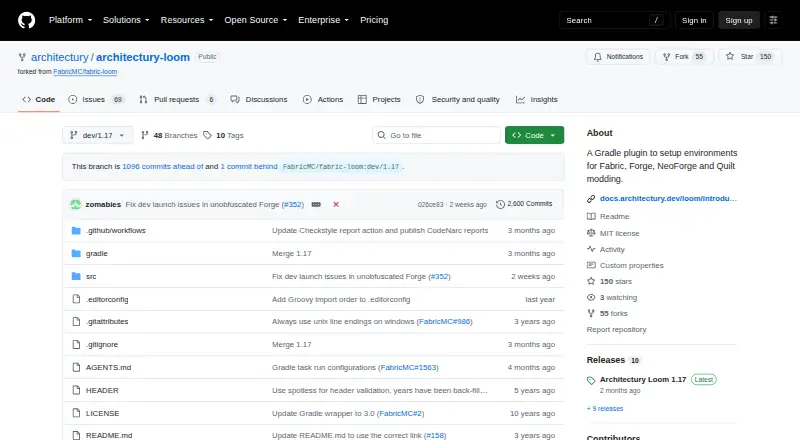
Architectury Loom is a Gradle plugin for preparing Minecraft mod development environments across Fabric, Forge, NeoForge, and Quilt. It is based on FabricMC Loom and described as a ForgeGradle replacement. Developers can choose Yarn, Official Mojang Mappings, or MCP mappings, while Fernflower and CFR generate source code with comments. The plugin supports IntelliJ IDEA and Visual Studio Code; other IDEs are not tested or supported. It requires Gradle 8.1 or newer and is available for Linux, macOS, and Windows. The project is experimental, so issues may arise; its documentation directs users to report them through the issue tracker. The project also offers a Discord community. The repository lists an MIT license, and the latest release listed is 1.17, which adds an API to convert access wideners to access transformers for Forge and NeoForge. Architectury describes its work as enabling development across multiple mod loaders. The plugin is free and open source.
Who it suits
It suits Minecraft mod developers working across Fabric, Forge, NeoForge, or Quilt. Users need Gradle 8.1 or newer and a supported IDE for documented support.
What it does well
- Supports four Minecraft mod loaders.
- Offers Yarn, Mojang, and MCP mappings.
- Fernflower and CFR generate commented source.
- Free and open source under MIT license.
What to know first
- Experimental status means issues may arise.
- Other IDEs are not tested or supported.
- Requires Gradle 8.1 or newer.
Limits
The free plan is described as experimental and requires Gradle 8.1 or newer. IntelliJ IDEA and Visual Studio Code are supported; other IDEs are not tested or supported.
Plans
| Plan | Billed and limits | Price |
|---|---|---|
| Architectury Loom | Experimental project · Gradle 8.1 or newer · IntelliJ IDEA and Visual Studio Code supported | Free |
As github.com lists them, read 4 Oct 2026. The maker's own page has the final word.
Getting started
- Open the Architectury Loom GitHub repository.
- Use a system running Linux, macOS, or Windows.
- Use Gradle 8.1 or newer.
- Choose the relevant supported mod loader and mapping option for the project.
- Use IntelliJ IDEA or Visual Studio Code as the supported IDE.
Architectury Loom is a Gradle plugin for building Minecraft mod development environments across several mod loaders. It is best suited to developers maintaining projects for more than one loader; its broad toolchain support is appealing, but its experimental status calls for caution.
Overview
Based on FabricMC Loom and described as a ForgeGradle replacement, Architectury Loom brings Fabric, Forge, NeoForge and Quilt development into one Gradle setup. That breadth can simplify a project that targets multiple loaders, while developers focused on a single toolchain may not need the extra coverage. It supports Minecraft 1.14.4 and newer, dependency management and artifact packaging.
The project is experimental, and issues may arise. It is a better fit for developers comfortable working with an evolving tool than for teams that need a more predictable foundation. The project invites users to discuss Loom on Discord and directs issue reports to its issue tracker.
Key features
- Loader coverage: Fabric, Forge, NeoForge and Quilt support makes Loom relevant to multi-loader development rather than tying a project to one ecosystem.
- Mapping options: Yarn, Official Mojang Mappings and MCP give developers a choice of naming conventions. That flexibility helps accommodate project preferences, though teams still need to settle on mappings for their work.
- Decompiled sources: Fernflower and CFR generate source code with comments, giving mod developers another way to inspect Minecraft code in a development environment.
- Forge and NeoForge conversion: Version 1.17 adds an API for converting access wideners to access transformers, a targeted capability for projects using those toolchains.
- Gradle integration: Loom supports Gradle 8.1 and newer. Existing projects on older Gradle versions cannot use it without meeting that minimum.
Pricing
Architectury Loom is free and open source under the MIT license. Its free plan costs nothing and includes the experimental project, support for Gradle 8.1 or newer, and documented support for IntelliJ IDEA and Visual Studio Code. There are no paid tiers or trial to weigh against the free offering.
Platforms
Loom supports Linux, macOS and Windows. Its documented IDE support is limited to IntelliJ IDEA and Visual Studio Code; other IDEs are not tested or supported, so developers using a different editor should not assume an equivalent setup.
Who it's for
Choose Loom if you build Minecraft mods for multiple loaders and want mapping choices, decompiled sources, dependency management and artifact packaging within a Gradle development environment. It is less suitable for teams that cannot accommodate experimental software, developers on Gradle earlier than 8.1, or users who rely on an IDE outside IntelliJ IDEA and Visual Studio Code.
Pros and cons
Pros
- Four supported loaders: Fabric, Forge, NeoForge and Quilt make one plugin a plausible foundation for multi-loader projects.
- Choice of mappings and decompilers: Three mapping options and two decompilers give developers control over how they work with Minecraft sources.
- Free and MIT-licensed: There is no subscription cost or paid tier to budget for.
Cons
- Experimental status: The project warns that issues may arise, which is a material risk for teams seeking a stable development base.
- Specific requirements: Gradle 8.1 or newer and support limited to two documented IDEs narrow the setup options.
Alternatives
Browse Minecraft Mod Development Tools for more options in the category. Choose ForgeGradle if you want the tool Loom is positioned to replace, or Fabric if your focus is the Fabric loader rather than a plugin spanning four loaders. Quilt Loom is another free, MIT-licensed Minecraft modding tool; consider it when you want to compare a Quilt-oriented option. Gradle is the open-source build system underneath this kind of workflow, not a substitute for Loom's loader and mapping support.
IntelliJ IDEA is an IDE, with a free core for Java and Kotlin and a paid Ultimate subscription, so it is an editor choice rather than a direct replacement for Loom. Visual Studio Code is another free option that runs on Linux, macOS, Windows and the web, and is among Loom's supported IDEs. Eclipse IDE is free and open source if you prefer that IDE, though Loom does not document support for it. Blockbench is free to use for any type of project and runs on desktop, mobile and web; choose it when that broader platform availability matters more than Loom's Gradle-based mod development workflow.
Verdict
Architectury Loom is a strong candidate for Minecraft mod developers who need one Gradle plugin across Fabric, Forge, NeoForge and Quilt. Its free, open-source model and mapping and decompilation choices make it useful for cross-loader work, but developers who need a more predictable tool or an IDE beyond IntelliJ IDEA and Visual Studio Code should look elsewhere.
Verdict
Architectury Loom brings several mod-loader toolchains and mapping choices into a Gradle development setup. Its experimental status and limited documented IDE support are worth considering before adoption.
Questions
Is Architectury Loom free?
Yes. The listed plan is free, and the project is open source under the MIT license.
Which Minecraft mod loaders does it support?
It supports Fabric, Forge, NeoForge, and Quilt.
Which platforms and IDEs are supported?
It runs on Linux, macOS, and Windows. IntelliJ IDEA and Visual Studio Code are supported; other IDEs are not tested or supported.
What Gradle version does it require?
Architectury Loom supports Gradle 8.1 and newer.
Is there a free trial?
The pricing information lists no free trial.
Facts from Architectury Loom's own pages
- Community support
- The repository README invites users to talk with the project on Discord. · github.com, 4 Oct 2026
- Current release
- The GitHub releases page lists Architectury Loom 1.17 as the latest release. · github.com, 4 Oct 2026
- Decompilers
- The README says Loom uses Fernflower and CFR to generate source code with comments. · github.com, 4 Oct 2026
- Decompiler support
- The README says it uses the Fernflower and CFR decompilers to generate source code with comments. · github.com, 3 Oct 2026
- Development environment
- The project describes Loom as a plugin for setting up a deobfuscated development environment for Minecraft mods. · github.com, 4 Oct 2026
- Experimental status
- The documentation describes Architectury Loom as experimental and says issues may arise, directing users to report them to the issue tracker. · docs.architectury.dev, 3 Oct 2026
- ForgeGradle replacement
- The documentation describes it as a replacement plugin for ForgeGradle based on FabricMC Loom. · docs.architectury.dev, 3 Oct 2026
- Forge support
- Architectury Loom is a fork based on Fabric Loom that supports the Forge modding toolchain. · github.com, 4 Oct 2026
- Gradle requirement
- The documentation says Architectury Loom supports Gradle 8.1 and up. · docs.architectury.dev, 4 Oct 2026
- IDE support
- The documentation lists IntelliJ IDEA and Visual Studio Code as supported IDEs; other IDEs are not tested or supported. · docs.architectury.dev, 4 Oct 2026
- Intended users
- The Architectury organization describes itself as a project enabling development across multiple mod loaders. · github.com, 4 Oct 2026
- Latest release
- The GitHub releases page lists Architectury Loom 1.17 as the latest release. · github.com, 3 Oct 2026
- License
- The repository includes an MIT License. · github.com, 4 Oct 2026
- Mappings
- The documentation says Loom supports Yarn or Official Mojang mappings, and also supports MCP. · docs.architectury.dev, 4 Oct 2026
- Modding audience
- The Architectury organization describes itself as a project to enable multi-modloaders development. · github.com, 3 Oct 2026
- Project status
- The documentation describes Architectury Loom as an experimental project and says issues may arise, with reports directed to its issue tracker. · docs.architectury.dev, 4 Oct 2026
- Purpose
- Architectury Loom is a Gradle plugin for setting up environments for Fabric, Forge, NeoForge, and Quilt Minecraft modding. · github.com, 4 Oct 2026
- Release capability
- Version 1.17 lists a new API for converting access wideners to access transformers for Forge and NeoForge. · github.com, 3 Oct 2026
Where Architectury Loom stands on Freedom251
- Minecraft Mod Development Tools#2 of 35