Freedom251 › On-Call Scheduling Software

OpsKnight
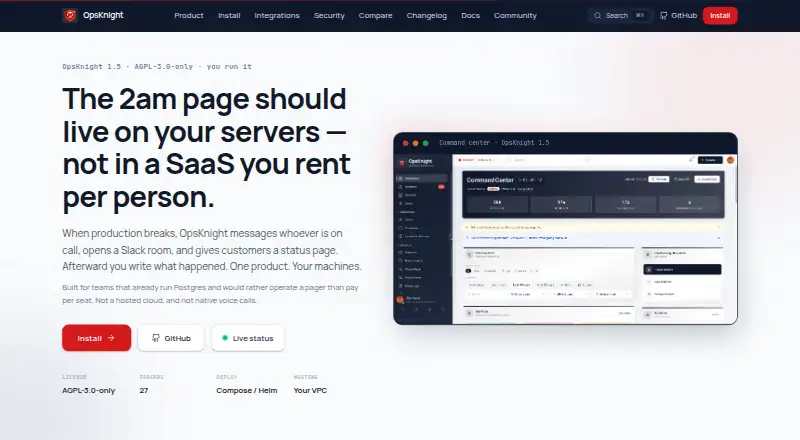
What OpsKnight is
OpsKnight is a self-hosted incident command and on-call platform for alerting, paging, escalation policies, war rooms, status pages, and incident timelines. Monitoring webhooks can open incidents for responders to acknowledge, assign, resolve, or group by fingerprint to reduce duplicate paging. On-call schedules support rotations, time zones, and swaps; pages can be sent through SMS, push, Slack, Microsoft Teams, WhatsApp, or automated voice calls. A responder can acknowledge a voice page by pressing 1, and unacknowledged calls move to the next escalation tier. The Community edition includes one status page per install, SLA policies, support-hours rules, and MTTA/MTTR analytics. The integrations page lists 27 native integrations, including Datadog, Sentry, Grafana Alerting, AWS CloudWatch, Slack, and Jira Cloud. Community is self-hosted under AGPL-3.0-only and requires PostgreSQL 14+ and configured secrets. The maker says it has no hosted SaaS cloud, external telemetry, or vendor phone-home, and it is not for users seeking a fully managed service today.
Who it suits
It is intended for SRE, DevOps, and platform teams able to run Postgres, Docker, or Kubernetes. It may suit teams that need a self-hosted incident platform, including those with strict compliance requirements.
What it does well
- Supports on-call rotations, time zones, and swaps
- Pages through SMS, push, chat tools, and voice
- Community includes one status page per install
- Lists 27 native integrations
- Maker states there is no external telemetry
What to know first
- Not intended for users needing a fully managed service
- Requires PostgreSQL 14+ and configured secrets
- Community includes one status page per install
Limits
The free Community edition includes one status page per installation. It requires PostgreSQL 14+ and configured secrets, and the maker says it is not for users who need a fully managed hosted service today.
Plans
| Plan | Billed and limits | Price |
|---|---|---|
| Community | Self-hosted · AGPL-3.0-only · one status page per install | Free |
As opsknight.com lists them, read 5 Oct 2026. The maker's own page has the final word.
Getting started
- Open https://opsknight.com/ and review the Community installation information.
- Prepare PostgreSQL 14+ and configured secrets.
- Choose a supported deployment route: Docker Compose, Docker Swarm, Helm, or Kustomize.
- Use Docker Engine 20+ with Compose 2+ or Kubernetes 1.24+ as listed in the installation requirements.
- Set up local accounts or OIDC sign-in with a supported identity provider.
OpsKnight brings alert handling, on-call coordination, and incident follow-through into a system teams operate themselves. It is most compelling for SRE, DevOps, and platform groups already comfortable with PostgreSQL and container infrastructure. Its operational reach is broad, but keeping that infrastructure running is part of the commitment.
Overview
Monitoring webhooks can open incidents for responders to acknowledge, assign, resolve, and group by fingerprint, helping reduce repeat pages for the same issue. War rooms, stakeholder updates, and post-incident timelines extend the workflow beyond alert delivery. That breadth suits teams seeking one incident command environment; it is less attractive if the priority is to hand operations to a vendor.
Key features
Rotations account for time zones and swaps, while escalation policies move unanswered incidents to the next tier. Notifications can arrive by SMS, push, Slack, Microsoft Teams, WhatsApp, or automated voice call. A responder can acknowledge a voice page by pressing 1, and calls that go unanswered or unacknowledged advance through escalation. Responders can also use an installable PWA with their desktop login, rather than a separate app-store product.
Community includes one public, restricted, or private status page per installation, with an optional custom domain. SLA policies, support-hours rules, and MTTA/MTTR analytics help teams track response performance. One page may be enough for a single service or team, but organizations separating public communications across multiple services will face a practical ceiling.
The integrations page names 27 native integrations, including Datadog, Sentry, Prometheus Alertmanager, Grafana Alerting, AWS CloudWatch, GitHub Actions, Slack, and Jira Cloud. Generic JSON webhooks with SHA-256 fingerprint deduplication extend ingestion to custom tools and scripts. That combination gives teams established connectors and a route for bespoke monitoring without relying solely on a built-in catalog.
Credentials are encrypted at rest in PostgreSQL with AES-256-CBC envelope encryption, and inbound webhooks use cryptographic verification. Local accounts and OIDC single sign-on are supported, including Google Workspace, Okta, Azure AD, Keycloak, and Authentik, alongside workspace and team roles. The maker says the Community data plane stays in the operator’s environment, with no hosted SaaS cloud, external telemetry beacons, vendor phone-home, or hosted cloud holding encryption keys. This is relevant to teams with strict data-control requirements, though they remain responsible for operating the deployment.
Pricing
Community: free. The self-hosted edition is licensed under AGPL-3.0-only and includes on-call scheduling, escalation policies, a basic status page, post-incident reviews, stakeholder updates, and ChatOps incident actions. Its one-status-page-per-install limit is the clearest product cap; the cost advantage comes with infrastructure and maintenance work rather than a managed service.
Community can run with Docker Compose, Docker Swarm, Helm, or Kustomize. The install prerequisites include PostgreSQL 14+ and configured secrets; the recommended container options are Docker Engine 20+ with Compose 2+ or Kubernetes 1.24+. Teams without that operational foundation should weigh the labor and expertise required alongside the zero subscription price. Enterprise modules, support, or hosted offerings may be offered under separate licenses, but the Community edition itself is the self-managed option.
Platforms
OpsKnight is available as a self-hosted and web platform, with API access and Android and iOS access listed. Phone response is through an installable PWA using the same account as desktop, not a separate app-store product.
Who it's for
OpsKnight is a strong fit for SRE, DevOps, and platform teams that already operate Postgres, Docker, or Kubernetes and want incident data to remain in their own environment. Its alerting, paging, escalation, status reporting, and review workflow can serve teams that need more than notification routing. It is a poor fit for organizations that need a fully managed hosted service today or cannot take responsibility for deployment prerequisites and ongoing operation.
Pros and cons
- Pro: A connected workflow from webhook ingestion through escalation, coordination, and post-incident review reduces the need to treat paging as a standalone task.
- Pro: Multiple paging channels, voice acknowledgment, and time-zone-aware rotations give responders several ways to receive and act on incidents.
- Pro: Self-hosting, encryption at rest, webhook verification, and OIDC support suit teams prioritizing control over data and identity.
- Con: PostgreSQL, container-orchestration prerequisites, configured secrets, and self-operation put meaningful infrastructure work on the customer.
- Con: Community permits just one status page per install, which can constrain teams that need distinct pages across services.
- Con: The maker says it is not intended for users seeking a fully managed hosted service today.
Alternatives
Choose incident.io if a free option centered on Slack or Microsoft Teams native incident response, single-team on-call, and a status page better matches the team’s needs. Choose PagerDuty if its free plan’s 5-user, 1-schedule, and 1-escalation-policy allowances suit a small team that wants those stated caps. PagerTree is another option to compare for its free Basic plan for up to 5 users and 2 teams, with three months of data retention. TaskCall offers a $9 a month Starter plan with unlimited global SMS and voice notifications, a distinction worth considering when those channels are central.
IncidentRelay is an open-source, self-hosted alternative. MonoDuty offers a free plan. Opsgenie offers a free plan for 5 users. Runframe offers a free plan with up to 5 users, one basic schedule, Slack incident response, and one basic hosted status page.
For category comparisons, see On-Call Scheduling Software, On-Call Management Software, and IT Incident Management Software.
Verdict
Choose OpsKnight if your SRE, DevOps, or platform team can operate PostgreSQL and container infrastructure and wants an incident workflow whose data plane stays under your control. Its strongest case is the combination of paging, escalation, coordination, and review in a free self-hosted edition. Look elsewhere if you need managed hosting or multiple Community status pages per install.
Verdict
OpsKnight offers incident response and on-call workflows as a self-hosted Community edition. Teams need to operate its dependencies themselves, and the Community edition is limited to one status page per install.
Questions
Is OpsKnight free?
Yes. The Community plan is free and is self-hosted under AGPL-3.0-only.
What deployment options does Community support?
It can be deployed with Docker Compose, Docker Swarm, Helm, or Kustomize. PostgreSQL 14+ and configured secrets are required.
Which platforms can I use?
The listed platforms are Android, iOS, web, API, and self-hosted. Phone access is through an installable PWA that uses the desktop login, not a separate app-store product.
How many status pages are included?
Community includes one public, restricted, or private status page per installation, with an optional custom domain.
Does OpsKnight support single sign-on?
Yes. It supports OIDC single sign-on with Google Workspace, Okta, Azure AD, Keycloak, and Authentik, as well as local accounts.
Is there a hosted service?
The maker says OpsKnight has no hosted SaaS cloud and is not for users who need a fully managed hosted service today. Separately licensed support or hosted offerings may be offered independently.
Facts from OpsKnight's own pages
- Audience
- The maker describes it as intended for SRE, DevOps, and platform teams already running Postgres, Docker, or Kubernetes, including teams with strict compliance requirements. · opsknight.com, 5 Oct 2026
- Commercial boundary
- The Community application is licensed under AGPL-3.0-only, while separately licensed Enterprise modules, support, or hosted offerings may be offered independently. · opsknight.com, 4 Oct 2026
- Custom ingestion
- Generic JSON webhooks are supported for internal tools, Kubernetes operators, cron jobs, and custom monitoring scripts. · opsknight.com, 5 Oct 2026
- Deployment
- Community is self-hosted and can be deployed with Docker Compose, Docker Swarm, Helm, or Kustomize. · opsknight.com, 5 Oct 2026
- Deployment requirements
- The install page lists Docker Engine 20+ with Compose 2+ or Kubernetes 1.24+, PostgreSQL 14+, and configured secrets as prerequisites. · opsknight.com, 4 Oct 2026
- Identity
- OpsKnight supports local accounts and OIDC single sign-on with Google Workspace, Okta, Azure AD, Keycloak, and Authentik. · opsknight.com, 5 Oct 2026
- Identity controls
- OpsKnight supports local accounts and OIDC single sign-on with Google Workspace, Okta, Azure AD, Keycloak, and Authentik, along with workspace and team roles. · opsknight.com, 4 Oct 2026
- Incident workflow
- It groups related alerts into incidents that responders can acknowledge, assign, resolve, and document from a timeline. · opsknight.com, 5 Oct 2026
- Integrations
- The integrations page lists 27 integrations, including Datadog, New Relic, Prometheus Alertmanager, Grafana, AWS CloudWatch, Slack, and Jira Cloud. · opsknight.com, 5 Oct 2026
- Intended users and limitation
- OpsKnight describes itself as intended for SRE, DevOps, and platform teams that can run Postgres, Docker, or Kubernetes, and says it is not for users who need a fully managed hosted service today. · opsknight.com, 4 Oct 2026
- On-call and paging
- It supports rotations and escalation, with voice calls, SMS, push, Slack, Microsoft Teams, and WhatsApp notifications. · opsknight.com, 5 Oct 2026
- Phone access
- Responders can acknowledge incidents from an installable PWA that uses the same login as desktop; the site says it is not a separate app-store product. · opsknight.com, 4 Oct 2026
- Purpose
- OpsKnight is a self-hosted incident command and on-call platform for alerting, paging, escalation, war rooms, status pages, and postmortem timelines. · opsknight.com, 5 Oct 2026
- Requirements
- OpsKnight requires PostgreSQL 14+ and configured secrets; the install page recommends Docker Engine 20+ with Compose 2+ or Kubernetes 1.24+. · opsknight.com, 5 Oct 2026
- Security
- The security page says stored credentials use AES-256-CBC envelope encryption and inbound webhook signatures are checked with constant-time verification. · opsknight.com, 5 Oct 2026
- Status and reporting
- The Community edition includes one public, restricted, or private status page per install, plus SLA policies, support-hours rules, and MTTA/MTTR analytics. · opsknight.com, 4 Oct 2026
- Status page limit
- The Community edition includes one public, restricted, or private status page per install, with an optional custom domain. · opsknight.com, 5 Oct 2026
- Support and hosting
- The maker says OpsKnight is not for users who need a fully managed hosted service today; separately licensed support or hosted offerings may be offered independently. · opsknight.com, 5 Oct 2026
- Telemetry
- The maker states there is no external telemetry, no vendor phone-home, and no hosted cloud holding encryption keys. · opsknight.com, 5 Oct 2026
- Telemetry and hosting
- OpsKnight says it has no hosted SaaS cloud, external telemetry beacons, or vendor phone-home; the Community data plane runs in the operator’s environment. · opsknight.com, 4 Oct 2026
- Voice calls
- Responders can acknowledge a voice page by pressing 1, and unanswered or unacknowledged calls advance to the next escalation tier. · opsknight.com, 5 Oct 2026
- What it does
- OpsKnight is a self-hosted incident command and on-call platform with alerting, paging, escalation policies, war rooms, status pages, and incident timelines. · opsknight.com, 4 Oct 2026
Where OpsKnight stands on Freedom251
- On-Call Scheduling Software#5 of 25
- On-Call Management Software#10 of 30
- IT Incident Management Software#15 of 31