Freedom251 › On-Call Scheduling Software
IncidentRelay
What IncidentRelay is
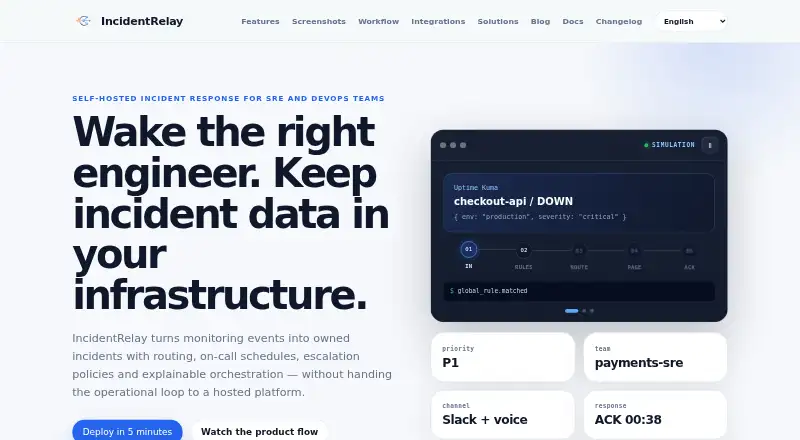
IncidentRelay is open-source, self-hosted software for on-call management and incident response, presented for SRE and DevOps teams. It routes alerts by source, labels, severity, and team ownership, then applies team rules and escalation policies. Teams can manage schedules, shifts, rotations, overrides, and escalation chains. Responders can acknowledge, resolve, silence, or escalate alerts, and temporarily shelve alert groups. Event orchestration rules can enrich, group, route, suppress, and automate events; rules are versioned, with execution history to review matches and results. Incoming integrations include Alertmanager, AWS SNS and CloudWatch, Grafana, Datadog, Azure Monitor, Zabbix, Sentry, LibreNMS, PagerDuty Events API v2, RMON, heartbeats, and generic webhooks. Notifications can be sent through Slack, Mattermost, Telegram, email, Discord, Microsoft Teams, webhooks, voice calls, or browser/PWA push. The software provides Swagger UI and OpenAPI JSON, route-intake and personal API tokens, and roles including viewer, editor, user_admin, responder, and manager. Deployment options include Docker Compose, Kubernetes with Helm, RPM packages, and manual systemd installation. Schedules can be exported through read-only CalDAV calendars or tokenized ICS feeds.
Who it suits
It suits SRE and DevOps teams seeking self-hosted incident management and on-call workflows. Teams can choose among several documented deployment methods and notification channels.
What it does well
- Routes alerts using source, severity, and team ownership.
- Supports shifts, rotations, overrides, and escalation chains.
- Event rules include execution history.
- Offers CalDAV and ICS schedule exports.
- Free, open-source, and self-hosted.
What to know first
- Requires a self-hosted deployment.
- Production installations run separate web/API and scheduler processes.
Plans
| Plan | Billed and limits | Price |
|---|---|---|
| IncidentRelay | Open-source · Self-hosted | Free |
As incidentrelay.io lists them, read 4 Oct 2026. The maker's own page has the final word.
Getting started
- Choose a deployment route: Docker Compose, Kubernetes with Helm, an RPM package, or manual systemd installation
- For production, run the separate web/API and scheduler processes
- Configure incoming alert integrations using route intake tokens
- Create teams, schedules, rotations, and escalation policies
- Connect notification channels for responders
IncidentRelay is open-source, self-hosted software for on-call management and incident response. It is aimed at SRE and DevOps teams that need detailed alert routing and scheduling under their own operational control. The trade-off is clear: there is no licence charge, but your team must run and maintain the service.
Overview
IncidentRelay combines alert intake, responder coordination and event automation in one workflow. Routing can account for source, labels, severity and team ownership before escalation policies and team rules are applied. That makes it a better fit than a schedule-only tool for organisations dealing with noisy, multi-team monitoring environments.
Self-hosting is central rather than incidental. Deployment is documented through Docker Compose, Kubernetes with Helm, RPM packages and manual systemd installation. Production setups separate web/API and scheduler processes, so operators should plan for service administration as well as incident configuration.
Key features
Routing and response
Responders can acknowledge, resolve, silence or escalate alerts, while alert groups can be temporarily shelved. These controls give teams practical ways to reduce repeat notifications and redirect ownership without losing the underlying workflow.
Schedules and calendars
Schedules support shifts, rotations, overrides and escalation chains. Read-only CalDAV calendars and tokenized ICS feeds export on-call information to calendar software, useful when responders need schedule visibility outside the incident system.
Event orchestration
Versioned rules can enrich, group, route, suppress and automate events. Execution history records rule matches and results, providing an inspectable trail when teams tune automation or investigate why an alert was handled a certain way.
Integrations and automation
Incoming integrations cover Alertmanager, AWS SNS and CloudWatch, Grafana, Datadog, Zabbix, Sentry, LibreNMS, RMON, PagerDuty Events API v2, heartbeats and generic webhooks. Delivery options include Slack, Mattermost, Telegram, email, Discord, Microsoft Teams, outbound webhooks, voice calls and browser/PWA push.
Swagger UI and OpenAPI JSON support API-driven work. Route intake tokens connect incoming integrations, while personal API tokens support user-scoped automation. Group and team roles include viewer, editor, user_admin, responder and manager, giving administrators a defined access model.
Webhook guidance requires HTTPS by default, blocks private and special network addresses unless allowlisted, and encrypts secret headers so APIs do not return them. Those controls matter for teams exposing event intake to external systems.
Migration
Migration tools for Grafana OnCall and PagerDuty use public APIs, avoid product databases and default to dry-run mode. That approach lowers the risk of an irreversible first migration, although teams still need to validate mappings and resulting schedules.
Pricing
The IncidentRelay plan costs free, is open-source and self-hosted. There are no published seat, incident or notification quotas in this plan. It suits teams able to provide their own hosting and operations; organisations wanting a vendor-managed service or a stated support commitment should look elsewhere.
Platforms
IncidentRelay provides an API and web interface and runs on Linux in a self-hosted deployment. The documented installation choices range from Docker Compose and RPM packages to manual systemd and Kubernetes with Helm, giving infrastructure teams several ways to fit it into their environment.
Who it's for
IncidentRelay is best for SRE and DevOps groups that want ownership of alert data, integrations and runtime placement. It is particularly suitable where routing by labels or severity, multiple escalation paths and event suppression are everyday requirements. Smaller teams without capacity to operate separate web/API and scheduler processes may prefer a hosted alternative.
Pros and cons
- Pro: Open-source self-hosting avoids licence fees and lets teams control deployment location.
- Pro: Routing, rotations, escalation chains and event rules cover the full path from alert intake to response.
- Pro: Broad monitoring, notification and API integration options reduce the need for custom connectors.
- Pro: Versioned orchestration rules and execution history make automated handling reviewable.
- Con: Deployment and upkeep remain the customer’s responsibility, including production process separation.
- Con: The free plan publishes no vendor-managed service, seat allowance or support terms, so operational expectations must be set internally.
Alternatives
For a broader directory of products, see On-Call Scheduling Software and On-Call Management Software.
Choose incident.io instead if you want a freemium service with Android, iOS, macOS and web access, including a free Basic plan with native Slack or Microsoft Teams incident response, single-team on-call, a status page and essential automation.
Choose OpsKnight instead for a self-hosted AGPL-3.0-only community edition with one status page per installation.
Choose PagerDuty instead if a freemium platform with a free annual plan for five users, one on-call schedule, one escalation policy and basic chat is the priority.
PagerTree is another freemium option with a five-user, two-team free plan and three months of data retention.
TaskCall is a freemium alternative whose Starter plan adds unlimited global SMS and voice-call notifications.
MonoDuty offers a freemium free tier limited to one user, three services, five monitors, five heartbeats, one team, one schedule, five webhooks and 50 incidents per month.
Opsgenie is a freemium option with a five-user free plan and paid tiers with stated incident and retention allowances.
LinkedIn Databus is a free Apache 2.0 open-source project for teams seeking a self-hosted data platform rather than incident-response workflows.
Verdict
Choose IncidentRelay when self-hosting, open-source licensing and deep routing, scheduling and orchestration are more important than a managed service. Look elsewhere if you want the provider to run the platform or need published seat, support and usage commitments.
Verdict
IncidentRelay combines alert routing, on-call schedules, escalation workflows, and event automation in a self-hosted package. Its documented deployment choices and integrations support teams that want control over where they run it.
Questions
Is IncidentRelay free?
Yes. Its listed IncidentRelay plan is free and is open-source and self-hosted.
Does IncidentRelay have on-call schedules and escalation policies?
Yes. Teams can create schedules, shifts, rotations, overrides, escalation chains, and escalation policies.
Which deployment options are available?
The documentation describes Docker Compose, Kubernetes with Helm, RPM packages, and manual systemd installation.
What alert sources can it connect to?
Listed sources include Alertmanager, AWS SNS and CloudWatch, Grafana, Datadog, Azure Monitor, Zabbix, Sentry, LibreNMS, PagerDuty Events API v2, RMON, heartbeats, and generic webhooks.
Which notification channels are supported?
Documented options include Slack, Mattermost, Telegram, email, Discord, Microsoft Teams, outbound webhooks, voice calls, and browser/PWA push.
Can schedules sync to calendars?
Schedules can be exported through read-only CalDAV calendars and tokenized ICS feeds.
Facts from IncidentRelay's own pages
- Access controls
- The documentation describes group and team roles, including viewer, editor, user_admin, responder and manager. · incidentrelay.io, 4 Oct 2026
- Alert integrations
- Available 1.x incoming integrations include Alertmanager, AWS SNS and CloudWatch, Grafana, Datadog, Zabbix, Sentry, LibreNMS, RMON, generic webhooks, PagerDuty Events API v2 and heartbeats. · incidentrelay.io, 4 Oct 2026
- Alert routing
- It routes incoming alerts by source, labels, severity and team ownership, then applies escalation policies and team rules. · incidentrelay.io, 4 Oct 2026
- Automation API
- IncidentRelay provides Swagger UI and OpenAPI JSON, with route intake tokens for incoming integrations and personal API tokens for user-scoped automation. · incidentrelay.io, 4 Oct 2026
- Calendar exports
- On-call schedules can be exported through read-only CalDAV calendars and tokenized ICS feeds. · incidentrelay.io, 4 Oct 2026
- Deployment options
- The documentation describes Docker Compose, Kubernetes with Helm, RPM packages and manual systemd installation. · incidentrelay.io, 4 Oct 2026
- Event processing
- Event orchestration can enrich, group, route, suppress and automate events, with execution history to inspect rule matches and results. · incidentrelay.io, 4 Oct 2026
- Incident actions
- Responders can acknowledge, resolve, silence or escalate alerts, and the documentation describes temporarily shelving alert groups. · incidentrelay.io, 4 Oct 2026
- Integrations
- Documented alert sources include Alertmanager, AWS SNS and CloudWatch, Grafana, Azure Monitor, Zabbix, Sentry, LibreNMS and generic webhooks. · incidentrelay.io, 4 Oct 2026
- Intended users
- The maker presents IncidentRelay for SRE and DevOps teams seeking self-hosted incident management and on-call workflows. · incidentrelay.io, 4 Oct 2026
- Migration
- The maker says its Grafana OnCall and PagerDuty migration tools use public APIs, avoid product databases and default to dry-run mode. · incidentrelay.io, 4 Oct 2026
- Notification channels
- Documented notification options include Mattermost, Telegram, Slack, email, webhooks, Discord, Microsoft Teams and voice calls. · incidentrelay.io, 4 Oct 2026
- Notifications
- Available delivery methods include Slack, Mattermost, Telegram, email, Discord, Microsoft Teams, outbound webhooks, voice calls and browser/PWA push. · incidentrelay.io, 4 Oct 2026
- Orchestration
- Event orchestration can enrich, group, route, suppress and automate events using versioned rules. · incidentrelay.io, 4 Oct 2026
- Purpose
- IncidentRelay is open-source, self-hosted on-call management and incident response software for routing alerts, notifying responders, managing rotations and reducing alert noise. · incidentrelay.io, 4 Oct 2026
- Scheduling
- Teams can create on-call schedules, shifts, rotations, overrides and escalation chains. · incidentrelay.io, 4 Oct 2026
- Security
- Its webhook delivery guidance says HTTPS is required by default, private and special network addresses are denied unless allowlisted, and secret headers are encrypted and not returned by APIs. · incidentrelay.io, 4 Oct 2026
- Self-hosting
- Installation paths include Docker Compose, an RPM package and manual systemd; production installations run separate web/API and scheduler processes. · incidentrelay.io, 4 Oct 2026
Where IncidentRelay stands on Freedom251
- On-Call Scheduling Software#3 of 25
- On-Call Management Software#6 of 30