Freedom251 › Change Data Capture Software
LinkedIn Databus
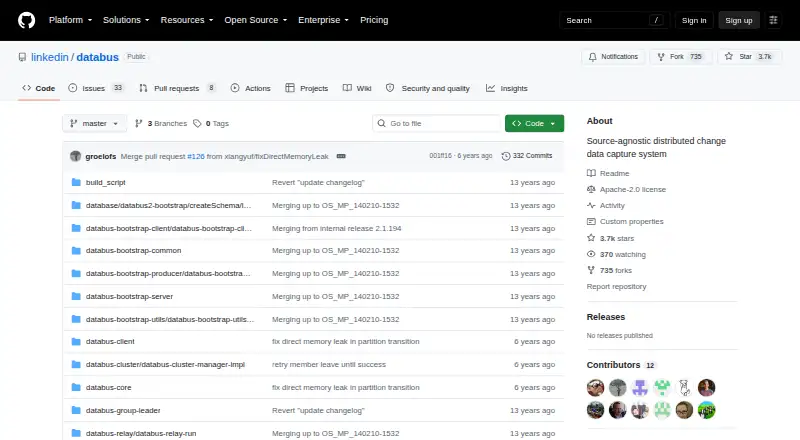
What LinkedIn Databus is
LinkedIn Databus is a self-hosted system for capturing changes in primary data and delivering them to downstream applications such as indexes and read replicas. It uses relays to serve change events, clients to process them, and bootstrap servers to supply historical events when consumers need to catch up. Consumers can start at a chosen point in the stream, use a full-data bootstrap, and consume partitioned data while preserving source consistency. The project describes in-order, at-least-once delivery with high availability, low-millisecond transport latency, and thousands of events per second per server. Its README describes Oracle sources; the wiki documents a MySQL adapter as a proof of concept that was not deployed in LinkedIn production. The project is free under Apache 2.0. Building it requires Gradle 1.0 or above and Oracle's ojdbc6 driver version 11.2.0.2.0, obtained under the Oracle Technology Network License. The repository points users to its wiki for documentation and examples.
Who it suits
Databus suits teams routing primary database changes to derived stores such as indexes, caches, and read replicas. It is intended for self-hosted data architectures and requires Oracle's specified driver to build.
What it does well
- Free under Apache 2.0.
- Supports replay from an arbitrary stream position.
- Provides full-data bootstrap for catch-up.
- Describes in-order, at-least-once delivery.
- Supports partitioned consumption and source consistency.
What to know first
- Build requires Oracle's ojdbc6 driver.
- MySQL adapter is only a proof of concept.
- Requires Gradle 1.0 or above to build.
Plans
| Plan | Billed and limits | Price |
|---|---|---|
| Databus (Apache 2.0 open source) | Source code licensed under Apache 2.0 | Free |
As github.com lists them, read 7 Oct 2026. The maker's own page has the final word.
Getting started
- Open the Databus repository at https://github.com/linkedin/databus.
- Review the repository wiki for documentation and examples.
- Use Gradle version 1.0 or above to build Databus.
- Obtain Oracle's ojdbc6 driver version 11.2.0.2.0 under the Oracle Technology Network License.
- Deploy it as a self-hosted system using relays, clients, and bootstrap servers.
LinkedIn Databus is a self-hosted system for moving database changes into downstream data services. It suits teams maintaining indexes, caches, or read replicas from primary data, especially where consumers need replay and historical catch-up. Its recovery model is useful, but the documented Oracle focus and build prerequisites make it a specialized choice.
Overview
Databus captures changes to primary data, routes events through relays, and lets clients process them. Bootstrap servers provide historical events, so consumers can join at a chosen point in the stream or catch up after falling behind. That is valuable when derived stores need to be brought back into line without treating every recovery as a complete rebuild.
The project describes transport latency in the low milliseconds and throughput of thousands of events per second per server. Its delivery model is in-order and at-least-once, with high availability. Ordering and replay support consistency-sensitive pipelines; at-least-once delivery, however, means downstream processing must be able to handle repeated events.
Key features
- Change capture and routing: Databus moves changes from primary data toward derived systems. LinkedIn describes using it to feed search indexes, a social-graph index, and member-profile read replicas, making its intended role concrete for teams with similar data flows.
- Replay and bootstrap: Consumers can select a starting point in the stream, while bootstrap servers supply historical events for catch-up. This supports both initial population and recovery of a lagging consumer.
- Partitioned consumption: Databus supports partitioned consumption while preserving source consistency. That can help teams distribute processing without abandoning consistency across the source data.
Pricing
Databus (Apache 2.0 open source): free. The plan provides source code under the Apache 2.0 license, and the project identifies Databus as self-hosted. There is no paid tier or trial in the stated pricing model; the cost advantage comes with the work of running and building the system yourself.
Building requires Gradle 1.0 or above and Oracle's ojdbc6 driver version 11.2.0.2.0, which is obtained under the Oracle Technology Network License. The driver requirement is a meaningful qualification for teams assessing the free plan, particularly if their deployment is not centered on Oracle.
Platforms
Databus is categorized for API, web, and self-hosted use, with Android also shown as a mobile platform. Its deployment model is self-hosted and its capture method is log-based, with initial snapshot support. These capabilities describe a data-pipeline system rather than a turnkey hosted service.
Who it's for
Databus is a fit for engineering teams that need to keep derived stores aligned with primary data and can operate a self-hosted change-capture pipeline. Oracle-oriented architectures get the clearest documented path, particularly where ordered delivery, replay, and historical bootstrap matter. Teams looking for broad, production-documented database coverage should be cautious: the README describes Oracle sources, while the wiki's MySQL adapter is a proof of concept that was not deployed in LinkedIn production.
Pros and cons
Pros
- Recovery options: Arbitrary stream positions and historical bootstrap give consumers a way to catch up without relying only on a full rebuild.
- Clear delivery model: In-order, at-least-once delivery and partitioned consumption with source consistency address important pipeline concerns.
- Open-source use: The Apache 2.0 license and free plan avoid a software license charge.
Cons
- Oracle-centered support: Oracle is the documented source; the MySQL adapter is only a proof of concept and was not used in LinkedIn production.
- Build dependencies: The required Oracle driver and Gradle version add setup considerations before a team can build the project.
- Self-hosting: Teams must run the system themselves rather than rely on a stated hosted deployment or support service.
Alternatives
For a broader choice among change-capture products, compare the Change Data Capture Software category. If the priority is mobile application security instead of database change routing, Ostorlab offers a free Community plan with unlimited mobile app scans, attack-surface discovery, and remediation and ticketing. AppSweep is another free option, with unlimited Android and iOS scans, unlimited team members, and static and interactive analysis. Reversense Security offers a free Android-focused community edition with instrumentation generation and dynamic deobfuscation. SEBASTiAn is a free open-source option for Linux, macOS, and Windows. Data Theorem Mobile Secure is a paid mobile-security option. Quixxi Scan offers one-off Android and iOS scans for $29 per scan. Quokka is a paid option for mobile-app vetting and security testing. Silker AI Mobile Security has a Pro plan at $19.50 a month during its beta offer for the first three months, then 39 USD per month.
For operational coverage rather than data pipelines, see Mobile Application Security Testing Software or On-Call Scheduling Software.
Verdict
Choose LinkedIn Databus if you can self-host an Oracle-oriented pipeline and need ordered change delivery, replay, and bootstrap to keep derived data current. Its free Apache 2.0 license is a practical advantage, but teams needing production-ready support for multiple documented source databases or a managed service should look elsewhere.
Verdict
Databus offers change capture, replay, and bootstrap for systems that need to keep derived data aligned with primary sources. Its documented Oracle support and build dependencies are important considerations; the MySQL adapter is not a production deployment.
Questions
Is LinkedIn Databus free?
Yes. The source code is licensed under Apache 2.0.
Where can Databus run?
Databus is self-hosted. Its listed platforms are API, self-hosted, and web.
Which database sources does it support?
The README describes Oracle sources. The wiki documents a MySQL adapter as a proof of concept that was not deployed in LinkedIn production.
What license does Databus use?
The repository identifies the license as Apache 2.0.
What is needed to build Databus?
The README requires Gradle version 1.0 or above and Oracle's ojdbc6 driver version 11.2.0.2.0, obtained under the Oracle Technology Network License.
What does Databus do with change events?
It captures, transports, and processes primary-data changes for downstream systems. Consumers can start at an arbitrary point and use historical events for bootstrap and catch-up.
Facts from LinkedIn Databus's own pages
- Architecture
- Databus uses relays to serve change events, clients to process them, and bootstrap servers to provide historical events for catch-up. · github.com, 7 Oct 2026
- Build requirement
- The README says Databus requires Gradle version 1.0 or above to build. · github.com, 7 Oct 2026
- Consumption
- Databus supports partitioned consumption and preservation of source consistency. · github.com, 7 Oct 2026
- Database support
- The project README describes Oracle sources, and its wiki documents a MySQL adapter as a proof-of-concept implementation. · github.com, 7 Oct 2026
- Delivery
- The wiki describes guaranteed in-order, at-least-once delivery with high availability. · github.com, 7 Oct 2026
- Documentation and support
- The repository points users to its wiki for documentation and examples; the reviewed project pages do not state a support service. · github.com, 7 Oct 2026
- Downstream uses
- LinkedIn says Databus feeds its Social Graph Index, People Search Index, and Member Profile read replicas. · github.com, 7 Oct 2026
- Founded
- 2015 · github.com, 28 Sept 2026
- Headquarters
- Sunnyvale, California, United States · github.com, 28 Sept 2026
- History and bootstrap
- Consumers can start from an arbitrary point in the change stream, with full-data bootstrap capability. · github.com, 7 Oct 2026
- Integration requirement
- Building Databus requires Oracle's ojdbc6 driver version 11.2.0.2.0, obtained under the Oracle Technology Network License. · github.com, 7 Oct 2026
- Intended use
- The README describes Databus as part of LinkedIn's data-processing pipeline for keeping derived stores and indexes consistent with primary data. · github.com, 7 Oct 2026
- Intended users
- The project describes use in data architectures that route primary database changes to derived stores such as indexes, caches, and read replicas. · github.com, 7 Oct 2026
- Latency and throughput
- The README describes low-millisecond transport latency and throughput of thousands of events per second per server. · github.com, 7 Oct 2026
- License
- The repository identifies Databus as licensed under Apache 2.0. · github.com, 7 Oct 2026
- MySQL limitation
- The wiki says the MySQL adapter was not deployed in LinkedIn production and was intended to demonstrate how to write a fetcher. · github.com, 7 Oct 2026
- Product
- Databus is a source-agnostic distributed change data capture system. · github.com, 7 Oct 2026
- Purpose
- It captures, transports, and processes changes to primary data so they can flow to downstream systems. · github.com, 7 Oct 2026
- Replay and bootstrap
- Consumers can start at an arbitrary point in the change stream, and the system supports full-data bootstrap and catch-up. · github.com, 7 Oct 2026
- Sources and downstream uses
- The README says Databus supports Oracle sources and describes downstream use for search and social-graph indexes and member-profile read replicas. · github.com, 7 Oct 2026
Where LinkedIn Databus stands on Freedom251
- Change Data Capture Software#9 of 23