Freedom251 › Change Data Capture Software
dbmazz
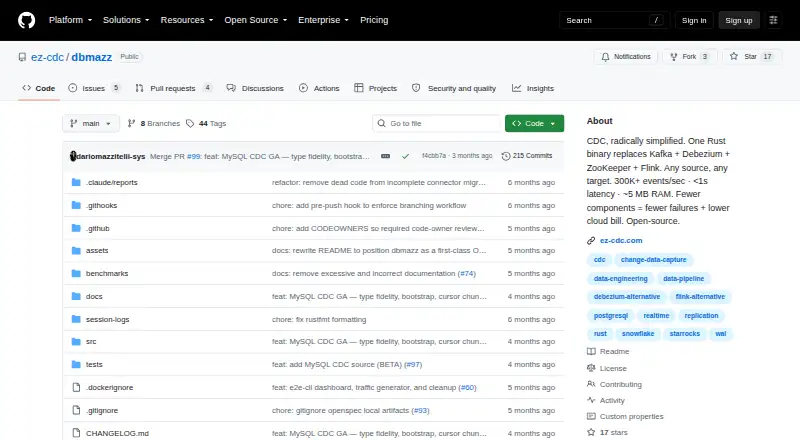
What dbmazz is
dbmazz is a Rust daemon that reads PostgreSQL changes through logical replication and streams inserts, updates, and deletes to a sink. The project reports sub-second replication lag and about 11 MB of resident memory per daemon. PostgreSQL and MySQL are listed as sources, while stable sinks include StarRocks, PostgreSQL, and Snowflake; S3/Iceberg is on the roadmap. Each dbmazz instance handles one replication job. The project provides an ez-cdc CLI quickstart demo and an official Docker image for running the daemon. Its CLI runs on Linux and macOS for amd64 and arm64. The maker also lists Prometheus metrics, gRPC reflection, an HTTP control plane, and a live terminal dashboard. Automatic setup can create publications, replication slots, sink tables, and audit columns. Self-hosting is free; the free BYOC plan deploys in a customer's AWS or GCP account, while support and optional PrivateLink connectivity are charged separately. dbmazz uses Elastic License 2.0, which allows commercial and non-commercial use but restricts offering it to third parties as a managed service.
Who it suits
It may suit teams seeking streaming PostgreSQL change data capture without operating a streaming platform, including teams deploying the daemon themselves or in their AWS or GCP account.
What it does well
- Streams inserts, updates, and deletes through logical replication.
- Stable sinks include StarRocks, PostgreSQL, and Snowflake.
- Automatic setup can create replication slots and sink tables.
- Self-hosted engine and BYOC plans are free.
- CLI supports Linux and macOS on amd64 and arm64.
What to know first
- Each instance handles one replication job.
- S3/Iceberg is listed as roadmap, not stable.
- BYOC support and optional PrivateLink are charged separately.
- The license restricts offering it as a managed service.
Limits
Each dbmazz instance handles one replication job. On the free BYOC plan, support and optional PrivateLink connectivity are charged separately.
Plans
| Plan | Billed and limits | Price |
|---|---|---|
| Self-host dbmazz | Free forever · Open-source engine · CLI and terminal dashboard · local web UI · community support | Free |
| BYOC | Free · Deploy into your AWS or GCP account · support and optional PrivateLink connectivity are charged separately | Free |
As github.com lists them, read 29 Sept 2026. The maker's own page has the final word.
Getting started
- Open the dbmazz GitHub project.
- Choose the self-hosted daemon or the BYOC deployment model.
- For self-hosting, use the ez-cdc CLI quickstart demo or official Docker image.
- Run the CLI on Linux or macOS with amd64 or arm64.
- Configure a source and sink for a replication job.
dbmazz is a self-hosted Rust daemon for capturing database changes and delivering them to supported destinations. It is a strong fit for teams that want PostgreSQL CDC without running a separate streaming platform, especially when a small, focused deployment is more useful than a broad orchestration layer. The trade-off is a single replication job per instance and a license that limits offering the software as a managed service.
Overview
dbmazz uses PostgreSQL logical replication to stream inserts, updates, and deletes into a sink. Initial snapshots help populate a destination before ongoing changes arrive, while schema-evolution support helps a pipeline accommodate subsequent structural changes. The project reports sub-second replication lag and approximately 11 MB of resident memory per daemon. Those figures make the stated resource profile attractive, although production results will vary with workload and topology.
PostgreSQL and MySQL are named as sources. Stable sinks are StarRocks, PostgreSQL, and Snowflake, giving teams several analytical and operational targets. S3/Iceberg is a roadmap item rather than a current destination, so it is not the right choice when object-storage delivery is a present requirement. A dbmazz instance handles one replication job; separate pipelines therefore require separate instances and the associated operational overhead.
Key features
The ez-cdc CLI quickstart provides a direct route into a demo, and an official Docker image supports container-based deployment. Automatic creation of publications, replication slots, sink tables, and audit columns can remove repetitive database preparation in supported setups. That is particularly useful for teams standardizing many similar environments, though the one-job boundary still determines how those environments must be split.
Operations teams get Prometheus metrics, gRPC reflection, an HTTP control plane, and a live terminal dashboard. Together, these interfaces support both conventional metrics collection and interactive inspection. Documentation points users to GitHub Discussions and Issues, with support by email or GitHub issue also described. This is community- and issue-based assistance rather than a bundled enterprise support commitment.
For managed infrastructure, EZ-CDC's BYOC model runs in the customer's AWS or GCP account, keeping data in that account. Listed BYOC capabilities include multi-AZ high availability, autoscaling, load balancing, optional PrivateLink, and data sovereignty. Support and optional PrivateLink connectivity are charged separately, so the free deployment price does not mean every BYOC service is included.
Pricing
Self-host dbmazz
The plan costs nothing, billed Free forever. It includes the open-source engine, CLI and terminal dashboard, local web UI, and community support. This is the natural option for teams comfortable operating their own Linux or macOS infrastructure and accepting issue-based support. It does not remove the one-job-per-instance constraint.
BYOC
BYOC is free, billed Free, and deploys into your AWS or GCP account. Support and optional PrivateLink connectivity are separate charges, so organizations needing vendor assistance or private connectivity should budget beyond the displayed plan price. The model is suited to teams that want account-level data location and the listed high-availability and scaling features while retaining control of the cloud environment.
Platforms
dbmazz is self-hosted and targets Linux and macOS. The README says its CLI runs on both amd64 and arm64 on those operating systems, which gives teams flexibility across common server and developer hardware. Docker is an additional deployment route through the official image.
Who it's for
Choose dbmazz when your primary need is log-based PostgreSQL CDC, your destinations are among StarRocks, PostgreSQL, or Snowflake, and you prefer to avoid operating a separate streaming platform. Its automatic setup, stated low daemon memory use, and multiple observability interfaces also suit compact platform teams.
Look elsewhere if you need S3/Iceberg now, a single service to host many independent replication jobs, or a permissive model for reselling the software as a managed service. The Elastic License 2.0 permits commercial and non-commercial use but restricts offering dbmazz to third parties as a managed service.
Pros and cons
Pros
- Focused CDC engine: logical replication, snapshots, and schema evolution cover the core path from source database to sink.
- Lean stated footprint: the project reports sub-second lag and about 11 MB resident memory per daemon.
- Useful operator tooling: Prometheus, gRPC reflection, an HTTP control plane, and a terminal dashboard provide several monitoring and control options.
- Flexible deployment: self-hosting, Docker, and BYOC in AWS or GCP accommodate different infrastructure policies.
Cons
- One job per instance: multiple pipelines require multiple daemon deployments.
- Limited current sink set: S3/Iceberg is not yet a current destination.
- Extra BYOC costs: support and optional PrivateLink connectivity are billed separately.
- Elastic License restriction: managed-service providers cannot offer it to third parties in that form.
Alternatives
For a wider connector ecosystem under Apache License 2.0, consider Apache Flink CDC, which provides released JARs and connectors across Linux, macOS, Windows, and self-hosted setups.
Canal is a free Apache-2.0 project for teams seeking an open-source CDC option with API support alongside self-hosted Linux and macOS deployments.
Debezium is the better fit when you want an open-source distributed CDC platform under Apache License 2.0, including API and Windows support.
Choose pgstream when a PostgreSQL-focused CDC CLI and Go library under Apache 2.0 better matches your implementation approach.
Sequin offers a self-hosted, MIT-licensed alternative for teams that want their own infrastructure with API and web interfaces.
For a hosted-style service with a free tier, Decodable includes 20 streams, four running tasks, and 24 hours or 10GiB of retention on its Free plan.
Estuary is another freemium alternative, with a free plan, a $100.00-per-month pay-as-you-go plan, and a free Developer plan.
LinkedIn Databus is a free Apache 2.0 open-source option for teams evaluating another self-hosted CDC platform.
Verdict
dbmazz is a sensible choice for teams that want a compact, self-managed PostgreSQL CDC daemon, supported sinks, and no software charge. Choose it for straightforward pipelines and account-controlled BYOC deployments; look elsewhere when many jobs must share one service, S3/Iceberg is essential today, or a managed-service business model conflicts with its license.
Verdict
dbmazz provides a focused path for streaming database changes, with a one-job-per-instance limit and a defined set of stable sinks. Teams should also account for its license restriction and any separately charged BYOC support or connectivity.
Questions
How much does dbmazz cost?
The self-hosted plan is free, billed Free forever. BYOC is free, billed Free; support and optional PrivateLink are charged separately.
Which databases can it connect?
PostgreSQL and MySQL are listed as sources. Stable sinks are StarRocks, PostgreSQL, and Snowflake; S3/Iceberg is listed as roadmap.
Where can I run dbmazz?
The daemon is self-hosted, with Linux, macOS, and self-hosted listed as platforms. The CLI runs on Linux and macOS for amd64 and arm64; BYOC runs in a customer's AWS or GCP account.
What license does dbmazz use?
It uses Elastic License 2.0, which allows commercial and non-commercial use while restricting offering it to third parties as a managed service.
How can I get support?
The project points users to GitHub Discussions and Issues. Its documentation also lists support by email or GitHub issue.
Facts from dbmazz's own pages
- Automatic setup
- The maker says ez-cdc can create publications, replication slots, sink tables, and audit columns automatically. · ez-cdc.com, 29 Sept 2026
- BYOC and data location
- EZ-CDC says BYOC runs in the customer's AWS or GCP account and that its data stays within that account. · ez-cdc.com, 29 Sept 2026
- BYOC security features
- The maker lists multi-AZ high availability, autoscaling, load balancing, optional PrivateLink, and data sovereignty for BYOC. · ez-cdc.com, 29 Sept 2026
- CLI platforms
- The project README says its CLI runs on Linux and macOS for amd64 and arm64. · github.com, 29 Sept 2026
- Intended users
- The README describes dbmazz as an option for teams seeking streaming PostgreSQL CDC without operating a streaming platform. · github.com, 29 Sept 2026
- License
- dbmazz uses Elastic License 2.0, which the README describes as allowing commercial and non-commercial use while restricting offering it to third parties as a managed service. · github.com, 29 Sept 2026
- Notable limitation
- The README says each dbmazz instance handles one replication job. · github.com, 29 Sept 2026
- Observability
- The maker lists Prometheus metrics, gRPC reflection, an HTTP control plane, and a live terminal dashboard. · ez-cdc.com, 29 Sept 2026
- Performance
- The project reports sub-second replication lag and about 11 MB of resident memory per daemon in its README. · github.com, 29 Sept 2026
- Setup
- The project provides an ez-cdc CLI quickstart demo and an official Docker image for running the daemon. · github.com, 29 Sept 2026
- Sources and sinks
- The README lists PostgreSQL and MySQL sources, with StarRocks, PostgreSQL, and Snowflake as stable sinks; S3/Iceberg is listed as roadmap. · github.com, 29 Sept 2026
- Support
- The project points users to GitHub Discussions and Issues, and its documentation lists support by email or GitHub issue. · docs.ez-cdc.com, 29 Sept 2026
- What it does
- dbmazz is a Rust daemon that reads PostgreSQL changes through logical replication and streams inserts, updates, and deletes to a sink. · github.com, 29 Sept 2026
Where dbmazz stands on Freedom251
- Change Data Capture Software#5 of 23