Freedom251 › Change Data Capture Software
TiCDC
What TiCDC is
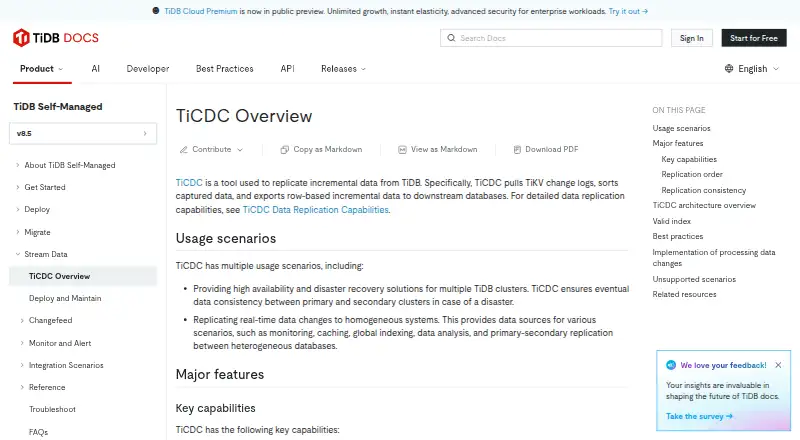
TiCDC is a free, self-hosted tool for replicating incremental data changes from TiDB. It captures TiKV change logs, sorts them, and exports row-based data to destinations including TiDB, MySQL-compatible databases, Kafka, Amazon S3, GCS, Azure Blob Storage, and NFS. Recommended Kafka formats include Canal-JSON, Avro, and Debezium. Filters can limit replication by database, table, DML, or DDL; the Open API can query task status, change task configuration, and create or delete tasks. TiCDC supports TiDB-to-TiDB replication for disaster recovery, with second-level RPO and minute-level RTO, and bidirectional replication for multi-active deployments. It can be deployed with a new TiDB cluster or added to an existing one; deployment guidance recommends at least two instances in production. The system supports adding and removing nodes dynamically and has no single point of failure. Delivery is at least once, so failures can lead to repeated statements or Kafka messages. Tables generally need at least one valid index unless force-replicate is used.
Who it suits
TiCDC suits teams running TiDB that need incremental feeds for recovery, monitoring, caching, indexing, analysis, or replication to heterogeneous databases. It is self-hosted and supports several database and storage destinations.
What it does well
- Replicates to databases, Kafka, cloud storage, and NFS.
- Supports bidirectional TiDB cluster replication.
- Filters databases, tables, DMLs, and DDLs.
- Nodes can be added or removed dynamically.
What to know first
- At-least-once delivery can repeat statements or Kafka messages.
- Tables generally need a valid index.
- Large transactions have partial support and out-of-memory risk.
- RawKV-only clusters are unsupported.
Limits
TiCDC delivers each DDL or DML at least once, so failures can produce repeated statements or Kafka messages. It generally replicates only tables with a valid index, and extremely large transactions can create an out-of-memory risk in the new architecture.
Plans
| Plan | Billed and limits | Price |
|---|---|---|
| TiCDC (open-source) | No paid plans or usage caps stated on the TiCDC pages opened | Free |
As docs.pingcap.com lists them, read 2 Oct 2026. The maker's own page has the final word.
Getting started
- Open the TiCDC documentation website.
- Deploy TiCDC with a new TiDB cluster or add it to an existing cluster.
- For production, follow the guidance recommending at least two TiCDC instances.
- Configure a downstream destination and any database, table, DML, or DDL filters.
- Use the Open API to check task status or manage replication tasks.
TiCDC is an open-source change-data-capture tool that streams incremental changes from TiDB to databases, message brokers, and cloud storage. It suits teams running TiDB that need downstream feeds or cluster replication and can operate self-hosted infrastructure. Its breadth is useful, but at-least-once delivery and documented edge cases call for careful planning.
Overview
TiCDC captures TiKV change logs, orders the changes, and exports row-based data. Its log-based approach supports both an initial snapshot and ongoing replication, while schema evolution support helps keep downstream data aligned as schemas change. It can join a new TiDB deployment or be added to an existing cluster.
For recovery, TiCDC can replicate between TiDB clusters with second-level recovery point objectives and minute-level recovery time objectives. It also supports bidirectional cluster replication for multi-active deployments. Those capabilities make it relevant to TiDB operators who need continuity or active data across clusters, rather than a general-purpose replication layer detached from TiDB.
Key features
Sinks, filtering, and control
TiCDC can send changes to TiDB, MySQL-compatible databases, Kafka, Amazon S3, Google Cloud Storage, Azure Blob Storage, and NFS. Kafka users can choose among recommended Canal-JSON, Avro, and Debezium formats. This mix supports operational databases as well as feeds for monitoring, caching, indexing, and analysis, though choosing a format and downstream system remains part of the integration work.
Filtering can target databases, tables, DMLs, and DDLs. The Open API can report task status, change task configuration, and create or delete tasks, giving operators control over replication jobs without limiting the product to a fixed set of pipelines.
Availability and delivery behavior
There is no single point of failure, and TiCDC nodes can be added or removed dynamically. Production deployment guidance recommends at least two instances. The trade-off is its at-least-once delivery guarantee: a failure can cause a DDL or DML to be emitted again, including repeated Kafka messages. Downstream consumers and recovery procedures need to account for duplicates.
Constraints to plan around
TiCDC generally replicates only tables with at least one valid index; a force-replicate option covers tables without one. The docs identify RawKV-only clusters, CREATE SEQUENCE and SEQUENCE functionality, and TiDB Lightning physical imports on tables being replicated as unsupported scenarios. Large upstream transactions receive only partial support, and extremely large transactions can put the new architecture at risk of running out of memory. These constraints make it a poor fit for replication paths that depend on those cases without a workaround.
The deployment guide documents TLS between TiDB components, including TiCDC. That is a useful security control for deployments that require encrypted component traffic.
Pricing
TiCDC (open-source): free. The free, open-source offering is self-hosted, with no paid plans or usage caps stated. It fits teams prepared to deploy and operate the service themselves; the trade-off is that infrastructure and operational responsibility stay with the user.
Platforms
TiCDC is available for API, Linux, macOS, and self-hosted environments. Its deployment model is self-hosted, so teams should expect to manage its place in their TiDB cluster rather than use it as a hosted service.
Who it's for
TiCDC is best suited to TiDB teams building disaster-recovery replication, real-time feeds for monitoring or downstream analysis, or replication between heterogeneous databases. It is less suitable when a required path involves unsupported TiDB features, very large transactions, or a need for exactly-once delivery.
Pros and cons
- Pros: Multiple database, Kafka, cloud-storage, and NFS sinks let TiDB changes serve varied downstream systems.
- Pros: Filtering and task-management APIs provide control over what replicates and how jobs are managed.
- Pros: Cluster-to-cluster recovery and bidirectional replication address recovery and multi-active use cases.
- Cons: At-least-once delivery means downstream systems must tolerate duplicate statements or messages.
- Cons: Index requirements and documented unsupported scenarios can rule out particular tables or workflows.
- Cons: Extremely large transactions carry an out-of-memory risk, limiting confidence in workloads that rely on them.
Alternatives
For a broader range of replication choices, compare Data Replication Software; teams focused specifically on proxying can browse Database Proxy Software, while CDC-focused buyers can compare Change Data Capture Software.
- SymmetricDS is worth considering when its Community plan, which is free forever under AGPL v3, or its Android, iOS, web, and Windows platform coverage better suits the deployment.
- MySQL may suit readers seeking a GPL-licensed community edition with SQL and NoSQL applications plus replication and high-availability components.
- Debezium is another free, open-source distributed change-data-capture platform, and may suit teams seeking CDC across its API, Linux, and self-hosted platforms.
- Amazon Database Migration Service is a paid option with an AWS Free Tier; its stated credits are valid for up to 12 months, so consider it if that AWS offer fits your migration needs.
- Artie may fit teams that want a managed or self-hosted pipeline option with a free tier capped at 1 million billable rows per month and two active pipelines.
- Couchbase XDCR is an alternative to consider for Couchbase deployments.
- Estuary may suit teams looking for a freemium replication option with a listed $100.00 per month pay-as-you-go plan.
- Fivetran Database Replication may suit readers seeking a freemium service with a free tier that specifies monthly active-row and model-run caps.
Verdict
Choose TiCDC if you run TiDB and need self-hosted incremental replication with flexible sinks, filtering, or cluster recovery. Its strongest case is the combination of TiDB-native change capture and cluster-to-cluster options; look elsewhere if duplicate delivery, index constraints, unsupported cases, or large-transaction risk do not fit your replication path.
Verdict
TiCDC provides incremental TiDB replication with filtering, multiple sink types, and cluster-to-cluster options. Plan for its at-least-once delivery behavior, table index requirements, and documented unsupported cases before relying on a replication path.
Questions
Is TiCDC free?
Yes. The open-source TiCDC plan is free; no paid plans or usage caps are stated on the TiCDC pages.
What does TiCDC replicate from?
It captures TiKV change logs to replicate incremental data from TiDB.
Which destinations does it support?
Destinations include TiDB, MySQL-compatible databases, Kafka, Amazon S3, GCS, Azure Blob Storage, and NFS.
Can TiCDC replicate between TiDB clusters?
Yes. It supports cluster replication for disaster recovery, with second-level RPO and minute-level RTO, as well as bidirectional replication for multi-active deployments.
How is TiCDC deployed?
It can be deployed with a new TiDB cluster or added to an existing one. Production deployment guidance recommends at least two instances.
Are there replication constraints?
Delivery is at least once, and TiCDC generally requires tables to have a valid index unless force-replicate is used. The documentation also lists RawKV-only clusters, CREATE SEQUENCE and SEQUENCE functionality, and TiDB Lightning physical import on replicated tables as unsupported scenarios.
Facts from TiCDC's own pages
- API limitation
- TiCDC OpenAPI v1 is deprecated, and its task-creation parameters are less complete than the CLI parameters; the documentation recommends OpenAPI v2. · docs.pingcap.com, 21 Oct 2026
- Availability
- TiCDC has no single point of failure and supports dynamically adding and deleting TiCDC nodes. · docs.pingcap.com, 2 Oct 2026
- Bidirectional replication
- TiCDC can replicate changes in both directions between TiDB clusters for multi-active deployments. · docs.pingcap.com, 21 Oct 2026
- Build requirements
- The repository documents compiling TiCDC on Linux or macOS with Go 1.25.12 using make cdc. · github.com, 21 Oct 2026
- Company founding
- LinkedIn states that the TiDB organization was founded in 2015 by three software engineers. · linkedin.com, 21 Oct 2026
- Company size
- LinkedIn lists TiDB powered by PingCAP as having 501–1,000 employees and headquarters in Sunnyvale, California. · linkedin.com, 21 Oct 2026
- Compatibility requirement
- The new architecture requires TiDB 7.5.0 or later. · docs.pingcap.com, 21 Oct 2026
- Delivery semantics
- TiCDC outputs each DDL or DML at least once, so failures can cause repeated statements or Kafka messages. · docs.pingcap.com, 2 Oct 2026
- Deployment
- TiCDC can be deployed with a new TiDB cluster or added to an existing cluster using TiUP. · docs.pingcap.com, 21 Oct 2026
- Deployment and scale
- TiCDC can be deployed with a new TiDB cluster or added to an existing cluster, and the deployment documentation recommends at least two instances in production. · docs.pingcap.com, 2 Oct 2026
- Disaster recovery
- TiCDC supports primary-secondary TiDB replication with second-level recovery-point objectives and minute-level recovery-time objectives. · docs.pingcap.com, 21 Oct 2026
- Documentation
- The TiCDC documentation includes deployment, changefeeds, monitoring, alerting, troubleshooting, performance tuning, integration scenarios, APIs, compatibility, FAQs, and a glossary. · docs.pingcap.com, 21 Oct 2026
- Download targets
- Published binaries cover Linux amd64 and arm64 plus macOS amd64 and arm64. · github.com, 21 Oct 2026
- Downstream sinks
- TiCDC can replicate to TiDB, MySQL-compatible databases, Kafka, Amazon S3, GCS, Azure Blob Storage, and NFS. · docs.pingcap.com, 2 Oct 2026
- Filtering
- Replication rules can filter databases, tables, DML events, and DDL events. · docs.pingcap.com, 21 Oct 2026
- Filtering and management
- TiCDC can filter databases, tables, DMLs, and DDLs, and its Open API can query task status, modify task configuration, and create or delete tasks. · docs.pingcap.com, 2 Oct 2026
- Founded
- 2015 · docs.pingcap.com, 28 Sept 2026
- Funding news
- PingCAP announced a $270 million Series D round on November 17, 2020, led jointly by GGV Capital, Access Technology Ventures, Anatole Investment, Jeneration Capital, and 5Y Capital. · prnewswire.co.uk, 21 Oct 2026
- Headquarters
- Sunnyvale, California, USA · docs.pingcap.com, 28 Sept 2026
- High availability
- TiCDC has no single point of failure and supports dynamically adding or deleting TiCDC nodes. · docs.pingcap.com, 21 Oct 2026
- Index requirement
- TiCDC generally replicates only tables with at least one valid index, though the force-replicate option can replicate tables without one. · docs.pingcap.com, 2 Oct 2026
- Intended users
- Documented use cases include disaster recovery, real-time data feeds for monitoring, caching, indexing and analysis, and replication between heterogeneous databases. · docs.pingcap.com, 2 Oct 2026
- Kafka formats
- Recommended Kafka data formats include Canal-JSON, Avro, and Debezium. · docs.pingcap.com, 2 Oct 2026
- Kafka integration
- TiCDC publishes changes to Kafka using Canal-JSON, Avro, Debezium, Open Protocol, or Simple formats. · docs.pingcap.com, 21 Oct 2026
Where TiCDC stands on Freedom251
- Change Data Capture Software#1 of 23
- Data Replication Software#2 of 27
- Database Proxy Software#3 of 31