Freedom251 › Database Replication Software

Artie
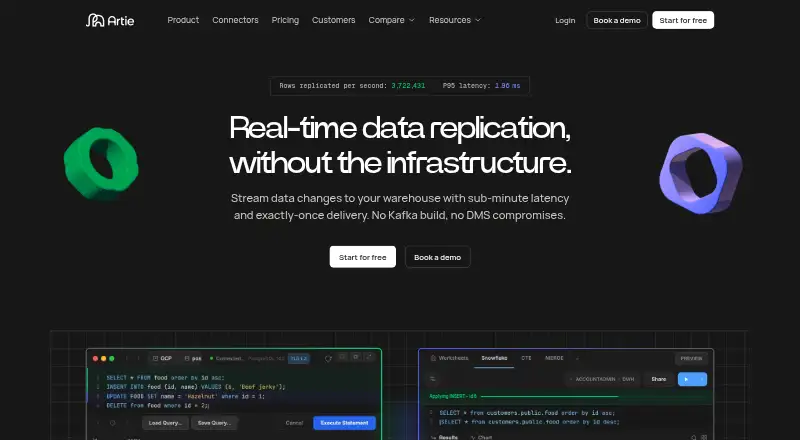
What Artie is
Artie moves database changes and API-ingested events to destination systems in real time. It captures database changes through CDC and describes replication latency as sub-minute, with exactly-once delivery. Automatic schema handling detects column additions, removals and type changes and applies them without pipeline restarts or manual DDL. History mode records row versions over time in the destination, while a dashboard tracks pipeline health, throughput, latency and errors. Artie lists sources including PostgreSQL, MySQL, MongoDB, DynamoDB, Oracle and SQL Server, and destinations including Snowflake, BigQuery, Redshift, Databricks and S3. Data controls include column-level inclusion or exclusion, encryption and hashing. Artie says it encrypts data in transit and at rest and does not retain it after processing. The Free plan allows up to 1M billable rows per month and two active pipelines. Growth starts at $500/month with annual billing; its plan listing gives $500 a month billed as $6,000 annually. Enterprise pricing is custom.
Who it suits
The Free plan is suited to teams starting out or running small pipelines; Growth is described for growing teams. Enterprise is aimed at large organizations needing governance, deployment and compliance options.
What it does well
- Free plan includes up to 1M monthly billable rows.
- Automatic schema changes need no pipeline restarts.
- Dashboard tracks health, throughput, latency and errors.
- Enterprise supports BYOC and on-premise deployment.
What to know first
- Free plan allows only two active pipelines.
- Growth starts at $500/month with annual billing.
- PrivateLink costs $500/month per connection on Growth.
Limits
The Free plan allows up to 1M billable rows per month and two active pipelines. Growth uses volume-based billing and has unlimited active pipelines; its 14-day trial is for Growth. Enterprise pricing is custom.
Plans
| Plan | Billed and limits | Price |
|---|---|---|
| Free | Up to 1M billable rows/month · Up to 2 active pipelines · Backfills included · Slack Community support · SOC 2 Type II | Free |
| Growth | $6,000 billed annually; $600/month month-to-month · Starting at $500/month with annual billing · Usage-based by billable rows · Unlimited active pipelines · 14-day Growth trial · PrivateLink costs $500/month per connection | $500 a month |
| Enterprise | Custom · All Growth features · BYOC and on-premise deployments · Unlimited PrivateLink included · Uptime guarantees · 24/7 support · White-glove onboarding | On request |
As artie.com lists them, read 3 Oct 2026. The maker's own page has the final word.
Getting started
- Visit Artie's website.
- Choose the Free, Growth, or Enterprise plan that fits your needs.
- Use the web or API platform, or consider self-hosted deployment.
- Connect a listed source and destination for replication.
Artie is a one-way data replication service that moves database changes and API events into destination systems in near real time. It fits teams feeding analytics or operational stores from many database types, particularly when schema drift and historical row tracking are important. The trade-off is a tightly capped Free tier and Growth billing that rises with row volume.
Overview
Artie uses change data capture (CDC) or API event ingestion, then delivers records to destinations with stated sub-minute latency and exactly-once delivery. That combination suits continuously updated targets better than batch-oriented jobs. Replication runs in one direction, so organizations requiring bidirectional database synchronization should choose another architecture.
Supported sources include PostgreSQL, MySQL, MariaDB, Microsoft SQL Server, Oracle, MongoDB, DocumentDB, CockroachDB, DynamoDB, Amazon Keyspaces, PlanetScale, Supabase, Aurora/RDS, and Cloud SQL. Destinations include Snowflake, BigQuery, Redshift, Databricks, and S3. This range is useful for mixed estates moving operational data into mainstream warehouses, lakes, or object storage.
Key features
Schema evolution and history
Artie detects column additions, drops, and type changes and applies them without pipeline restarts or manual DDL. Teams with frequently changing source schemas avoid a recurring intervention point. History mode uses SCD Type 2 to retain each row version at the destination, creating an audit trail for compliance reviews, debugging, and analysis of past states.
Monitoring and data controls
The built-in dashboard reports pipeline health, throughput, latency, and errors. Datadog and Grafana integrations let operations teams bring those signals into established observability workflows. Column-level inclusion and exclusion reduce unnecessary exposure, while encryption and hashing protect selected fields in flight. Artie says data is encrypted in transit and at rest, is not retained after processing, and has SOC 2 Type II coverage.
Deployment and transformation
Data transformations are supported, and enterprise customers can run the data plane in their own cloud account or on premises. BYOC keeps processing inside a customer's cloud account, a meaningful option for governance or residency requirements. These deployment choices are aimed at organizations with infrastructure and compliance staff rather than teams seeking a purely hands-off service.
Pricing
Free
The Free plan costs nothing and includes up to 1M billable rows per month, two active pipelines, backfills, Slack Community support, and SOC 2 Type II. It is a sensible starting point for evaluation, small data flows, or teams with predictable low volume. The row and pipeline ceilings make it unsuitable for broad production estates or many concurrent sources.
Growth
Growth starts at $500 a month with annual billing, shown as $6,000 billed annually; month-to-month billing is $600/month. Billing is usage-based by billable rows, while active pipelines are unlimited. A 14-day Growth trial helps teams validate higher-volume operation, but readers should model row growth rather than treating the starting price as a fixed ceiling. A PrivateLink connection costs $500/month. Dedicated Slack or Teams support is included.
Enterprise
Enterprise uses custom pricing and includes all Growth features, BYOC and on-premise deployment, unlimited PrivateLink, uptime guarantees, 24/7 support, and white-glove onboarding. It is the appropriate tier for large organizations that need contractual reliability, controlled deployment, and governance support; smaller teams are likely better served by Free or Growth.
Platforms
Artie is offered through an API, web interface, and self-hosted deployment model. Its hybrid deployment options accommodate teams that want managed access while keeping the data plane in their own environment.
Who it's for
Choose Artie for CDC-driven pipelines into warehouses, lake platforms, or S3 when low latency, automatic schema adaptation, and row-level history reduce operational work. Free suits teams starting out or running small pipelines. Growth targets expanding teams that need unlimited active pipelines and dedicated support. Enterprise is for organizations with on-premise or BYOC requirements, uptime commitments, and compliance-heavy operations.
Pros and cons
Pros
- Exactly-once, sub-minute replication keeps destinations current without relying on frequent batch schedules.
- Automatic handling of column additions, drops, and type changes avoids restarts and manual DDL.
- SCD Type 2 history preserves row versions for auditing and time-based analysis.
- Broad source coverage and destinations such as Snowflake, BigQuery, Databricks, and S3 support varied data estates.
- Column controls, encryption, hashing, and stated SOC 2 Type II coverage address sensitive-data handling.
Cons
- Replication is one way, so it cannot provide bidirectional synchronization.
- Free is limited to 1M billable rows per month and two active pipelines.
- Growth costs depend on billable-row volume, and each PrivateLink connection adds $500/month.
- 24/7 support, uptime guarantees, and on-premise deployment require the custom-priced Enterprise tier.
Alternatives
SymmetricDS is a better fit when an AGPL v3 community edition with a forever-free plan and broad desktop, mobile, server, and web platform coverage is the priority.
MySQL suits teams that want a database product with GPL-licensed replication and high-availability components rather than a standalone replication service.
Debezium is the choice for an Apache-licensed, open-source distributed change-data-capture platform.
TiCDC fits users seeking a free, open-source CDC option with no paid plans or usage caps stated.
Amazon Database Migration Service is preferable for AWS-centered migration work with a free tier that provides credits for up to 12 months.
Bucardo is a free, BSD-licensed option for Linux, macOS, and self-hosted deployments.
Couchbase XDCR is aimed at Couchbase deployments with node-based paid tiers rather than Artie's row-based billing.
Estuary is an alternative freemium platform offering a free tier and a $100-per-month pay-as-you-go plan.
For broader comparisons, see Data Replication Software and Database Replication Software.
Verdict
Artie is a strong choice for teams that need dependable one-way CDC or API ingestion, automatic schema evolution, and retained row history across diverse sources and modern destinations. Its main reason to choose it is the combination of low-latency delivery and reduced schema-maintenance work. Look elsewhere if you need bidirectional synchronization, very small fixed budgets at scale, or a fully open-source stack without usage-based Growth billing.
Verdict
Artie combines database replication, event ingestion, schema handling and monitoring, with plans for small pipelines through enterprise deployments. Check row and pipeline limits, and the stated Growth billing terms, before choosing a plan.
Questions
Is there a free plan?
Yes. The Free plan costs nothing and includes up to 1M billable rows per month and two active pipelines.
How much does Growth cost?
Growth starts at $500/month with annual billing, billed as $6,000 annually. Month-to-month billing is $600/month.
Is a free trial available?
Yes. Artie lists a 14-day Growth trial.
Which databases and destinations does Artie support?
Listed sources include PostgreSQL, MySQL, MariaDB, SQL Server, Oracle, MongoDB, DynamoDB, and others. Listed destinations include Snowflake, BigQuery, Redshift, Databricks, and S3.
Can Artie be self-hosted?
Self-hosted is a listed platform. Enterprise customers can deploy the data plane in their own cloud account or on-premise.
What integrations are available for monitoring?
The dashboard tracks pipeline health, throughput, latency, and errors. Datadog and Grafana integrations are available.
Facts from Artie's own pages
- Data controls
- Artie supports column-level inclusion, exclusion, encryption, and hashing for protecting sensitive data in flight. · artie.com, 3 Oct 2026
- Deployment
- Enterprise customers can deploy Artie's data plane in their own cloud account or on-premise; BYOC is also described as running within the customer's cloud account. · artie.com, 3 Oct 2026
- Headquarters
- San Francisco, California, United States · artie.com, 28 Sept 2026
- History mode
- History mode (SCD Type 2) tracks each row version over time to create an audit trail in the destination. · artie.com, 3 Oct 2026
- Integrations
- Listed sources include PostgreSQL, MySQL, MongoDB, DynamoDB, Oracle, and SQL Server; destinations include Snowflake, BigQuery, Redshift, Databricks, and S3. · artie.com, 3 Oct 2026
- Intended users
- The company describes Free as suited to teams starting out or running small pipelines, Growth to growing teams, and Enterprise to large organizations with governance, deployment, and compliance requirements. · artie.com, 3 Oct 2026
- Latency and delivery
- Artie describes its replication as sub-minute latency with exactly-once delivery. · artie.com, 3 Oct 2026
- Monitoring
- The built-in dashboard tracks pipeline health, throughput, latency, and errors, with Datadog and Grafana integrations available. · artie.com, 3 Oct 2026
- Plan limits
- The Free plan includes up to 1M billable rows per month and up to two active pipelines, while Growth has unlimited active pipelines and volume-based billing. · artie.com, 3 Oct 2026
- Product
- Artie streams database changes via CDC or ingests events via API and replicates them to destinations in real time. · artie.com, 3 Oct 2026
- Schema evolution
- Artie automatically detects and applies column additions, drops, and type changes without pipeline restarts or manual DDL. · artie.com, 3 Oct 2026
- Security
- Artie says it encrypts data in transit and at rest and does not retain data after processing; it lists SOC 2 Type II coverage. · artie.com, 3 Oct 2026
- Support
- Free includes Slack Community support, Growth includes a dedicated Slack or Teams channel, and Enterprise includes 24/7 support. · artie.com, 3 Oct 2026
Where Artie stands on Freedom251
- Database Replication Software#2 of 32
- Data Replication Software#3 of 27