Freedom251 › Cloud Migration Tools

Amazon Database Migration Service
Visit Amazon Database Migration Service Alternatives Pricing
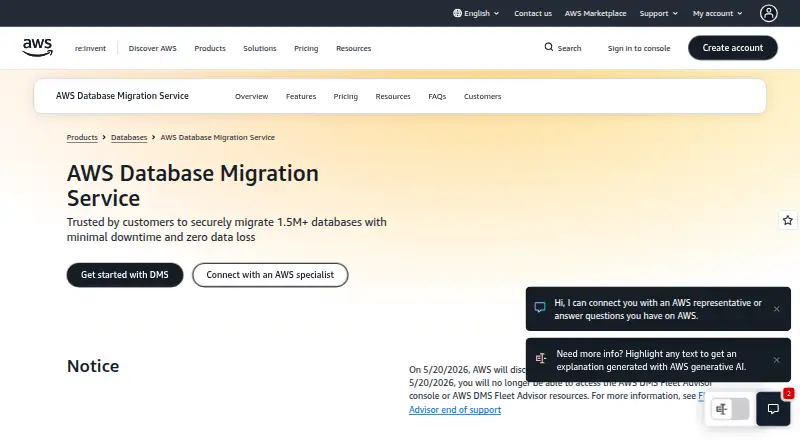
What Amazon Database Migration Service is
Amazon Database Migration Service (AWS DMS) moves relational databases, data warehouses, NoSQL databases, and other data stores to AWS or between cloud and on-premises environments. It supports one-time migrations and ongoing replication that keeps source and target data in sync, including moves between similar or different database engines. AWS says DMS supports more than 20 databases and data warehouses as endpoints. Its Schema Conversion tool assesses and converts schemas and many code objects, while identifying items that need manual conversion. DMS Serverless provisions and scales migration capacity according to transaction volume, with hourly capacity billing. The Multi-AZ option uses redundant replication instances, and migrations can resume after interruptions. DMS integrates with CloudTrail and CloudWatch Logs; its API and AWS CLI can automate task management. Security options include TLS for connections, resource-based access policies, PrivateLink VPC endpoints, and masking selected sensitive columns. The free tier offers $100 in credits, with up to an additional $100 for activating foundational AWS services; credits last up to 12 months. At least one replication endpoint must be in Amazon RDS or on EC2, so on-premises-to-on-premises replication is not supported.
Who it suits
It is intended for organizations migrating or modernizing databases and analytics workloads to AWS, including moves from self-managed databases to managed AWS databases. The endpoint requirement makes it unsuitable for on-premises-to-on-premises replication.
What it does well
- Supports one-time migration and ongoing replication.
- Works with more than 20 database and warehouse types.
- Schema Conversion flags objects needing manual work.
- Migrations can resume after interruptions.
- Offers Multi-AZ replication instances.
What to know first
- On-premises-to-on-premises replication is unsupported.
- At least one endpoint must be Amazon RDS or on EC2.
- Free-tier credits last up to 12 months.
- Usage prices vary by capacity, instance type, or region.
Limits
The AWS Free Tier provides $100 in credits, with up to an additional $100 for activating foundational AWS services; credits last up to 12 months. After credits are depleted, a Paid Plan is required to continue using DMS. Replication requires at least one endpoint to be in Amazon RDS or on EC2.
Plans
| Plan | Billed and limits | Price |
|---|---|---|
| AWS Free Tier | Credits valid up to 12 months for new post-July-15-2025 sign-ups · $100 credits plus up to $100 for foundational services · no DMS transfer charge · credits unavailable in GovCloud and China Beijing | Free |
| On-demand instances | Hourly capacity usage; no long-term commitment · T2, T3, C4, C5, C6i, R4, R5 and R6i instance classes | On request |
| Database Savings Plans | Commitment measured in dollars per hour for one year · Eligible AWS DMS usage · savings in exchange for commitment | On request |
| AWS DMS Serverless | Per hour for AWS DMS capacity units used · 1–384 DCUs · 1 DCU equals 2 GB RAM · Single-AZ or Multi-AZ | On request |
As aws.amazon.com lists them, read 15 Oct 2026. The maker's own page has the final word.
Getting started
- Open the AWS DMS website.
- Choose the AWS Free Tier or a paid usage or commitment option.
- Use DMS to configure source and target database endpoints, with at least one in Amazon RDS or on EC2.
- Choose a one-time migration or ongoing replication.
- Use Schema Conversion to assess and convert schemas and database objects where needed.
Overview
Amazon Database Migration Service (AWS DMS) moves relational, NoSQL and warehouse data stores to AWS or between cloud and on-premises environments. It is best for teams migrating databases to AWS or keeping data synchronized during a move. Its range of migration patterns is useful, but the requirement that at least one endpoint be on RDS or EC2 rules out on-premises-to-on-premises replication.
Key features
DMS handles both one-time migrations and ongoing replication, for moves between like database engines as well as between different engines. AWS says it supports more than 20 databases and data warehouses as source and target endpoints, giving teams with mixed estates options for consolidation. The endpoint rule is a real boundary, not a minor qualification: DMS is not the right fit when both databases must remain on premises.
DMS Schema Conversion assesses schemas and converts most database code objects, including views, stored procedures and functions. It also identifies objects requiring manual conversion, which can help teams scope migration work without implying that every object will transfer automatically.
DMS Serverless provisions and scales migration capacity according to transaction volume, with hourly charges measured in DCUs. That removes the need to set replication capacity in advance, but cost varies with data volume and the maximum DCU setting. On-demand instances instead bill hourly, without a long-term commitment; instance type and AWS Region affect the price, and additional log storage may cost extra. For steady, eligible DMS usage, Database Savings Plans trade a one-year commitment to a specific usage amount for savings of up to 20%.
For resilience, the Multi-AZ option uses redundant replication instances, and DMS can resume a migration after an interruption. CloudTrail and CloudWatch Logs integrations, plus API and AWS CLI controls, support task automation and custom monitoring. Security controls include TLS 1.2 for API clients (AWS recommends TLS 1.3), resource-based access policies, PrivateLink VPC endpoints, SSL/TLS-protected database connections, VPC-hosted replication instances and masking for specified sensitive columns.
Pricing
AWS DMS combines paid usage with an AWS Free Tier offer. The free plan costs nothing and provides $100 in credits, with up to an additional $100 for activating foundational AWS services. Credits are valid for up to 12 months; after they run out, a Paid Plan is required to continue using DMS. Credits are unavailable in AWS GovCloud (US) and China.
AWS DMS Serverless uses hourly capacity billing, with the price varying by data volume and maximum DCU setting. On-demand instances are billed hourly with no long-term commitment, and the rate varies by instance type and Region; log storage may add cost. Database Savings Plans have custom pricing and require a one-year commitment to a specific amount of eligible usage, in exchange for savings of up to 20% when usage is consistent. Serverless suits variable workloads; on-demand fits teams avoiding commitments, while the savings plan is better for predictable usage that can support its term.
Platforms
DMS is offered as a SaaS service on the web, with an API for integration and task management. Discovery and assessment, database migration and continuous replication are supported.
Who it's for
DMS is a strong fit for organizations moving self-managed databases and analytics workloads to AWS, especially when a migration needs ongoing replication or spans different database engines. Teams should look elsewhere if both endpoints must stay on premises, or if they need costs independent of usage and capacity choices.
Pros and cons
- Broad migration coverage: More than 20 database and warehouse endpoints, with homogeneous and heterogeneous moves, can accommodate varied estates.
- Useful continuity options: Ongoing replication, Multi-AZ redundancy and resumption after interruption support migrations that cannot rely on a single uninterrupted run.
- Conversion assistance, not full automation: Schema Conversion handles most code objects and flags manual work, but remaining objects still need attention.
- Endpoint constraint: At least one endpoint must be on RDS or EC2, excluding on-premises-only replication.
- Usage-sensitive costs: Serverless charges depend on DCUs, data volume and maximum capacity, while instance and log-storage costs can also vary.
Alternatives
SymmetricDS is worth considering for a free-forever Community plan under AGPL v3 and support across mobile, desktop, server and web platforms. MySQL is a relevant alternative for teams seeking a database with a Community Edition that includes replication and high-availability components. Debezium offers an open-source distributed change data capture platform under Apache License 2.0. TiCDC is another free, open-source option. Artie has a free plan capped at 1M billable rows per month and two active pipelines, with backfills included. Bucardo is a free, open-source choice for Linux and macOS. Couchbase XDCR is an alternative to consider for Couchbase deployments. Estuary offers a free plan alongside a $100.00 per month pay-as-you-go plan. For broader comparisons, browse Data Replication Software or Cloud Migration Tools.
Verdict
Choose AWS DMS if you are moving databases to AWS and need broad engine support, ongoing replication and recovery options around the migration. Its clearest drawback is the RDS-or-EC2 endpoint requirement; teams that need on-premises-to-on-premises replication should choose another tool.
Verdict
AWS DMS supports several migration patterns and ongoing replication, with schema conversion and resumption after interruptions. Confirm that an endpoint can be hosted on RDS or EC2 and account for the usage-based pricing options.
Questions
Is AWS DMS free?
The AWS Free Tier offers $100 in credits, with up to an additional $100 for activating foundational AWS services. Credits are valid for up to 12 months; after they are depleted, a Paid Plan is required to continue using DMS.
What platforms does AWS DMS support?
The listed platforms are API and web.
What kinds of databases can it migrate?
It migrates relational databases, data warehouses, NoSQL databases, and other data stores. AWS says it supports more than 20 databases and data warehouses as source and target endpoints.
Can it replicate changes continuously?
Yes. DMS supports ongoing replication to keep source and target data in sync.
Can DMS move data between on-premises databases?
No. At least one source or target must be an Amazon RDS database or a database on EC2.
How is paid usage billed?
DMS Serverless is billed hourly based on capacity used. On-demand instances are billed hourly, while Database Savings Plans require a one-year usage commitment; prices vary by usage, instance type, or AWS Region.
Facts from Amazon Database Migration Service's own pages
- API and SDK access
- AWS publishes a DMS API reference with operations, sample requests, responses and errors, and provides AWS CLI commands for DMS. · docs.aws.amazon.com, 15 Oct 2026
- AWS service integrations
- DMS documentation describes VPC endpoints for S3, DynamoDB, Kinesis, Redshift, OpenSearch and Secrets Manager. · docs.aws.amazon.com, 15 Oct 2026
- Company founding
- Amazon Web Services says it launched in 2006. · aws.amazon.com, 15 Oct 2026
- Company headquarters and size
- G2 lists Amazon Web Services headquarters in Seattle, Washington and 148,266 LinkedIn employees. · g2.com, 15 Oct 2026
- Company ownership
- AWS says it operates as part of Amazon. · aws.amazon.com, 15 Oct 2026
- Compliance
- AWS lists DMS in scope for SOC, PCI, ISO, FedRAMP, DoD CC SRG, HIPAA BAA, MTCS, CS, K-ISMS, ENS High, OSPAR and HITRUST CSF programs. · docs.aws.amazon.com, 15 Oct 2026
- Continuous replication
- DMS continuously captures source changes and applies them to a target so applications can keep using the source during migration. · aws.amazon.com, 15 Oct 2026
- Database coverage
- AWS says DMS supports more than 20 databases and data warehouses as source and target endpoints. · aws.amazon.com, 30 Sept 2026
- Database integrations
- Documented source options include Oracle, SQL Server, MySQL, MariaDB, PostgreSQL, MongoDB, SAP ASE, IBM Db2, Azure databases, Google Cloud databases, OCI MySQL, Amazon RDS, Aurora, S3 and DocumentDB. · docs.aws.amazon.com, 15 Oct 2026
- Data protection
- DMS can secure endpoint connections with SSL/TLS, run replication instances inside a VPC, and mask specified sensitive data columns. · aws.amazon.com, 30 Sept 2026
- Data validation
- DMS uses continuous validation and a resync function to detect and correct source-target discrepancies. · aws.amazon.com, 15 Oct 2026
- Documentation depth
- AWS provides data migration, Fleet Advisor, Schema Conversion, step-by-step, API reference and CLI reference documentation. · docs.aws.amazon.com, 15 Oct 2026
- Fleet Advisor
- DMS Fleet Advisor inventories on-premises database and analytics infrastructure and produces migration target recommendations. · docs.aws.amazon.com, 15 Oct 2026
- Founded
- 2006 · aws.amazon.com, 28 Sept 2026
- Generative AI conversion
- The feature page says generative-AI-assisted schema conversion can automatically convert up to 90% of complex objects such as procedures, triggers and functions. · aws.amazon.com, 15 Oct 2026
- Installation model
- DMS requires no local drivers or application installation and is started through the AWS Management Console. · aws.amazon.com, 15 Oct 2026
- Integrations
- DMS integrates with CloudTrail and CloudWatch Logs, and its API and AWS CLI can automate replication task management and custom monitoring. · aws.amazon.com, 30 Sept 2026
- Intended users
- AWS describes DMS as a service for migrating and modernizing databases and analytics workloads to AWS, including migrations from self-managed databases to managed AWS databases. · aws.amazon.com, 30 Sept 2026
- Limit: CDC complexity
- A G2 reviewer says change-data-capture setup requires detailed study and sometimes messy JSON configuration. · g2.com, 15 Oct 2026
- Limit: complex transformations
- A TrustRadius reviewer says task and mapping controls are limited for complex replication, requiring manual deduplication and producing poor ROI. · trustradius.com, 15 Oct 2026
- Limit: data-type compatibility
- G2 reviewers report JSON parsing failures with multiline objects and geospatial-column problems requiring datatype changes. · g2.com, 15 Oct 2026
- Limit: pricing
- G2 reviewers report that pricing can be higher than competing suppliers and that infrastructure maintenance costs remain. · g2.com, 15 Oct 2026
- Migration types
- DMS supports homogeneous migrations between like database engines and heterogeneous migrations between different engines. · aws.amazon.com, 30 Sept 2026
- Network requirements
- API clients must support TLS 1.2, while AWS recommends TLS 1.3 and perfect-forward-secrecy cipher suites. · docs.aws.amazon.com, 15 Oct 2026
Where Amazon Database Migration Service stands on Freedom251
- Cloud Migration Tools#3 of 32
- Data Migration Tools#3 of 25
- Data Replication Software#6 of 27
Look at these too
- AWS Transform MGN (formerly AWS Application Migration Service)
- AWS Schema Conversion Tool
- Google Cloud Migration Center
- Google Compute Engine
- Google Migrate to Containers
- Flexera One IT Asset Management
- Every alternative →
- Compare Amazon Database Migration Service with AWS Transform MGN (formerly AWS Application Migration Service)