Freedom251 › Database Replication Software
Debezium
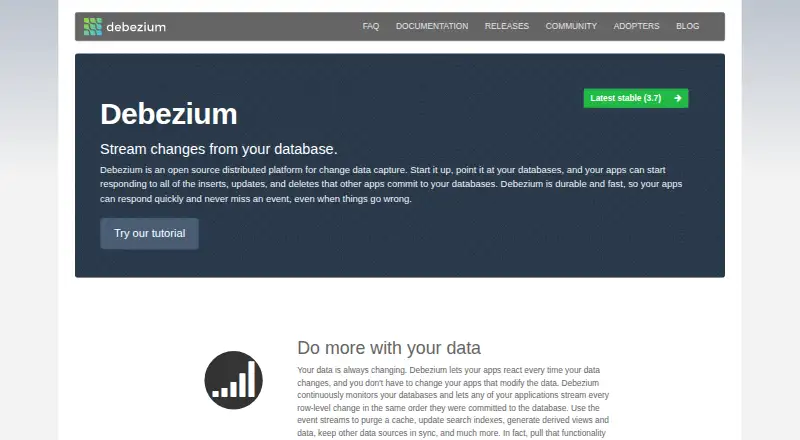
What Debezium is
Debezium is a free, open-source platform that captures row-level changes in databases and streams them to applications as events. Its connectors use database logs to detect inserts, updates, and deletes with low delay, without requiring a change to the data model. Changes are recorded in commit order, and the platform is designed to resume monitoring after applications or services are unavailable. Connectors can take initial or incremental snapshots, filter which schemas, tables, and columns they capture, and mask values in selected columns.
Listed source databases include MongoDB, MariaDB, MySQL, PostgreSQL, SQL Server, Oracle, Db2, and Cassandra. The project also lists connectors for CockroachDB, Spanner, Vitess, Informix, Ingres, Milvus, and YashanDB as incubating; these may change without backward compatibility. A common deployment uses Apache Kafka Connect. Debezium can also run through Debezium Server or as a library in a custom JVM application. Debezium Server can deliver serialized change events to messaging systems such as Amazon Kinesis, Google Cloud Pub/Sub, and Apache Pulsar. Ready-to-use transformations support message routing, filtering, and event flattening. Debezium is licensed under Apache License 2.0 and offers documentation, a Zulip chat room, and a Google Group for community questions.
Who it suits
Debezium suits developers and teams building applications that need to respond to database changes as events. It is intended for users who can deploy and operate a self-hosted platform, commonly with Apache Kafka Connect, or embed a connector in a JVM application.
What it does well
- Captures inserts, updates, and deletes from database logs.
- Does not require changes to the data model.
- Supports initial and incremental snapshots.
- Can filter captured schemas, tables, and columns.
- Can mask values in selected columns.
- Apache License 2.0 open-source software.
What to know first
- The listed deployment methods focus on self-hosting.
- The quay.io container images are intended for testing and evaluation.
- Embedded connectors are less fault tolerant and require the application to manage state.
- Several listed database connectors are incubating and may change without backward compatibility.
Limits
The quay.io container images are for testing and evaluation, not production. Embedding connectors avoids Kafka services but is less fault tolerant because the application must manage state normally held in Kafka's distributed replicated logs. The listed installation methods for Debezium Operator, Server, and CLI are described as coming soon.
Plans
| Plan | Billed and limits | Price |
|---|---|---|
| Debezium | Open-source distributed change data capture platform · Apache License 2.0 | Free |
As debezium.io lists them, read 7 Oct 2026. The maker's own page has the final word.
Getting started
- Visit https://debezium.io/ and review the documentation.
- Choose a listed database source connector.
- Deploy the connector with Apache Kafka Connect, or use Debezium Server or a JVM application.
- Configure snapshots, filters, or masking for captured data as needed.
- Use the documentation, Zulip chat room, or Google Group for questions.
Overview
Debezium turns database row changes into events that applications can consume. It is a strong fit for teams building their own change data capture pipelines across supported databases. Its broad connector set and event controls are useful, but you need to own deployment and reliability choices.
Key features
Log-based capture covers inserts, updates, and deletes with low delay, including deletes without changes to the source data model. Changes are recorded in commit order, and Debezium is designed to resume monitoring after an application or service is unavailable. This suits systems that need an ongoing change stream; it does not remove the work of operating that stream.
Connectors can take initial or incremental snapshots, then filter captured schemas, tables, or columns. They can mask selected column values, including sensitive data, and ready-to-use transformations support routing, filtering, and event flattening. Those controls help teams shape events and limit what reaches downstream systems without building every operation themselves.
Source connectors cover MongoDB, MariaDB, MySQL, PostgreSQL, SQL Server, Oracle, Db2, and Cassandra. Vitess, Spanner, Informix, CockroachDB, YashanDB, Ingres, and Milvus connectors are incubating and may change without backward compatibility. They are a less secure choice for pipelines that depend on a stable connector contract.
Apache Kafka Connect is the most common deployment. Debezium Server can send serialized events to Amazon Kinesis, Google Cloud Pub/Sub, and Apache Pulsar, while JVM applications can embed connectors as a library. Embedding removes the need for Kafka services, but shifts state management to the application and is less fault tolerant because it no longer relies on Kafka's distributed replicated logs. The installation documentation lists Kafka Connect deployment; Debezium Operator, Server, and CLI installation methods are described as coming soon.
Pricing
Debezium is free and open source under the Apache Software License 2.0. Its Debezium plan costs nothing. There is no paid tier to weigh against, but self-hosting means teams must account for the operational work of their chosen deployment.
Platforms
Debezium supports API, Linux, self-hosted, and Windows environments. The project describes Kafka Connect as its common deployment, with JVM embedding and Debezium Server as other options. Its quay.io container images are intended for testing and evaluation, not production, because they do not undergo rigorous testing or security analysis. Teams that require production-ready vendor images should look elsewhere or plan another deployment path.
Who it's for
Debezium suits engineering teams that need one-way, log-based capture from supported databases and can operate a self-hosted pipeline. The project welcomes community participation, and users can turn to its documentation, Zulip chat room, and Google Group. It is a poor fit for buyers seeking a managed service or teams that cannot take responsibility for deployment state and reliability.
Pros and cons
- Broad database coverage: Connectors span widely used relational and document databases, giving teams options for pipelines across different sources.
- Useful event controls: Snapshots, filters, masking, and transformations let teams shape captured data and protect selected column values.
- Operational ownership: Debezium is self-hosted, and embedded use places state management in the application, which can reduce fault tolerance.
- Production image caveat: The published quay.io images are for evaluation rather than production use.
- Connector maturity varies: Incubating integrations may change without backward compatibility, raising upgrade risk for dependent pipelines.
Alternatives
SymmetricDS is another free-plan option, with a Community plan at no cost under AGPL v3. TiCDC is another free change capture option, with no paid plans or usage caps stated on its pages.
Amazon Database Migration Service is the alternative to consider for an AWS-oriented migration workflow; its Free Tier offers $100 in credits, with up to another $100 for activating foundational AWS services, valid for up to 12 months. Artie offers a managed-style alternative for readers who prefer a capped free tier: its Free plan allows up to 1M billable rows per month and two active pipelines, with backfills included. Bucardo is a free, BSD-licensed option for Linux, macOS, and self-hosted use.
Couchbase XDCR is worth considering for readers already evaluating Couchbase: its Basic plan starts at $0.15 a month, billed from $0.15 per hour per node, with a one-node minimum and a 24-hour backup interval. Estuary has both free plans and a $100 a month pay-as-you-go plan, making it another option for readers comparing free and paid entry points. For broader discovery, browse Data Replication Software, Change Data Capture Software, and Database Replication Software.
Verdict
Choose Debezium if you need free, open-source, one-way change capture across varied databases and have the engineering capacity to run it. Its log-based events, filtering, masking, and transformations make it a capable foundation for self-hosted pipelines. Look elsewhere if you need managed operations, production-ready quay.io images, or a deployment that does not shift reliability work to your team.
Verdict
Choose Debezium when you need open-source, log-based capture of database changes and can manage its deployment. Kafka Connect is its most common deployment, with Debezium Server and JVM embedding also available. Look elsewhere if you need a managed service or a production-ready container image from quay.io.
Questions
Is Debezium free?
Yes. Debezium is free and open source under the Apache License 2.0.
Which databases does it support?
Listed connectors include MongoDB, MariaDB, MySQL, PostgreSQL, SQL Server, Oracle, Db2, and Cassandra. The site also lists several incubating connectors, including CockroachDB, Spanner, and Vitess.
How can Debezium be deployed?
A common deployment uses Apache Kafka Connect. It can also run through Debezium Server or as a library embedded in a JVM application.
What can Debezium Server send events to?
It can send serialized change events to messaging systems including Amazon Kinesis, Google Cloud Pub/Sub, and Apache Pulsar.
Can Debezium filter or mask captured data?
Yes. Connectors can filter schemas, tables, and columns, and mask values in selected columns.
Are all listed connectors stable?
No. Vitess, Spanner, Informix, CockroachDB, YashanDB, Ingres, and Milvus are marked incubating and may change without backward compatibility.
Facts from Debezium's own pages
- CDC approach
- Its source connectors use database features for log-based change data capture, which can capture deletes without requiring changes to the data model. · debezium.io, 7 Oct 2026
- Change capture
- Its log-based CDC captures inserts, updates, and deletes with low delay, without requiring changes to the data model. · debezium.io, 7 Oct 2026
- Community support
- The project points users to documentation, a Zulip chat room, and a Google Group for questions. · debezium.io, 7 Oct 2026
- Database connectors
- The connector list includes MongoDB, MariaDB, MySQL, PostgreSQL, SQL Server, Oracle, Db2, and Cassandra, as well as several connectors marked incubating. · debezium.io, 7 Oct 2026
- Database integrations
- Source connectors are listed for MongoDB, MariaDB, MySQL, PostgreSQL, SQL Server, Oracle, Db2, and Cassandra, among others. · debezium.io, 7 Oct 2026
- Data masking
- Debezium can mask values in specified columns, including columns containing sensitive data. · debezium.io, 7 Oct 2026
- Deployment
- The most common deployment uses Apache Kafka Connect; Debezium can also be embedded in JVM applications or run through Debezium Server. · debezium.io, 7 Oct 2026
- Deployment limit
- The installation page lists Kafka Connect connector deployment and says the Debezium Operator, Server, and CLI installation methods are coming soon. · debezium.io, 7 Oct 2026
- Embedded reliability
- The installation documentation says embedded connectors are lighter weight without Kafka services, but are less fault tolerant because the application must manage state normally kept in Kafka logs. · debezium.io, 7 Oct 2026
- Embedded use
- Debezium connectors can be embedded as a library in custom JVM-based applications. · debezium.io, 7 Oct 2026
- Event delivery
- Debezium records changes in commit order and is designed to resume monitoring after applications or services are unavailable. · debezium.io, 7 Oct 2026
- Event destinations
- Debezium Server can send serialized change events to messaging systems including Amazon Kinesis, Google Cloud Pub/Sub, and Apache Pulsar. · debezium.io, 7 Oct 2026
- Incubating feature caveat
- The documentation says embedding a connector library removes the need for Kafka services but is less fault tolerant because the application must manage state normally kept in Kafka's distributed replicated logs. · debezium.io, 7 Oct 2026
- Installation caveat
- The documentation says Debezium container images from quay.io are for testing and evaluation and are not intended for production because they do not undergo rigorous testing or security analysis. · debezium.io, 7 Oct 2026
- Intended users
- The project describes itself as an open-source platform and welcomes community participation in using, discussing, and developing it. · debezium.io, 7 Oct 2026
- License
- All Debezium project code is licensed under the Apache License 2.0. · debezium.io, 7 Oct 2026
- Message transformations
- Ready-to-use transformations support message routing, filtering, event flattening, and other operations. · debezium.io, 7 Oct 2026
- Preview connectors
- The site marks Vitess, Spanner, Informix, CockroachDB, YashanDB, Ingres, and Milvus connectors as incubating and says they may change without backward compatibility. · debezium.io, 7 Oct 2026
- Purpose
- Debezium is an open source distributed platform for change data capture that streams database row changes to applications. · debezium.io, 7 Oct 2026
- Sensitive data
- Connectors can mask values from selected columns that contain sensitive data. · debezium.io, 7 Oct 2026
- Snapshots and filters
- Connectors can take initial or incremental snapshots and filter captured schemas, tables, and columns. · debezium.io, 7 Oct 2026
- Streaming integrations
- Debezium commonly runs with Apache Kafka Connect, and Debezium Server can send events to systems including Amazon Kinesis, Google Cloud Pub/Sub, and Apache Pulsar. · debezium.io, 7 Oct 2026
- Support
- The project points users to its documentation, user chat room, and Google Group for questions. · debezium.io, 7 Oct 2026
- What it does
- Debezium captures row-level database changes so applications can respond to inserts, updates, and deletes as events. · debezium.io, 7 Oct 2026
Where Debezium stands on Freedom251
- Database Replication Software#4 of 32
- Change Data Capture Software#4 of 23
- Data Replication Software#5 of 27