Freedom251 › Log Management Software
Fluentd
by Fluentd
What Fluentd is
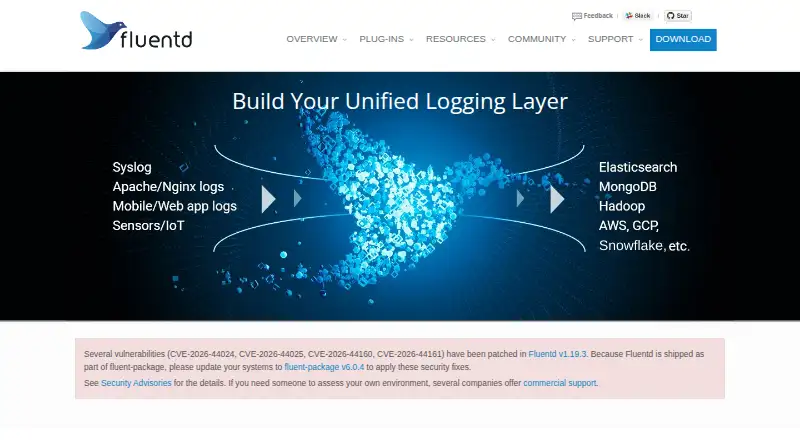
Fluentd is a free, open-source data collector for creating a unified logging layer. It uses JSON to bring log collection, filtering, buffering, and output together across sources and destinations. More than 500 community plugins connect data sources and outputs, including Elasticsearch and Kibana, Splunk, AWS S3, Kafka, BigQuery, Datadog, and OpenTelemetry. Fluentd supports memory and file buffering, failover, and high availability to help prevent data loss between nodes. The project reports that a vanilla instance uses 30–40 MB of memory and can process 13,000 events per second per core. Fluentd v1 is available for Linux, Mac OSX, and Windows; community distributions also include Docker images, a Kubernetes DaemonSet, and Ruby gems. It is self-hosted, and its components are available under the Apache 2 License. The project is a CNCF graduated project and lists community help and commercial support. Its homepage identifies vulnerabilities patched in Fluentd v1.19.3 and advises updating fluent-package to v6.0.4.
Who it suits
Fluentd suits teams building self-hosted log pipelines that need to collect, process, buffer, and route structured logs. Its listed integrations and deployment options cover several systems and destinations.
What it does well
- More than 500 community plugins.
- Supports memory and file buffering, failover, and high availability.
- Available for Linux, Mac OSX, and Windows.
- Free and available under the Apache 2 License.
What to know first
- Self-hosted deployment.
- The homepage advises updating fluent-package to v6.0.4.
Plans
| Plan | Billed and limits | Price |
|---|---|---|
| Fluentd | Open source data collector · Apache 2 License | Free |
As fluentd.org lists them, read 11 Oct 2026. The maker's own page has the final word.
Getting started
- Visit the Fluentd website.
- Choose a deployment route: Fluentd v1 for Linux, Mac OSX, or Windows, or a community distribution such as Docker images, Kubernetes DaemonSet, or Ruby gems.
- Set up a self-hosted instance.
- Select community plugins for the data sources and outputs you need.
- Configure log collection, filtering, buffering, and output.
Fluentd is an open-source data collector for building a unified logging layer across many sources and destinations. It suits engineers who can operate self-hosted infrastructure and need adaptable routing more than a managed dashboard. The zero licence cost is attractive, but deployment, maintenance and security remain your responsibility.
Overview
Fluentd uses JSON to collect, filter, buffer and forward logs, giving teams a consistent pipeline for otherwise unrelated application and system records. It is a foundation for centralised logging rather than a complete analysis interface, so you select destinations and design the routing model yourself.
Conceived and open-sourced in 2011, Fluentd is now a graduated Cloud Native Computing Foundation project, with components under the Apache 2 License. The project says more than 5,000 data-driven companies use it, including a largest deployment collecting from over 50,000 servers. Community assistance and companies offering commercial Fluentd enterprise services provide support beyond the software.
Key features
Collection, parsing and routing
Log pipelines, structured parsing and live tailing cover the main collection workflow. JSON processing lets you filter and reshape events before delivery, while archive export supports retention and later analysis. This flexibility is useful when different teams need different outputs, but it also means designing and maintaining your own pipeline rules.
Plugin ecosystem
More than 500 community plugins connect dozens of data sources and outputs. Listed integrations include Elasticsearch and Kibana, Splunk, Amazon S3, Kafka, BigQuery, Datadog and OpenTelemetry. That breadth can reduce custom connector work and make Fluentd a practical hub in mixed environments; plugin quality and long-term maintenance can vary, so larger deployments need an ownership plan.
Buffering and resilience
Memory and file buffering, failover and high-availability features are aimed at preventing data loss between nodes and destinations. File buffering is the more durable choice when restarts or destination outages matter, while memory buffering trades persistence for lower storage overhead. A vanilla instance uses 30–40 MB of memory and can process 13,000 events per second per core, useful for resource-conscious collectors, although real throughput depends on parsing, plugins and outputs.
Security and operations
Vulnerabilities CVE-2026-44024, CVE-2026-44025, CVE-2026-44160 and CVE-2026-44161 were patched in Fluentd v1.19.3. The project advises updating fluent-package to v6.0.4, making update management an essential operating task.
Pricing
| Plan | Price | Includes |
|---|---|---|
| Fluentd | free | Open source data collector under the Apache 2 License |
There are no licence charges or paid tiers. That suits teams with engineering capacity to run collectors, storage and destinations themselves. It does not remove infrastructure, support or operational costs, and commercial support is supplied by third-party Fluentd service companies.
Platforms
Fluentd v1 runs on Linux, Mac OSX and Windows, with self-hosted deployment. Community distributions include Docker images, a Kubernetes DaemonSet and Ruby gems. This range fits local development, servers and container platforms, but the self-hosted model leaves capacity, upgrades and availability to your team.
Who it's for
Choose Fluentd when you need a programmable collection layer across varied systems, want many prebuilt integrations, or need control over buffering and failover. It is particularly suitable for organisations already operating Linux, Windows or Kubernetes infrastructure. Look elsewhere if you want a managed service with vendor-operated storage, dashboards and scaling, or if your team cannot own patching and pipeline maintenance.
Pros and cons
- Pros: Apache 2 licensing keeps software cost at zero; 500-plus plugins cover a wide range of sources and destinations; JSON processing, structured parsing and archive export support varied workflows; file and memory buffering plus failover address destination outages; modest baseline memory use suits lightweight collectors; runs across Linux, Mac OSX and Windows with container options.
- Cons: Self-hosting puts upgrades, availability, storage and security on your team; plugin-heavy designs require governance and maintenance; Fluentd provides the pipeline foundation, so analysis and presentation depend on the destinations you configure.
Alternatives
ELK Stack is the better fit when you want a self-managed Elastic Stack or a usage-priced Logs Essentials option, with API, desktop and server platform coverage.
Google Cloud Logging suits teams preferring a managed Google service, with web and API access and a stated 50 GiB-per-project-per-month free storage allowance for non-vended network logs.
Amazon CloudWatch Logs is a choice for AWS environments that want pay-as-you-go ingestion, including a published 0.50 USD-per-month rate for the first 10 TB per month in US East (N. Virginia).
Oracle Cloud Infrastructure Logging fits Oracle users seeking a free allowance of 10 GB log storage per month before usage charges.
Oracle Log Analytics is another Oracle-oriented option with a free first 10 gigabytes of log storage.
Sumo Logic offers a hosted web service with a free tier of 20 daily credits, seven-day log retention and up to three users.
Grafana Loki is worth choosing for a self-hosted or Grafana Cloud logs workflow, including a free cloud tier with 50 GB monthly ingestion and 14-day retention.
Logstash is a free alternative for teams seeking Elastic's default distribution and its broad processing approach.
For a wider shortlist, browse Log Management Software and Telemetry Pipeline Software.
Verdict
Fluentd is a strong choice for infrastructure teams that want an open, extensible logging layer and are prepared to run it themselves. Its plugin breadth and buffering and failover controls are the main reasons to choose it. Prefer a managed logging service when your priority is vendor-operated scaling, storage and maintenance rather than pipeline control.
Verdict
Fluentd offers a broad plugin ecosystem and multiple buffering and failover options for self-hosted logging. Review the listed security update advice and plan how to operate it in your environment.
Questions
How much does Fluentd cost?
The listed Fluentd plan is free. Fluentd is open source under the Apache 2 License.
Which platforms does Fluentd support?
Fluentd v1 is available for Linux, Mac OSX, and Windows. Community distributions also include Docker images, a Kubernetes DaemonSet, and Ruby gems.
Does Fluentd support log pipelines and live tailing?
Yes. Its listed capabilities include log pipelines and live log tailing, along with archive export and structured log parsing.
What can Fluentd connect to?
It has more than 500 community plugins connecting dozens of data sources and outputs. Listed outputs include Elasticsearch and Kibana, Splunk, AWS S3, Kafka, BigQuery, Datadog, and OpenTelemetry.
How is Fluentd deployed?
Fluentd's listed deployment option is self-hosted.
What support does the project list?
The project lists community help and commercial support from companies offering Fluentd enterprise services.
Facts from Fluentd's own pages
- Archive export
- Yes · fluentd.org, 20 Sept 2026
- Audience and scale
- The project says 5,000+ data-driven companies rely on Fluentd and its largest user collects logs from 50,000+ servers. · fluentd.org, 11 Oct 2026
- Data processing
- Fluentd uses JSON to unify log collection, filtering, buffering, and output across sources and destinations. · fluentd.org, 11 Oct 2026
- Deployment options
- self-hosted · fluentd.org, 20 Sept 2026
- Founded
- 2011 · fluentd.org, 28 Sept 2026
- History
- Fluentd was conceived in 2011 and open-sourced in October 2011. · fluentd.org, 11 Oct 2026
- Integrations
- Listed outputs include Elasticsearch and Kibana, Splunk, AWS S3, Kafka, BigQuery, Datadog, and OpenTelemetry. · fluentd.org, 11 Oct 2026
- License and governance
- Fluentd is a CNCF graduated project and its components are available under the Apache 2 License. · fluentd.org, 11 Oct 2026
- Live log tailing
- Yes · fluentd.org, 20 Sept 2026
- Log pipelines
- Yes · fluentd.org, 20 Sept 2026
- Plugins
- Fluentd has 500+ community plugins connecting dozens of data sources and outputs. · fluentd.org, 11 Oct 2026
- Purpose
- Fluentd is an open source data collector for a unified logging layer. · fluentd.org, 11 Oct 2026
- Reliability
- Fluentd supports memory and file buffering, failover, and high availability to help prevent inter-node data loss. · fluentd.org, 11 Oct 2026
- Resource use
- A vanilla Fluentd instance runs on 30–40 MB of memory and can process 13,000 events per second per core. · fluentd.org, 11 Oct 2026
- Security
- The Fluentd homepage says vulnerabilities CVE-2026-44024, CVE-2026-44025, CVE-2026-44160, and CVE-2026-44161 were patched in Fluentd v1.19.3 and advises updating fluent-package to v6.0.4. · fluentd.org, 11 Oct 2026
- Structured log parsing
- Yes · fluentd.org, 20 Sept 2026
- Support
- The project lists community help and commercial support from companies offering Fluentd enterprise services. · fluentd.org, 11 Oct 2026
- Supported systems
- Fluentd v1 is available for Linux, Mac OSX, and Windows; community distributions also include Docker images, Kubernetes DaemonSet, and Ruby gems. · fluentd.org, 11 Oct 2026
Where Fluentd stands on Freedom251
- Log Management Software#14 of 111
- Telemetry Pipeline Software#9 of 28