Freedom251 › Customer Data Platforms

RudderStack Customer Data Platform
Visit RudderStack Customer Data Platform Alternatives Pricing
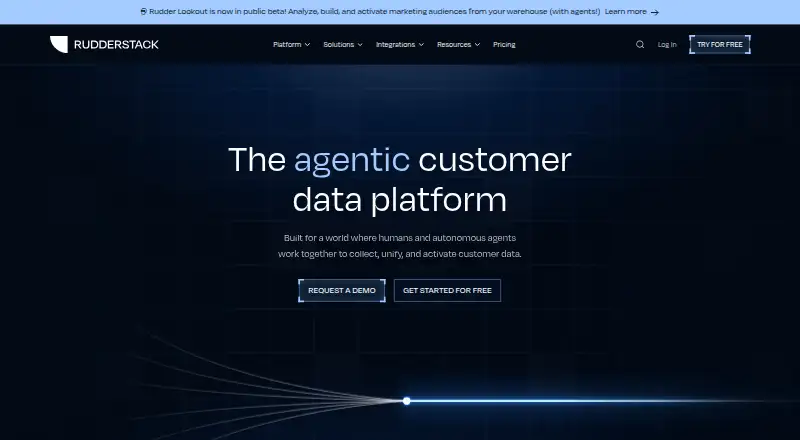
What RudderStack Customer Data Platform is
RudderStack Customer Data Platform collects data from websites, applications, and backend systems, then routes it to downstream tools in real time. Its warehouse-first approach builds on a customer's data warehouse, and the company says it does not store customer data. RudderStack Profiles can combine event information with other data-cloud data to model a customer 360; identity-resolved data can then be sent to more than 200 tools for activation. Listed destinations and integrations include Google Ads, Salesforce, Snowflake, Google BigQuery, Databricks, and Apache Kafka. Governance tools cover schema management, event validation, consent automation, and PII handling, while enterprise security features include SSO, SSH tunnels, permissions management, and audit logs. RudderStack states that it has SOC 2 Type 2 compliance, complies with HIPAA requirements and can sign a BAA, and is GDPR compliant. The Free plan costs nothing and includes 250K events per month; data processing stops after a second consecutive overage. Growth costs $265 a month, and a 30-day trial is listed.
Who it suits
The Free plan is described for startups and small teams; Growth is aimed at teams with greater volume or advanced integration needs. Enterprise is positioned for large organizations needing advanced security, governance, and dedicated support.
What it does well
- Collects and routes data in real time.
- Free plan includes 250K events per month.
- Identity-resolved data can reach 200+ tools.
- Includes schema management and consent automation.
- Lists SSO, permissions management, and audit logs.
What to know first
- Free processing stops after a second consecutive overage.
- Free plan support is community Slack, without dedicated support.
- Growth costs $265 a month.
- Enterprise pricing is custom.
Limits
The Free plan includes 250K events per month, and data processing stops after the second consecutive monthly overage. It includes 16 SDK sources, 200+ cloud destinations, warehouse destinations, and Reverse ETL. Growth includes one million events per month; Enterprise limits and price are custom.
Plans
| Plan | Billed and limits | Price |
|---|---|---|
| Free | free forever · 250K events/month · 16 SDK sources · 200+ cloud destinations · warehouse destinations · Reverse ETL | Free |
| Growth | monthly; save 15% with annual billing · 1 million events/month · unlimited team members · 30-minute warehouse sync · 2 workspaces · 25 Reverse ETL connections | $265 a month |
| Enterprise | custom · enterprise-grade volume · 5-minute warehouse sync · unlimited transformations · Profiles & Data Apps · HIPAA · SSO · white-glove support | On request |
As rudderstack.com lists them, read 14 Oct 2026. The maker's own page has the final word.
Getting started
- Visit the RudderStack website.
- Choose the Free plan or review Growth and Enterprise options.
- Use the 30-day trial if you want to try the platform.
- Choose a platform option: Android, iOS, Linux, web, API, or self-hosted.
- Connect data sources and downstream destinations for collection and activation.
RudderStack Customer Data Platform collects and unifies customer data around a warehouse, then routes it to tools teams use to act on customer signals. It best suits organizations with an existing data warehouse and a need for real-time collection, customer profiles, and broad activation. Its architecture and governance are strengths; the Free plan’s event cap and cutoff demand careful volume management.
Overview
RudderStack builds on a customer's warehouse and says it does not store customer data. It collects events from websites, applications, and backend systems and routes them downstream in real time. Profiles can combine event data with other data-cloud data to model a customer 360, while identity-resolved data can be sent to more than 200 tools.
That makes it a strong fit for teams that want warehouse data to inform customer-facing activity without centering the CDP on a separate customer-data store. The tradeoff is that the product's appeal depends on a warehouse-led approach; teams looking for a standalone data environment may prefer another direction.
Key features
- Collection and routing: Real-time ingestion from websites, apps, and backend systems gives teams a way to route customer activity as it arrives.
- Profiles and activation: Profiles can draw on event and data-cloud data, and identity resolution supports sending those signals to downstream tools. This connects customer modeling to activation rather than stopping at data collection.
- Destinations and integrations: More than 200 cloud destinations span marketing automation, advertising, CRM, product messaging, and customer support. The directory includes Google Ads, Salesforce, Snowflake, Google BigQuery, Databricks, and Apache Kafka.
- Governance: Schema management, event validation, consent automation, and PII handling address data quality and control needs as collection scales.
- Security and compliance: Enterprise controls include SSO, SSH tunnels, permissions management, and audit logs. RudderStack states SOC 2 Type 2 compliance, HIPAA requirements compliance with the ability to sign a BAA, and GDPR compliance.
- Self-hosting: The self-hosted project is released under Elastic 2.0 and shares its core data-processing layer across Community and Enterprise editions, a useful option for teams that want to operate the platform themselves.
Pricing
RudderStack uses a freemium model, with a 30-day trial and paid plans from $265/mo. The Free plan is billed free forever at no cost. It includes 250K events/month, 16 SDK sources, 200+ cloud destinations, warehouse destinations, and Reverse ETL. It suits startups and small teams testing a warehouse-based pipeline, but community Slack is the support option and there is no dedicated support. Most importantly, processing stops after a second consecutive overage, so teams near the cap need to watch usage closely.
Growth costs $265 a month, billed $265 /month. It raises the allowance to 1 million events/month and keeps 16 SDK sources and 200+ cloud destinations, while adding unlimited team members, a 30 minute warehouse sync, 2 workspaces, and 25 reverse ETL connections. The plan is aimed at teams with higher volume and more advanced integration needs; its fixed event allowance remains a planning constraint, and support is some team support rather than the Enterprise account-manager package.
Enterprise has custom pricing and is intended for large organizations needing advanced security, governance, and white-glove support. It includes Enterprise-grade volume, a 5 minute warehouse sync, unlimited Transformations, Profiles & Data Apps, HIPAA, SSO, white glove support, an account manager, and a dedicated Slack channel. The faster sync and dedicated support make it the clearer fit for organizations with demanding operational and governance requirements, but its custom pricing calls for a budget discussion rather than a direct price comparison.
Platforms
RudderStack supports Android, iOS, Linux, web, API, and self-hosted deployments. That range suits teams collecting across application and web environments or choosing to run a self-hosted setup.
Who it's for
Choose RudderStack if your team already relies on a warehouse and wants to combine event collection, customer profiles, governance, and activation in one workflow. Free is positioned for startups and small teams; Growth is the step up for more volume and integration needs; Enterprise is designed for large organizations that need stronger controls and dedicated support. It is less suitable if the Free event ceiling is too restrictive or if a warehouse-centered architecture is not how your team wants to manage customer data.
Pros and cons
- Pro: Warehouse-first design and the claim that RudderStack does not store customer data suit teams that want their warehouse at the center of customer data work.
- Pro: More than 200 destinations, profiles, and identity resolution link customer data to a wide range of activation categories.
- Pro: Governance capabilities and enterprise security controls cover data handling needs that become more important as teams scale.
- Con: Free is capped at 250K events/month, and processing stops after a second consecutive overage, which can disrupt teams that outgrow the allowance without noticing.
- Con: Free support is community Slack without dedicated support; teams needing an account manager and dedicated Slack channel must choose Enterprise.
- Con: Enterprise pricing is custom, so larger teams cannot assess its cost from a published monthly price.
Alternatives
For a broader set of options, compare Customer Data Platforms. If the priority is reverse sync, see Reverse ETL Tools; for a narrower focus on event instrumentation, browse Event Tracking Software.
Clay is a freemium alternative with a free plan offering 500 actions/month and 100 data credits/month, and a Launch plan at $167 a month. Consider it when those action and credit allowances align better with your needs than RudderStack's event-based plans.
Singular is a freemium option with a free plan billed per conversion, including 15,000 paid conversions and no credit card required; its Growth plan is billed per conversion on request. It may suit readers comparing conversion-based pricing with RudderStack's event allowances.
Bitscale offers a free plan with 200 Bitscale Credits, 2,000 monthly company/people searches, 50,000 rows per grid, and 20 action columns per grid. Choose it if those search and grid limits fit the task better than a CDP's event collection and activation model.
Fivetran Database Replication has a free plan with 500,000 monthly active rows for connections, 3,500 for activations, and 5,000 monthly model runs for transformations. It is worth considering when those row- and model-run-based limits better match the workload.
Hightouch offers a free plan with 2 active syncs per month, hourly sync frequency, and 100,000,000 operations per month. It is a relevant alternative when a small number of hourly syncs is the central need.
Zoho DataPrep has a free plan with 20,000 rows per month, one user, manual imports and exports only, and one month of audit retention. Its limits make it a consideration for a smaller, manual data-preparation workflow.
Dataddo Data Activation offers a Data Anywhere™ plan at $129 a month, with 3 data flows shown and price varying by flow count. Consider it when that flow-based plan fits better than RudderStack's event-based CDP tiers.
drt is a free alternative for Windows, macOS, and Linux.
Verdict
RudderStack is a strong choice for warehouse-oriented teams that want to collect customer events, build profiles, govern data, and activate identity-resolved signals across a broad destination set. Its main reason to choose is the combination of warehouse-centered design and downstream reach; its main reason to look elsewhere is the Free plan's firm event ceiling and processing cutoff, or the custom price required for Enterprise-level support and controls.
Verdict
RudderStack combines warehouse-based data collection, customer profiles, governance, and downstream activation. Review the event allowance and support level against your team's needs; Enterprise pricing is custom.
Questions
Is there a free plan?
Yes. Free is billed free forever and includes 250K events per month, 16 SDK sources, 200+ cloud destinations, warehouse destinations, and Reverse ETL.
What does Growth cost?
Growth costs $265 a month and includes one million events per month, 16 SDK sources, 200+ cloud destinations, unlimited team members, 30-minute warehouse sync, two workspaces, and 25 Reverse ETL connections.
Is a free trial available?
Yes. A 30-day trial is listed.
Which platforms are supported?
The listed platforms are Android, API, iOS, Linux, self-hosted, and web.
What integrations are listed?
The integration directory includes Google Ads, Salesforce, Snowflake, Google BigQuery, Databricks, and Apache Kafka, among others.
What is the self-hosted project licensed under?
RudderStack says its self-hosted project is released under Elastic 2.0 and shares its core data-processing layer across Community and Enterprise editions.
Facts from RudderStack Customer Data Platform's own pages
- Activation
- The CDP sends identity-resolved data directly to over 200 tools for teams to act on customer signals. · rudderstack.com, 2 Oct 2026
- API surface
- Documented APIs cover audit logs, usage, data catalog, event audit, user suppression, HTTP, Pixel, Profiles, Reverse ETL connections and transformations. · rudderstack.com, 14 Oct 2026
- Chrome extension
- RudderStack Assistant locally inspects SDK events, destinations and state and claims to transmit no debugging data off-device. · chromewebstore.google.com, 14 Oct 2026
- Company facts
- LinkedIn lists RudderStack as a privately held San Francisco software company founded in 2019 with 51–200 employees. · linkedin.com, 14 Oct 2026
- Compliance
- The security page states SOC 2 Type 2, HIPAA with BAA availability and GDPR compliance support. · rudderstack.com, 14 Oct 2026
- Compliance toolkit
- Consent IDs, cookieless tracking, PII or PHI blocking and masking, and stack-wide suppression and deletion are provided. · rudderstack.com, 14 Oct 2026
- Customer profiles
- RudderStack Profiles can use event data and other data-cloud data to model a customer 360. · rudderstack.com, 2 Oct 2026
- Documentation depth
- Documentation includes getting-started guides, SDK setup, API references, CLI-as-code tools, dashboard guides, event specifications and release notes. · rudderstack.com, 14 Oct 2026
- Event Stream
- Event Stream collects behavioral data from websites, applications and backend systems and routes it to destinations. · rudderstack.com, 14 Oct 2026
- Founded
- 2019 · rudderstack.com, 28 Sept 2026
- Funding
- CB Insights reports $82 million raised across five funding rounds, including a $56 million Series B announced February 2, 2022. · cbinsights.com, 14 Oct 2026
- Governance
- The platform offers schema management, event validation, consent automation, and PII handling. · rudderstack.com, 2 Oct 2026
- HTTP and Pixel APIs
- The HTTP API accepts authenticated POST event requests, while the Pixel API supports GET tracking where POST is unavailable. · rudderstack.com, 14 Oct 2026
- Integrations
- The integration catalog advertises more than 200 destination integrations across analytics, advertising, CRM, data warehouses and other categories. · rudderstack.com, 14 Oct 2026
- Intended users
- The Free plan is described for startups and small teams, Growth for teams with higher volume and advanced integration needs, and Enterprise for large organizations needing advanced security, governance, and white-glove support. · rudderstack.com, 2 Oct 2026
- Legal name
- Crunchbase lists the legal entity as RudderStack, Inc., also known as RudderLabs. · crunchbase.com, 14 Oct 2026
- Licence
- The RudderStack server repository is licensed under Elastic License 2.0; SDK repositories use open-source licenses including MIT. · github.com, 14 Oct 2026
- Limit: missing integrations
- The Capterra reviewer says unavailable integrations require a transformation plus webhook until native connectors are added. · capterra.com, 14 Oct 2026
- Limit: reporting depth
- A G2 reviewer reports limited user-level views, reporting and debugging or observability depth. · g2.com, 14 Oct 2026
- Limit: setup complexity
- G2 reviewers report that implementation can be difficult without strong engineering resources and that documentation takes time to learn. · g2.com, 14 Oct 2026
- Notable limits
- Free includes 250K events per month, and data processing stops after the second consecutive overage. · rudderstack.com, 2 Oct 2026
- Praise: Capterra reviewer
- The Capterra reviewer praises easy Event Stream setup, warehouse-to-tool piping, free trial value and the live event viewer. · capterra.com, 14 Oct 2026
- Praise: developer fit
- G2 reviewers repeatedly praise the developer-friendly warehouse-first design, flexible transformations and broad integrations. · g2.com, 14 Oct 2026
- Profiles
- Profiles creates an identity graph and computes customer features in a data warehouse or lake. · rudderstack.com, 14 Oct 2026
Where RudderStack Customer Data Platform stands on Freedom251
- Customer Data Platforms#2 of 58
- Reverse ETL Tools#1 of 29
- Event Tracking Software#2 of 24
- Customer Intelligence#2 of 20