Freedom251 › Customer Data Platforms

Tracardi
What Tracardi is
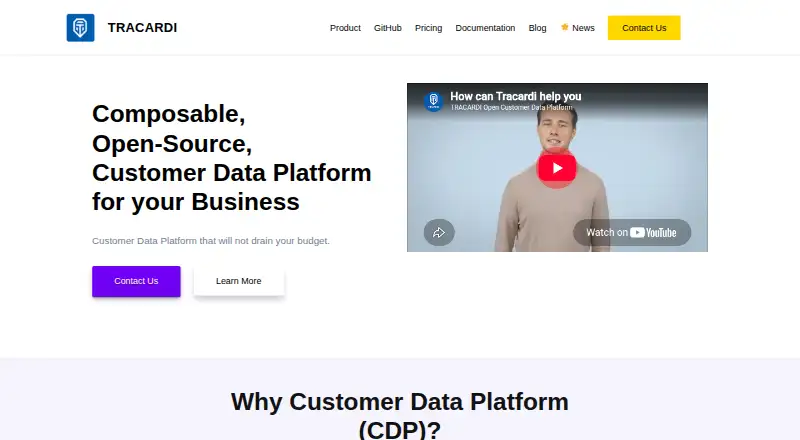
Tracardi is an open-source, composable, API-first customer data platform engine for building a tailored CDP. It collects behavioral data from websites, mobile apps, web services, CRMs, online shops, CSV files, APIs, queues, and databases. The platform can merge customer information into unified profiles and automatically deduplicate records. Journey automation supports collection, engagement, messaging, targeting, product recommendations, and reminders. Documentation lists integration resources for services including HubSpot, Salesforce, Mailchimp, Mautic, Mixpanel, Airtable, RabbitMQ, Slack, Discord, and Telegram. Tracardi does not send marketing campaigns, though it can collect consent and subscription data and connect marketing data with other platforms. Deployment documentation describes open-source and commercial Docker installations, plus Helm-based production installation. The production guide lists Redis, Elasticsearch, Apache Pulsar, and MySQL as dependencies and recommends encrypted API connections, separate event-collection and GUI APIs, and restricting GUI access to trusted networks. The maker describes the project as MIT with Common Clause; commercial hosted use requires a commercial license. The free plan has limits on event rate, tenancy, automation, and validation.
Who it suits
The free open-source version is positioned for small companies with limited customers. The enterprise option is intended for larger companies with substantial data, while the multi-tenant version is for SaaS providers.
What it does well
- Combines behavioral data into unified customer profiles
- Can automatically deduplicate customer records
- Journey automation supports targeting and recommendations
- Open-source version is free
What to know first
- Free plan limits events per second and automation
- Free plan is single tenant and lacks event validation
- Does not send marketing campaigns
- Production deployment lists four dependencies
Limits
The free open-source plan is limited to a stated event rate, a single tenant, limited automation, and no event validation. The enterprise plan includes unlimited profile storage and event collection; commercial plan prices require contacting the maker.
Plans
| Plan | Billed and limits | Price |
|---|---|---|
| Open-Source Version | Free · Limited events per second · single tenant · limited automation · no event validation | Free |
| Commercial Enterprise Version | Contact for pricing · Single tenant · includes on-premise license with unlimited profile storage and event collection | On request |
| Commercial Multi-Tenant Version | Contact for pricing · For SaaS providers · multi-tenant setup · installation and integration support | On request |
As tracardi.com lists them, read 2 Oct 2026. The maker's own page has the final word.
Getting started
- Visit the Tracardi website and choose the open-source or commercial route.
- Install with the documented Docker option, or use Helm for production deployment.
- For production installation, prepare Redis, Elasticsearch, Apache Pulsar, and MySQL.
- Configure encrypted API connections and limit GUI access to trusted networks.
Tracardi is an open-source, composable customer-data platform engine for organizations building a CDP around their own sources and workflows. It suits technical teams that can self-host and operate a multi-service stack. Choose it for flexible data unification and journey logic; look elsewhere if you need the platform itself to deliver marketing campaigns.
Overview
Tracardi is API-first and designed to be assembled around the way a business already collects and uses customer data. It accepts behavioral information from websites, mobile apps, web services, CRMs, online shops, CSV files, APIs, queues, and databases. That broad intake makes it a practical foundation when data is distributed across many systems rather than concentrated in one application.
The product is available as open-source software and can be deployed with Docker or Helm. Production operation is not lightweight: the documented stack includes Redis, Elasticsearch, Apache Pulsar, and MySQL. Teams also need to follow the project’s security guidance, including encrypted API connections, separating event-collection and GUI APIs, and restricting GUI access to trusted networks.
Key features
Tracardi merges incoming records into unified customer profiles and can automatically remove duplicate customer records. Real-time profiles and identity resolution are supported, helping teams maintain a coherent customer view when identifiers arrive from different channels. Both batch and streaming ingestion are available, while audience activation lets that profile data feed downstream actions.
Journey automation covers collection, engagement, messaging, targeting, product recommendations, and reminders. This is useful for coordinating data-driven workflows and responses, but it does not turn Tracardi into a campaign-delivery suite. The platform can gather consent and subscription data and connect marketing information to other services; marketing campaigns must be sent through another platform.
Documented integrations and resources include HubSpot, Salesforce, Mailchimp, Mautic, Mixpanel, Airtable, RabbitMQ, Slack, Discord, and Telegram. The mix spans CRM, marketing, analytics, messaging, and infrastructure systems, giving a technical team building blocks for a tailored deployment rather than a single all-in-one marketing console.
Pricing
Open-Source Version — free (billed Free) is aimed at small companies with limited customer volumes. It is single-tenant and imposes limited events per second, limited automation, and no event validation. That makes it a sensible way to build or evaluate a deployment, but the stated caps and missing validation can become constraints for demanding production pipelines.
Commercial Enterprise Version — custom pricing (billed Contact for pricing) is single-tenant and includes an on-premise license with unlimited profile storage and event collection. It is the better fit for large companies with substantial data that need those capacity terms and a commercial license.
Commercial Multi-Tenant Version — custom pricing (billed Contact for pricing) targets SaaS providers. It adds a multi-tenant setup plus installation and integration support, making it the relevant commercial option for a product serving multiple customer organizations.
Tracardi is described as MIT with Common Clause. Commercial hosted use requires a commercial license, so a hosted business offering should account for licensing before choosing the free edition.
Platforms
Tracardi runs through an API, on Linux, on the web, and in self-hosted environments. Docker installation is documented for open-source and commercial deployments, with Helm described for production installation. This favors organizations controlling infrastructure over teams seeking a vendor-managed, turnkey service.
Who it's for
Small companies with limited customers can start with the free single-tenant edition, provided its event-rate, automation, and validation limits fit. Larger organizations handling substantial data should consider the enterprise edition’s unlimited profile storage and event collection. SaaS providers have a dedicated multi-tenant commercial path with deployment and integration support.
Tracardi is a poor fit for a marketing team that wants campaign creation and sending in the same product. It is also demanding for organizations without the operational capacity to run Redis, Elasticsearch, Apache Pulsar, MySQL, and the surrounding security controls.
Pros and cons
- Pro: Wide ingestion coverage lets teams bring together behavioral data from digital channels, business systems, files, queues, and databases.
- Pro: Profile merging, deduplication, real-time profiles, and identity resolution address fragmented customer identities directly.
- Pro: Journey automation and audience activation support recommendations, reminders, targeting, and other data-triggered workflows.
- Con: The free edition limits event rate and automation and provides no event validation, reducing its headroom for demanding use.
- Con: It does not send marketing campaigns, so outbound programs require connected tools and additional operational coordination.
- Con: Production deployment carries a substantial infrastructure and security burden, with several required dependencies and network controls.
- Con: Commercial hosted use requires a commercial license, while enterprise and multi-tenant pricing is custom.
Alternatives
Choose Jitsu instead if you want a freemium, self-hostable option with a forever-free open-source plan and no usage limits, across a wider range of platforms.
SnowcatCloud is an alternative for teams seeking Apache 2.0 self-hosted software with no licensing fees, although some loaders require payment.
Pick RudderStack Customer Data Platform when a free tier with 250,000 events per month, 16 SDK sources, and more than 200 cloud destinations better matches your operating model.
Stape suits teams focused on Meta Conversions API deployment, with pay-as-you-go pricing starting at $8 a month when billed yearly.
Hightouch is an option for API and web users who need scheduled data syncs, including two active syncs on its free plan.
SetRoasFlow is an alternative with defined monthly event and website allowances on paid plans.
walkerOS offers MIT-licensed, self-hosted software with no event limits, while infrastructure costs remain your responsibility.
OpenSnowcat is a free self-hosted alternative; its data loaders require a paid license.
For broader comparison, see Event Tracking Software and Customer Data Platforms.
Verdict
Tracardi is best for technical small companies, enterprises, and SaaS providers that need a composable CDP they can operate and tailor. Its strongest reason to choose it is the combination of broad ingestion, unified profiles, identity resolution, and journey automation. Look elsewhere if you need built-in campaign sending, a simpler managed deployment, or unrestricted capacity on a free plan.
Verdict
Tracardi offers customer-data collection, profile management, and journey automation for tailored CDP deployments. The free plan has stated limits, and commercial hosted use requires a commercial license.
Questions
Is Tracardi free?
The Open-Source Version is listed as free. It has limits on event rate, tenancy, automation, and event validation.
What are the commercial plans?
The Commercial Enterprise Version is single tenant and includes an on-premise license with unlimited profile storage and event collection. The Commercial Multi-Tenant Version is for SaaS providers and includes installation and integration support; pricing for both requires contacting the maker.
Is Tracardi open source?
Yes. The maker describes Tracardi as MIT with Common Clause and says commercial hosted use requires a commercial license.
Does Tracardi send marketing campaigns?
No. It can gather consent and subscription data and integrate marketing data with other platforms.
What platforms and deployment options does it support?
Listed platforms are API, Linux, self-hosted, and web. Installation documentation covers Docker and Helm-based production deployment.
Which integrations are listed?
Integration resources include HubSpot, Salesforce, Mailchimp, Mautic, Mixpanel, Airtable, RabbitMQ, Slack, Discord, and Telegram.
Facts from Tracardi's own pages
- Automation
- Journey automation supports customer data collection, engagement, messaging, targeting, product recommendations, and reminders. · tracardi.com, 2 Oct 2026
- Commercial support
- The multi-tenant commercial plan includes installation and integration support. · tracardi.com, 2 Oct 2026
- Data collection
- It collects behavioral customer data from websites, mobile apps, web services, CRMs, e-commerce shops, CSV files, APIs, queues, and databases. · tracardi.com, 2 Oct 2026
- Dependencies
- The production guide lists Redis, Elasticsearch, Apache Pulsar, and MySQL as dependencies. · docs.tracardi.com, 2 Oct 2026
- Deployment
- The project documentation describes open-source Docker installation and commercial Docker installation, as well as Helm-based production installation. · tracardi.github.io, 2 Oct 2026
- Integrations
- The documentation lists integrations and resources including HubSpot, Salesforce, Mailchimp, Mautic, Mixpanel, Airtable, RabbitMQ, Slack, Discord, and Telegram. · tracardi.github.io, 2 Oct 2026
- Intended users
- The maker positions the free open-source version for small companies with limited customers, the enterprise version for big companies with substantial data, and the multi-tenant version for SaaS providers. · tracardi.com, 2 Oct 2026
- License
- The maker describes Tracardi as MIT with Common Clause and says commercial hosted use requires a commercial license. · tracardi.com, 2 Oct 2026
- Marketing limit
- Tracardi does not send marketing campaigns; it can gather consents and subscription data and integrate marketing data with other platforms. · docs.tracardi.com, 2 Oct 2026
- Product
- Tracardi is an open-source, composable, API-first customer data platform engine for building a tailored CDP. · tracardi.com, 2 Oct 2026
- Profiles
- It aggregates and merges customer data into unified profiles and can automatically deduplicate customer records. · tracardi.com, 2 Oct 2026
- Security guidance
- The production guide recommends encrypted API connections, separating event collection and GUI APIs, and limiting GUI access to trusted networks. · docs.tracardi.com, 2 Oct 2026
Where Tracardi stands on Freedom251
- Customer Data Platforms#7 of 58
- Event Tracking Software#9 of 24