Freedom251 › Reverse ETL Tools
drt
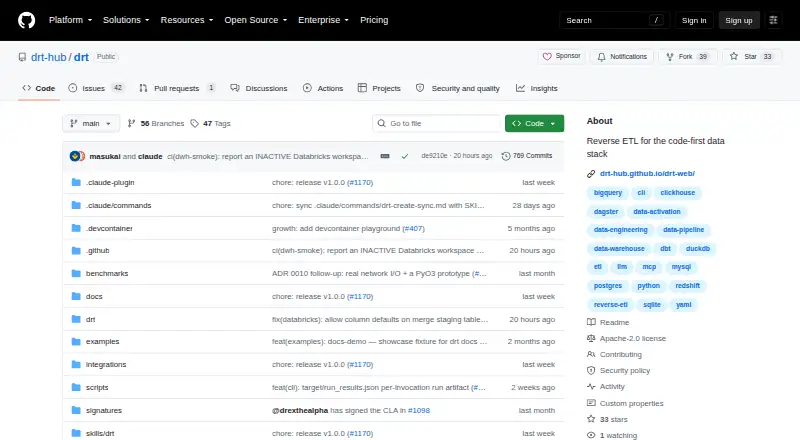
What drt is
drt is a free, self-hosted reverse ETL tool that moves modeled warehouse data into team tools. Teams define syncs in YAML, version them in Git, install `drt-core` with pip, and run them from the terminal with `drt run`. Before writing data, `drt run --dry-run --diff` previews rows that would be added, updated or deleted. The project lists 13 sources and 34 destinations, including BigQuery, Snowflake, Postgres, Slack and Salesforce. Destination types include warehouses, SaaS APIs, cloud storage, files and webhooks.
For teams using dbt, drt can read dbt projects and use `ref()` models so activation follows model lineage. Listed orchestration integrations include Dagster, Prefect and Airflow, alongside a dbt manifest reader. A GitHub Action supports scheduled or event-triggered syncs, and an optional MCP server lets compatible clients list, run and validate syncs and inspect their status. Data travels directly from the user's warehouse to the destination, without passing through a drt-hosted intermediary. Telemetry is off by default. The project uses Apache 2.0; RBAC, audit logging, plugins and managed cloud hosting are outside drt-core.
Who it suits
drt suits data teams that use dbt and Git and want reverse ETL syncs managed in their repository. It also fits teams comfortable installing a Python package and running batch syncs from the terminal or through the listed orchestration and GitHub Action integrations.
What it does well
- Free, self-hosted core under Apache 2.0
- YAML syncs can be versioned in Git
- Dry runs preview row changes before writing
- Uses dbt model lineage through `ref()`
- Lists 13 sources and 34 destinations
- Data goes directly from warehouse to destination
What to know first
- Syncs run in batches
- Reverse sync is not supported
- RBAC, audit logging, plugins and managed cloud hosting are outside drt-core
Limits
The core syncs in batches and does not support reverse sync. RBAC, audit logging, a plugin system and managed cloud hosting are outside drt-core.
Plans
| Plan | Billed and limits | Price |
|---|---|---|
| drt-core | All connectors · sync engine · CLI · MCP server · self-hosted | Free |
As github.com lists them, read 8 Oct 2026. The maker's own page has the final word.
Getting started
- Visit the drt GitHub project.
- Install `drt-core` with pip.
- Define syncs in YAML and version them in Git.
- Run `drt run --dry-run --diff` to preview row changes.
- Run syncs from the terminal with `drt run`, or use the listed orchestration integrations or GitHub Action.
Overview
drt is a self-hosted tool for moving modeled warehouse data into the apps a team uses, with sync definitions kept in YAML and Git. It is best suited to teams already building with dbt and repository-based workflows. Its appeal is a free, inspectable batch process; your team remains responsible for running and hosting it.
Install drt-core with pip and run syncs from the terminal. A dry run with a diff previews rows that would be added, updated, or deleted before any write, giving teams a useful review point for changes.
Key features
drt lists 13 sources and 34 destinations across warehouses, SaaS APIs, cloud storage, files, and webhooks. Named connectors include BigQuery, Snowflake, Postgres, Slack, and Salesforce. That covers a range of common warehouse-to-tool flows, though the connector count alone does not guarantee a particular endpoint or operation will fit; check the connectors your pipeline needs.
For dbt users, drt can read a project and use ref() models so activations follow model lineage. Documented integrations include Dagster, Prefect, Airflow, and a dbt manifest reader. A GitHub Action supports scheduled or event-triggered syncs and structured status outputs, making drt a natural fit for teams that already manage data work in repositories and CI/CD.
The optional MCP server allows compatible clients to list syncs, run them, validate configuration, and inspect status. This can bring routine operations into an AI-enabled client, but it is optional and requires a compatible client. Data moves directly from the user's warehouse to the destination rather than through a drt-hosted intermediary. Telemetry is off by default; if enabled, it collects sync metadata and excludes sync names, SQL, destination URLs, credentials, and project paths.
The project describes Dependabot, CodeQL, pip-audit, and CycloneDX SBOM generation for releases as part of its security practices. Its vulnerability reporting policy asks for reports by email, acknowledges receipt within 48 hours, and targets critical fixes or mitigations within 7 days. The Apache 2.0 license makes drt-core open source. Teams needing RBAC, audit logging, plugins, or managed cloud hosting should account for those features sitting outside drt-core.
Pricing
drt-core: free. The free plan includes all connectors, the sync engine, CLI, MCP server, and self-hosted deployment. That is a substantial starting point for teams able to operate the tool themselves, with no paid tier required for the core listed capabilities. Its limits are operational and functional: syncs are batch, reverse sync is unavailable, and RBAC, audit logging, plugins, and managed cloud hosting are outside the core plan.
Platforms
drt supports Linux, macOS, and Windows, and is self-hosted. The pip installation and terminal workflow suit teams comfortable running command-line software on their own infrastructure.
Who it's for
Choose drt if your team ships with dbt and Git, wants reverse ETL definitions versioned alongside its project, and can own deployment and operations. The preview-before-write workflow is especially useful when you want to inspect proposed row changes before a sync applies them. Look elsewhere if you need reverse sync, managed hosting, or the enterprise controls excluded from drt-core.
Pros and cons
- Pros: The free core includes all connectors, the sync engine, CLI, and MCP server, so teams can build a self-hosted workflow without a paid plan.
- Pros: Dry-run diffs preview additions, updates, and deletions before writes, giving reviewers a concrete check on sync effects.
- Pros: dbt lineage, orchestration integrations, and a GitHub Action connect syncs to familiar repository and pipeline workflows.
- Cons: Batch syncs and no reverse sync make it unsuitable for workflows that need continuous updates or data flowing back from destinations.
- Cons: Self-hosting puts deployment and operations on the team, and RBAC, audit logging, plugins, and managed cloud hosting are outside drt-core.
Alternatives
Compare reverse ETL tools if you want to weigh drt against other options in the category.
RudderStack Customer Data Platform is a candidate if you want a broader customer data platform with Android and iOS support, a free plan covering 250K events per month, 16 SDK sources, and more than 200 cloud destinations.
Clay may fit better when lead enrichment is the priority: its free plan includes 500 actions per month, 100 data credits per month, unlimited seats and tables, and up to 200 rows per table.
Singular offers a free, conversion-billed option with 15,000 paid conversions and no credit card required, making it worth considering when that pricing model fits your needs.
Bitscale has a free plan with 200 credits, 2,000 monthly company or people searches, and 50,000 rows per grid; consider it if those research and grid limits match your workflow.
DataChannel offers a free tier with 1 million rows per month, two data sources, five user accounts, and 20 transformations, which may suit teams looking for a row-based data workflow.
Dataflowz is another option with a free Starter plan that includes one warehouse connection, three destination connections, 10K rows synced per month, and daily syncs.
Fastero has a free tier limited to public apps and 1 GB RAM per app, with paid plans from $20 a month for compute tiers up to 16 GB RAM per app.
Fivetran Database Replication may be worth comparing if its free-plan quotas—500,000 monthly active rows for connections, 3,500 for activations, and 5,000 monthly model runs for transformations—fit your workload.
Verdict
drt is a strong fit for dbt and Git-oriented teams that want a free, self-hosted way to manage batch reverse ETL, with lineage-aware syncs and a preview before writes. The case for choosing it is control over repository-managed pipelines without a software charge. The case for looking elsewhere is equally clear: it has no reverse sync, and drt-core leaves managed hosting and enterprise controls to other offerings.
Verdict
Pick drt if your team wants to manage reverse ETL syncs alongside dbt and Git, with a free self-hosted core and a preview before writes. Look elsewhere if you need reverse sync, or if your requirements include RBAC, audit logging, plugins or managed cloud hosting within drt-core.
Questions
Is drt free?
Yes. The drt-core plan is listed at 0.00 USD and includes connectors, the sync engine, CLI, MCP server and self-hosted use.
Which destinations and sources does drt support?
The project lists 13 sources and 34 destinations, including BigQuery, Snowflake, Postgres, Slack and Salesforce. Destination categories include warehouses, SaaS APIs, cloud storage, files and webhooks.
How do I run a sync?
Install `drt-core` with pip, define syncs in YAML, and run them from the terminal with `drt run`. A dry run with a diff previews rows due to be added, updated or deleted.
Does drt work with dbt?
Yes. drt can read dbt projects and use `ref()` models so activation follows model lineage. The project also lists a dbt manifest reader integration.
Is drt open source?
The project is licensed under Apache 2.0. Its open-core document places RBAC, audit logging, plugins and managed cloud hosting outside drt-core.
Does data pass through drt's hosted service?
The project says data goes directly from the user's warehouse to the destination and never through a drt-hosted intermediary.
Facts from drt's own pages
- AI integration
- An optional MCP server lets compatible clients list syncs, run syncs, validate configuration, and inspect status. · github.com, 8 Oct 2026
- CI/CD
- The project provides a GitHub Action for scheduled or event-triggered syncs and documents structured status outputs. · github.com, 8 Oct 2026
- Connectors
- The project lists 13 sources and 34 destinations, including BigQuery, Snowflake, Postgres, Slack, and Salesforce. · drt-hub.github.io, 8 Oct 2026
- Data handling
- The README says data goes directly from the user's warehouse to the destination and never through a drt-hosted intermediary. · github.com, 8 Oct 2026
- dbt lineage
- drt can read dbt projects and use `ref()` models so activation follows the model lineage. · drt-hub.github.io, 8 Oct 2026
- Enterprise boundary
- The open-core document places RBAC, audit logging, plugin system, and managed cloud hosting outside drt-core. · github.com, 8 Oct 2026
- Intended users
- The site describes drt as suited to teams that ship with dbt and Git and want reverse ETL pipelines managed in their repository. · drt-hub.github.io, 8 Oct 2026
- License
- The project is licensed under Apache 2.0. · github.com, 8 Oct 2026
- Orchestration
- The README lists integrations for Dagster, Prefect, Airflow, and a dbt manifest reader. · github.com, 8 Oct 2026
- Preview
- `drt run --dry-run --diff` previews which rows will be added, updated, or deleted before writing. · drt-hub.github.io, 8 Oct 2026
- Purpose
- drt moves modeled warehouse data into team tools as reverse ETL, with syncs defined in YAML and versioned in Git. · drt-hub.github.io, 8 Oct 2026
- Security
- The security policy describes Dependabot, CodeQL, pip-audit, and CycloneDX SBOM generation for releases. · github.com, 8 Oct 2026
- Support
- The security policy asks vulnerability reports to be emailed and says receipt is acknowledged within 48 hours, with critical fixes or mitigations within 7 days. · github.com, 8 Oct 2026
- Telemetry
- Telemetry is off by default; when enabled, the project says it collects sync metadata and does not transmit sync names, SQL, destination URLs, credentials, or project paths. · github.com, 8 Oct 2026
- Workflow
- Users install `drt-core` with pip and run syncs from the terminal using `drt run`. · github.com, 8 Oct 2026
Where drt stands on Freedom251
- Reverse ETL Tools#3 of 29