Freedom251 › AWS Marketplace Software

Confluent Cloud
What Confluent Cloud is
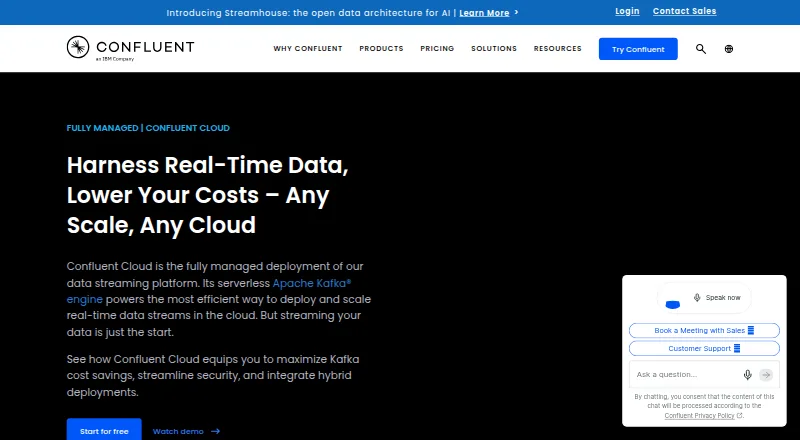
Confluent Cloud is a managed data streaming platform powered by a serverless Apache Kafka engine. It is intended for real-time data streaming, event-driven applications, analytics, and AI/ML use cases. Cluster choices include Basic, Standard, Enterprise, and Freight, with Dedicated clusters for workloads requiring pre-provisioned resources. Confluent says the cloud-native engine automatically adjusts cluster infrastructure to workloads. Cluster Linking can replicate, sync, and share data across regions, public clouds, and organizations. The service includes managed Kafka connectors for sources and destinations such as databases, data lakes, and data warehouses, along with serverless Apache Flink stream processing and managed Stream Governance. Tableflow can materialize Kafka topics and schemas as Apache Iceberg and Delta Lake tables. Listed security features include RBAC, self-managed encryption keys, client-side field-level encryption, and audit logs. A web UI and Confluent CLI manage clusters and topics; client languages include Java, Python, .NET, Go, Node.js, and C/C++. The service runs on AWS, Microsoft Azure, and Google Cloud across more than 100 regions. A free plan is available; paid plans start at $385.00 per month. New signups receive $400 to spend during their first 30 days, after which usage-based pricing applies.
Who it suits
It suits teams building real-time data streams, event-driven applications, analytics, or AI/ML workloads. Its cluster choices, connectors, processing, and governance tools support different streaming needs.
What it does well
- Free Basic plan with serverless managed clusters.
- More than 80 managed connectors are listed.
- Supports AWS, Azure, and Google Cloud.
- Cluster Linking spans regions and public clouds.
- Client language support includes Java, Python, and Go.
What to know first
- Paid plans start at $385.00 per month.
- Usage-based pricing applies after the 30-day credits.
- Dedicated clusters require pre-provisioned resources.
Limits
Basic is free and includes managed clusters, autoscaling Kafka resources, 80+ managed connectors, security and governance essentials, and AWS, Azure, and GCP support. Standard starts at $385/mo and adds a 99.99% uptime SLA, infinite storage, audit logs, and throughput savings that scale with usage.
Plans
| Plan | Billed and limits | Price |
|---|---|---|
| Basic | Starting at $0/Month · Serverless, fully managed clusters · Autoscaling Kafka resources · 80+ fully managed connectors · Security and governance essentials · AWS, Azure, and GCP support | Free |
| Standard | Starting at ~$385/Month · Everything in Basic · 99.99% uptime SLA · Infinite storage · Audit logs · Throughput savings that scale with usage | $385 a month |
| Enterprise | Starting at ~$895/Month · Everything in Basic and Standard · Private networking · GBps+ autoscaling · Mission-critical workload support | $895 a month |
| Confluent Cloud | New signups receive $400 to spend during their first 30 days; usage-based pricing applies after credits. · $400 in credits · first 30 days · consumption-based billing | Free |
As confluent.io lists them, read 20 Sept 2026. The maker's own page has the final word.
Getting started
- Visit https://www.confluent.io/confluent-cloud/.
- Choose the Basic free plan, a paid plan, or the 30-day trial.
- Select a cluster option and a supported cloud provider.
- Manage clusters and topics through the web UI or Confluent CLI.
- Connect using a supported client language or a managed Kafka connector.
Confluent Cloud is a managed streaming platform built around serverless Apache Kafka, for teams building real-time data pipelines, event-driven applications, and analytics or AI/ML workloads. Its appeal is the combination of Kafka, connectors, processing, and governance in one cloud service; teams that need only a queue or schema registry may find it broader and costlier than necessary.
Overview
Clusters come in Basic, Standard, Enterprise, and Freight options, with Dedicated clusters for workloads that need pre-provisioned resources. Confluent says its cloud-native engine scales clusters automatically to match workloads, which can reduce infrastructure sizing work. Cluster Linking can replicate, synchronize, and share data between clusters across regions, cloud providers, and organizations, making the platform suitable for distributed deployments.
Confluent Cloud runs on AWS, Azure, and Google Cloud across more than 100 regions. That choice, together with its managed service model, can simplify deployment across cloud environments; it remains a cloud product rather than a self-hosted option.
Key features
- Connectors: More than 80 fully managed Kafka connectors cover sources and sinks such as databases, data lakes, and warehouses. This can spare teams from building and operating some integrations themselves, though connector availability does not guarantee a match for every pipeline.
- Stream processing and governance: Serverless Apache Flink processing and managed Stream Governance extend the platform beyond message transport. They suit teams that want processing and governance alongside Kafka, but may be unnecessary overhead for a basic messaging workload.
- Security: RBAC, self-managed encryption keys, client-side field-level encryption, and audit logs give teams options for access control, data protection, and oversight. Audit logs are included with Standard and above, so buyers needing that plan benefit should account for the higher entry price.
- Analytics tables: Tableflow can materialize Kafka topics and schemas as Apache Iceberg and Delta Lake tables, connecting streaming data to table formats used in analytics.
- Clients and management: Java, Python, .NET, Go, Node.js, and C/C++ clients cover a range of development stacks. A web UI and Confluent CLI manage clusters and topics, while Terraform, Pulumi, and OpenTelemetry support infrastructure and observability workflows.
Pricing
Confluent Cloud uses a freemium, consumption-based model. Basic is free, while paid plans start at $385.00 per month; new signups receive $400 to spend during their first 30 days, after which usage-based billing applies. The credit period is a short way to evaluate usage, not an ongoing free allowance.
- Basic — $0.00 per free: Serverless managed clusters, autoscaling Kafka resources, 80+ managed connectors, security and governance essentials, and AWS, Azure, and GCP support. It is the sensible starting point for pilots and smaller workloads that can work within usage-based billing. It does not include the stated Standard uptime SLA, infinite storage, or audit logs.
- Standard — $385.00 per month: Everything in Basic, plus a 99.99% uptime SLA, infinite storage, audit logs, and throughput savings that scale with usage. This is the entry paid tier for teams that need those assurances and capabilities, though its monthly starting price is a significant step up from Basic.
- Enterprise — $895.00 per month: Everything in Basic and Standard, plus private networking, GBps+ autoscaling, and support for mission-critical workloads. It fits higher-throughput or more demanding environments; teams without those needs may not gain enough from the added tier to justify its price.
A separate Confluent Cloud offer gives new signups $400 in credits for the first 30 days, with consumption-based billing after credits. Since pricing is usage-based, the credit should not be mistaken for a fixed monthly rate.
Platforms
Confluent Cloud is a cloud deployment with API, Linux, and web platform support. Its multi-cloud availability spans AWS, Azure, and Google Cloud, while the listed client libraries cover Java, Python, .NET, Go, Node.js, and C/C++.
Who it's for
Confluent Cloud is best suited to organizations that need managed Kafka streaming alongside integrations, Flink processing, governance, or cross-cloud data movement. It is a stronger fit when those pieces belong in one operating environment than when a team simply needs a lightweight message queue, a standalone schema registry, or self-hosted software.
Pros and cons
- Pro: Managed Kafka, 80+ connectors, Flink processing, and governance can bring several streaming needs together.
- Pro: Automatic scaling and AWS, Azure, and Google Cloud availability support changing workloads and multi-cloud deployments.
- Pro: Basic is free, and first-time signups get $400 in credits for the first 30 days.
- Con: Standard starts at $385.00 per month and Enterprise at $895.00 per month, making the paid tiers a material commitment for teams that do not need their additional features.
- Con: The signup credit expires after 30 days, and consumption-based billing applies afterward, so it does not provide a lasting cap on spend.
- Con: The broad platform may be more than a small project needs if its requirements stop at messaging or schema management.
Alternatives
For a narrower schema-registry or messaging need, compare Schema Registry Software and Message Queue (MQ) Software; for a broader platform comparison, see Event Streaming Platforms. Teams focused on contract testing, analytics, or processing can also browse Contract Testing Tools, Streaming Analytics Software, and Stream Processing Software.
- Apache Pulsar is a free option with API, Linux, macOS, self-hosted, and Windows platforms; choose it when a free, self-hostable alternative is the priority.
- TIBCO Messaging Schema Repository for Apache Kafka offers a free Community Edition capped at 100 application instances or 1,000 web/mobile instances in production, with no TIBCO Support; its Enterprise Edition has custom pricing. It is a schema-repository alternative for teams whose needs fit those terms.
- AWS Glue Schema Registry is free to use, with up to 100 registries and 10,000 schema versions per Region per account. It is a focused option for teams that need schema registry capabilities within those limits.
- AxonOps Schema Registry is free and open source under Apache 2.0, with API, Linux, and self-hosted platforms. It suits teams seeking a self-hosted registry rather than a managed streaming platform.
- Buf Schema Registry has a free Community plan with one private repository and unlimited public repositories, plus a Teams plan at $0.50 per month. It is a fit for teams whose work centers on repositories rather than managed Kafka infrastructure.
- Google Cloud Pub/Sub includes a 10 GiB throughput free usage allowance, then a pay-as-you-go throughput plan at $40.00 per month after the first 10 GiB per calendar month. Choose it when that allowance and billing structure suit the workload.
- Karapace is free and self-hosted, capped at 250 KiB/s throughput, retention up to 3 days, and up to 5 topics with two partitions each; Schema Registry and REST proxy are included. It suits small deployments that can stay within those limits.
- Sourcemeta One offers a free self-hosted Community edition with a subset of functionality under Business Source License 1.1; releases transition to AGPL-3.0-or-later after four years. It is an alternative for teams interested in that licensing model and scope.
Verdict
Choose Confluent Cloud if your team needs managed Kafka plus connectors, stream processing, governance, or cross-cloud data sharing in one cloud platform. Its breadth and scaling options are the main reasons to choose it; the substantial paid entry point and consumption-based billing are reasons to look elsewhere if your needs are limited to basic messaging or schema management.
Verdict
Confluent Cloud combines managed Kafka streaming with connectors, stream processing, and governance options. A free plan is available, while paid plans start at $385.00 per month and new signups receive $400 in first-30-day credits.
Questions
Is Confluent Cloud free?
Yes. The Basic plan is listed as free. New signups also receive $400 to spend during their first 30 days, after which usage-based pricing applies.
How much do the paid plans cost?
Standard starts at $385/mo. Enterprise is listed at $895 a month.
Which platforms and clouds does it support?
The listed platforms are API, Linux, and web. The service is available on AWS, Microsoft Azure, and Google Cloud across more than 100 regions.
Which integrations and client languages are listed?
Confluent Cloud offers managed Kafka connectors for sources and sinks such as databases, data lakes, and data warehouses. Listed client languages include Java, Python, .NET, Go, Node.js, and C/C++.
Does it include stream processing?
Yes. It includes serverless stream processing with Apache Flink and a managed Stream Governance suite.
Facts from Confluent Cloud's own pages
- Analytics tables
- Tableflow can materialize Kafka topics and schemas as Apache Iceberg and Delta Lake tables. · confluent.io, 29 Sept 2026
- Client languages
- The page lists Java, Python, .NET, Go, Node.js, and C/C++ client language support. · confluent.io, 29 Sept 2026
- Cloud availability
- Confluent says the service is available on Amazon Web Services, Microsoft Azure, and Google Cloud across more than 100 regions. · confluent.io, 29 Sept 2026
- Cluster options
- The page lists Basic, Standard, Enterprise, and Freight clusters, alongside Dedicated clusters for workloads needing pre-provisioned resources. · confluent.io, 29 Sept 2026
- Company headquarters
- Confluent lists its headquarters at 899 West Evelyn, Mountain View, California 94041. · confluent.io, 29 Sept 2026
- Founded
- 2014 · confluent.io, 23 Sept 2026
- Headquarters
- Mountain View, California, USA · confluent.io, 23 Sept 2026
- Hybrid and multicloud
- Cluster Linking can replicate, sync, and share data across clusters in different regions, public clouds, and organizations. · confluent.io, 29 Sept 2026
- Integrations
- Confluent Cloud offers pre-built and fully managed Kafka connectors for sources and sinks such as databases, data lakes, and data warehouses. · confluent.io, 29 Sept 2026
- Intended use
- The page presents Confluent Cloud for real-time data streaming, event-driven applications, analytics, and AI/ML use cases. · confluent.io, 29 Sept 2026
- Pricing model
- Monthly bills depend on consumption of cloud-organization resources, selected tier, features, and task rates; customers can make annual minimum-spend commitments. · confluent.io, 29 Sept 2026
- Processing and governance
- Confluent Cloud includes serverless stream processing with Apache Flink and a managed Stream Governance suite. · confluent.io, 29 Sept 2026
- Product
- Confluent Cloud is a fully managed deployment of Confluent’s data streaming platform, powered by a serverless Apache Kafka engine. · confluent.io, 29 Sept 2026
- Scaling
- Confluent says its cloud-native engine automatically scales clusters to right-size infrastructure for workloads. · confluent.io, 29 Sept 2026
- Security
- The page names RBAC, self-managed encryption keys, client-side field-level encryption, and audit logs among its security features. · confluent.io, 29 Sept 2026
- Tools
- The page describes a web UI and Confluent CLI for managing clusters and topics, and also lists Terraform, Pulumi, and OpenTelemetry support. · confluent.io, 29 Sept 2026
Where Confluent Cloud stands on Freedom251
- AWS Marketplace Software#2 of 31
- Contract Testing Tools#4 of 22
- Event Streaming Platforms#5 of 27
- Schema Registry Software#8 of 26
- Stream Analytics Software#10 of 26
- Streaming Analytics Software#10 of 25
- Message Queue (MQ) Software#13 of 29
- Stream Processing Software#12 of 26