Freedom251 › AWS Marketplace Software

Firebolt
What Firebolt is
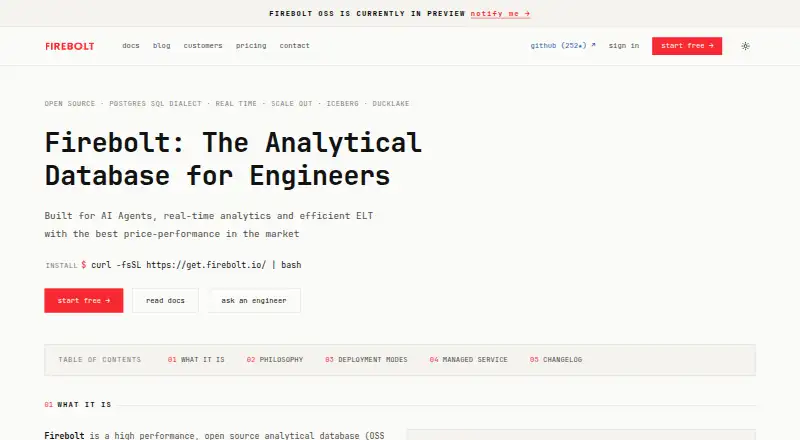
Firebolt is an open-source analytical database for engineers that uses Postgres-compatible SQL. It can run as a single binary on a laptop or as a cluster in a customer's cloud, with deployment choices also including a Helm chart, Kubernetes Operator and fully managed service. Firebolt is designed for sub-second query latency and low-latency, high-concurrency analytics. It supports Apache Iceberg and DuckLake using open storage standards. The Firebolt Core self-hosted plan is free, billed free forever, with no usage limits; it cannot be used to build a hosted SaaS product competing with Firebolt's managed service. Managed compute is billed per second and includes scale-to-zero, auto-start, auto-stop and auto-scaling. Object storage is pass-through at $0.0264 / GB·mo, and the managed service includes $200 free credits. Firebolt lists AI query and embedding features, vector search, an MCP Server and a preview agent. Self-managed deployments are generally available on AWS and GCP and in preview on Azure; managed service is currently offered on AWS only.
Who it suits
Firebolt suits engineers choosing between self-managed and managed analytical database deployments. Its free self-hosted plan may fit projects that do not involve a competing hosted SaaS product.
What it does well
- Postgres-compatible SQL
- Free self-hosted plan has no usage limits
- Supports Apache Iceberg and DuckLake
- Managed compute bills per second
What to know first
- Free Core plan excludes competing hosted SaaS products
- Managed service is currently AWS-only
- Airflow 3.x is not supported
- Delta Lake is not natively supported
Limits
Firebolt Core is self-hosted and cannot be used to build a hosted SaaS product competing with Firebolt’s managed service. The managed service is currently offered on AWS only; self-managed Azure is in preview. The native dbt adapter supports dbt Core only, Airflow 3.x is unsupported, and Delta Lake is not natively supported.
Plans
| Plan | Billed and limits | Price |
|---|---|---|
| Firebolt Core | free forever · self-hosted · no usage limits · cannot be used to build a hosted SaaS competing with Firebolt managed service | Free |
As firebolt.io lists them, read 30 Sept 2026. The maker's own page has the final word.
Getting started
- Visit the Firebolt website.
- Choose self-managed Core or the fully managed service.
- For self-managed deployment, use the single binary, Helm chart, or Kubernetes Operator.
- For managed service, start with the available free credits.
- Connect through a supported SQL client, language, BI tool, or data platform.
Firebolt is an open-source analytical database for engineers who need fast SQL analytics and control over where workloads run. It suits teams moving between local development, self-managed cloud clusters and a managed service, especially when open lake storage matters. Its strongest case is flexible, low-latency analytics; AWS-only managed hosting and several integration boundaries narrow the fit.
Overview
Firebolt uses Postgres-compatible SQL and is designed for sub-second queries under high concurrency. The same product can run as a zero-dependency single binary on a laptop or scale to clusters of hundreds of nodes in your cloud. That range serves both developers who want a lightweight starting point and platform teams that require their own infrastructure, but self-managed deployments also leave operations, upgrades and capacity decisions with you.
Deployment choices include the single binary, a Helm chart, a Kubernetes Operator and a fully managed service. Separate storage and compute, streaming ingestion, and support for Apache Iceberg and DuckLake make it suitable for lake-oriented architectures based on open storage standards rather than a closed storage layer.
Key features
Managed compute is charged per second and can scale to zero, start and stop automatically, and scale automatically with demand. Those controls are useful for intermittent or changing workloads because idle compute need not remain running. Object storage is billed separately at $0.0264 / GB·mo, so total managed cost depends on retained data as well as query activity. The managed service includes $200 in free credits, giving new deployments room to evaluate usage before compute charges become the deciding factor.
AI functions include AI_QUERY, AWS_BEDROCK_AI_QUERY and AI_EMBED_TEXT, alongside HNSW vector indexes and VECTOR_SEARCH. An MCP Server and a preview Firebolt Agent extend the database toward AI-assisted applications, though the Agent is not presented as a finished capability. Traditional analytics tooling is well covered: Looker, Tableau and Power BI can connect, as can Postgres-compatible clients and Go, JDBC, .NET, Node.js, Python, Rust, SQLAlchemy and REST API applications.
Data-platform integrations include dbt Core, Airflow 2.x, Confluent Kafka, Apache Iceberg catalogs, Databricks Unity Catalog, Snowflake Open Catalog and AWS Glue. The boundaries matter: the native dbt adapter is for dbt Core, Airflow 3.x is unsupported, and Delta Lake has no native support. Teams standardising on those technologies should verify that their existing pipelines do not depend on the missing versions or format.
Security and governance features include SOC 2 Type II, ISO 27001, ISO 27018, HIPAA support, GDPR alignment, MFA, role-based access control, encryption in transit and at rest, plus audit logs and metrics in the managed service. These provisions make Firebolt more credible for regulated or centrally governed environments, while self-managed customers remain responsible for operating their chosen deployment.
Pricing
Firebolt Core
Firebolt Core costs nothing, billed free forever, and is self-hosted with no usage limits. It is the clearest option for developers, experiments and teams that want complete control without a license bill. The important commercial restriction is that Core cannot be used to build a hosted SaaS competing with Firebolt’s managed service, so it is unsuitable as the database behind a competing multi-tenant offering. The plan supports hybrid deployment, separate storage and compute, data-lake use and streaming ingestion, but self-hosting still carries infrastructure and operational work.
Managed service
The managed service uses usage-based compute billing per second, with $200 in free credits. Scale-to-zero and automatic start, stop and scaling can limit waste for elastic workloads; object storage remains a pass-through charge of $0.0264 / GB·mo. Choose this route when avoiding cluster operations is worth variable billing. Choose Core instead when predictable infrastructure ownership, unlimited free usage and self-management are more important.
Platforms
Firebolt is available through its API, Linux deployments, self-hosting and the web. Self-managed Firebolt is generally available on AWS and GCP and in preview on Azure. The fully managed service is currently offered only on AWS, making self-management the practical path for teams committed to GCP or Azure.
Who it's for
Firebolt fits engineering and data-platform teams building high-concurrency analytics, lakehouse workloads or streaming pipelines that benefit from Postgres-compatible SQL and open storage. It is also a good match for organisations that want to begin with a local binary and later move to Kubernetes or managed compute. Look elsewhere if you require native Delta Lake, Airflow 3.x or dbt adapters beyond dbt Core, or if a managed service in GCP or Azure is essential.
Pros and cons
Pros
- Flexible deployment: A single binary, Kubernetes tooling and managed hosting cover development through large clusters.
- Fast concurrent analytics: Sub-second query design targets demanding interactive workloads.
- Open lake compatibility: Apache Iceberg, DuckLake and separated storage and compute suit open data architectures.
- Elastic managed billing: Per-second compute, scale-to-zero and automatic scaling align cost with variable demand.
- Broad connectivity: Major BI tools, programming languages and catalog platforms are supported.
Cons
- Managed AWS constraint: The fully managed option does not currently cover GCP or Azure.
- Ecosystem gaps: Airflow 3.x, native Delta Lake and dbt adapters beyond dbt Core are not supported.
- Operational burden on Core: Self-hosted users run the infrastructure themselves.
- SaaS restriction: Core cannot power a hosted service competing with Firebolt managed service.
- Storage is extra: Managed users pay object-storage pass-through charges in addition to compute.
Alternatives
Exasol is worth choosing when you want a freemium database with a free trial and published pay-as-you-go XS and S plans, plus macOS support.
Apache Hive is the straightforward choice for free, open-source data-warehouse software across Linux, macOS, Windows and self-hosted environments.
Databend suits teams seeking a free self-hosted Community plan alongside a separate Dedicated offering.
Oracle Autonomous AI Lakehouse offers an always-free plan with unlimited-time usage subject to capacity limits.
Teradata VantageCloud is an alternative for organisations evaluating Teradata Database and ClearScape Analytics in a lake-oriented cloud service.
Databricks Notebooks is better when browser-based notebooks and a free edition with one serverless workspace are the priority.
Greenplum Database provides an Apache 2-licensed open-source option, with commercial VMware Tanzu Greenplum available through sales.
BigQuery Data Clean Rooms is aimed specifically at publishing and querying data in clean-room collaborations.
For broader comparisons, browse Data Warehouse Software, Columnar Databases, Query Engine Software, OLAP Databases and OLAP Software.
Verdict
Choose Firebolt if you need fast, concurrent analytical SQL with the freedom to run a free self-hosted binary, operate your own cloud cluster or use elastic managed compute. Its open-storage support and broad tooling strengthen the case for modern lake architectures. Look elsewhere when AWS-only managed hosting, missing Delta Lake or Airflow 3.x support, or the Core plan’s competing-SaaS restriction conflicts with your platform strategy.
Verdict
Firebolt offers both self-managed and managed deployment paths, plus a free self-hosted plan and a managed service with usage-based compute billing. Check the deployment restrictions and listed integration limits before choosing a setup.
Questions
Is Firebolt free?
Firebolt Core is free forever for self-hosted use, with no usage limits. The managed service includes $200 in free credits; managed compute is billed per second and object storage is charged at $0.0264 / GB·mo.
Where can Firebolt run?
Self-managed Firebolt is generally available on AWS and GCP and in preview on Azure. The fully managed service is currently offered on AWS.
Does Firebolt support open table formats?
Yes. Firebolt supports Apache Iceberg and DuckLake and uses open storage standards.
What tools and platforms does Firebolt integrate with?
Listed integrations include Looker, Tableau, Power BI, Postgres-compatible tools, several programming languages, SQLAlchemy, REST clients, dbt Core, Airflow 2.x, and Confluent Kafka.
Can Firebolt be used for a hosted SaaS product?
The free self-hosted Core plan cannot be used to build a hosted SaaS product competing with Firebolt’s managed service.
Facts from Firebolt's own pages
- AI features
- Firebolt supports AI_QUERY, AWS_BEDROCK_AI_QUERY, AI_EMBED_TEXT, HNSW vector indexes, VECTOR_SEARCH, an MCP Server, and a preview Firebolt Agent. · firebolt.io, 30 Sept 2026
- Cloud availability
- Self-managed Firebolt is generally available on AWS and GCP and in preview on Azure; the fully managed service is currently offered on AWS only. · firebolt.io, 30 Sept 2026
- Data platforms
- Supported integrations include dbt Core, Airflow 2.x, Confluent Kafka, Apache Iceberg catalogs, Databricks Unity Catalog, Snowflake Open Catalog, and AWS Glue. · firebolt.io, 30 Sept 2026
- Deployment
- It runs as a single binary on a laptop or as a cluster of hundreds of nodes in your own cloud. · firebolt.io, 30 Sept 2026
- Deployment models
- Firebolt offers a zero-dependency single binary, Helm chart, Kubernetes Operator, and fully managed service. · firebolt.io, 30 Sept 2026
- Founded
- 2019 · firebolt.io, 28 Sept 2026
- Free credits
- The managed service includes $200 free credits. · firebolt.io, 30 Sept 2026
- Integrations
- It integrates with Looker, Tableau, Power BI, Postgres-compatible tools, Go, JDBC, .NET, Node.js, Python, Rust, SQLAlchemy, and REST API clients. · firebolt.io, 30 Sept 2026
- Managed pricing
- Managed compute is billed per second, with scale-to-zero, auto-start, auto-stop, and auto-scaling; object storage is pass-through at $0.0264 / GB·mo. · firebolt.io, 30 Sept 2026
- Notable limits
- The native dbt adapter supports dbt Core only, Airflow 3.x is not supported, and Delta Lake is not natively supported. · firebolt.io, 30 Sept 2026
- Performance
- Firebolt is designed for sub-second query latency and low-latency, high-concurrency analytics. · firebolt.io, 30 Sept 2026
- Product
- Firebolt is a high-performance, open-source analytical database for engineers with Postgres-compatible SQL. · firebolt.io, 30 Sept 2026
- Security
- Firebolt lists SOC 2 Type II, ISO 27001, ISO 27018, HIPAA support, GDPR alignment, MFA, RBAC, and encryption in transit and at rest. · firebolt.io, 30 Sept 2026
- Storage
- The platform supports Apache Iceberg and DuckLake and uses open storage standards. · firebolt.io, 30 Sept 2026
- Support
- The pricing page lists audit logs, metrics, and support as managed-service capabilities. · firebolt.io, 30 Sept 2026
Where Firebolt stands on Freedom251
- AWS Marketplace Software#3 of 31
- Cloud Analytics Solutions#4 of 29
- Data Warehouse Software#5 of 27
- Analytics Data#6 of 30
- Analytical Data Store Software#8 of 28
- Analytics Databases#9 of 31
- OLAP Software#10 of 32
- Query Engine Software#9 of 28
- Columnar Databases#9 of 27
- OLAP Databases#11 of 30
- Big Data Analytics Software#16 of 30