Freedom251 › Data Exchange Platforms

BigQuery Data Clean Rooms
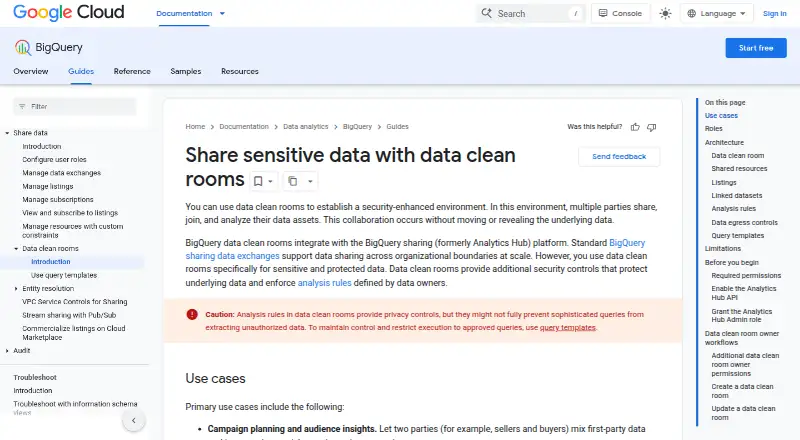
What BigQuery Data Clean Rooms is
BigQuery Data Clean Rooms let multiple parties share, join, and analyze data without transferring or exposing the underlying data. The cloud service connects to BigQuery sharing, and shared resources must be BigQuery tables, views, or table-valued functions. Owners manage rooms, contributors publish data, and subscribers query it. Contributors can configure analysis rules, including aggregation thresholds, and provide predefined queries through templates without sharing underlying tables or views. The service prevents subscribers from copying or exporting raw data, while contributors can configure controls for query results. Google cautions that analysis rules may not stop sophisticated queries from extracting unauthorized data, and recommends templates when approved-query control is needed. Each room can contain at most 100 shared resources. Availability is limited to BigQuery sharing regions, with no listings across multiple regions. Rooms can be managed in the Google Cloud console or created through the API. Setup requires enabling the Analytics Hub API and assigning required IAM roles. Contributors pay for storage; subscribers pay for compute when running queries. The service has a free plan, but those storage and compute charges still apply.
Who it suits
It suits organizations that need to share and analyze data with separate owner, contributor, and subscriber roles. Campaign, measurement, retail, finance, healthcare, and supply-chain use cases are listed.
What it does well
- Blocks subscribers from copying or exporting raw data.
- Contributors can set aggregation thresholds and query-result controls.
- Query templates offer predefined analysis without exposing underlying tables.
- Available through the console and API.
What to know first
- A room is limited to 100 shared resources.
- Availability is limited to BigQuery sharing regions.
- Analysis rules may not block sophisticated data extraction.
- Storage and query compute charges still apply.
Limits
Each room can contain up to 100 shared resources. Rooms are available only in BigQuery sharing regions, and listings across multiple regions are unsupported. Analysis rules can be set only on views and might not prevent sophisticated queries from extracting unauthorized data.
Plans
| Plan | Billed and limits | Price |
|---|---|---|
| Data contributor | Publishes data to a clean room | On request |
| Data clean room subscriber | Subscribes to and queries clean-room data | On request |
As cloud.google.com lists them, read 20 Sept 2026. The maker's own page has the final word.
Getting started
- Open the BigQuery Data Clean Rooms documentation.
- Enable the Analytics Hub API.
- Assign the required IAM roles, including Analytics Hub Admin for owners.
- Manage a room in the Google Cloud console or create one through the API.
- Publish BigQuery tables, views, or table-valued functions as shared resources.
- Set analysis rules and query templates for subscribers.
BigQuery Data Clean Rooms is a cloud service for organizations that want partners to analyze shared data without transferring the underlying records. It suits teams already using BigQuery and the Google Cloud console or API. Its separate owner, contributor, and subscriber roles support controlled collaboration, but regional limits and privacy safeguards that need careful configuration narrow its fit.
Overview
Built into BigQuery sharing, formerly Analytics Hub, the service lets parties join and analyze data in place. Shared resources must be BigQuery tables, views, or table-valued functions, so it is a more natural choice for BigQuery-centered partnerships than for organizations seeking a standalone data exchange.
Google identifies campaign planning, measurement and attribution, and activation as primary uses, with applications in retail, financial services, healthcare, and supply chains. Owners manage rooms, contributors publish data, and subscribers query it. That division makes responsibilities clear, though every participant’s workflow depends on the BigQuery sharing setup.
Key features
Query and privacy controls
Contributors can set analysis rules, including aggregation thresholds that limit subscribers to aggregate queries. Rules apply only to views, which constrains how teams can protect shared resources. Query templates let owners and publishers offer predefined queries without exposing the underlying tables or views, a stronger fit when approved-query control matters.
The service automatically blocks subscribers from copying or exporting raw data, and contributors can configure controls on query results. These protections reduce straightforward routes for data removal, but they do not make disclosure impossible: Google warns that sophisticated queries may extract unauthorized data despite analysis rules. Teams handling sensitive data should not rely on rules alone and should consider query templates to constrain analysis.
Scale and deployment
A room can contain up to 100 shared resources; Google directs users to its feedback address to request a higher limit. Clean rooms are available only in BigQuery sharing regions, and listings spanning multiple regions are unsupported. Those boundaries may be manageable for a focused partnership, but they can rule out broad, multi-region catalogs.
Setup requires enabling the Analytics Hub API and assigning IAM roles, including Analytics Hub Admin for owners. Rooms can be managed in the Google Cloud console or created through the API. The cloud deployment and SQL analysis suit teams already equipped to administer BigQuery access; organizations that need a different deployment model should look elsewhere.
Pricing
The plan model is free, but that does not mean querying and storing data have no cost. Contributors pay for data storage, while subscribers pay for compute when they run queries. The cost split follows each party’s role, so collaborators should agree in advance who publishes data and who runs analyses.
- Data contributor: Custom pricing; publishes data to a clean room. Contributors are charged for storage.
- Data clean room subscriber: Custom pricing; subscribes to and queries clean-room data. Subscribers are charged for compute when they run queries.
- Free plan: The service has a free-plan designation, but storage and query compute charges still apply to the relevant parties.
There are no published seat counts or trial terms to factor into this role-based pricing. The key budget question is therefore expected storage and query compute, not a per-seat subscription.
Platforms
BigQuery Data Clean Rooms is a cloud service with web and API access. The console supports room management, while the API supports creation; the product also requires BigQuery sharing and IAM configuration.
Who it's for
This is a strong fit for BigQuery users coordinating data partnerships in campaign planning, measurement, attribution, or activation, especially when data should remain in place and access needs to be separated by role. Retail, financial services, healthcare, and supply chain teams may also find the collaboration model relevant. It is a weaker fit for groups that need multi-region listings, more than 100 resources per room, or privacy guarantees based solely on analysis rules.
Pros and cons
- Pros: Parties can join and analyze data without moving underlying records, reducing the need to distribute raw copies.
- Pros: Role separation, aggregation rules, query templates, and result controls give contributors several ways to shape subscriber access.
- Pros: Storage and compute costs fall to different parties, matching charges to publishing and querying responsibilities.
- Cons: Analysis rules are limited to views and may not stop sophisticated extraction, so sensitive collaborations need more than rule configuration.
- Cons: The 100-resource ceiling and BigQuery-sharing-region restriction limit larger or geographically distributed setups.
- Cons: API enablement and IAM role assignment add administrative work before participants can collaborate.
Alternatives
Amazon Marketing Cloud is another free-plan option with web and API access; consider it when an eligible advertiser wants Amazon’s offering rather than a BigQuery-based clean room.
Placino offers a free tier with 500K datapoints per month, one clean room, and up to three partners, so it may suit a small collaboration with a defined usage cap.
AppsFlyer Data Clean Room has a free plan and supports Android, iOS, web, and API, making it an option when those platform connections matter.
Aggregion DataLabs & CleanRoom offers API, web, and self-hosted platforms; consider it if self-hosting is a requirement.
Anjuna Northstar is a paid, self-hosted alternative for teams seeking that deployment model.
BeeKeeperAI (EscrowAI) is a paid option with web and self-hosted platforms, which may fit teams comparing those deployment choices.
Decentriq Data Clean Rooms is a paid web and API alternative for organizations comparing another clean-room service.
INDICO DataHub 2 has a free trial and a Professional plan at $79 a month; consider it if a trial and a published monthly plan are priorities.
For broader comparisons, browse Data Clean Room Software, Data Warehouse Software, Query Engine Software, Columnar Databases, SQL Query Tools, and OLAP Databases.
Verdict
Choose BigQuery Data Clean Rooms if your partners already work in BigQuery and need role-based collaboration without moving underlying data. The query templates and configurable controls are useful, but the 100-resource limit, regional constraints, and warning about sophisticated extraction are real reasons to look elsewhere or add stronger query governance.
Verdict
BigQuery Data Clean Rooms provide role-based sharing and configurable query controls, with explicit limits on resource count and regional availability. Google warns that analysis rules alone may not prevent all unauthorized extraction.
Questions
How is BigQuery Data Clean Rooms priced?
The pricing model is free, and a free plan is listed. Contributors are charged for data storage, while subscribers are charged for compute when they run queries.
Which platforms are listed?
The listed platforms are API and web. The documentation describes management in the Google Cloud console and creation through the API.
What data can a room share?
A shared resource must be a BigQuery table, view, or table-valued function.
What controls are available for queries?
Contributors can configure analysis rules, including aggregation thresholds, and controls for query results. Owners and publishers can provide query templates. Analysis rules can be set only on views, and Google cautions that they might not prevent sophisticated extraction queries.
What are the storage and compute charges?
Contributors pay for storage. Subscribers pay for compute when they run queries.
What is required to use the service?
Setup requires enabling the Analytics Hub API and assigning the required IAM roles, including Analytics Hub Admin for owners.
Facts from BigQuery Data Clean Rooms's own pages
- Access setup
- Using data clean rooms requires enabling the Analytics Hub API and assigning the required IAM roles, including Analytics Hub Admin for owners. · docs.cloud.google.com, 2 Oct 2026
- Analysis controls
- Contributors can configure analysis rules, including aggregation thresholds, to restrict how subscribers query shared data. · docs.cloud.google.com, 2 Oct 2026
- BigQuery sharing
- Data clean rooms integrate with the BigQuery sharing platform, formerly called Analytics Hub. · docs.cloud.google.com, 3 Oct 2026
- Egress controls
- Data egress controls automatically prevent subscribers from copying or exporting raw data, and contributors can add controls for query results. · docs.cloud.google.com, 3 Oct 2026
- Founded
- 1998 · cloud.google.com, 28 Sept 2026
- Headquarters
- Mountain View, California, United States · cloud.google.com, 28 Sept 2026
- Interfaces
- The documentation describes managing clean rooms in the Google Cloud console and creating them through the API. · docs.cloud.google.com, 2 Oct 2026
- Limitations
- Analysis rules can be set only on views, and Google cautions that rules might not prevent sophisticated queries from extracting unauthorized data. · docs.cloud.google.com, 3 Oct 2026
- Pricing
- Data contributors are charged only for data storage, and subscribers are charged only for compute when they run queries. · docs.cloud.google.com, 3 Oct 2026
- Pricing basis
- Contributors are charged for data storage, while subscribers are charged for compute when they run queries. · docs.cloud.google.com, 2 Oct 2026
- Privacy controls
- Contributors can configure analysis rules, including an aggregation threshold rule that allows subscribers to analyze data only through aggregation queries. · docs.cloud.google.com, 3 Oct 2026
- Privacy limitation
- Google cautions that analysis rules might not prevent sophisticated queries from extracting unauthorized data and recommends query templates for approved-query control. · docs.cloud.google.com, 2 Oct 2026
- Purpose
- BigQuery data clean rooms let multiple parties share, join, and analyze data without moving or revealing the underlying data. · docs.cloud.google.com, 3 Oct 2026
- Query templates
- Owners and publishers can share predefined queries through query templates without sharing the underlying tables or views. · docs.cloud.google.com, 3 Oct 2026
- Regional availability
- Data clean rooms are available only in BigQuery sharing regions, and listings for multiple regions are unsupported. · docs.cloud.google.com, 3 Oct 2026
- Resource limit
- A data clean room can contain at most 100 shared resources; Google directs users to contact [email protected] to request an increase. · docs.cloud.google.com, 3 Oct 2026
- Roles
- The product defines owner, contributor, and subscriber roles for managing rooms, publishing data, and querying shared data. · docs.cloud.google.com, 3 Oct 2026
- Shared resources
- A shared resource must be a BigQuery table, view, or table-valued function routine. · docs.cloud.google.com, 3 Oct 2026
- Use cases
- Google lists campaign planning, measurement and attribution, activation, retail, financial services, healthcare, and supply chain use cases. · docs.cloud.google.com, 3 Oct 2026
Where BigQuery Data Clean Rooms stands on Freedom251
- Data Exchange Platforms#5 of 13
- Data Clean Room Software#11 of 21
- Data Migration Tools#16 of 25
- Data Integration#19 of 26
- Graph Databases#32 of 39