Freedom251 › Analytical Data Store Software

Databend
What Databend is
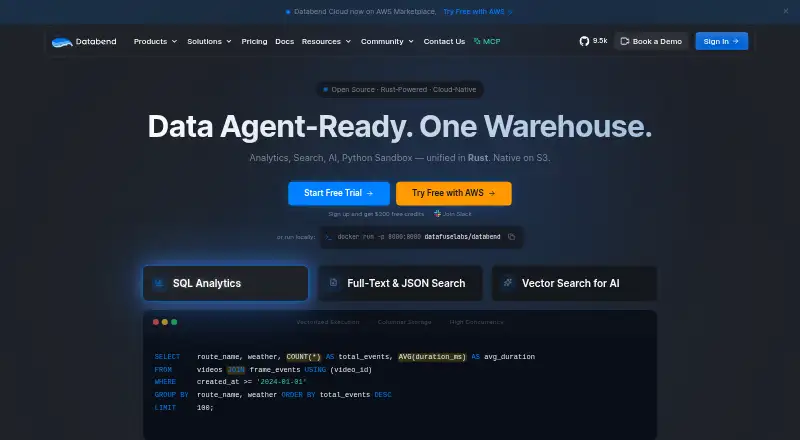
Databend is a hybrid, open-source data warehouse for SQL analytics, search, and AI workloads. Its capabilities include full-text and JSON search alongside vector search for AI. Storage options span S3, Azure, GCS, OSS, R2, MinIO, HDFS, and HF, and Databend lists more than 50 integrations across the data stack. Documented continuous-sync pipelines connect to S3/SQS, MySQL, PostgreSQL, TiDB, and Kafka. The Community edition is self-hosted and includes Time Travel, multi-catalog support for Apache Hive and Apache Iceberg, and ingestion for CSV, JSON, and Parquet. Databend Cloud plans cover personal developers and small businesses through medium and large enterprises, with usage-based warehouse charges on Personal and Business and a dedicated environment on Dedicated. Security controls include RBAC and DAC, masking, network, and password policies. Databend says client connections use TLS 1.2 and describes a SOC 2 Type II assessment and GDPR compliance. AWS PrivateLink supports connections to Databend Cloud clusters over VPC peering and is available only on AWS. Databend is available through web, API, Linux, macOS, and self-hosted options.
Who it suits
Databend suits teams that need a warehouse for analytics, search, or AI and want to choose between self-hosting and cloud plans. Its Community edition fits people comfortable running software in their own environment, while Personal, Business, and Dedicated address different business sizes and support needs.
What it does well
- Combines SQL analytics, full-text, JSON, and vector search.
- Supports storage across S3, Azure, GCS, OSS, R2, MinIO, HDFS, and HF.
- Documents continuous sync from five source types.
- Community edition includes Time Travel and Hive and Iceberg catalogs.
- Lists RBAC, DAC, masking, network, and password policies.
What to know first
- Community edition requires self-hosting in your own environment.
- Personal and Business warehouse charges are usage-based.
- AWS PrivateLink is currently limited to AWS.
Limits
The Community plan is self-hosted in your own environment. Personal provides up to 1 day of historical data access and restore; Business provides up to 90 days of data retention.
Plans
| Plan | Billed and limits | Price |
|---|---|---|
| Databend Community | Free, self-hosted · Self-hosted in your own environment | Free |
| Community | self-hosted · open-source community edition | Free |
| Personal | $23.00 / mo. / TB storage; compute minimum $1.00 / hr. · 1-day historical restore · 1–5 minute provisioning · 1-business-day non-critical response · 99.9% SLA | $23 a month |
| Business | $23.00 / mo. / TB storage; compute minimum $1.50 / hr. · 90-day retention · under-15-second provisioning · AWS PrivateLink · 24/7 support with 8-hour critical response · 99.9% SLA | $23 a month |
| Dedicated | Storage and compute shown as **; contact sales · fully isolated environment · customizable resources · scheduled upgrades · dedicated support · Prometheus metrics · up to 99.9% SLA | On request |
As databend.com lists them, read 30 Sept 2026. The maker's own page has the final word.
Getting started
- Visit the Databend website.
- Choose the self-hosted Community edition or a Databend Cloud plan.
- For self-hosting, use the downloads for Ubuntu ARM or x86 64-bit.
- Install BendSQL for Mac Apple or Intel chips, Ubuntu, or generic Linux ARM or x86 64-bit.
- Start with the free plan or use the 30-day trial.
Databend is a cloud-native warehouse for analytics, search, and AI workloads, offered as a self-hosted open-source edition and a hosted cloud service. It suits teams that need SQL alongside full-text, JSON, or vector search and want to choose their storage and deployment model. Its breadth is useful, though the cloud plans charge by usage and trade off retention and support.
Overview
Databend brings SQL analytics together with full-text, JSON, and vector search. Separate storage and compute, data lake support, and a hybrid deployment model make it a candidate for teams working across varied data environments. Those capabilities may be unnecessary for organizations that only need conventional SQL reporting.
The product says it has more than 50 integrations across the data stack. Databend Cloud Agent supports continuous synchronization from S3/SQS, MySQL, PostgreSQL, TiDB, and Kafka, while the Community edition supports CSV, JSON, and Parquet ingestion. This gives teams several routes into the warehouse, though the documented continuous-sync pipelines are specific to the cloud agent.
Key features
- Search with analytics: SQL, full-text, JSON, and vector search bring several query patterns into one warehouse. That mix suits teams building search or AI workloads alongside analytics; it is less compelling for a SQL-only use case.
- Broad storage options: Databend lists S3, Azure, GCS, OSS, R2, MinIO, HDFS, and HF. The range can accommodate varied cloud and data-lake setups without tying the choice to one storage provider.
- Access controls: RBAC and DAC, masking policies, network policies, and password policies give administrators several ways to govern access and data exposure.
- Security commitments: Client connections use TLS 1.2, and Databend describes a SOC 2 Type II assessment and GDPR compliance. AWS PrivateLink supports connections to Databend Cloud clusters over VPC peering, but only on AWS, limiting its fit for teams that require private connectivity elsewhere.
- Self-hosted capabilities: Community includes Time Travel and Multi Catalog for Apache Hive and Apache Iceberg. It is a stronger fit for teams that want control over their environment and these features without a cloud subscription.
Pricing
Databend uses a freemium model and offers a 30-day trial. Community costs nothing and runs in your own environment. It is the clearest fit for teams able to manage self-hosting; it does not include the cloud plans' stated support and uptime commitments.
Personal and Business use custom pricing with usage-based charges for warehouse compute, billed per second. Personal targets individual developers and small businesses, with up to one day of historical data access and restore, a one-business-day response for non-critical issues, and a 99.9% uptime SLA. Its short history window makes it a better fit for lighter workloads than teams needing longer recovery or retention.
Business is aimed at small and medium-sized enterprises. It raises data retention to 90 days and includes 24/7 support with an eight-hour response for critical issues, alongside a 99.9% uptime SLA. Dedicated has custom pricing for medium and large enterprises, with a fully isolated environment, dedicated support, and up to 99.9% uptime SLA. These cloud plans offer stronger operational commitments than Community, but per-second compute charges and custom pricing make costs less straightforward to forecast.
Platforms
Databend lists API, Linux, macOS, self-hosted, and web platforms. Downloads include Databend for Ubuntu ARM and x86 64-bit. BendSQL is available for Mac with Apple or Intel chips, plus Ubuntu and generic Linux on ARM and x86 64-bit. That gives teams several deployment and client options, with the listed downloads centered on Ubuntu and Linux architectures.
Who it's for
Databend is best suited to teams that want analytics and search in the same warehouse, need flexible storage choices, or must decide between managed cloud and self-hosting. Community is a practical starting point for teams with the capacity to run their own environment. Cloud plans suit organizations willing to pay by warehouse usage for defined retention, support, and uptime terms. A team that needs a fixed cloud price or AWS PrivateLink outside AWS should consider another fit.
Pros and cons
- Pro: SQL, full-text, JSON, and vector search cover more than standard analytics queries.
- Pro: Storage choices span major cloud object stores, data-lake systems, and MinIO.
- Pro: Community is free and self-hosted, with Time Travel, multi-catalog support, and common file ingestion formats.
- Con: Cloud compute is billed by the second, and plans use custom pricing, making budget estimates less direct.
- Con: Personal offers only up to one day of historical access and restore; teams needing longer retention must move to Business or another plan.
- Con: PrivateLink is limited to AWS, excluding teams that require this connection method on other clouds.
Alternatives
Data Warehouse Software and Columnar Databases are useful category lists for comparing more products.
- Exasol is another freemium option with a free plan and trial; its listed XS and S plans have pay-as-you-go monthly prices, which may suit buyers comparing priced compute tiers.
- Apache Hive is a free, open-source data warehouse for teams looking for a no-cost alternative across desktop and server platforms.
- Oracle Autonomous AI Lakehouse offers an always-free plan for unlimited time subject to capacity limits, making it worth considering for users who want a free hosted option.
- Teradata VantageCloud is another freemium warehouse with a free plan and trial for teams comparing cloud warehouse services.
- Databricks Notebooks has a free edition with one serverless workspace and limited compute and usage, which may suit users exploring a constrained free workspace.
- Firebolt offers a free self-hosted Core edition with no usage limits; it cannot be used to build a hosted SaaS that competes with Firebolt's managed service.
- Greenplum Database has a free open-source edition under the Apache 2 license, alongside a paid VMware Tanzu option.
- BigQuery Data Clean Rooms is a free option for publishing data to, or querying data from, a clean room.
Verdict
Choose Databend if you need one warehouse for SQL analytics and search, want broad storage compatibility, and value a choice between self-hosting and cloud deployment. Its free Community edition lowers the barrier to self-managed use, while cloud tiers add retention and support commitments. Look elsewhere if you need a fixed cloud price or AWS PrivateLink outside AWS.
Verdict
Choose Databend if you need an analytics warehouse with search capabilities, broad storage options, and a choice of self-hosted or cloud deployment. Look elsewhere if your setup requires AWS PrivateLink outside AWS, or if you need a listed fixed price for the cloud plans.
Questions
Is Databend open source?
Databend describes itself as open source. Its Community edition is self-hosted.
What does Databend cost?
The pricing note says “Free plan · paid from $1 · 30-day trial.” The Community plan is free; Personal and Business use usage-based warehouse charges, and Dedicated is billed by contacting sales.
Which platforms does Databend support?
The listed platforms are API, Linux, macOS, self-hosted, and web. Downloads list Databend for Ubuntu ARM and x86 64-bit, and BendSQL for Mac Apple and Intel chips, Ubuntu, and generic Linux ARM and x86 64-bit.
What storage and integrations does it support?
Listed storage options include S3, Azure, GCS, OSS, R2, MinIO, HDFS, and HF. Databend says it has 50+ integrations across the data stack.
What are the cloud plans?
Personal and Business use usage-based warehouse charges. Dedicated provides a fully isolated environment, dedicated support, and up to 99.9% uptime SLA, with billing by contacting sales.
What security controls does Databend list?
It documents RBAC and DAC, masking policies, network policies, and password policies. Databend says client connections use TLS 1.2 and describes SOC 2 Type II assessment and GDPR compliance.
Facts from Databend's own pages
- Access controls
- Databend documents RBAC and DAC, masking policies, network policies, and password policies. · databend.com, 30 Sept 2026
- Analytics and search
- The product lists SQL analytics, full-text and JSON search, and vector search for AI among its capabilities. · databend.com, 30 Sept 2026
- API and drivers
- Official connection resources cover HTTP access, BendSQL, DBeaver, Java, Go, Python, Node.js, Rust, MCP server and MCP client. · docs.databend.com, 15 Oct 2026
- BI and notebook tools
- Documentation lists Deepnote, Jupyter, Metabase, Grafana, Redash, Superset, Tableau and MindsDB as analytics or visualization connections. · docs.databend.com, 15 Oct 2026
- Branching
- Git-like data branching lets agents experiment against production snapshots. · github.com, 15 Oct 2026
- Community scale
- The about page reports more than 230 contributors and over 9.5 thousand GitHub stars. · databend.com, 15 Oct 2026
- Company
- Databend Labs says it was founded by a team of engineers; the company page lists its address as 732 S 6TH ST, STE R, Las Vegas, NV 89101, USA. · databend.com, 30 Sept 2026
- Company founding and headquarters
- LinkedIn lists the company as founded in 2021 with headquarters in Reno, Nevada, United States. · linkedin.com, 15 Oct 2026
- Company size
- LinkedIn lists Databend as a software-development company with 51–200 employees. · linkedin.com, 15 Oct 2026
- Compliance
- The vendor states that Databend Cloud has SOC 2 Type II and GDPR compliance and undergoes regular audits. · databend.com, 15 Oct 2026
- Data ingestion
- Databend Cloud Agent documentation describes continuous sync pipelines from S3/SQS, MySQL, PostgreSQL, TiDB, and Kafka. · docs.databend.com, 30 Sept 2026
- Documentation depth
- The documentation is organized into cloud, self-hosted, connection, loading, unloading, AI/ML, multimodal analytics, performance, security, data management, benchmarks and troubleshooting sections. · docs.databend.com, 15 Oct 2026
- Downloads
- The download page offers Databend Ubuntu x86-64 and ARM64 binaries plus BendSQL builds for Apple Silicon, Intel Mac, ARM64 and x86-64 Ubuntu and generic Linux. · databend.com, 15 Oct 2026
- Encryption
- Databend states that client-to-API traffic uses TLS 1.2 over HTTPS and that Enterprise supports server-side encryption for OSS storage. · databend.com, 15 Oct 2026
- Encryption and compliance
- Databend states that client connections use TLS 1.2 and describes SOC 2 Type II assessment and GDPR compliance. · databend.com, 30 Sept 2026
- Full-text and JSON search
- Databend advertises full-text and JSON search with inverted-index support for hybrid retrieval. · databend.com, 15 Oct 2026
- Funding
- Crunchbase lists one seed funding round and names UnityVC as the investor, without exposing the amount. · crunchbase.com, 15 Oct 2026
- Geospatial
- Geospatial indexes and functions support map and location analysis. · docs.databend.com, 15 Oct 2026
- Headquarters
- Las Vegas, Nevada, United States · databend.com, 28 Sept 2026
- Integrations
- Databend says it has more than 50 integrations spanning relational databases, streams and orchestrators, lake formats, cloud storage, visualization tools, languages and drivers. · databend.com, 15 Oct 2026
- Legal entity
- Crunchbase identifies the legal name as Datafuse Labs, Inc. and describes Databend as an active for-profit company. · crunchbase.com, 15 Oct 2026
- License
- The repository is Apache 2.0, while a small set of enterprise features uses the Elastic 2.0 license. · github.com, 15 Oct 2026
- Limit: independent review evidence
- G2, Capterra and Software Advice listings each show no user reviews, so there is no repeated independent praise or complaint pattern in those directories. · g2.com, 15 Oct 2026
- Limit: unpublished enterprise pricing
- Dedicated plan storage and compute prices are displayed as ** and require contacting sales. · databend.com, 15 Oct 2026
Where Databend stands on Freedom251
- Analytical Data Store Software#1 of 28
- Columnar Databases#2 of 27
- Data Warehouse Software#2 of 27