Freedom251 › Change Data Capture Software
Maxwell's Daemon
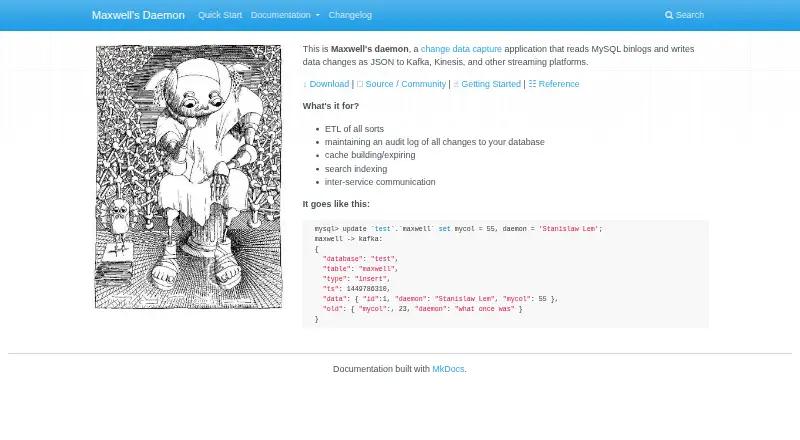
What Maxwell's Daemon is
Maxwell's Daemon is a free, open-source tool for capturing changes from MySQL databases and sending them as JSON to streaming platforms. It reads MySQL binary logs, using a log-based capture method, and documents output producers for Kafka, Kinesis, SQS, SNS, NATS, Google Cloud Pub/Sub, BigQuery, RabbitMQ and Redis. Listed uses include ETL, database change auditing, cache building or expiring, search indexing and communication between services. It supports schema evolution and an initial snapshot.
Filtering can select events by database, table or column values. JavaScript filters allow custom row filtering and data changes. When encryption is enabled, Maxwell encrypts messages with AES/CBC/PKCS5PADDING using a key supplied by the user, then base64-encodes the values. Metrics can be exposed through logging, JMX, HTTP or Datadog; HTTP endpoints cover metrics, Prometheus, health checks, ping and diagnostics. The software runs on Linux in a self-hosted deployment. The quick start describes command-line and Docker use and provides a binary distribution and a Homebrew installation command. Documented requirements include JRE 11 or above and MySQL 5.1, 5.5, 5.6, 5.7 or 8; Kafka 0.8.2 or greater is required when using Kafka. With MySQL's MINIMAL row image setting, UPDATE and DELETE output may be incomplete, and INSERT output leaves out column default values.
Who it suits
Maxwell's Daemon suits technical teams that need to stream MySQL changes into Kafka or other documented destinations for ETL, auditing, indexing, cache work or service communication. It fits Linux environments where teams can manage a self-hosted deployment and its runtime and database requirements.
What it does well
- Free and open source, with no paid plans stated.
- Streams MySQL binlog changes as JSON to documented destinations.
- Filters events by database, table and column values.
- Supports custom JavaScript filters, schema evolution and an initial snapshot.
- Exposes metrics through logging, JMX, HTTP or Datadog.
What to know first
- It is self-hosted and listed for Linux.
- Requires JRE 11 or above and a compatible MySQL version.
- MINIMAL row images can lead to incomplete UPDATE and DELETE output.
- High availability is documented as experimental and alpha quality.
Limits
The software is free, with no usage limits stated on the opened pages. With binlog_row_image=MINIMAL, UPDATE and DELETE output may be incomplete, and INSERT output omits column default values. The documented client-side high-availability approach is experimental and alpha quality, and requires at least three Maxwell nodes for leader elections.
Plans
| Plan | Billed and limits | Price |
|---|---|---|
| Free | No paid plans or usage limits stated on the opened pages | Free |
As maxwells-daemon.io lists them, read 3 Oct 2026. The maker's own page has the final word.
Getting started
- Review the documented JRE and MySQL requirements, and the Kafka requirement if using Kafka.
- Choose a documented output producer such as Kafka, Kinesis, SQS, SNS, NATS, Google Cloud Pub/Sub, BigQuery, RabbitMQ or Redis.
- Use the quick start to run Maxwell from the command line or Docker.
- Alternatively, use the provided binary distribution or Homebrew installation command.
- Find source code and bug tracking through GitHub.
Verdict
Choose Maxwell's Daemon if you need a free, self-hosted way to stream MySQL changes as JSON and can operate its Linux deployment. Check the MINIMAL row image caveat if your database uses that setting, and treat its documented high-availability approach as experimental.
Questions
How much does Maxwell's Daemon cost?
The listed Free plan costs nothing. It is open source, and no paid plans are stated.
Which platforms and deployment model does it support?
It is listed for Linux and self-hosted deployment. The quick start describes command-line and Docker use, as well as binary and Homebrew installation routes.
Which streaming destinations are documented?
Producers are documented for Kafka, Kinesis, SQS, SNS, NATS, Google Cloud Pub/Sub, BigQuery, RabbitMQ and Redis.
What does Maxwell require?
The compatibility page lists JRE 11 or above and MySQL 5.1, 5.5, 5.6, 5.7 or 8. Kafka 0.8.2 or greater is required when using Kafka.
Is Maxwell's Daemon open source?
Yes. The project is free and open source, and its quick start directs users to GitHub for source code and bug tracking.
What happens with MySQL's MINIMAL row image setting?
UPDATE and DELETE output may be incomplete, while INSERT output omits column default values.
Facts from Maxwell's Daemon's own pages
- Deployment
- The quick start documents running Maxwell from the command line or Docker and provides a binary distribution and Homebrew installation command. · maxwells-daemon.io, 3 Oct 2026
- Encryption
- When enabled, Maxwell encrypts messages with AES/CBC/PKCS5PADDING using a user-provided key, then base64-encodes values. · maxwells-daemon.io, 3 Oct 2026
- Filtering
- Maxwell can filter by database, table, and column values, and supports JavaScript filters for custom row filtering and data changes. · maxwells-daemon.io, 3 Oct 2026
- High availability
- The documentation describes client-side high availability as experimental and alpha quality, and says at least three Maxwell nodes are needed for leader elections. · maxwells-daemon.io, 3 Oct 2026
- Monitoring
- Metrics can be exposed through logging, JMX, HTTP, or Datadog, and HTTP endpoints include metrics, Prometheus, health check, ping, and diagnostics. · maxwells-daemon.io, 3 Oct 2026
- Notable limitation
- With binlog_row_image=MINIMAL, UPDATE and DELETE output may be incomplete, and INSERT output omits column default values. · maxwells-daemon.io, 3 Oct 2026
- Output integrations
- Documented producers include Kafka, Kinesis, SQS, SNS, NATS, Google Cloud Pub/Sub, BigQuery, RabbitMQ, and Redis. · maxwells-daemon.io, 3 Oct 2026
- Requirements
- The compatibility page lists JRE 11 or above, MySQL 5.1, 5.5, 5.6, 5.7, or 8, and Kafka 0.8.2 or greater when using Kafka. · maxwells-daemon.io, 3 Oct 2026
- Support and source
- The quick start directs users to GitHub for source code and bug tracking. · maxwells-daemon.io, 3 Oct 2026
- Use cases
- The site lists ETL, database change auditing, cache building or expiring, search indexing, and inter-service communication as use cases. · maxwells-daemon.io, 3 Oct 2026
- What it does
- Maxwell reads MySQL binlogs and writes database changes as JSON to Kafka, Kinesis, and other streaming platforms. · maxwells-daemon.io, 3 Oct 2026
Where Maxwell's Daemon stands on Freedom251
- Change Data Capture Software#11 of 23