Freedom251 › Software Composition Analysis Software
DeepFilterNet
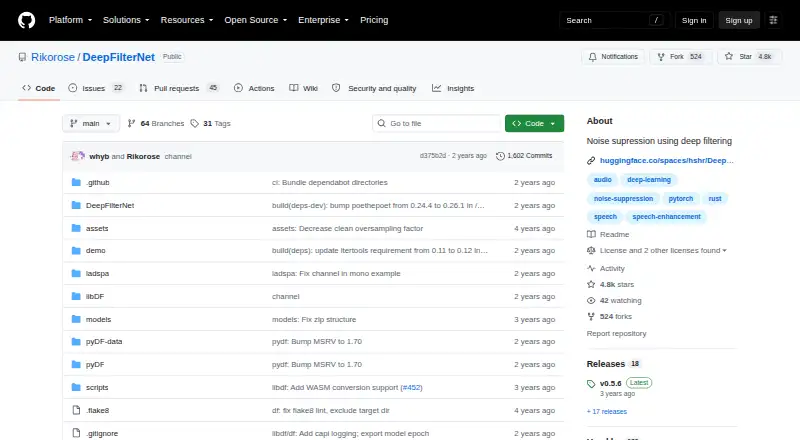
What DeepFilterNet is
DeepFilterNet is a free, open-source speech enhancement framework for full-band 48 kHz audio. Its command-line tool suppresses noise in WAV files, and a LADSPA plugin provides real-time noise suppression. The plugin can be used with PipeWire filter chains to create a virtual microphone or audio output for VoIP applications such as Zoom or Discord. Its minimum latency is 20 ms from STFT processing, with additional latency from the LADSPA host.
The Rust command-line tool uses DeepFilterNet2 by default; the Python interface documents DeepFilterNet and DeepFilterNet2. An optional post-filter can slightly over-attenuate very noisy segments. The framework supports Linux, macOS, and Windows, but training has only been tested under Linux. The Python package installs through pip as deepfilternet, with an optional train extra adding data-loading functionality for Linux training. Training uses HDF5 datasets and a configuration file for train, validation, and test sets. Precompiled binaries are available through GitHub releases, and a Python wheel through PyPI. The code is available under either the MIT License or Apache License 2.0.
Who it suits
It suits people who want to suppress noise in 48 kHz WAV audio or set up real-time noise filtering through LADSPA and PipeWire. Developers can also use its Python interface or train models on Linux.
What it does well
- Free and open source under MIT or Apache 2.0.
- Real-time suppression is available through a LADSPA plugin.
- PipeWire filter chains can create a virtual microphone.
- Framework supports Linux, macOS, and Windows.
- Precompiled binaries and a Python wheel are available.
What to know first
- Command-line processing currently supports only 48 kHz audio.
- Training is tested only under Linux.
- LADSPA processing adds at least 20 ms latency plus host delay.
- Post-filter may over-attenuate very noisy sections.
Limits
The command-line tool currently supports only 48 kHz WAV audio. The LADSPA plugin has a minimum 20 ms latency from STFT processing, plus latency from its host.
Plans
| Plan | Billed and limits | Price |
|---|---|---|
| DeepFilterNet | Free and open source · MIT or Apache-2.0 license | Free |
| Free and open source | MIT or Apache-2.0 licensing · self-hosted framework · Linux, macOS and Windows support | Free |
As github.com lists them, read 4 Oct 2026. The maker's own page has the final word.
Getting started
- Open the DeepFilterNet project on GitHub.
- Choose a platform supported by the framework: Linux, macOS, or Windows.
- Install the Python package with pip as deepfilternet, or obtain a precompiled binary from GitHub releases.
- For Python training on Linux, add the optional train extra and prepare HDF5 datasets with a configuration file for train, validation, and test sets.
- For real-time use, configure the LADSPA plugin in a PipeWire filter chain.
Overview
DeepFilterNet is a speech-enhancement framework for cleaning noise from full-band 48 kHz audio. It suits developers and technically comfortable users who want to process recordings or build noise suppression into a live audio chain. Its open-source code and multiple integration routes are useful, but the 48 kHz limit and plugin latency make it a poor fit for workflows that need broader format support or minimal delay.
Key features
File processing and model choice
The command-line tool suppresses noise in WAV files and defaults to DeepFilterNet2. The Python interface documents both DeepFilterNet and DeepFilterNet2, offering a route for users building their own workflows. The command-line tool currently accepts only 48 kHz audio, so recordings at other sampling rates need another step before processing.
Real-time audio
A LADSPA plugin enables live noise suppression. Used in PipeWire filter chains, it can create a virtual microphone or audio output for apps such as Zoom and Discord. That makes DeepFilterNet adaptable to desktop audio routing, but it is not a turnkey call app: users need a compatible host and must configure the chain. The plugin has a minimum 20 ms latency from STFT processing, with additional delay from the LADSPA host, a meaningful drawback for latency-sensitive audio.
Installation and training
Precompiled binaries are distributed through GitHub releases, and the Python package installs with pip as deepfilternet. An optional train extra adds data-loading functionality for training on Linux. Training expects HDF5 datasets and a configuration file covering train, validation, and test sets. The framework supports Linux, macOS, and Windows, but training is tested only under Linux; users planning to train on another platform should not assume the same workflow.
An optional post-filter slightly over-attenuates very noisy sections. That may help suppress difficult noise, but it can also reduce speech in those passages.
Pricing
DeepFilterNet costs nothing. The code is open source under either the MIT License or Apache License 2.0, at the user's option. There is no free trial, paid tier, seat count, or usage quota to weigh against the free plan; the trade-off is that users work with a framework and its audio-routing setup rather than a packaged call interface.
Platforms
The framework supports Linux, macOS, and Windows. Training is tested only under Linux. The real-time route depends on the LADSPA plugin and, for PipeWire filter chains, PipeWire; the command-line WAV workflow is limited to 48 kHz.
Who it's for
DeepFilterNet is a good choice for developers, Linux audio users, and technically confident people who want free noise suppression in scripts, applications, or a PipeWire setup. It is less suitable for users who want a polished, guided interface, need to process audio outside 48 kHz, or cannot tolerate the plugin's minimum latency and host overhead.
Pros and cons
Pros
- Open source with no price: MIT or Apache-2.0 licensing gives users a free framework they can integrate into their own workflows.
- File and live-audio options: Command-line processing and a LADSPA plugin cover both WAV files and real-time routing.
- Multiple integration routes: Precompiled binaries and a Python package support different development and deployment approaches.
Cons
- 48 kHz ceiling: The command-line tool supports only this sampling rate, constraining file-processing workflows.
- Live setup and delay: PipeWire filter chains require configuration, and the plugin adds at least 20 ms plus host latency.
- Training platform caveat: Training is tested only under Linux, despite broader framework support.
Alternatives
NoiseTorch-ng is a free Linux option if you want a noise-suppression alternative centered on PulseAudio or PipeWire. For a free, open-source choice specifically on macOS, consider NoNoise Mac. Windows users with a supported RTX PC or workstation can consider NVIDIA Broadcast, which offers free AI audio and video effects; NVIDIA ShadowPlay is another free Windows option, but requires Windows 10 or 11, GeForce driver 551.52 or later, and a supported GPU.
Kleervox may suit users who prefer a virtual microphone for calls and want a free tier with neural noise cancellation and acoustic echo cancellation, capped at one hour of cleaning per day. DeskBroadcast is a macOS alternative with a free plan that is fully functional forever but carries a video watermark; its Pro plan costs $79, paid once for three Macs. Noise Suppression for Voice is another free option for Linux, macOS, and Windows.
SoliCall Noise Firewall is worth considering for buyers who want a paid option spanning desktop, web, and self-hosted platforms; contact SoliCall for pricing.
Verdict
Choose DeepFilterNet if you want a free, open-source framework for 48 kHz noise suppression and are prepared to manage command-line processing or configure a live audio chain. Its flexible integration paths are the main reason to choose it. Look elsewhere if you need a consumer-ready interface, other sampling rates, or lower latency in live audio.
Verdict
DeepFilterNet offers command-line and real-time noise suppression, with a 48 kHz constraint and additional plugin latency to consider. Its training workflow is tested only on Linux.
Questions
Is DeepFilterNet free?
Yes. It is free and open source under either the MIT License or Apache License 2.0.
Which operating systems does it support?
The framework supports Linux, macOS, and Windows. Training is tested only under Linux.
What audio can the command-line tool process?
It suppresses noise in WAV files and currently supports only a 48 kHz sampling rate.
Can it suppress noise in real time?
Yes. Its LADSPA plugin supports real-time noise suppression and can be used in PipeWire filter chains.
How can I install it?
Precompiled binaries are provided through GitHub releases, and a Python wheel is available through PyPI. The Python package installs with pip as deepfilternet.
Facts from DeepFilterNet's own pages
- Audio coverage
- The framework targets 48 kHz full-band speech audio. · github.com, 15 Oct 2026
- CLI limitation
- The precompiled deep-filter command currently accepts only WAV files sampled at 48 kHz. · github.com, 15 Oct 2026
- Distribution
- The project provides precompiled binaries through its GitHub releases and a Python wheel through PyPI. · github.com, 4 Oct 2026
- Embedded performance
- The DeepFilterNet2 paper reports a real-time factor of 0.04 on a notebook Core-i5 CPU and describes embedded real-time use. · arxiv.org, 15 Oct 2026
- Framework platforms
- The framework supports Linux, macOS, and Windows; training is only tested under Linux. · github.com, 4 Oct 2026
- Hugging Face demos
- Hendrik Schröter's Hugging Face profile lists two DeepFilterNet Spaces, including one marked Runtime error. · huggingface.co, 15 Oct 2026
- Latency
- The LADSPA plugin has a minimum latency of 20 ms from STFT processing, plus latency from the LADSPA host. · github.com, 4 Oct 2026
- Latest release
- GitHub lists version 0.5.6 as the latest release and says it fixes issues 421 and 293. · github.com, 15 Oct 2026
- Licence
- The repository is free and dual-licensed so users may choose MIT or Apache License 2.0. · github.com, 15 Oct 2026
- License
- The repository code is free and open source under either the MIT License or Apache License 2.0, at the user's option. · github.com, 4 Oct 2026
- Limit: ASR use
- A Hacker News commenter cautioned that DeepFilterNet would not improve an automatic-speech-recognition model such as Whisper. · news.ycombinator.com, 15 Oct 2026
- Limit: Colab installation
- A 2025 GitHub issue reports metadata-generation failure while installing deepfilternet 0.5.6 in Google Colab. · github.com, 15 Oct 2026
- Limit: dependency setup
- A Hacker News user reported frustrating Poetry setup involving keyring behavior over SSH. · news.ycombinator.com, 15 Oct 2026
- Limit: package installation
- A GitHub issue reports that installing deepfilternet 0.5.3 failed because the required deepfilterlib 0.5.3 distribution was unavailable. · github.com, 15 Oct 2026
- Models and processing
- The Rust command-line tool defaults to DeepFilterNet2, while the Python interface also documents use of DeepFilterNet and DeepFilterNet2 models. · github.com, 4 Oct 2026
- Noise suppression
- Its command-line tool suppresses noise in WAV recordings. · github.com, 15 Oct 2026
- Package activity
- SkillFed lists the package as dormant, with its latest release dated 2023-08-31. · skillfed.io, 15 Oct 2026
- Package downloads
- SkillFed reports 78,622 monthly downloads for deepfilternet in its displayed 30-day window. · skillfed.io, 15 Oct 2026
- PipeWire integration
- The LADSPA plugin can be used in PipeWire filter chains to create a virtual noise-suppressed microphone. · github.com, 15 Oct 2026
- Post-filter
- An optional post-filter slightly over-attenuates very noisy sections. · github.com, 4 Oct 2026
- Postfilter
- An optional postfilter is documented as slightly over-attenuating very noisy sections. · github.com, 15 Oct 2026
- Praise: CPU efficiency
- A Hacker News commenter reported adequate inference speed on plain CPU using an ONNX-based deployment. · news.ycombinator.com, 15 Oct 2026
- Praise: overall capability
- A Hacker News commenter called DeepFilterNet the most well-rounded open-source AI noise-suppression tool they had found. · news.ycombinator.com, 15 Oct 2026
- Pretrained models
- The command-line and Python workflows can load pretrained DeepFilterNet, DeepFilterNet2 and DeepFilterNet3 models. · github.com, 15 Oct 2026
Where DeepFilterNet stands on Freedom251
- Software Composition Analysis Software#1 of 65
- AI Speech Enhancement Software#1 of 35
- Open Source License Compliance Software#1 of 28
- AI Noise Cancellation Software#1 of 24
- Noise Cancellation Software#1 of 19
- Database Migration Tools#2 of 32