Freedom251 › Software Composition Analysis Software
Grype
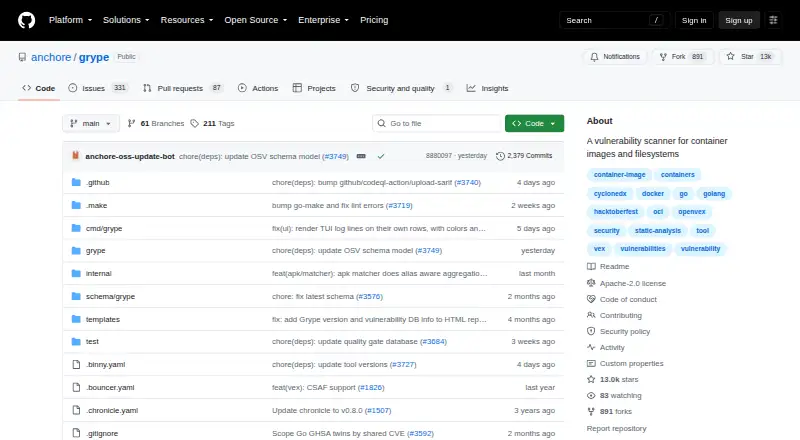
What Grype is
Grype is a free vulnerability scanner for checking container images, filesystems, software bills of materials (SBOMs), and individual packages. It can scan directories, files, archives, and packages identified by PURL or CPE. Coverage includes major operating-system ecosystems and language packages such as Ruby, Java, JavaScript, Python, .NET, Go, PHP, and Rust; listed image formats include Docker, OCI, and Singularity. EPSS, KEV, and risk scoring help organize vulnerability findings, while OpenVEX can filter results or add context. Output options include tables, JSON, SARIF, and custom Go templates. Grype also supports SBOM generation and runs on Linux, macOS, Windows, or in a self-hosted setup. Installation options include a Docker image and community packages such as Homebrew, MacPorts, Winget, Scoop, and Snapcraft. It is Apache-2.0 licensed. Security updates apply only to the latest release, and the project describes support as best effort.
Who it suits
Grype suits teams and individuals checking software packages, images, filesystems, or SBOMs for known vulnerabilities. Its documentation also describes individual package scans as useful for lightweight checks and dependency compliance.
What it does well
- Scans images, files, archives, directories, SBOMs, and packages.
- Covers major operating-system and language package ecosystems.
- Uses EPSS, KEV, and risk scoring to prioritize findings.
- Supports table, JSON, SARIF, and custom Go template output.
What to know first
- Security updates apply only to the latest release.
- Support is described as best effort.
Plans
| Plan | Billed and limits | Price |
|---|---|---|
| Grype | Apache-2.0 licensed open-source vulnerability scanner | Free |
| Grype open-source scanner | No cost · CLI tool · locally run · vulnerability database published at no cost | Free |
As github.com lists them, read 4 Oct 2026. The maker's own page has the final word.
Getting started
- Open the Grype project website.
- Choose an installation route, such as the Docker image or a listed community option.
- Install it on Linux, macOS, or Windows, or use a self-hosted deployment.
- Select a container image, directory, file, archive, SBOM, or individual package to scan.
- Choose a table, JSON, SARIF, or custom Go template output format.
Grype is a free, Apache-2.0-licensed scanner for known vulnerabilities in software artifacts. It is a strong fit for developers and security teams that want to scan images, filesystems, SBOMs, or individual dependencies in their own environment. Its flexible inputs and prioritization options are useful; the latest-release-only security updates and best-effort support call for operational planning.
Overview
Grype checks container images, directories, files, archives, SBOMs, and individual packages identified by PURL or CPE. That range makes it practical for both broad artifact scans and lightweight checks of a particular dependency, including compliance scanning. It supports major operating-system package ecosystems and a wide selection of language packages, so teams can apply one scanner across varied software components.
Self-hosted deployment and an Apache-2.0 license suit teams that want to run vulnerability scanning under their own control without a paid plan. The trade-off is maintenance responsibility: security updates apply only to the newest release, while vulnerability-report support is best effort.
Key features
- Multiple scan targets: Grype handles images, directories, files, archives, SBOMs, and individual packages. Docker, OCI, and Singularity image support helps accommodate different container formats; individual-package scanning is useful when a full artifact scan is unnecessary.
- Broad ecosystem coverage: Supported ecosystems include Alpine, Debian, Ubuntu, RHEL, SUSE, Amazon Linux, PyPI, npm, Maven, Go modules, Composer, NuGet, Pub, RubyGems, Crates, Swift, GitHub Actions, Bitnami, Conda, and WordPress plugins. This breadth is valuable for mixed stacks, though it does not remove the need to keep the scanner itself current.
- Prioritization and VEX: EPSS, KEV, and risk scoring help teams sort findings, while OpenVEX can filter or augment scan results. These options can focus review on more consequential issues rather than treating every finding alike.
- Flexible output: Results can be emitted as a table, JSON, SARIF, or a custom Go template, giving teams choices for human review and integration into their own processes.
- Installation options: A Docker image is provided, alongside community installation options including Homebrew, MacPorts, Winget, Scoop, and Snapcraft.
- SBOM generation: Grype supports SBOM generation, complementing its ability to scan SBOMs as input.
Pricing
Grype — free. The free plan is an Apache-2.0-licensed open-source vulnerability scanner. There is no paid tier or seat or scan quota to weigh in this plan; teams can use it self-hosted. The cost advantage comes with an operational caveat: security updates are applied only to the most recent release, and support is best effort. Commercial support options for Syft or Grype are available by contacting Anchore.
Platforms
Grype supports Linux, macOS, and Windows, and can be deployed self-hosted. The Docker image and community installation options provide additional ways to fit it into development or security environments.
Who it's for
Grype is best suited to developers and security teams that need a no-cost scanner across container images, filesystems, SBOMs, and individual packages. Its package-level checks fit lightweight vulnerability and compliance reviews, while risk prioritization and multiple output formats suit teams that need to sort and route findings. It is less suitable for organizations that require security updates for older releases or dependable support for vulnerability reports.
Pros and cons
- Pro: Broad inputs and package ecosystems let teams scan both complete artifacts and individual dependencies.
- Pro: EPSS, KEV, risk scoring, and OpenVEX provide ways to focus and refine findings.
- Pro: Free, Apache-2.0 licensing and self-hosted deployment suit teams seeking control without a paid scanner plan.
- Con: Security updates go only to the latest release, which constrains teams that need coverage for older versions.
- Con: Vulnerability-report support is best effort, so organizations needing assured assistance should consider commercial support options.
Alternatives
Trivy is another free, Apache-2.0-licensed scanner for readers comparing open-source options. Consider Intruder if its freemium plan, free trial, and infrastructure-target scanning better match your needs. Mondoo CSPM offers free open-source tools spanning cloud, Kubernetes, OS, SaaS, and API scanning, making it worth considering for that broader scope. Kubescape is a free, self-hosted Apache 2.0 option with a CLI and Kubernetes operator.
Prowler Cloud offers a free trial and an open-source plan for readers comparing cloud-focused choices. Cy5 Cloud-Native Vulnerability Management is another alternative to consider. Qualys TotalCloud has a free license with limited API calls for control evaluation, alongside a cloud platform subscription. RapidFort may suit readers seeking curated container images and patching, with its free plan limited to five images from a limited catalog. For category-level comparisons, see cloud vulnerability scanners, container image scanning tools, container security software, and software composition analysis software.
Verdict
Choose Grype if you want a free, self-hosted scanner that can cover varied artifacts and dependencies, then help prioritize and export its findings. Look elsewhere if your team depends on security updates for older releases or needs more than best-effort vulnerability-report support.
Verdict
Grype covers a broad range of scan targets and package ecosystems, with several output formats and vulnerability prioritization options. Its update policy and best-effort support are worth considering.
Questions
How much does Grype cost?
The Grype plan is free. It is released under the Apache-2.0 License.
What can Grype scan?
It scans container images, directories, files, archives, SBOMs, and individual packages identified by PURL or CPE.
Which image formats does it support?
The listed image formats are Docker, OCI, and Singularity.
What output formats are available?
Results can be emitted as a table, JSON, SARIF, or a custom Go template.
Where can I install or run Grype?
It supports Linux, macOS, Windows, and self-hosted deployment. Installation options include a Docker image and community packages such as Homebrew, MacPorts, Winget, Scoop, and Snapcraft.
How are security updates and support handled?
Security updates are applied only to the most recent release. The project requests vulnerability reports by email and describes support as best effort; commercial support is available by contacting Anchore.
Facts from Grype's own pages
- API and SDKs
- Grype is documented as a command-line tool and Go project; the cited documentation does not describe a hosted REST API or official SDK. · github.com, 15 Oct 2026
- CI/CD integration
- Grype can run directly in build pipelines or through Anchore's Container Scan GitHub Action, with pipelines able to fail on severity thresholds. · anchore.com, 15 Oct 2026
- Company founded
- Anchore says Saïd Ziouani and Daniel Nurmi opened the company in 2016. · anchore.com, 15 Oct 2026
- Company headquarters
- Anchore is headquartered in Santa Barbara, California. · anchore.com, 15 Oct 2026
- Company legal name
- Crunchbase identifies the maker as Anchore Inc., an active privately held company. · crunchbase.com, 15 Oct 2026
- Company size
- LinkedIn lists Anchore at 51–200 employees. · linkedin.com, 15 Oct 2026
- Container support
- It can scan images from local daemons or remote registries, including Docker and OCI workflows. · github.com, 15 Oct 2026
- Database
- Grype uses a locally cached vulnerability database assembled from multiple feeds and published online without charge. · oss.anchore.com, 15 Oct 2026
- Database commands
- The CLI provides commands to check, update, delete, import, diff, search and inspect database status. · oss.anchore.com, 15 Oct 2026
- Database freshness limit
- Scans fail automatically when the local vulnerability database is more than five days old unless age validation is changed. · oss.anchore.com, 15 Oct 2026
- Documentation
- Anchore publishes getting-started material, installation instructions, scan-target guidance, configuration reference, CLI reference and architecture documentation. · oss.anchore.com, 15 Oct 2026
- Extensibility
- The public Go codebase exposes library packages, including database read/write utilities used by the Grype DB command. · oss.anchore.com, 15 Oct 2026
- Founded
- 2016 · github.com, 28 Sept 2026
- Funding
- Anchore announced a $20 million Series A led by SignalFire on January 22, 2020; VentureBeat reported that this brought total funding to about $30 million. · venturebeat.com, 15 Oct 2026
- Headquarters
- Santa Barbara, California, United States · github.com, 28 Sept 2026
- Image formats
- The README lists Docker, OCI, and Singularity image format support. · github.com, 4 Oct 2026
- Independent ecosystem evidence
- Ecosyste.ms lists Grype as Apache-2.0 licensed, with more than 200 published versions and public Go documentation. · summary.ecosyste.ms, 15 Oct 2026
- Installation
- Official binaries and source archives are provided for Linux, macOS and Windows, with installer-script, Docker and package-manager options. · oss.anchore.com, 15 Oct 2026
- Integrations
- The installation documentation provides a Docker image and lists community installation options including Homebrew, MacPorts, Winget, Scoop, and Snapcraft. · oss.anchore.com, 4 Oct 2026
- Intended users
- The project documentation describes individual package scanning as useful for lightweight vulnerability checks and compliance scanning of specific dependencies. · oss.anchore.com, 4 Oct 2026
- Language packages
- The scanner supports language ecosystems including Ruby, Java, JavaScript, Python, .NET, Go, PHP and Rust. · github.com, 15 Oct 2026
- Licence
- Grype is released under the permissive Apache-2.0 licence; its logo uses CC BY 4.0. · github.com, 15 Oct 2026
- License
- The project is released under the Apache-2.0 License. · github.com, 4 Oct 2026
- Limit: pre-1.0 compatibility
- The independent review warns that Grype remains below version 1.0, so minor upgrades may introduce behavior changes and should be pinned in CI. · hysenlabs.com, 15 Oct 2026
Where Grype stands on Freedom251
- Software Composition Analysis Software#2 of 65
- Container Image Scanning Tools#1 of 29
- Vulnerability Scanner Software#1 of 29
- Cloud Vulnerability Scanners#1 of 28
- Container Security Software#1 of 26