Freedom251 › Container Image Scanning Tools
RapidFort
What RapidFort is
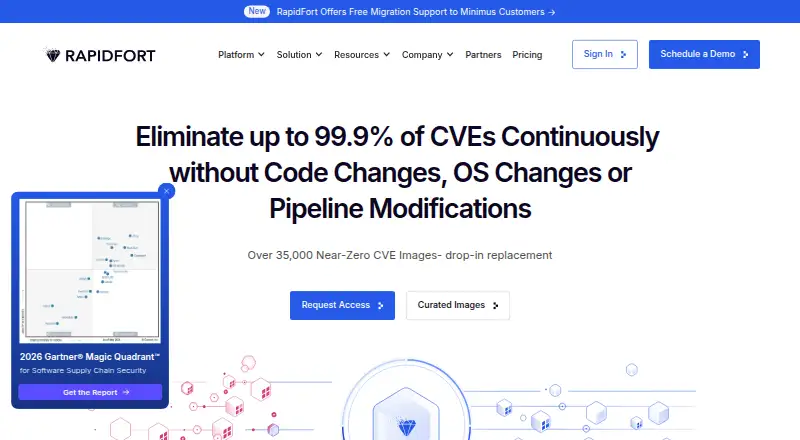
RapidFort is a software supply chain security platform for containerized applications. Its tools cover image and registry scanning, runtime visibility, image hardening, and compliance validation. RapidFort Analyzer scans images, registries, CI pipelines, and clusters, while Profiler describes runtime behavior and creates a Runtime Bill of Materials from production usage. Optimizer removes unused components and refreshes hardened images on 24-hour cycles. The company also offers more than 35,000 curated near-zero CVE images built on trusted Linux distributions. CART provides ongoing compliance validation and audit artifacts aligned with benchmarks including CIS, STIG, NIST, HIPAA, PCI, and FedRAMP. The Free plan costs nothing and includes five images from a limited catalog, daily rebuilds and patching, and standard registry compatibility. Custom-priced options cover the full image catalog or the catalog with platform features. RapidFort lists Linux, web, and self-hosted platforms, plus on-premises and air-gapped deployment. It says continuous runtime profiling has less than 1% overhead and needs no application changes.
Who it suits
RapidFort presents its tools for security, DevSecOps, and procurement teams, including organizations in regulated or mission-critical environments. It may suit teams that need container image scanning, hardening, runtime visibility, or compliance validation.
What it does well
- Free plan includes five curated images.
- Scans images, registries, CI pipelines, and clusters.
- Profiler creates a Runtime Bill of Materials.
- On-premises deployment can support air-gapped environments.
- Compliance artifacts align with several named benchmarks.
What to know first
- Free catalog is limited to five images.
- Full catalog and platform plans have no listed price.
- Free images receive daily rather than 24-hour rebuilds.
Limits
The free plan includes five curated near-zero-CVE images from a limited catalog, with daily rebuilding and patching. The full catalog and platform plans are custom-priced; the full platform plan adds runtime profiling, RBOM, 24-hour hardening refresh, compliance validation, and audit artifacts.
Plans
| Plan | Billed and limits | Price |
|---|---|---|
| Free | 5 curated near-zero CVE images from a limited catalog · daily rebuilds and patching · Alpine, Debian, UBI, Ubuntu LTS · standard container registries | Free |
| Custom — Full Catalog | 35,000+ curated images · full SBOM export · CIS and DISA STIG variants · FIPS 140-2 and 140-3 compliant images | On request |
| Custom — Images + Platform | Full catalog plus platform · runtime profiling and RBOM · 24-hour hardening refresh · compliance validation and audit artifacts | On request |
As rapidfort.com lists them, read 30 Sept 2026. The maker's own page has the final word.
Getting started
- Open RapidFort’s website and review its free and custom offerings.
- Choose the free plan for five curated images from the limited catalog, or contact RapidFort about a custom plan.
- Use the free tier with a standard container registry.
- For on-premises deployment, use the Big Bang Helm Chart in an on-premises or air-gapped environment.
- Contact RapidFort through its Technical Support link for support.
RapidFort is a container supply-chain security platform that brings vulnerability analysis, runtime insight, image reduction and compliance work into one workflow. It best fits security and DevSecOps groups running regulated or mission-critical services, particularly those needing on-premises or air-gapped deployment. Teams wanting only a basic scanner may find its wider platform unnecessary.
Overview
RapidFort follows containers from build and registry through production use. Analyzer examines images, registries, CI pipelines and clusters, while Profiler records runtime behavior and builds a Runtime Bill of Materials (RBOM) from actual production usage. Optimizer then removes unused components and creates hardened images on recurring cycles, and CART validates compliance continuously while producing audit artifacts.
The hybrid deployment model matters for organizations with infrastructure or data-residency constraints: RapidFort describes an on-premises installation through the Big Bang Helm Chart, including air-gapped environments. Continuous runtime profiling is stated to add less than 1% overhead and requires no application changes. The main compromise is commercial scope: the free offer is small, and the catalog and platform tiers use custom pricing.
Key features
Analysis and image catalog
Analyzer covers more than a registry checkpoint, scanning images, registries, CI pipelines and clusters. Its validated vulnerability intelligence is designed to reduce scanner noise, which can help teams prioritize actionable findings instead of repeatedly triaging duplicate or irrelevant results. RapidFort also offers more than 35,000 curated near-zero-CVE images based on trusted Linux distributions. That catalog can shorten remediation work, but the free tier exposes only five images from a limited catalog.
Runtime visibility and hardening
Profiler creates an RBOM from what applications actually use in production, giving security teams a usage-based view of components rather than relying solely on build-time inventory. Optimizer removes unused pieces and rebuilds hardened images on continuous 24-hour cycles. This combination is most useful where reducing attack surface and keeping images current are operational priorities; it is more capability than a team seeking occasional vulnerability checks needs.
Compliance and exports
RapidFort CART continuously validates against CIS, STIG, NIST, HIPAA, PCI and FedRAMP benchmarks and automates audit artifacts. The wider security and compliance coverage also includes SOC 2, CMMC, CRA, NIS2 and DISA STIG. SBOM exports include JSON, CSV, SPDX and CycloneDX, while VEX and XML support is tied to the full catalog tier. These features suit organizations that must demonstrate controls repeatedly, not just generate a one-time report.
Pricing
Free
The Free plan costs nothing. It includes five curated near-zero-CVE images from a limited catalog, daily rebuilding and patching, Alpine, Debian, UBI and Ubuntu LTS bases, and compatibility with standard container registries. This is a practical entry point for a small proof of concept or a team evaluating curated images, but the five-image ceiling and limited catalog restrict sustained use.
Custom — Full Catalog
Custom pricing buys more than 35,000 curated images, full SBOM export, CIS and DISA STIG variants, and FIPS 140-2 and 140-3 compliant images. It is the appropriate tier for organizations that need breadth, regulated-image variants or formal export workflows; the free plan does not provide those catalog and compliance options.
Custom — Images + Platform
This custom-priced plan adds the platform to the full catalog: runtime profiling and RBOM, 24-hour hardening refreshes, compliance validation and audit artifacts. Choose it when production behavior, continuous hardening and evidence generation must be managed together. Teams that only need curated images can avoid paying for capabilities they will not use by staying with the catalog tier.
Platforms
RapidFort supports Linux, web and self-hosted deployments, with a hybrid deployment model. Its on-premises and air-gapped Big Bang Helm Chart option is particularly relevant to environments that cannot place container-security operations entirely in a hosted service. Registry scanning, image scanning, SBOM generation, runtime protection and Kubernetes security are supported.
Who it's for
Security, DevSecOps and procurement teams in regulated or mission-critical organizations are the clearest audience. They can connect image analysis, production usage evidence, hardening and benchmark validation in one program. Smaller development teams that need a free scanner, or organizations without compliance and deployment constraints, may get more than they need from RapidFort's platform approach.
Pros and cons
Pros
- Broad lifecycle coverage: analysis, runtime RBOMs, image hardening and compliance artifacts are connected rather than separate tools.
- Large curated catalog: more than 35,000 near-zero-CVE images and FIPS-compliant options support standardized, lower-maintenance bases.
- Deployment flexibility: hybrid, self-hosted and air-gapped operation suits strict infrastructure requirements.
- Low stated profiling overhead: continuous profiling is described as below 1% and requires no application changes.
Cons
- Restricted free tier: five images from a limited catalog is insufficient for a broad container estate.
- Custom pricing at scale: full catalog and platform costs require a sales-led decision, making budgeting less direct.
- Potentially excessive scope: teams seeking only open-source vulnerability scanning may not benefit from runtime and compliance modules.
Alternatives
For a focused comparison of image scanners, see Container Image Scanning Tools; broader cloud assessment is covered by Cloud Vulnerability Scanners, while an all-round shortlist is in Container Security Software.
Docker Desktop is a better fit when you want a freemium desktop workflow combining Docker Engine, Kubernetes, Docker Hub, Scout and Debug; its Personal plan is free and Pro is $9 a month. Choose Snyk Open Source for software-composition analysis across broader platforms, with a free plan covering five projects and a Team plan at $25 a month. Mondoo CSPM suits teams wanting free-forever cloud, Kubernetes, OS, SaaS and API scanning with a Kubernetes operator.
Trivy and Grype are free Apache-2.0 open-source scanners for a simpler, self-managed approach. Qualys External Attack Surface Management is the alternative for external asset visibility, with a 30-day no-cost trial. Clair provides open-source, self-hosted container vulnerability analysis, while Harbor combines an open-source registry with unlimited project storage quotas by default.
Verdict
Choose RapidFort if your organization needs curated low-CVE images, runtime evidence, continuous hardening and compliance validation in a deployment model that can run on premises or in an air-gapped environment. Its main reason to look elsewhere is equally clear: the free plan is limited to five images, and the capabilities that distinguish the platform require custom pricing, while simpler open-source scanners cover narrower needs at no cost.
Verdict
RapidFort combines container vulnerability analysis, runtime profiling, image hardening, and compliance features in one offering. The free tier is limited in catalog size, while broader catalog and platform options are custom-priced.
Questions
Does RapidFort have a free plan?
Yes. The free plan includes five curated near-zero-CVE images from a limited catalog, daily rebuilding and patching, and standard container registry compatibility.
How much do RapidFort’s paid plans cost?
The Full Catalog and Images + Platform offerings are custom-priced.
What does the full catalog include?
The custom Full Catalog plan includes more than 35,000 curated images, full SBOM export, CIS and DISA STIG variants, and FIPS 140-2 and 140-3 compliant images.
What platforms and deployment options does RapidFort offer?
Its listed platforms are Linux, self-hosted, and web. RapidFort describes on-premises deployment through the Big Bang Helm Chart, including air-gapped environments.
Which SBOM export formats are supported?
The pricing page lists JSON, CSV, SPDX, and CycloneDX. VEX and XML are supported for the full catalog tier.
Who makes RapidFort?
RapidFort was founded in 2020 and is headquartered in Sunnyvale, California, United States.
Facts from RapidFort's own pages
- Analyzer
- RapidFort Analyzer scans images, registries, CI pipelines, and clusters and provides validated vulnerability intelligence to help reduce scanner noise. · rapidfort.com, 30 Sept 2026
- Compliance
- RapidFort CART provides continuous compliance validation and automated audit artifacts aligned with CIS, STIG, NIST, HIPAA, PCI, and FedRAMP benchmarks. · rapidfort.com, 30 Sept 2026
- Container registries
- The free tier is described as compatible with standard container registries. · rapidfort.com, 30 Sept 2026
- Curated images
- RapidFort offers more than 35,000 curated near-zero CVE container images built on trusted Linux distributions. · rapidfort.com, 30 Sept 2026
- Deployment
- RapidFort describes an on-premises platform deployable through the Big Bang Helm Chart in on-premises or air-gapped environments. · rapidfort.com, 30 Sept 2026
- Exports
- The pricing page lists SBOM export formats JSON, CSV, SPDX, and CycloneDX, with VEX and XML support for the full catalog tier. · rapidfort.com, 30 Sept 2026
- Founded
- 2020 · rapidfort.com, 28 Sept 2026
- Headquarters
- Sunnyvale, California, United States · rapidfort.com, 28 Sept 2026
- Optimizer
- RapidFort Optimizer removes unused components and builds hardened images on continuous 24-hour cycles. · rapidfort.com, 30 Sept 2026
- Product
- RapidFort is a software supply chain security platform for containerized applications, combining vulnerability analysis, runtime visibility, image hardening, and compliance validation. · rapidfort.com, 30 Sept 2026
- Profiler and RBOM
- RapidFort Profiler reports runtime behavior and generates a Runtime Bill of Materials from actual production usage. · rapidfort.com, 30 Sept 2026
- Runtime overhead
- The platform overview states continuous runtime profiling has less than 1% overhead and requires no application changes. · rapidfort.com, 30 Sept 2026
- Security and compliance
- RapidFort states that its offering supports frameworks including FedRAMP, HIPAA, PCI, SOC 2, CMMC, CRA, NIS2, DISA STIG, CIS, and NIST SP 800-53. · rapidfort.com, 30 Sept 2026
- Support
- RapidFort provides a Technical Support contact link on its website. · rapidfort.com, 30 Sept 2026
- Target users
- RapidFort presents its products for security, DevSecOps, and procurement teams, including organizations in regulated and mission-critical environments. · rapidfort.com, 30 Sept 2026
Where RapidFort stands on Freedom251
- Container Image Scanning Tools#7 of 29
- Cloud Vulnerability Scanners#9 of 28
- Container Security Software#10 of 26