Freedom251 › Build Automation Software

Bazel
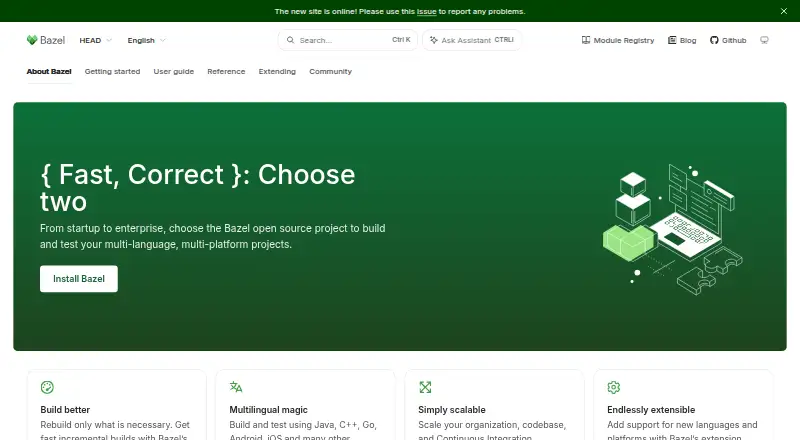
What Bazel is
Bazel is a free, open-source tool for automating software builds and tests across languages and platforms. Projects declare build targets in BUILD files using Starlark, which can also be used to create custom rules and macros. Bazel caches completed work, rebuilds what has changed and supports parallel execution. It handles languages including C++, Java, Kotlin, Python, Go and Rust, and can produce outputs for desktop, server, Android and iOS. It runs on Linux, macOS and Windows. Sandboxing can make builds and tests more hermetic, while non-zero exit codes on failed invocations support basic CI integration. Teams can share outputs through a remote cache, but need to select and maintain a backend server and secure access because the cache may hold binaries. The documentation says Bazel can manage builds involving 100,000 or more source files and multiple repositories. It is particularly suited to large codebases, multiple compiled languages, multi-platform deployments and extensive test suites.
Who it suits
Bazel suits software teams working with large codebases, multiple compiled languages, multi-platform targets or extensive tests. It is also relevant where teams want incremental builds and can manage a remote cache backend if needed.
What it does well
- Caches prior work and rebuilds changed parts.
- Supports parallel builds across several languages.
- Builds outputs for desktop, server, Android and iOS.
- Sandboxing can improve build reproducibility.
- Runs on Linux, macOS and Windows.
What to know first
- Remote cache requires a separately managed backend.
- Remote cache access needs security controls.
- Not well suited to uncached deployment operations.
- Some distribution packages are community-supported, not official.
Plans
| Plan | Billed and limits | Price |
|---|---|---|
| Bazel | Free open-source project · Open-source build and test tool | Free |
As bazel.build lists them, read 30 Sept 2026. The maker's own page has the final word.
Getting started
- Open https://bazel.build/.
- Install Bazelisk, the recommended installation method for Ubuntu Linux, macOS, and Windows.
- Define build targets in project BUILD files using Starlark.
- Use the IDE integration options for IntelliJ, Android Studio, CLion, Visual Studio Code, or Xcode if needed.
- For shared outputs, select and maintain a remote-cache backend and restrict who can write to it.
Overview
Bazel is an open-source build and test system for software projects spanning languages, platforms or large test suites. It is best suited to teams willing to define and maintain explicit build rules in exchange for incremental, parallel builds and reproducible execution. It is a less natural fit for deployment work that must run afresh rather than reuse cached outputs.
Key features
Incremental and parallel execution
Bazel caches prior work and rebuilds only what needs to change, while running build tasks in parallel. For large projects, this can avoid repeating unaffected work; the benefit depends on modeling targets in BUILD files, so build definitions become part of the project’s ongoing engineering work.
Languages, platforms and custom rules
Build definitions use Starlark, a Python subset, and teams can extend them with custom rules and macros. Bazel supports C++, Java, Kotlin, Python, Go and Rust, and can produce desktop, server, Android and iOS software. That breadth is useful when one project crosses language or deployment boundaries, though it asks teams to learn and maintain a shared build language.
Reproducibility and remote caching
Actions can run in individual sandboxes, and builds can be configured to run hermetically to reduce environmental differences and improve reproducibility. Teams and continuous integration systems can share outputs through a remote cache, but they must choose and maintain a backend server. Because the cache can contain binaries, write access needs careful restriction.
Scale and workflow fit
Bazel is intended for large codebases, and its documentation describes handling builds with 100,000 or more source files across multiple repositories. It can return a non-zero exit code when builds or tests fail, supporting basic CI integration. It is not well suited to operations whose outputs should not be cached, such as deployment steps that change cloud configuration; teams should keep those tasks outside the build workflow.
Pricing
Bazel is free and open source. The Bazel plan costs nothing, with open-source build and test tooling. There is no free trial because there is no paid plan to try. The free plan is a strong fit for teams that can manage their own build setup; it does not remove the operational work of maintaining build rules or a remote-cache backend.
Platforms
Bazel runs on Linux, macOS and Windows. Bazelisk is the recommended installation method for Ubuntu Linux, macOS and Windows. Official IDE integration options include plugins for IntelliJ, Android Studio, CLion and Visual Studio Code, plus Xcode integration options. Some packages for distributions and package managers are community-supported rather than officially supported by the Bazel team.
Who it's for
Bazel is a compelling choice for teams with large codebases, multiple compiled languages, multi-platform outputs or extensive tests, especially when repeatable builds matter across developer machines and CI. Google leads and manages the project, alongside contributors and some community-managed components. Community support channels include Slack and Stack Overflow, as well as an issue tracker. Smaller or simpler projects may find the explicit rule system and infrastructure responsibilities disproportionate to their needs.
Pros and cons
- Efficient repeat builds: cached, incremental and parallel execution can avoid repeating unaffected work in projects with many targets.
- Broad project coverage: support for several compiled and scripting languages, desktop and mobile outputs, and custom Starlark rules suits cross-platform codebases.
- Reproducibility options: sandboxed actions and hermetic builds help limit environmental skew.
- Remote cache overhead: shared outputs require a separately chosen and maintained server, with security controls because cached artifacts can include binaries.
- Build-rule maintenance: teams must express targets in BUILD files and sustain their Starlark rules and macros.
- Deployment mismatch: tasks that should not reuse cached outputs, including cloud-configuration changes, are a poor fit.
Alternatives
Build Automation Software is a useful starting point for comparing tools in the category. For managing a monorepo, browse Monorepo Management Tools; game-focused teams can compare options in Game Build Automation Software.
- Nx is worth considering for teams that want a freemium option with a free Hobby plan capped at 50,000 monthly-reset credits, five contributors and 10 concurrent CI connections, plus a free trial.
- AWS CodeBuild suits readers looking for a paid, usage-based service: it charges for compute resources by build duration and selected compute type, and also has a free plan.
- Buck2 is another free build system, from Meta, with an open-source plan.
- Gradle offers a free, open-source build system for teams considering another build-tool option.
- Pants provides a free build system under the Apache License 2.0, a no-charge, royalty-free license.
- Rush is a free, open-source JavaScript monorepo manager installable via npm.
- Xmake is a free alternative supporting Android, iOS, Linux, macOS and Windows.
- build2 is a free option for Linux, macOS and Windows.
Verdict
Choose Bazel if your team needs a disciplined build system for a large, multi-language or multi-platform codebase and can invest in maintaining its rules. Its incremental execution, broad target support and reproducibility options are strong reasons to adopt it; look elsewhere for deployment steps that must always run anew or when a project does not justify the build-system overhead.
Verdict
Bazel offers a free build-and-test system with incremental execution, broad language support and multi-platform outputs. Its remote cache and deployment limitations matter for teams deciding how to fit it into their workflows.
Questions
Is Bazel free?
Yes. Bazel is an open-source build and test tool listed as free.
Which operating systems does Bazel run on?
Bazel runs on Linux, macOS, and Windows. Bazelisk is the recommended installation method for Ubuntu Linux, macOS, and Windows.
Which languages can Bazel build?
Supported languages include C++, Java, Kotlin, Python, Go, and Rust.
Can teams share build outputs?
Yes. Teams and continuous integration systems can share outputs through a remote cache. They need to choose and maintain the backend server and secure access because the cache can contain binaries.
Which IDEs integrate with Bazel?
The listed options are plugins for IntelliJ, Android Studio, CLion, and Visual Studio Code, plus integration options for Xcode.
Who manages Bazel?
Google leads and manages the Bazel project, with contributors and some community-managed components.
Facts from Bazel's own pages
- Build language
- Projects define build targets in BUILD files using Starlark, a domain-specific language. · bazel.build, 30 Sept 2026
- Caching
- Teams and continuous integration systems can share build outputs through a remote cache, which requires a separately chosen and maintained backend server. · bazel.build, 30 Sept 2026
- CI integration
- Bazel returns a non-zero exit code when a build or test invocation fails, supporting basic CI integration. · bazel.build, 30 Sept 2026
- Extensibility
- Users can write custom Bazel rules and macros in Starlark, a language that is a subset of Python. · bazel.build, 30 Sept 2026
- Governance
- The Bazel project is led and managed by Google, with contributors and some community-managed components. · cr.bazel.build, 30 Sept 2026
- IDE integrations
- The official IDE integration page lists plugins for IntelliJ, Android Studio, CLion, and Visual Studio Code, plus integration options for Xcode. · bazel.build, 30 Sept 2026
- Incremental builds
- Bazel caches previous work and rebuilds only what needs to change. · bazel.build, 30 Sept 2026
- Install method
- Bazelisk is the recommended installation method for Ubuntu Linux, macOS, and Windows. · bazel.build, 30 Sept 2026
- Intended projects
- Bazel is especially suited to large codebases, projects using multiple compiled languages, multi-platform deployments, and projects with extensive tests. · bazel.build, 30 Sept 2026
- Languages
- Bazel supports languages including C++, Java, Kotlin, Python, Go, and Rust. · bazel.build, 30 Sept 2026
- Languages and platforms
- Bazel supports multiple languages and can build outputs for multiple platforms, including desktop, server, and mobile. · bazel.build, 30 Sept 2026
- Maker
- Google identifies Bazel as its own build tool. · opensource.google, 30 Sept 2026
- Mobile targets
- Bazel can build software for Android and iOS. · bazel.build, 30 Sept 2026
- Notable limitation
- The FAQ says Bazel is not well suited to build operations whose outputs should not be cached, such as deployment steps that change cloud configuration. · bazel.build, 30 Sept 2026
- Package support limits
- The installation page says packages for several distributions and package managers are community-supported and not officially supported by the Bazel team. · bazel.build, 30 Sept 2026
- Parallel execution
- Bazel can run builds in a highly parallel and incremental fashion. · bazel.build, 30 Sept 2026
- Purpose
- Bazel is an open-source tool that automates software builds and tests. · bazel.build, 30 Sept 2026
- Reproducibility
- Bazel can run builds and tests hermetically through sandboxing to minimize skew and improve reproducibility. · bazel.build, 30 Sept 2026
- Scale
- The documentation says Bazel can handle builds with 100,000 or more source files and work across multiple repositories. · bazel.build, 30 Sept 2026
- Security consideration
- The remote cache can contain binaries, so the documentation says it needs to be secured and advises limiting who can write to it. · bazel.build, 30 Sept 2026
- Security-related feature
- Bazel actions can run in individual sandboxes, and builds can be configured to run hermetically. · bazel.build, 30 Sept 2026
- Support
- The documentation points users to community support channels including Slack and Stack Overflow, as well as an issue tracker. · bazel.build, 30 Sept 2026
- Supported operating systems
- Bazel runs on Linux, macOS, and Windows. · bazel.build, 30 Sept 2026
- What it does
- Bazel is an open-source tool for building and testing software across languages and platforms. · bazel.build, 30 Sept 2026
Where Bazel stands on Freedom251
- Build Automation Software#5 of 42
- Monorepo Management Tools#5 of 33
- Game Build Automation Software#10 of 43