Freedom251 › Build Automation Software

fastlane
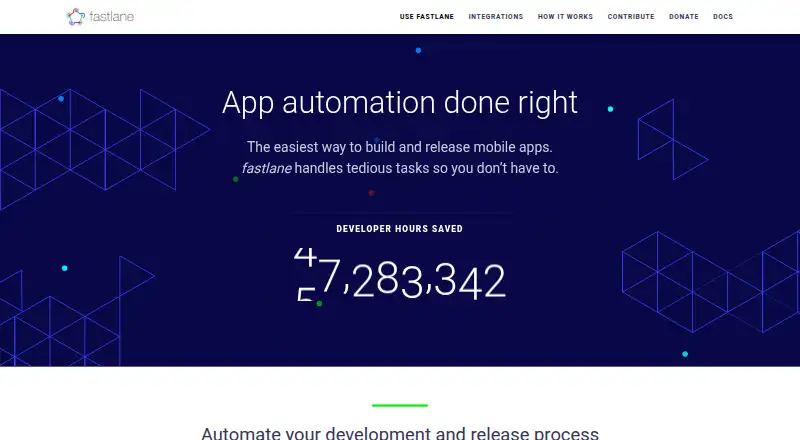
What fastlane is
fastlane is free, MIT-licensed software for automating iOS and Android app development and release workflows. Teams define workflows as lanes and can run each lane with a single command. For beta distribution, it can handle build numbering, code signing, building, uploading, and changelog creation, and supports more than 15 beta testing services, including TestFlight, Crashlytics Beta, Play, and Hockey. It can also build and upload store releases, manage metadata and screenshots, and submit versions for review. Screenshot automation can produce localized app store images for the languages and devices an app supports. fastlane documents integrations with more than 400 tools and services, including major CI systems, and community-built actions and plugins for customization. For iOS signing, it can sync signing identities and profiles through a private encrypted Git repository. It runs on the user's machine or server; its documentation says credentials and other sensitive information stay there. Usage metrics are collected, with an opt-out available in the Fastfile or through an environment variable. macOS is officially supported, while Linux and Windows are partially supported. The project requires Ruby 3.2 or newer and prefers Ruby 3.3 or greater.
Who it suits
It suits teams automating app builds, beta distribution, screenshots, and store releases for iOS and Android. Teams using Linux or Windows should note that those platforms are only partially supported.
What it does well
- Workflows run as lanes with a single command.
- Supports more than 15 beta testing services.
- Integrates with more than 400 tools and services.
- Sensitive credentials remain on the user's machine or server.
What to know first
- Linux and Windows support is partial.
- Collects usage metrics unless users opt out.
- Requires Ruby 3.2 or newer.
Plans
| Plan | Billed and limits | Price |
|---|---|---|
| fastlane | Open source under the MIT license | Free |
As fastlane.tools lists them, read 9 Oct 2026. The maker's own page has the final word.
Getting started
- Visit the fastlane website and review the installation documentation.
- Install Ruby 3.2 or newer; fastlane prefers Ruby 3.3 or greater.
- Install fastlane with Bundler, the preferred method.
- On macOS, Homebrew is another documented installation route; RubyGems is also available.
- Define the workflow tasks as lanes, then run a lane with a command.
fastlane is an open-source release-automation tool for iOS and Android development teams. It is best suited to teams that want to configure repeatable delivery steps and connect them to existing services. Its breadth is compelling, but the Ruby requirement and uneven support outside macOS narrow its fit.
Overview
Workflows are organized as lanes that teams can run with a command, making recurring build and release steps configurable rather than one-off tasks. The MIT license and free plan remove a purchase decision, but teams still need the capacity to set up and maintain their own workflows.
Key features
fastlane automates beta distribution tasks such as build numbering, signing, building, uploading, and changelog creation. It supports more than 15 beta services, including TestFlight, Crashlytics Beta, Play, and Hockey. That range can help teams carry builds through their existing beta channels, though the work remains part of a workflow the team configures.
For store releases, it can build and upload versions, manage app metadata and screenshots, distribute releases, and submit versions for review. It can also capture localized screenshots for the languages and devices an app supports, which is useful for teams with multiple store assets to prepare.
For iOS signing, identities and profiles can be stored in a private encrypted Git repository and synchronized across machines. fastlane integrates with more than 400 tools and services, including major CI systems, and offers hundreds of community-built actions and plugins. That extensibility suits varied delivery pipelines, while also making workflow choices and upkeep the team's responsibility.
Installation is preferably handled through Bundler, with Homebrew on macOS and RubyGems also documented. fastlane supports Ruby 3.2 or newer and prefers 3.3 or greater. It runs on the user's machine or server, and its documentation says credentials and other sensitive information stay there. It also collects usage metrics, including run count, a salted hash of the app identifier or package name, versions, and environment details; users can opt out in the Fastfile or with an environment variable.
Pricing
The fastlane plan costs nothing and is open source under the MIT license. There are no paid tiers or seat quotas described. This makes it a straightforward option for teams able to manage the setup themselves; the tradeoff is that support is directed through GitHub issues, where users are asked to include setup details such as fastlane env output.
Platforms
fastlane is listed for Android, iOS, Linux, macOS, and Windows, but macOS is officially supported while Linux and Windows are only partially supported. Teams relying on Linux or Windows should weigh that limitation before making it central to release operations. The project identifies Mobile Native Foundation in its copyright notice.
Who it's for
fastlane fits mobile teams that want to automate beta and store-release work, use configurable lanes, and connect a range of tools without buying a software plan. It is less suitable for teams that need fully supported Linux or Windows operation, do not want to work with Ruby, or prefer not to opt out of usage metrics themselves.
Pros and cons
- Pros: Release workflows can cover signing, beta distribution, store submissions, metadata, and localized screenshots, reducing the need to coordinate each step manually.
- Pros: More than 400 integrations and hundreds of community actions and plugins give teams substantial room to connect and customize workflows.
- Pros: Free MIT-licensed use avoids plan fees, and execution remains on the user's machine or server.
- Cons: Official support is for macOS; Linux and Windows support is partial.
- Cons: Ruby 3.2 or newer is required, with 3.3 or greater preferred, adding a runtime consideration for adopters.
- Cons: Usage metrics are collected by default, although users can opt out through configuration or an environment variable.
Alternatives
For other build and release tools, browse Build Automation Software and Deployment Automation Software.
- Qbs is another free option across Android, iOS, Linux, macOS, and Windows, with commercial, LGPL version 3, and GPL version 2 licensing.
- Bazel is a free open-source build and test tool from Google, for teams seeking a build-focused alternative on Linux, macOS, or Windows.
- FASTBuild is a free open-source option for Linux, macOS, and Windows, with commercial use and redistribution permitted under its license terms.
- Ninja is a free, speed-focused small build system, available as a binary or from source.
- Nx may suit teams wanting a managed free tier: Hobby includes 50,000 monthly-reset credits, five contributors, ten concurrent CI connections, and community support.
- qmake is a free Qt Community Edition option for supported platforms, but its open-source use requires LGPL or GPL licensing and source-code sharing, with some Qt capabilities limited.
- SCons offers a free MIT-licensed option for teams that want to use, modify, or redistribute it without charge.
- Shake is a free BSD-licensed alternative installed with Haskell Stack.
Verdict
Choose fastlane if your mobile team wants a free, extensible way to coordinate beta and store-release workflows across services, and can own Ruby-based configuration and maintenance. Look elsewhere if full Linux or Windows support is essential, or if you need a build-focused tool without fastlane's mobile release workflow scope.
Verdict
fastlane brings build, beta, and store-release tasks into configurable workflows, with extensive integrations and local execution. Platform support and usage-metric collection are points to weigh when adopting it.
Questions
How much does fastlane cost?
The fastlane plan is free. The project is open source under the MIT license.
Which platforms are supported?
fastlane supports iOS and Android app workflows. macOS is officially supported, while Linux and Windows are partially supported.
What can fastlane automate?
It can automate beta distribution tasks, store releases, metadata and screenshot management, and submissions for review. It can also create localized store screenshots.
Does fastlane work with beta testing services?
Yes. fastlane supports more than 15 beta testing services, including TestFlight, Crashlytics Beta, Play, and Hockey.
Where does fastlane run, and how does it handle credentials?
It runs on the user's machine or server. Its documentation says credentials and other sensitive information stay on that computer.
What are fastlane's Ruby requirements?
The documentation says fastlane supports Ruby 3.2 or newer and prefers Ruby 3.3 or greater.
Facts from fastlane's own pages
- App releases
- It can build and upload releases, manage app metadata and screenshots, and submit new versions for review. · fastlane.tools, 8 Oct 2026
- Beta distribution
- It automates beta distribution steps such as incrementing build versions, signing, building, uploading, and setting changelogs. · fastlane.tools, 9 Oct 2026
- Beta integrations
- The site says fastlane supports over 15 beta testing services, including TestFlight, Crashlytics Beta, Play, and Hockey. · fastlane.tools, 8 Oct 2026
- Beta services
- The site says fastlane supports over 15 beta testing services, including TestFlight, Crashlytics Beta, Play, and Hockey. · fastlane.tools, 9 Oct 2026
- Code signing
- For iOS code signing, fastlane can sync signing identities and profiles across machines using the team's own private, encrypted git repository. · fastlane.tools, 9 Oct 2026
- Customization
- Users can define workflow lanes and extend them with community built actions and plugins. · fastlane.tools, 9 Oct 2026
- Data handling
- The documentation says fastlane runs on the user's machine and app data stays there; it also says credentials and other sensitive information do not leave the computer or server running it. · docs.fastlane.tools, 8 Oct 2026
- Extensibility
- The site describes hundreds of community-built actions and plugins for customizing workflows. · fastlane.tools, 8 Oct 2026
- Installation
- The preferred installation method is Bundler; the documentation also describes Homebrew on macOS and RubyGems installation. · docs.fastlane.tools, 8 Oct 2026
- Integrations
- The documentation says fastlane integrates with more than 400 tools and services and lists major CI systems such as GitHub Actions, GitLab CI, Jenkins, and CircleCI. · docs.fastlane.tools, 9 Oct 2026
- License
- The project is licensed under the MIT license. · docs.fastlane.tools, 8 Oct 2026
- Local execution
- The documentation says fastlane runs on the user's machine or server, and its tools do not send credentials or other sensitive information away from that computer. · docs.fastlane.tools, 9 Oct 2026
- Maintainer
- The fastlane site identifies Mobile Native Foundation in its copyright notice. · fastlane.tools, 9 Oct 2026
- Platform support
- fastlane is officially supported on macOS; Linux and Windows are partially supported, with some tools limited by underlying software availability. · docs.fastlane.tools, 9 Oct 2026
- Purpose
- fastlane is an open source platform for automating development and release workflows for iOS and Android apps. · fastlane.tools, 9 Oct 2026
- Requirements
- The documentation says fastlane supports Ruby 3.2 or newer and prefers Ruby 3.3 or greater. · docs.fastlane.tools, 9 Oct 2026
- Screenshot automation
- It can capture localized app store screenshots for each language and device an app supports. · fastlane.tools, 9 Oct 2026
- Screenshots
- It can generate localized app store screenshots for the languages and devices an app supports. · fastlane.tools, 8 Oct 2026
- Store releases
- It can build, upload, distribute, and submit app releases for review while managing app metadata and screenshots. · fastlane.tools, 9 Oct 2026
- Support
- The documentation directs users to search existing GitHub issues and submit an issue with setup details, including the output of fastlane env, if needed. · docs.fastlane.tools, 9 Oct 2026
- Usage metrics
- fastlane collects run and environment metrics, including a salted hash of the app identifier, and documents an opt out setting. · docs.fastlane.tools, 9 Oct 2026
- Workflow configuration
- Teams define workflows as lanes and can run a lane with a single command. · docs.fastlane.tools, 8 Oct 2026
Where fastlane stands on Freedom251
- Build Automation Software#7 of 42
- Deployment Automation Software#7 of 34