
Supernotes
by Supernotes
What Supernotes is
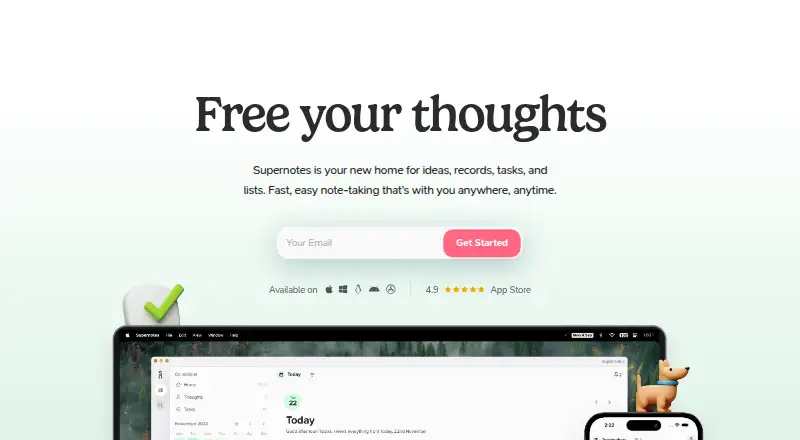
Supernotes is a note-taking app that organizes ideas, records, tasks, and lists as digital notecards. Cards can hold equations, tables, images, checklists, and emojis, with a soft limit of 1,200 characters. Users can tag, nest, and link cards, then search them or explore their relationships in graph views. The apps work offline and merge changes and sync when a device reconnects. Cards can be shared for read-only access or edited together in real time. Supernotes imports from Obsidian, Roam Research, Google Keep, Notion, and Markdown, and exports notes as PDF, JSON, or Markdown. Listed integrations include Telegram, Raycast, Pipedream, email, SupaSend, and Funnel; an API is also available. The free Starter plan lists 100 cards. Unlimited costs £6/mo, billed £72 billed annually, and includes unlimited cards, AI Superpowers, full API and integrations, and priority support. Supernotes is available on web, Windows, macOS, Linux, iOS, and Android.
Who it suits
Supernotes is designed for individual users managing personal knowledge. Its sharing, real-time editing, and offline syncing may also suit people who need to work with others or across devices.
What it does well
- Cards can be linked and explored with graph views.
- Apps work offline and sync after reconnection.
- Supports real-time collaborative card editing.
- Imports from five named note sources.
- Exports notes as PDF, JSON, or Markdown.
What to know first
- Starter plan lists a limit of 100 cards.
- Cards have a 1,200-character soft limit.
- Unlimited costs £6/mo, billed £72 billed annually.
Limits
The free Starter plan includes 100 cards. Unlimited costs £6/mo, billed £72 annually, and includes unlimited cards, AI Superpowers, full API and integrations, and priority support.
Plans
| Plan | Billed and limits | Price |
|---|---|---|
| Unlimited | £72 billed annually · Unlimited cards · AI Superpowers · full API and integrations · priority support | £6 a month |
| Starter | 100 cards initially · mobile, desktop and web apps · offline editing · sync · collaboration | Free |
| Unlimited monthly | £6/ month · unlimited cards · AI Superpowers · full API and integrations · flashcards, tables and maps · priority support | £6 a month |
| Unlimited annual | £72 billed annually · unlimited cards · AI Superpowers · full API and integrations · flashcards, tables and maps · priority support | £72 a year |
As supernotes.app lists them, read 29 Sept 2026. The maker's own page has the final word.
Getting started
- Visit the Supernotes website.
- Choose the free Starter plan or Unlimited at £6/mo, billed £72 annually.
- Use the app on web, Windows, macOS, Linux, iOS, or Android.
- Create cards for ideas, records, tasks, or lists, then tag, nest, or link them.
Supernotes is built for people who prefer to capture knowledge in short, connected cards rather than long documents. It suits personal knowledge management especially well, but its 1,200-character soft limit makes it a less natural home for extended writing.
Its strongest case is the combination of linked-card organization, offline syncing, and practical ways to share and move notes. The trade-off is a strict free-tier card cap and a paid plan required for uncapped cards and the full API and integrations.
Overview
Supernotes treats ideas, records, tasks, and lists as digital notecards. Tags, nesting, links, search, and graph views give users several ways to keep a growing collection navigable. That structure favors building a web of concise reference notes over drafting essays or keeping large, unstructured documents.
Cards can hold equations, tables, images, checklists, and emojis, but the 1,200-character soft limit still shapes how they are used: a topic may need to be split across multiple cards. The outliner organization model and backlinks support that connected approach, while graph views help surface relationships between notes.
Key features
Offline access is a substantial practical advantage. The apps continue working without a connection, then merge changes and sync when the device is back online. Shared cards can be read-only or collaborative, with people able to edit together in real time; that is useful for joint work, though the product is primarily designed around individual knowledge management.
Supernotes accepts imports from Obsidian, Roam Research, Google Keep, Notion, and Markdown, and exports notes as PDF, JSON, or Markdown. Those options reduce friction when moving an existing note collection or taking it elsewhere. Available integrations include Telegram, Raycast, Pipedream, email, SupaSend, and Funnel; Zapier, Make, and Tally are marked as coming soon. An API is offered for building integrations, while the full API and integrations are part of Unlimited.
Notes are encrypted in transit with SSL and at rest with AES-256. The privacy policy says Supernotes does not own or sell user data or use it for advertising, and staff do not access note content without express permission during support. Support is available through the in-app messenger; Unlimited subscribers receive priority support.
Pricing
Supernotes uses a freemium model and has no free trial. Starter is free, but is capped at 100 cards. That is enough to try the card system or keep a small collection, but regular users may reach the ceiling and need to prune or upgrade.
Unlimited costs £6.00 per month, billed £72 billed annually. It removes the card cap and includes AI Superpowers, the full API and integrations, and priority support. It is the fit for users who want to grow a substantial card library or rely on the full integration offering; those who can work within 100 cards can stay on Starter.
Platforms
Supernotes is available on web, Windows, macOS, Linux, iOS, and Android, and also offers an API. Offline use with automatic merging and syncing makes the cross-device offering more useful than access that depends on a live connection.
Who it's for
Choose Supernotes if you want to organize personal knowledge as short, linked notes and value graph-based exploration, offline work, and straightforward import and export. It is less suited to people who regularly need long-form notes, or anyone who needs more than 100 cards but does not want a paid subscription.
Pros and cons
- Pros: Tags, nesting, backlinks, search, and graph views support several ways to connect and navigate a personal note collection.
- Pros: Offline editing with automatic merging and syncing helps keep work moving across connections and devices.
- Pros: Imports from five named note sources and exports to PDF, JSON, or Markdown make portability a strength.
- Cons: The 1,200-character soft limit per card can force extended material into multiple notes.
- Cons: Starter's 100-card ceiling limits how far a free collection can grow.
- Cons: The full API and integrations, plus priority support, require Unlimited.
Alternatives
Personal Knowledge Management Software, AI Note-Taking Apps, and Note-taking apps offer broader category comparisons.
- Logseq is worth considering if a free, forever personal-use plan is more important than Supernotes' card format; its Sync Backer plan is a $5 a month recurring donation with beta access to sync.
- Obsidian is another option if you want a freemium notes app with a paid Sync Standard plan at $5 a month, billed annually, for one user, one synced vault, 1 GB total storage, and a 5 MB maximum file size.
- SiYuan may suit readers looking for an open-source option: its download page describes it as completely open source, with most features free, including for commercial use.
- TheBrain offers a free app plan with unlimited thoughts, links, and brains, plus private sync for up to 1,000 thoughts and 100 MB of synced attachments.
- TiddlyWiki is a free and open-source project for readers who want that model rather than Supernotes' freemium card app.
- Capacities is another freemium choice, with its Basic plan allowing 5 GB of media uploads total and 100 MB per month afterwards.
- Neoma offers a free Personal plan described as having every feature, every platform, no account, no limits, and no expiry.
- Lattics is another option for readers comparing freemium note-taking apps.
Verdict
Supernotes is a strong choice for individual users who want a compact, connected knowledge system that works offline and can be shared or exported when needed. Its linked-card structure is the main reason to choose it; the short card limit and Starter's 100-card cap are the reasons to look elsewhere or budget for Unlimited.
Verdict
Supernotes centers note organization on linked digital cards, with offline access, collaboration, and multiple import and export options. The free Starter tier is capped at 100 cards; Unlimited adds uncapped cards and the full API and integrations.
Questions
Is Supernotes free?
Yes. The Starter plan is free and includes 100 cards.
How much does Unlimited cost?
Unlimited costs £6/mo, billed £72 annually.
Which platforms does Supernotes support?
It is available on web, Windows, macOS, Linux, iOS, and Android.
Can Supernotes work offline?
Yes. Its apps work offline and merge changes and sync when the device is back online.
Can I import notes from other apps?
Imports are supported from Obsidian, Roam Research, Google Keep, Notion, and Markdown.
Who makes Supernotes?
Supernotes is made by Supernotes, whose headquarters are in London, United Kingdom. The maker says the founders began building it in 2018.
Facts from Supernotes's own pages
- AI feature
- The optional AI tools suggest tags, proofread text and identify possible improvements to notes. · supernotes.app, 15 Oct 2026
- API
- Supernotes exposes a REST API with account-managed API keys that can create, edit and delete cards and other account data. · help.supernotes.app, 15 Oct 2026
- Audience
- The product describes itself as designed for individual users and their personal knowledge management. · supernotes.app, 29 Sept 2026
- Backups
- Databases receive daily full backups with write-ahead logs supporting seven-day point-in-time restoration, plus encrypted monthly backups on another provider. · supernotes.app, 15 Oct 2026
- Card format
- Notecards support content such as equations, tables, images, checklists, and emojis, with a 1200-character soft limit. · supernotes.app, 29 Sept 2026
- Collaboration
- Shared cards support real-time editing and comments, with moderator, editor, collaborator and reader permissions. · supernotes.app, 15 Oct 2026
- Company
- The about page says the founders began building Supernotes in 2018 after finding existing note-taking tools difficult to organize and share. · supernotes.app, 29 Sept 2026
- Company founding and founders
- The founders say they began building Supernotes in 2018; Connor Neblett is CTO and Tobias Whetton is CEO. · supernotes.app, 15 Oct 2026
- Company legal identity
- The service is operated by Supernotes Education Ltd, an England and Wales company registered under number 11376395. · supernotes.app, 15 Oct 2026
- Company size
- LinkedIn categorizes Supernotes as a privately held software company with 2-10 employees headquartered in London. · uk.linkedin.com, 15 Oct 2026
- Current status
- The status page reports 99.999% API uptime and 100.000% web-app and website uptime for its displayed 90-day period. · status.supernotes.app, 15 Oct 2026
- Developer documentation
- The developer site provides API reference material, enum guidance, API-key setup, webhook and widget examples, plus links to Rust and Supervocab clients, but calls the documentation a work in progress. · developer.supernotes.app, 15 Oct 2026
- Export
- Cards can be exported as Markdown, JSON or PDF, and the API can send notes to other formats or services. · supernotes.app, 15 Oct 2026
- Free plan
- Yes · supernotes.app, 22 Sept 2026
- Funding and ownership
- Crunchbase lists Supernotes as a private pre-seed company backed by Flamefinch Partners, with Tobias Whetton and Connor Neblett as founders. · crunchbase.com, 15 Oct 2026
- Headquarters
- The company lists 86-90 Paul Street, London, United Kingdom EC2A 4NE as its address. · supernotes.app, 15 Oct 2026
- Image privacy limitation
- Uploaded images are not encrypted at rest and can be accessed by anyone possessing their unique image URL. · supernotes.app, 15 Oct 2026
- Import
- Importers cover Obsidian, Roam Research, Google Keep, Notion and Markdown while preserving formatting and bidirectional links. · supernotes.app, 15 Oct 2026
- Import and export
- Users can import from Obsidian, Roam Research, Google Keep, Notion, or Markdown, and export notes as PDF, JSON, or Markdown. · supernotes.app, 29 Sept 2026
- Integrations
- Official integrations include Telegram, Raycast, Pipedream, email capture, SupaSend and Funnel; Zapier, Make and Tally are marked coming soon. · supernotes.app, 15 Oct 2026
- Limit: integrations and AI
- G2 reviewers ask for stronger Microsoft Office integration and more capable AI tools. · g2.com, 15 Oct 2026
- Limit: pricing and card cap
- G2 feedback cites a monthly price increase and the 100-card ceiling on the free version. · g2.com, 15 Oct 2026
- Limit: product pace and mobile
- Product Hunt criticism includes slow feature delivery, an underpowered or slow mobile experience and points viewed as gimmicky for solo users. · producthunt.com, 15 Oct 2026
- Limit: workflow gaps
- A community subscriber reported cumbersome multi-step linking, no Apple Share Menu, Shortcuts or AppleScript support, and insufficient progress to renew. · community.supernotes.app, 15 Oct 2026
Where Supernotes stands on Freedom251
- Note-taking apps#24 of 216
- Personal Knowledge Management Software#18 of 32
- AI Note-Taking Apps#27 of 42