Freedom251 › Anomaly Detection Software

Soda
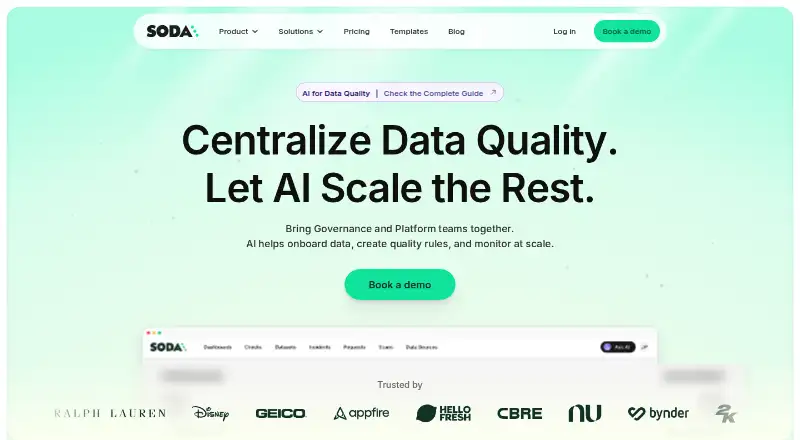
What Soda is
Soda is a data quality platform for monitoring production data, finding problems, and helping teams investigate issues and act on them. Its ML-powered observability looks for unexpected changes without requiring every rule to be defined in advance. Teams can also test data during development, deployment, transformation, and CI/CD workflows to catch issues before production. Data contracts let producers and consumers specify expected schemas, data types, value ranges, and other constraints. Integrations include Databricks, Snowflake, PostgreSQL, Airflow, dbt, Slack, Microsoft Teams, Jira, and PagerDuty, among others. Soda lists database support for systems including Athena, BigQuery, Databricks SQL, DuckDB, MySQL, Oracle, PostgreSQL, Redshift, Snowflake, and SQL Server. It offers three deployment models for differing infrastructure and data privacy needs. Its Trust Center lists SOC 2 Type 2, SOC 3, DORA, and GDPR; security controls include SSO and encryption in transit and at rest. Sample rows are not collected by default, though collection can be configured during onboarding. The Free plan costs nothing, and Team costs $750 a month.
Who it suits
Soda describes its workflow for data engineers, data producers and consumers, governance teams, and platform teams. It can suit teams testing data through development and CI/CD as well as monitoring production data.
What it does well
- Tests data across development and CI/CD workflows.
- Observability does not require every rule upfront.
- Sample rows are not collected by default.
- Offers three deployment models.
- Free plan includes pipeline testing and alerting integrations.
What to know first
- Team plan costs $750 a month.
- Premium support is an Enterprise feature.
Limits
The Free plan includes Free Soda Processing Units, pipeline testing, metrics observability, and alerting and ticketing integrations. Team costs $750 a month and adds unlimited users, catalog integrations, and pay-as-you-go additional SPUs; collaborative data contracts and private deployment are listed under Enterprise.
Plans
| Plan | Billed and limits | Price |
|---|---|---|
| Free | per month · pipeline testing · metrics observability · alerting and ticketing integrations · no credit card required | Free |
| Team | per month · unlimited users · pay as you go for additional Soda Processing Units · catalog integrations · add-ons available | $750 a month |
| Enterprise | custom pricing · collaborative data contracts · no-code interface · advanced AI data quality · audit logs · custom roles and RBAC · private deployment · SSO · premium support | On request |
As soda.io lists them, read 15 Oct 2026. The maker's own page has the final word.
Getting started
- Open soda.io.
- Choose the Free plan or review the Team and Enterprise features.
- Use the API, Linux, self-hosted, or web platform.
- Connect a supported database or listed integration.
- Set up pipeline testing, metrics observability, or data contracts for your workflow.
Soda is a data-quality platform for teams that need monitoring, testing, and shared rules across data pipelines. It suits data engineers, data owners, governance groups, and platform teams working together. The combination is broad and capable, but the paid entry point makes it a substantial purchase for smaller teams.
Overview
Soda connects production observability with checks that run before data reaches production and contracts that define what producers and consumers should expect. Its machine-learning observability watches for unexpected changes without requiring a manually written rule for every possible condition. Explicit tests remain available for requirements that must be assessed consistently.
Testing can run during development, deployment, transformation, and CI/CD workflows, while contracts can specify schemas, data types, value ranges, and other constraints. That gives organizations a way to link prevention, detection, and cross-team accountability. A team looking only for a narrowly focused database test runner may find this wider scope unnecessary.
Key features
- ML-powered observability: Monitoring can identify unusual production changes that teams did not anticipate in advance. It is useful for discovering emerging problems, while defined tests remain the better choice for non-negotiable requirements.
- Pipeline testing: Tests cover development, deployment, transformation, and CI/CD stages, allowing issues to be caught before production rather than only after a pipeline has delivered bad data.
- Data contracts: Contracts capture expected schemas, types, ranges, and related constraints so producers and consumers have a shared technical agreement. Collaborative contracts are reserved for Enterprise.
- Broad database coverage: Supported systems include Athena, BigQuery, Databricks SQL, Dremio, DuckDB, Fabric, MySQL, Oracle, PostgreSQL, Redshift, Spark Dataframe, Snowflake, SQL Server, Synapse, and Trino.
- Test formats and scope: YAML and SQL are supported, with both schema-migration tests and data-quality checks. Test execution supports both modes offered by the platform.
- Workflow integrations: Integrations include Databricks, Snowflake, PostgreSQL, Airflow, dbt, Slack, Microsoft Teams, Jira, and PagerDuty, connecting checks with orchestration and response workflows.
- Deployment and privacy: Three deployment models address infrastructure and data-privacy requirements. Sample rows are not collected by default, and collection can be configured during onboarding.
- Security posture: Soda lists SOC 2 Type 2, SOC 3, DORA, and GDPR compliance information, plus SSO, encryption in transit and at rest, data-security controls, and application penetration testing.
Pricing
Soda uses a freemium model. The Free plan costs free and includes free Soda Processing Units, pipeline testing, metrics observability, and alerting and ticketing integrations. No credit card is required, making it suitable for evaluation or small workloads, but the plan does not include the broader paid capabilities.
Team costs $750 a month. It includes every Free feature, unlimited users, pay-as-you-go pricing for additional SPUs, catalog integrations, and available add-ons. This is the practical starting point for a multi-user deployment, though the fixed monthly price is difficult to justify for teams with limited data estates.
Enterprise has custom pricing and includes Team features plus collaborative data contracts, a no-code interface, advanced AI-powered data-quality features, audit logs, custom roles and RBAC, private deployment, SSO, and premium support. Annual billing and volume discounts are available. Organizations needing governance controls, private deployment, or premium assistance should discuss this tier rather than assume Team will cover those requirements.
Platforms
Soda is offered through an API, Linux, self-hosted deployment, and the web. The deployment choice can therefore accommodate hosted workflows as well as infrastructure and privacy requirements that favor self-management.
Who it's for
Soda is aimed at data engineers, data producers and consumers, governance teams, and platform teams. It is a strong fit when several groups need one system for production monitoring, pre-production tests, and agreed data constraints. Smaller teams that only need occasional SQL checks, or organizations unwilling to commit to a 750.00 USD monthly Team plan, should consider narrower or open-source options.
Pros and cons
Pros
- One quality workflow: Observability, testing, and contracts cover both unexpected incidents and known requirements.
- Useful ecosystem reach: Database, orchestration, transformation, messaging, ticketing, and incident tools are represented among the integrations.
- Flexible deployment: API, web, Linux, and self-hosted options support different operating and privacy models.
- Enterprise controls: RBAC, audit logs, private deployment, SSO, and premium support address regulated or larger organizations.
Cons
- High paid starting price: Team begins at $750 a month before additional SPU usage, which can rule it out for small deployments.
- Key governance features are gated: Collaborative contracts, no-code tooling, advanced AI features, and enterprise controls require custom-priced Enterprise.
- Potentially broader than needed: Teams seeking only database testing may pay for observability and collaboration capabilities they will not use.
Alternatives
For a wider directory of anomaly-focused products, see Anomaly Detection Software; for tools centered on database checks, see Database Testing Tools.
- ManageEngine NetFlow Analyzer is a freemium network-analysis alternative with Android, iOS, Linux, web, and Windows support; choose it when network flow monitoring is the priority.
- OpenSearch is a free Apache 2.0 open-source project for teams that prefer a no-license-fee platform.
- PyOD is a free open-source Python library when anomaly detection in code, rather than a managed data-quality platform, is the goal.
- Anomalib is a free Apache-2.0 library installable from PyPI or source for open-source computer-vision anomaly work.
- PySAD is a free open-source Python framework for streaming anomaly detection.
- Axomaly offers a free alpha plan for teams starting with one metric, guided onboarding, and direct support.
- Metaplane offers a free tier with 10 monitored tables, four users, and three custom SQL monitors, making it a smaller-scope observability option.
- ObservabilityOS provides free developer and self-host source-available plans for teams evaluating observability in a self-hosted or API-based setup.
Verdict
Choose Soda when your organization needs a unified system for detecting production drift, testing data throughout delivery, and formalizing expectations between teams. Its main advantage is coverage across the data-quality lifecycle; its main drawback is the 750.00 USD monthly Team commitment and the custom-priced Enterprise gate for advanced governance. Smaller or narrowly focused teams should start with a simpler testing or open-source alternative.
Verdict
Soda combines data testing, observability, and contracts for teams managing data quality across workflows. Teams considering paid use should account for the Team plan’s 750.00 USD monthly price and the Enterprise tier for premium support.
Questions
Is Soda free?
Yes. The Free plan costs nothing and requires no credit card.
How much does the Team plan cost?
Team costs $750 a month.
Which platforms does Soda support?
Its listed platforms are API, Linux, self-hosted, and web.
Which databases does it support?
Listed databases include Athena, BigQuery, Databricks SQL, Dremio, DuckDB, Fabric, MySQL, Oracle, PostgreSQL, Redshift, Spark Dataframe, Snowflake, SQL Server, Synapse, and Trino.
What does Enterprise add?
Enterprise includes collaborative data contracts, a no-code interface, advanced AI-powered data quality features, audit logs, custom roles, RBAC, private deployment, SSO, and premium support.
Who makes Soda?
Soda Data, Inc. lists an address in Chicago, Illinois, and Soda Data NV lists an address in Brussels, Belgium. Soda was founded in 2019.
Facts from Soda's own pages
- Adaptive thresholds
- Monitoring supports intelligent adaptive thresholds as well as user-defined thresholds. · soda.io, 15 Oct 2026
- AI automations
- Soda can turn plain-language requests into checks and generate complete data contracts through a copilot workflow. · soda.io, 15 Oct 2026
- AI monitoring
- Its monitoring uses machine-learning methods to detect unexpected metric changes without requiring every rule to be predefined. · docs.soda.io, 15 Oct 2026
- CLI and Python API
- Soda documents command-line and Python interfaces for configuring and automating verification workflows. · docs.soda.io, 15 Oct 2026
- Collaborative contracts
- Engineers manage versioned contracts in Git while business users review or propose changes in the interface. · soda.io, 15 Oct 2026
- Company LinkedIn facts
- LinkedIn lists Soda as a privately held Brussels software company founded in 2018 with a stated size of 11–50 employees. · linkedin.com, 15 Oct 2026
- Company locations
- Soda Data, Inc. lists an address in Chicago, Illinois, and Soda Data NV lists an address in Brussels, Belgium. · soda.io, 30 Sept 2026
- Customer data control
- Soda states that diagnostic data stays in the customer’s cloud and remains under customer control. · soda.io, 15 Oct 2026
- Data contracts
- Data contracts define expected schemas, data types, value ranges, and other constraints for collaboration between data producers and consumers. · docs.soda.io, 30 Sept 2026
- Data testing
- Soda supports testing data during development, deployment, transformation, and CI/CD workflows to catch issues before production. · docs.soda.io, 30 Sept 2026
- Deployment
- Soda offers three deployment models based on infrastructure and data privacy needs. · docs.soda.io, 30 Sept 2026
- Deployment choices
- Documented deployment models are Soda Python Libraries, a Soda-hosted Agent and a self-hosted Agent. · docs.soda.io, 15 Oct 2026
- Diagnostics warehouse
- Failed records are written to a customer-selected warehouse for investigation while remaining in the customer environment. · soda.io, 15 Oct 2026
- Documentation depth
- Public documentation covers quickstarts, YAML contract language, CLI and Python references, data-source connections, architecture and release notes. · docs.soda.io, 15 Oct 2026
- Founded
- 2019 · soda.io, 28 Sept 2026
- Funding
- CB Insights reports Soda’s latest funding round as a $14 million Series B announced on July 3, 2024. · cbinsights.com, 15 Oct 2026
- Headquarters
- Chicago, Illinois, United States; Brussels, Belgium · soda.io, 28 Sept 2026
- Historical analysis
- Built-in backfilling and backtesting can analyze up to one year of historical data for patterns and trends. · soda.io, 15 Oct 2026
- Independent licensing assessment
- Data Stack Index characterizes Soda Core v4 as source-available Elastic License 2.0 rather than OSI-approved open source, while older v3 remained Apache 2.0. · datastackindex.com, 15 Oct 2026
- Independent technical description
- Shipshape Data describes Soda Core as a YAML-based testing framework while Soda Cloud adds scheduled scans, dashboards and alerting. · shipshapedata.com, 15 Oct 2026
- Integrations
- Soda advertises integrations with data-stack tools, catalogs, orchestration systems, incident-management tools and CI/CD workflows. · soda.io, 15 Oct 2026
- Intended users
- Soda describes its workflow as serving data engineers, data producers and consumers, governance teams, and platform teams. · docs.soda.io, 30 Sept 2026
- Interactive observability
- Users can view organization-wide quality information and drill into individual anomalies with interactive visualizations. · soda.io, 15 Oct 2026
- Legal entity
- Crunchbase identifies the legal name as Soda Data NV and lists Brussels, Belgium as headquarters. · crunchbase.com, 15 Oct 2026
Where Soda stands on Freedom251
- Anomaly Detection Software#8 of 22
- Database Testing Tools#11 of 28
- Data Preparation for Analytics#10 of 22