Freedom251 › Anomaly Detection Software
PySAD
What PySAD is
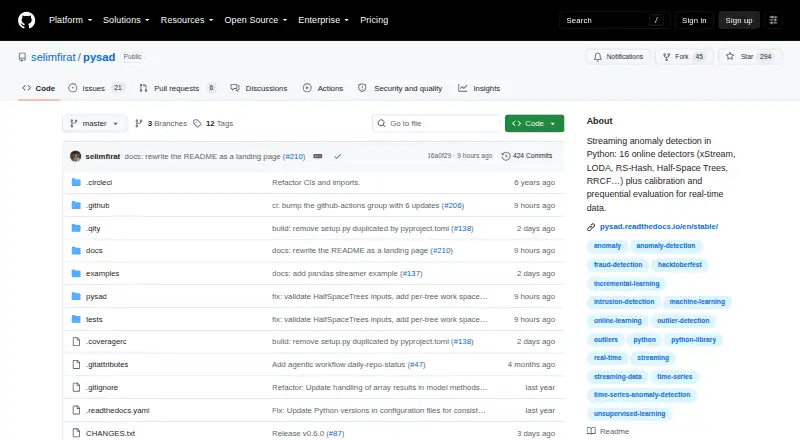
PySAD is a free, open-source Python framework for detecting anomalies in streaming univariate and multivariate data. Its online models update as each new data instance arrives, supporting sequential detection. The project describes 16 online detectors, including xStream, LODA, RS-Hash, Half-Space Trees, and Robust Random Cut Forest. It also includes stream simulators, evaluators, preprocessors, statistic trackers, postprocessors, and probability calibrators. PySAD connects batch anomaly detectors from PyOD to streaming use, and supports supervised, semi-supervised, and unsupervised experiments. The documentation notes that streaming methods may retain a single instance or a small recent window to stay within memory and processing constraints. Install it with pip or from its GitHub source; the current README lists Python 3.10 or newer on Linux, macOS, and Windows. PySAD is self-hosted and distributed under a BSD 3-Clause license. The project says 17 labelled benchmark datasets download on first use.
Who it suits
PySAD suits developers and data practitioners building streaming anomaly detection workflows in Python. It supports experiments across univariate and multivariate data and supervised, semi-supervised, or unsupervised settings.
What it does well
- Online models update with each new data instance.
- Describes 16 online detectors.
- Includes evaluation and preprocessing tools.
- Supports PyOD batch detectors in streaming settings.
- BSD 3-Clause license.
What to know first
- Requires Python 3.10 or newer, per the current README.
- Self-hosted deployment.
Plans
| Plan | Billed and limits | Price |
|---|---|---|
| PySAD | Open-source Python framework | Free |
As github.com lists them, read 2 Oct 2026. The maker's own page has the final word.
Getting started
- Open the PySAD GitHub repository.
- Use Linux, macOS, or Windows with Python 3.10 or newer.
- Install with pip or from the GitHub source.
- Choose detectors and supporting tools for the streaming workflow.
- For questions or project demonstrations, use GitHub Discussions.
PySAD is an open-source Python framework for detecting anomalies in streaming data. It suits developers and researchers who want to assemble and run their own detection workflows. Its breadth of online methods is useful; teams seeking a ready-made monitoring service should look elsewhere.
Overview
PySAD updates models as new data instances arrive, so it is designed for sequential detection rather than analysis that waits for a complete batch. It supports univariate and multivariate data, and supervised, semi-supervised, and unsupervised experiments. That flexibility helps practitioners compare approaches across learning settings, but the self-hosted framework leaves workflow design and operation to the user.
The project uses the BSD 3-Clause license and can be installed with pip or from GitHub. Its current README lists Python 3.10 or newer on Linux, macOS, and Windows. Streaming methods may retain just an instance or a small recent window, which can help meet memory and processing constraints. PySAD also downloads 17 labelled benchmark datasets on first use, a practical starting point for evaluation.
Key features
Online detection and evaluation
The repository describes 16 online detectors, including xStream, LODA, RS-Hash, Half-Space Trees, and Robust Random Cut Forest. Having several methods in one framework makes comparison more convenient for Python practitioners, though choosing and integrating a suitable detector still requires technical work.
Stream simulators, evaluators, preprocessors, statistic trackers, postprocessors, and probability calibrators support experiments beyond detector selection. PySAD also integrates batch anomaly detectors from PyOD into streaming settings. This makes it useful when adapting existing batch methods or building an evaluation pipeline; it is not a substitute for a managed alerting and monitoring product.
Pricing
PySAD is free: its PySAD plan costs nothing and provides the open-source Python framework. There is no paid tier or free trial. The cost advantage comes with a self-hosted setup and a Python-based workflow rather than a packaged service.
Platforms
PySAD supports Linux, macOS, and Windows, with Python 3.10 or newer. It is self-hosted, so users run it in their own environment rather than relying on a hosted deployment.
Who it's for
PySAD is a good fit for developers and researchers who need sequential anomaly detection, want to compare online methods, or need to bring PyOD batch detectors into a streaming workflow. Its support for multiple data dimensions and learning settings suits experimentation. Organizations that want an out-of-the-box monitoring interface or do not want to maintain Python software should consider a different category of tool.
Pros and cons
- Broad online detector selection: 16 methods give practitioners options within one streaming-focused framework.
- Useful experiment toolkit: Simulators, evaluators, preprocessing and postprocessing utilities, trackers, and calibrators support more complete evaluation workflows.
- Low resource design: Methods may keep only an instance or small recent window, which can suit constrained streaming workloads.
- Technical ownership required: PySAD is self-hosted and Python-based, so users must build and operate their own workflows.
Alternatives
Anomaly Detection Software is the broader category directory for comparing options. Choose ManageEngine NetFlow Analyzer instead if a freemium product with Android, iOS, Linux, web, and Windows support and interface-based editions is a better fit. OpenSearch is a free, Apache 2.0 open-source option across API, Linux, macOS, self-hosted, web, and Windows platforms. PyOD is another free open-source Python library, with optional capabilities requiring pip extras. Anomalib is a free Apache-2.0 library installable from PyPI or source. Soda offers a free plan with pipeline testing, metrics observability, and alerting and ticketing integrations. Axomaly offers an alpha plan billed free with one metric, guided onboarding, and direct support. Metaplane has a free plan for 10 monitored tables, four users, and three custom SQL monitors. ObservabilityOS offers a free developer plan with one service, 500MB of monthly logs, and seven-day retention.
Verdict
Choose PySAD if you can work in Python and want a free, self-hosted toolkit for streaming anomaly detection, with multiple online detectors and evaluation utilities in one framework. Its main draw is that focused combination of methods and workflow tools. Look elsewhere if you need a turnkey monitoring service rather than software to build and run yourself.
Verdict
PySAD brings online detectors and workflow utilities together for streaming anomaly detection. Its self-hosted, Python-based setup is suited to users who want to build and run their own detection workflows.
Questions
How much does PySAD cost?
The listed plan is free. There is no free trial.
Which platforms does PySAD support?
The current README lists Linux, macOS, and Windows, with Python 3.10 or newer.
Is PySAD open source?
Yes. It is distributed under the BSD 3-Clause license.
What kinds of data and learning settings does it support?
It supports univariate and multivariate data, with supervised, semi-supervised, and unsupervised experiments.
Can PyOD detectors be used with streaming data?
Yes. PySAD provides integrations for running batch anomaly detectors from PyOD in a streaming setting.
Who maintains PySAD?
The maintainer is identified as Selim Firat Yilmaz, an AI researcher based in London, UK. Issues and pull requests are welcome; questions and project demonstrations go in GitHub Discussions.
Facts from PySAD's own pages
- Benchmarks
- The README says 17 labelled benchmark datasets are downloaded on first use. · github.com, 2 Oct 2026
- Data and learning settings
- The framework supports models for univariate and multivariate data and experiments in supervised, semi-supervised, and unsupervised settings. · pysad.readthedocs.io, 2 Oct 2026
- Detectors
- The repository describes 16 online detectors, including xStream, LODA, RS-Hash, Half-Space Trees, and Robust Random Cut Forest. · github.com, 2 Oct 2026
- Evaluation tools
- PySAD includes stream simulators, evaluators, preprocessors, statistic trackers, postprocessors, and probability calibrators. · pysad.readthedocs.io, 2 Oct 2026
- Installation
- The project can be installed with pip or from its GitHub source, and its current README lists Python 3.10 or newer on Linux, macOS, and Windows. · github.com, 2 Oct 2026
- License
- The project is distributed under a BSD 3-Clause license. · github.com, 2 Oct 2026
- Maintainer
- The GitHub profile identifies Selim Firat Yilmaz as an AI researcher based in London, UK. · github.com, 2 Oct 2026
- Online detection
- Its models update as each new data instance arrives for online or sequential anomaly detection. · pysad.readthedocs.io, 2 Oct 2026
- Purpose
- PySAD is an open-source Python framework for anomaly detection on streaming multivariate data. · pysad.readthedocs.io, 2 Oct 2026
- PyOD integration
- PySAD provides integrations that let batch anomaly detectors from PyOD run in a streaming setting. · pysad.readthedocs.io, 2 Oct 2026
- Resource use
- The documentation says streaming methods may store only an instance or a small window of recent instances to meet memory and processing constraints. · pysad.readthedocs.io, 2 Oct 2026
- Security
- The repository links to a security policy, but the policy page could not be opened during this research. · github.com, 2 Oct 2026
- Support
- The maintainer says issues and pull requests are welcome and aims to reply within a few days; questions and show-and-tell go in GitHub Discussions. · github.com, 2 Oct 2026
Where PySAD stands on Freedom251
- Anomaly Detection Software#7 of 22