Freedom251 › Anomaly Detection Software
Anomalib
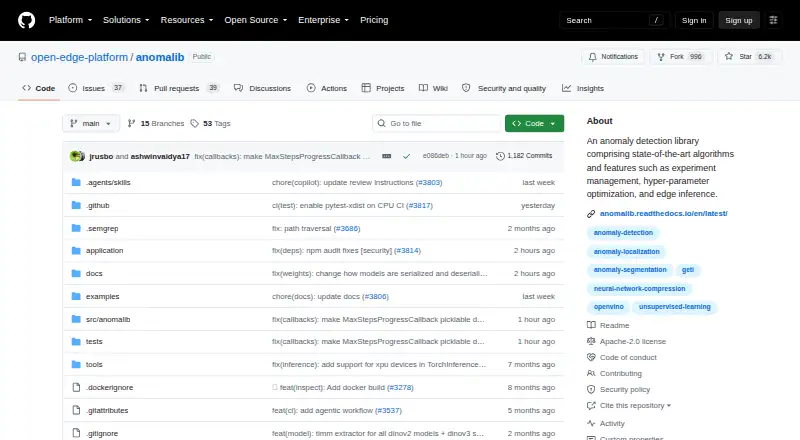
What Anomalib is
Anomalib is a deep learning library for developing, benchmarking, and deploying machine-learning methods that detect or locate anomalies in images and videos. Its modular Python API and command-line interface support training, inference, and benchmarking, and the project includes ready-to-use algorithms and benchmark datasets. Models are built on Lightning, with inference options through Torch, Lightning, Gradio, or OpenVINO. Most models can be exported to OpenVINO Intermediate Representation for accelerated inference on Intel hardware. Installation choices include CPU, NVIDIA CUDA on Linux or Windows, AMD ROCm on Linux, and Intel XPU on Linux. Documented experiment-tracking integrations include Weights & Biases, Comet.ml, and TensorBoard through PyTorch Lightning loggers. Anomalib Studio adds a low/no-code web application that accepts USB or IP cameras or image folders, with output options for industrial pipelines using ROS messages or MQTT. Studio is an actively developed pre-release, offered as a Docker container or standalone application, and may be incomplete or unstable. The library is Apache-2.0 licensed and free.
Who it suits
Anomalib suits developers and teams building image or video anomaly detection workflows who want a Python API, CLI, or self-hosted deployment. Studio may suit users seeking a low/no-code web interface, provided they can work with pre-release software.
What it does well
- Free, Apache-2.0-licensed library.
- Training, inference, and benchmarking via Python API and CLI.
- Supports image and video anomaly detection.
- Most models export to OpenVINO IR.
- Studio accepts camera feeds or image folders.
What to know first
- Studio is a pre-release and may be unstable.
- Intel GPU training supports only one GPU.
- Intel XPU installation is listed for Linux only.
Limits
Intel GPU training currently supports one GPU. Anomalib Studio is a pre-release under active development, and features may change while some functionality remains incomplete or unstable.
Plans
| Plan | Billed and limits | Price |
|---|---|---|
| Open-source library | Apache-2.0 licensed library · Install from PyPI or source | Free |
| Open-source Anomalib library | Apache-2.0 licensed · installable from PyPI or source · self-hosted | Free |
As github.com lists them, read 4 Oct 2026. The maker's own page has the final word.
Getting started
- Install the Apache-2.0 library from PyPI or source.
- Choose a supported hardware installation path: CPU, CUDA, ROCm, or Intel XPU.
- Use the Python API or CLI for training, inference, and benchmarking.
- Choose an inference route such as Torch, Lightning, Gradio, or OpenVINO.
- For Studio, use its Docker container or standalone application.
Anomalib is a free, Apache-2.0-licensed Python library for developing, benchmarking and deploying image and video anomaly detection. It is best suited to teams building their own inspection or monitoring workflows, especially those targeting Intel hardware. Its library provides multiple routes from experiments to inference; Studio is a more tentative option because it remains in pre-release.
Overview
Anomalib focuses on detecting or localizing anomalies in images and videos. A modular Python API and CLI cover training, inference and benchmarking, while ready-to-use algorithms and benchmark datasets give practitioners material to compare and adapt. That makes it a development toolkit rather than a finished detection service: teams still need to build a workflow around their application.
Its model implementations are based on Lightning. The open-source library is available from PyPI or source, with no license fee, and the repository identifies the license as Apache-2.0.
Key features
The combination of algorithms, datasets and benchmarking can shorten the path to comparing approaches, while leaving room to shape models for a particular task. Experiment logging through PyTorch Lightning loggers supports Weights & Biases, Comet.ml and TensorBoard, useful for teams that already rely on those tools to track work.
Inference options include Torch, Lightning, Gradio and OpenVINO. Most models can also be exported to OpenVINO Intermediate Representation for accelerated inference on Intel hardware. That is a practical edge route for Intel deployments, but not a general promise of acceleration across hardware.
Studio adds a low/no-code web application for input from USB or IP cameras and image folders. It can send outputs to industrial pipelines using ROS messages or MQTT, offering a visual path for teams that do not want to assemble every step in code. However, Studio is a pre-release under active development, and features may change while functionality may be incomplete or unstable. It is offered as a Docker container or standalone application, but should not be treated as a dependable production workflow without accounting for that status.
Installation options cover CPU, NVIDIA CUDA on Linux or Windows, AMD ROCm on Linux, and Intel XPU on Linux. Intel GPU training currently supports a single GPU; testing is noted on Arc 750 and Arc 770. This makes hardware choice material for teams planning multi-GPU Intel training.
The project documents continuous security scanning with CodeQL, Semgrep, Bandit, Zizmor, Trivy and Dependabot, and directs vulnerability reports to Intel's vulnerability handling guidelines. Those practices add useful project-level security process, though they do not remove the need to assess and secure a deployment.
Pricing
Anomalib is free. The Open-source library plan costs nothing and includes the Apache-2.0-licensed library, installable from PyPI or source. There are no paid tiers or plan caps described here, so it suits teams that can supply their own development and deployment environment. The trade-off is that this is library software, not a packaged managed detection service.
Platforms
Anomalib supports Linux, Windows, web and self-hosted use. Its hardware installation routes include CPU and the platform-specific CUDA, ROCm and Intel XPU options. The library supports image and video data, with self-hosted deployment options.
Who it's for
Anomalib fits developers and technical teams that need to train, benchmark or deploy image and video anomaly detection, and want control over the implementation. It is particularly compelling when OpenVINO on Intel hardware is part of the target path. Teams seeking a ready-to-run detection product, or a stable low-code production interface, should look elsewhere or treat Studio as experimental.
Pros and cons
- Pros: A single library combines training, inference and benchmarking with ready-to-use algorithms and datasets, giving model developers a foundation for evaluating methods.
- Pros: Multiple inference routes and OpenVINO export support offer flexibility, including an Intel-focused edge option.
- Pros: Free Apache-2.0 licensing and CPU, NVIDIA, AMD and Intel installation paths make it accessible across several development setups.
- Cons: It is a toolkit, not a turnkey detection service, so teams must build and operate their own workflow.
- Cons: Studio may be incomplete or unstable while in pre-release, making it a risky foundation for production processes.
- Cons: Intel GPU training is limited to one GPU, constraining teams that need multi-GPU training on that hardware.
Alternatives
Anomaly Detection Software is a useful starting point for comparing tools across the category. For a Python library alternative, choose PyOD if its open-source library and optional pip extras better fit the capabilities you need; PySAD is another free, open-source Python framework. OpenSearch is a free Apache 2.0 option if you want an open-source platform rather than Anomalib's focused anomaly-detection library. ManageEngine NetFlow Analyzer is a freemium alternative with a free edition capped at two interfaces, or paid editions starting at $172 a month for 10 interfaces. Soda, Axomaly, Metaplane and ObservabilityOS are other listed alternatives.
Verdict
Choose Anomalib if you have the technical capacity to build an anomaly-detection workflow and value a free, flexible library for developing and benchmarking image or video models. Its range of inference options and Intel-oriented OpenVINO path are the strongest reasons to adopt it. Look elsewhere if you need a turnkey service or a stable low-code interface: Studio's pre-release status is a significant qualification, not a minor caveat.
Verdict
Anomalib combines model development and benchmarking with several inference and deployment routes. Studio adds a visual workflow, but its pre-release status and stated instability are important considerations.
Questions
Is Anomalib free and open source?
Yes. The Open-source library plan costs nothing and is Apache-2.0 licensed.
What data can Anomalib analyze?
Its anomaly detection focus covers images and videos.
Which platforms and hardware options are supported?
The listed platforms include Linux, Windows, web, and self-hosted. Installation options include CPU, NVIDIA CUDA on Linux or Windows, AMD ROCm on Linux, and Intel XPU on Linux.
What experiment tracking integrations are documented?
Weights & Biases, Comet.ml, and TensorBoard are documented through PyTorch Lightning loggers.
How can I deploy inference?
Inference options include Torch, Lightning, Gradio, and OpenVINO. Most models can also be exported to OpenVINO Intermediate Representation for accelerated inference on Intel hardware.
What is Anomalib Studio?
It is a low/no-code web application that accepts USB or IP cameras or image folders and can output to industrial pipelines through ROS messages or MQTT. It is a pre-release offered as a Docker container or standalone application.
Facts from Anomalib's own pages
- Algorithm collection
- The documentation lists ready-made image models including PatchCore, PaDiM, DRAEM, FastFlow, GANomaly, Reverse Distillation, STFPM and WinCLIP. · anomalib.readthedocs.io, 15 Oct 2026
- Algorithms and datasets
- The project describes its collection as ready-to-use deep learning anomaly detection algorithms and benchmark datasets. · github.com, 4 Oct 2026
- API and CLI
- It provides a modular Python API and command-line interface for training, inference, benchmarking and hyperparameter optimization. · anomalib.readthedocs.io, 15 Oct 2026
- Breaking changes
- The 2.7.0 changelog removes the legacy ONNX exporter, several deprecated APIs and older checkpoint migration support. · github.com, 15 Oct 2026
- Core dependency requirement
- The v2.7.0 README badge states minimum PyTorch 2.10+, Lightning 2.2+ and OpenVINO 2024.0+. · github.com, 15 Oct 2026
- Datasets
- Anomalib includes datamodules for image, video and depth datasets and documents public benchmark datasets. · anomalib.readthedocs.io, 15 Oct 2026
- Deployment
- Inference options include Torch, Lightning, Gradio, and OpenVINO. · github.com, 4 Oct 2026
- Detection scope
- The project targets anomaly detection, anomaly localization and anomaly segmentation for images and videos. · github.com, 15 Oct 2026
- Documentation depth
- The documentation includes reference APIs, CLI, data and model guides, inference, metrics, pipelines, tutorials and developer guides. · anomalib.readthedocs.io, 15 Oct 2026
- Edge inference
- Most models can be exported to OpenVINO Intermediate Representation for accelerated inference on Intel hardware. · github.com, 4 Oct 2026
- Experiment tracking
- Optional logging integrations include Weights & Biases, Comet.ml, TensorBoard and MLflow. · github.com, 15 Oct 2026
- Hardware extras
- Installation extras cover CPU, NVIDIA CUDA 12.6 or 13.0, AMD ROCm and Intel XPU backends. · github.com, 15 Oct 2026
- Hardware support
- Installation options include CPU, CUDA on Linux or Windows with NVIDIA GPUs, ROCm on Linux with AMD GPUs, and Intel XPU on Linux. · github.com, 4 Oct 2026
- Independent distribution evidence
- SourceForge hosts an unaffiliated mirror and lists zero downloads for the displayed release folders. · sourceforge.net, 15 Oct 2026
- Independent package status
- PyPI classifies Anomalib 2.7.0 as production/stable software for developers and scientific or engineering use. · pypi.org, 15 Oct 2026
- Independent research description
- The peer-reviewed project paper describes Anomalib as an open-source, plug-and-play library with experiment trackers, visualizers, hyperparameter optimizers and OpenVINO optimization. · arxiv.org, 15 Oct 2026
- Industrial outputs
- Studio can send outputs into industrial pipelines through ROS messages and MQTT. · github.com, 15 Oct 2026
- Inference options
- Inference support covers Torch, Lightning, Gradio and OpenVINO workflows. · github.com, 15 Oct 2026
- Installation
- The recommended standard installation is through PyPI using pip or uv, with source installation available for development. · github.com, 15 Oct 2026
- Intel GPU limit
- Training on Intel GPUs currently supports only a single GPU and was tested on Arc 750 and Arc 770. · github.com, 15 Oct 2026
- Licence
- The repository and package metadata identify Apache License 2.0 as the project licence. · github.com, 15 Oct 2026
- License
- The repository identifies its license as Apache-2.0. · github.com, 4 Oct 2026
- Maker founding
- Intel was founded by Robert Noyce and Gordon Moore in 1968. · intel.com, 15 Oct 2026
- Maker headquarters
- Intel Corporation’s principal executive office is at 2200 Mission College Boulevard, Santa Clara, California. · sec.gov, 15 Oct 2026
Where Anomalib stands on Freedom251
- Anomaly Detection Software#1 of 22